

The 1/3-octave bass-warble tones on Editor's Choice sounded powerful down to the 50Hz band, with the 40Hz warble a little lower in level than the bands above them, and the 32Hz warble exaggerated by the lowest mode in my room. The 25 and 20Hz warbles weren't audible at normal listening levels. The half-step–spaced tonebursts on Editor's Choice spoke cleanly above 63Hz; Dynaudio claims that the Special Forty's woofer offers low levels of distortion and, given the lack of audible "doubling" with this track, I'm inclined to believe them. However, some slight emphasis was audible between 200 and 600Hz.
The Special Fortys offered a surprisingly solid bass foundation, considering their modest size. Joey DeFrancesco's Hammond-organ bass pedals in "Miss Otis Regrets," from Van Morrison's You're Driving Me Crazy (16-bit/44.1kHz WAV, Exile/Legacy 19075820041; see this issue's "My Back Pages"), were reproduced with sufficient weight to give Van the Man's vocalizing a solid foundation. With our "Recording of the Month" for August 2017, Evelina Vorontsova performing Rachmaninoff's Piano Sonata 2 (16/44.1, STH Quality Classics 1416092), the piano's lowest notes offered sufficient power coupled with superb definition. My Fender Precision bass guitar in the channel-identification tracks on Editor's Choice sounded surprisingly powerful, yet again without any boom obscuring the instrument's attack.
Given its size and the fact that it's a two-way design with a relatively small woofer, the Special Forty did well with high-level rock. Because I am, at heart, an old rocker and this review will be published in our Zeptember issue, I cued up "Whole Lotta Love," from Led Zeppelin's reunion concert, Celebration Day (24/48 FLAC, Rhino/HDtracks). Seven minutes and 26 seconds later I stopped dancing, reached over to the iPad, and hit Repeat. If you have a fairly small room and like to play your classic rock loud, the Dynaudio Special Fortys might be all you need.
With the Dynaudios driven by Lamm M1.2 Reference monoblocks, not only Van Morrison's but vocal recordings in general were reproduced with a superb sense of palpability. The live recording of the late Lorraine Hunt Lieberson singing Peter Lieberson's Rilke Songs and other works (16/44.1 ALAC, Wigmore Hall Live 0013) has long been a favorite, and Roon in its Radio random-play mode called up from this album her performance of the first of Mahler's Rückert Lieder, "Ich atmet' einen linden duft." The sense of poignancy was overwhelming. I turned off Radio and listened to all five songs, seduced by the quality of verisimilitude I experienced while listening through the Dynaudios.
 With Radio turned back on after the applause at the end of the Mahler, Roon pulled up my 24/192 needle drop of Peter Skellern singing "About a Quarter to Nine," a song made famous by Al Jolson, from Skellern's 1982 album, A String of Pearls (UK LP, Mercury). Skellern's adenoidal baritone in the verse was again poignantly palpable via the Special Fortys, and when the rhythm section joins Skellern's piano for the refrain, it was goose-bump time.
However, this track confirmed something I'd been suspecting: The Special Forty's top octave was a touch on the mellow side, though this was never a problem with orchestral recordings. After a long time, I've recently been listening to our October 2014 "Recording of the Month": Bruckner's Symphony 9, performed by the Lucerne Festival Orchestra conducted by the late Claudio Abbado (24/48 FLAC, Deutsche Grammophon 479 3441/HDtracks). This recording's rich, warm balance was complemented by the Dynaudio's clean, fatigue-free high frequencies.
I returned to Vorontsova's recording of Rachmaninoff's Piano Sonata 2 because, after 63 minutes of Bruckner, I needed to hear some more readily accessible melodies—and followed that with another "Recording of the Month," this one for June 2018: After Bach, pianist Brad Mehldau's serial mashup of keyboard works by J.S. Bach with his own Bach-flavored improvisations (CD, Nonesuch 7559-79318-0). Again, the surprising weight of the piano's left-hand register through the Dynaudio, coupled with the speaker's clean treble and stable, well-defined stereo imaging, let this music communicate most effectively. But, especially with the Mehldau, I was starting to notice some unevenness in the Special Forty's reproduction of the piano's middle register. And when I played the Academy of Ancient Music's performance of Bach's Brandenburg Concerto 2 (24/88.2 FLAC, Harmonia Mundi), I was sufficiently bothered by some midrange congestion to investigate.
With the Mehldau piano recording playing, I listened to the enclosure's panels with a stethoscope. While the top panel was quiet, the sidewalls were afflicted with several resonant modes that affected the midrange. The amplitudes of these spurious vibrations were sufficiently high that I could hear them with the stethoscope placed on the center pillar of the Blu-Tack–coupled stand. The audibility of this behavior will depend on the size of the area of the cabinet panel affected, the relative phase of the radiation, and how well that area couples to the air. However, the touch of midrange congestion was something I'd first noticed from my listening chair.
I tried placing a cloth bag of lead shot atop each speaker, and while this did reduce the cabinet talk a little, it destroyed the Special Fortys' beautiful appearance. I then tried AudioQuest Sorbothane pads instead of Blu-Tack between speakers and stands. If anything, the enclosures' vibrational behavior worsened, then further worsened when I returned the bags of lead shot to the speakers' tops.
With Radio turned back on after the applause at the end of the Mahler, Roon pulled up my 24/192 needle drop of Peter Skellern singing "About a Quarter to Nine," a song made famous by Al Jolson, from Skellern's 1982 album, A String of Pearls (UK LP, Mercury). Skellern's adenoidal baritone in the verse was again poignantly palpable via the Special Fortys, and when the rhythm section joins Skellern's piano for the refrain, it was goose-bump time.
However, this track confirmed something I'd been suspecting: The Special Forty's top octave was a touch on the mellow side, though this was never a problem with orchestral recordings. After a long time, I've recently been listening to our October 2014 "Recording of the Month": Bruckner's Symphony 9, performed by the Lucerne Festival Orchestra conducted by the late Claudio Abbado (24/48 FLAC, Deutsche Grammophon 479 3441/HDtracks). This recording's rich, warm balance was complemented by the Dynaudio's clean, fatigue-free high frequencies.
I returned to Vorontsova's recording of Rachmaninoff's Piano Sonata 2 because, after 63 minutes of Bruckner, I needed to hear some more readily accessible melodies—and followed that with another "Recording of the Month," this one for June 2018: After Bach, pianist Brad Mehldau's serial mashup of keyboard works by J.S. Bach with his own Bach-flavored improvisations (CD, Nonesuch 7559-79318-0). Again, the surprising weight of the piano's left-hand register through the Dynaudio, coupled with the speaker's clean treble and stable, well-defined stereo imaging, let this music communicate most effectively. But, especially with the Mehldau, I was starting to notice some unevenness in the Special Forty's reproduction of the piano's middle register. And when I played the Academy of Ancient Music's performance of Bach's Brandenburg Concerto 2 (24/88.2 FLAC, Harmonia Mundi), I was sufficiently bothered by some midrange congestion to investigate.
With the Mehldau piano recording playing, I listened to the enclosure's panels with a stethoscope. While the top panel was quiet, the sidewalls were afflicted with several resonant modes that affected the midrange. The amplitudes of these spurious vibrations were sufficiently high that I could hear them with the stethoscope placed on the center pillar of the Blu-Tack–coupled stand. The audibility of this behavior will depend on the size of the area of the cabinet panel affected, the relative phase of the radiation, and how well that area couples to the air. However, the touch of midrange congestion was something I'd first noticed from my listening chair.
I tried placing a cloth bag of lead shot atop each speaker, and while this did reduce the cabinet talk a little, it destroyed the Special Fortys' beautiful appearance. I then tried AudioQuest Sorbothane pads instead of Blu-Tack between speakers and stands. If anything, the enclosures' vibrational behavior worsened, then further worsened when I returned the bags of lead shot to the speakers' tops.
 I then replaced each Sorbothane pad with a trio of upturned Black Diamond cones under each speaker. In theory this should have made things even worse, as it allows the resonances to be fully developed. However, I felt that the midrange congestion was reduced in level, perhaps because, with the speaker/stand interface now providing no damping, the Q (Quality factor) of the resonances was increased, meaning that each resonance covered a narrower range of frequencies. With the upturned cones there was also less energy coupled into the stand. All I can suggest is that if you buy Dynaudio Special Fortys, you experiment with different interface materials between the speakers and your stands.
Conclusions
I then replaced each Sorbothane pad with a trio of upturned Black Diamond cones under each speaker. In theory this should have made things even worse, as it allows the resonances to be fully developed. However, I felt that the midrange congestion was reduced in level, perhaps because, with the speaker/stand interface now providing no damping, the Q (Quality factor) of the resonances was increased, meaning that each resonance covered a narrower range of frequencies. With the upturned cones there was also less energy coupled into the stand. All I can suggest is that if you buy Dynaudio Special Fortys, you experiment with different interface materials between the speakers and your stands.
Conclusions
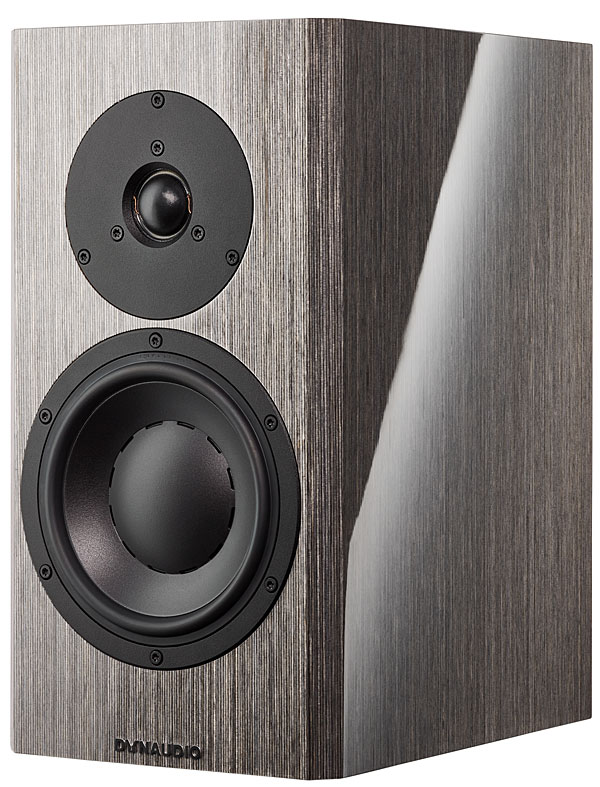
For a relatively small speaker, Dynaudio's Special Forty does a lot of things exceptionally well. Its clean, powerful low frequencies, its stable, well-defined, accurate stereo imaging, its clean, grain-free high frequencies, and its superb way with recorded voices are complemented by looks to die for. It is indeed, for want of a better word, special. How, then, to put that lively cabinet behavior into proper perspective? After writing every word in this review other than these Conclusions, I did something I never do: I searched the Web to see what other reviewers of the Special Forty have had to say. However, while their descriptions, in the nine reviews I read, of the Special Forty's sound quality and tonal balance pretty much aligned with my own, not one other reviewer had noted an over-lively enclosure or any congestion in the midrange!
Perhaps, then, not too much should be made of this potential Achilles' heel. As I write these words, I'm again listening to the Rachmaninoff, and yes, in critical listening mode, I can hear the congestion in the piano's midrange. But in listening-to-music mode, that congestion is outweighed by everything else the Dynaudio Special Forty does right—which seems to be just about everything.
With Radio turned back on after the applause at the end of the Mahler, Roon pulled up my 24/192 needle drop of Peter Skellern singing "About a Quarter to Nine," a song made famous by Al Jolson, from Skellern's 1982 album, A String of Pearls (UK LP, Mercury). Skellern's adenoidal baritone in the verse was again poignantly palpable via the Special Fortys, and when the rhythm section joins Skellern's piano for the refrain, it was goose-bump time.
However, this track confirmed something I'd been suspecting: The Special Forty's top octave was a touch on the mellow side, though this was never a problem with orchestral recordings. After a long time, I've recently been listening to our October 2014 "Recording of the Month": Bruckner's Symphony 9, performed by the Lucerne Festival Orchestra conducted by the late Claudio Abbado (24/48 FLAC, Deutsche Grammophon 479 3441/HDtracks). This recording's rich, warm balance was complemented by the Dynaudio's clean, fatigue-free high frequencies.
I then replaced each Sorbothane pad with a trio of upturned Black Diamond cones under each speaker. In theory this should have made things even worse, as it allows the resonances to be fully developed. However, I felt that the midrange congestion was reduced in level, perhaps because, with the speaker/stand interface now providing no damping, the Q (Quality factor) of the resonances was increased, meaning that each resonance covered a narrower range of frequencies. With the upturned cones there was also less energy coupled into the stand. All I can suggest is that if you buy Dynaudio Special Fortys, you experiment with different interface materials between the speakers and your stands.
ConclusionsFor a relatively small speaker, Dynaudio's Special Forty does a lot of things exceptionally well. Its clean, powerful low frequencies, its stable, well-defined, accurate stereo imaging, its clean, grain-free high frequencies, and its superb way with recorded voices are complemented by looks to die for. It is indeed, for want of a better word, special. How, then, to put that lively cabinet behavior into proper perspective? After writing every word in this review other than these Conclusions, I did something I never do: I searched the Web to see what other reviewers of the Special Forty have had to say. However, while their descriptions, in the nine reviews I read, of the Special Forty's sound quality and tonal balance pretty much aligned with my own, not one other reviewer had noted an over-lively enclosure or any congestion in the midrange!















