

The story behind European Audio Team (E.A.T.) is that of one woman, company owner and CEO Jozefína Lichtenegger.
While studying for her MBA at the University of Economics in Bratislava, Slovakia, Lichtenegger (née Krahulkova) sold vacuum tubes for her brother-in-law, Alesa Vaic, then owner of Czech Republic–based tube brand VAIC. After VAIC shuttered in 2003, Lichtenegger founded her own retail business and engaged 100-year-old tube manufacturer Tesla Vrovice to supply 300B and KT88 tubes made to her specifications. When the owner of Tesla retired, she bought the company. She christened her new endeavor E.A.T. (The original Tesla continues as TESLA ElectronTubes, s.r.o.)
Lichtenegger brought over workers from Tesla, including the craftspeople who make E.A.T.'s 300B and KT88 tubes, entirely by hand. These highly skilled employees bring a lifetime of knowledge to their unique professions. "We have three dedicated tube builders," she told me via email, "Kveta Perglerova, Miluse Rösslerová, and Martin Orna."
"The tradition of making the world's best vacuum tubes is the DNA of E.A.T.," Lichtenegger said. "This is how I started European Audio Team 20 years ago."
Jozefína Krahulkova and Pro-Ject founder and CEO Heinz Lichtenegger were married in 2010, creating a true EU audio power couple.
 E.A.T. and Pro-Ject share production facilities. Joining forces with Pro-Ject allowed E.A.T. to start producing cartridges, phono stages, and turntables.
"Thanks to Pro-Ject," wrote Anthony Chiarella, national sales manager of E.A.T.'s US distributor, Vana, Ltd., in an email, "E.A.T. has resources which other companies its size simply don't. At this level of professionalism, products are authored by a team of skilled engineers and designers rather than a single individual whose skill set could not possibly cover every aspect of product development, quality control, manufacturing, etc."
First, following their holy high-end union, "came the E-Glo phono preamplifier ($6995), then E-Glo S ($2995), and E-Glo Petit phono ($1495) preamplifiers," Jozefína Lichtenegger told me in an email.1 After that, "the logical progression [was] a great line of turntables." E.A.T. now makes seven of those, including the C-Major ($2545), E-Flat ($6000), and Forte ($8495). The E-Glo I integrated amplifier ($9995) is E.A.T.'s first foray into power-amplification components. It looks and feels like a well-made, smartly constructed, luxury component.
Design
E.A.T. and Pro-Ject share production facilities. Joining forces with Pro-Ject allowed E.A.T. to start producing cartridges, phono stages, and turntables.
"Thanks to Pro-Ject," wrote Anthony Chiarella, national sales manager of E.A.T.'s US distributor, Vana, Ltd., in an email, "E.A.T. has resources which other companies its size simply don't. At this level of professionalism, products are authored by a team of skilled engineers and designers rather than a single individual whose skill set could not possibly cover every aspect of product development, quality control, manufacturing, etc."
First, following their holy high-end union, "came the E-Glo phono preamplifier ($6995), then E-Glo S ($2995), and E-Glo Petit phono ($1495) preamplifiers," Jozefína Lichtenegger told me in an email.1 After that, "the logical progression [was] a great line of turntables." E.A.T. now makes seven of those, including the C-Major ($2545), E-Flat ($6000), and Forte ($8495). The E-Glo I integrated amplifier ($9995) is E.A.T.'s first foray into power-amplification components. It looks and feels like a well-made, smartly constructed, luxury component.
Design
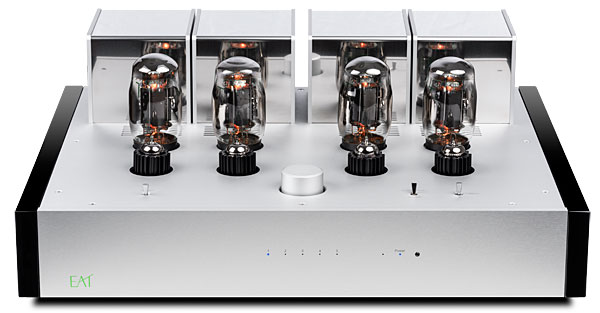
The E-Glo I is wide (19 5/8") and low (7" tall, including the tubes and transformer covers; the main chassis is about half that tall). I find it unusual in appearance, its body broad and flat, low-slung like an immaculate river barge. It's finished in silver, somewhere between matte and satin, with Macassar-veneered side panels. Heavy-gauge aluminum is used for the E.A.T.'s top plate, front, and sides, joined to a steel bottom plate and back panel. Cube-shaped transformer covers extend upward from the main chassis, their front panels mirrored to reflect the tubes' glow.
The fascia of the E-Glo I is very plain, featuring five small LEDs that turn blue when an input is chosen. To the right, another LED, labeled Power, flashes blue during standby then turns solid when in use. Also on the right is a 3.5mm headphone jack.
 I particularly liked the placement of the aluminum alloy volume control on top of the chassis—a more natural, fingers-to-knob fit than the typical front-mounted volume pot. To the left of the knob (which uses an ALPS Blue Velvet potentiometer) is a toggle switch for power on/off. To the right are two more toggle switches: one for switching between Ultralinear and triode mode, the other for selecting the input; the switches are made from an aluminum alloy. Behind the toggles stand four recessed signal tubes: two 12AX7s and two 12AT7s, by ElectroHarmonix. Each small tube is fitted with an adjustable, thermally conductive, cherry red E.A.T. Cool Damper, made of a combination of aluminum extrusions and Teflon/carbon V-grooved strips. Behind each signal tube is a Sovtek KT88 power tube; substituting E.A.T.'s in-house–manufactured KT88 tubes adds $1500 to the price. Finally, behind the power tubes are those transformers. "The output transformers have permalloy cores, which offer much better sound, mostly in the mids and high notes," Lichtenegger noted. Polypropylene coupling capacitors are employed.
The E.A.T. E-Glo I is a true dual-mono design, with separate PCB circuitry, tubes, capacitors, and transformers for each channel. "There are identical power transformers for each channel along with the two output transformers," Roy Feldstein, Vana's managing director, told me by email.
I particularly liked the placement of the aluminum alloy volume control on top of the chassis—a more natural, fingers-to-knob fit than the typical front-mounted volume pot. To the left of the knob (which uses an ALPS Blue Velvet potentiometer) is a toggle switch for power on/off. To the right are two more toggle switches: one for switching between Ultralinear and triode mode, the other for selecting the input; the switches are made from an aluminum alloy. Behind the toggles stand four recessed signal tubes: two 12AX7s and two 12AT7s, by ElectroHarmonix. Each small tube is fitted with an adjustable, thermally conductive, cherry red E.A.T. Cool Damper, made of a combination of aluminum extrusions and Teflon/carbon V-grooved strips. Behind each signal tube is a Sovtek KT88 power tube; substituting E.A.T.'s in-house–manufactured KT88 tubes adds $1500 to the price. Finally, behind the power tubes are those transformers. "The output transformers have permalloy cores, which offer much better sound, mostly in the mids and high notes," Lichtenegger noted. Polypropylene coupling capacitors are employed.
The E.A.T. E-Glo I is a true dual-mono design, with separate PCB circuitry, tubes, capacitors, and transformers for each channel. "There are identical power transformers for each channel along with the two output transformers," Roy Feldstein, Vana's managing director, told me by email.
 Stationed on the E-Glo I's back panel are five pairs of gold-plated, single-ended (RCA) input jacks, IEC receptacle, master power switch, and two sets of gold-plated, five-way speaker binding posts, each with separate posts for 4 or 8 ohm loads, and a post marked "comm" for ground. A tube cage was supplied but not used.
The E-Glo I includes a palm-sized, sleek, brushed-aluminum remote, its small buttons enabling power-on or standby, input selection, and volume adjustment using buttons marked + and –, and mute engage/disengage. Circuitry is all-tube except for rectification, which is solid-state. The amplifier operates in class-A, and it runs a little bit hot to the touch. Also, noted in E.A.T.'s online literature, the E-Glo I includes "auto bias functionality with cathode feedback," "PCB technology with 'wire to wire' connection quality," and premium Solen capacitors in all stages.
Stationed on the E-Glo I's back panel are five pairs of gold-plated, single-ended (RCA) input jacks, IEC receptacle, master power switch, and two sets of gold-plated, five-way speaker binding posts, each with separate posts for 4 or 8 ohm loads, and a post marked "comm" for ground. A tube cage was supplied but not used.
The E-Glo I includes a palm-sized, sleek, brushed-aluminum remote, its small buttons enabling power-on or standby, input selection, and volume adjustment using buttons marked + and –, and mute engage/disengage. Circuitry is all-tube except for rectification, which is solid-state. The amplifier operates in class-A, and it runs a little bit hot to the touch. Also, noted in E.A.T.'s online literature, the E-Glo I includes "auto bias functionality with cathode feedback," "PCB technology with 'wire to wire' connection quality," and premium Solen capacitors in all stages.
 I queried Lichtenegger about that "PCB technology with 'wire to wire' connection quality." In response, she noted that printed circuit boards dissipate more electrical energy than air does—an advantage of point-to-point wiring. "The 'loss factor' (also known as Tangent delta [tanδ]) of PCB material is worse than the loss factor of air, or a [high] quality capacitor (footnote 2). With the high impedances in tube circuits, every tangent deterioration negatively affects the sound." To deal with that, E.A.T. mills "interrupt traces ... in the PCB under the capacitors and along the critical signal paths."
 The E.A.T. E-Glo I is a beautiful machine, subtle in design but so substantially built that it makes a serious visual impression.
Setup
The E.A.T. E-Glo I is a beautiful machine, subtle in design but so substantially built that it makes a serious visual impression.
Setup
The E-Glo I's minimal array of inputs and outputs made for easy setup. Like the Rotel Michi P5 preamplifier I reviewed before it, the width of the E-Glo I meant it barely fit between the four columns of my Salamander rack, but fit it did. I played records with my EMT TSD15 N MC cartridge ($1950) attached to my Kuzma 4Point tonearm ($7090) and Kuzma Stabi R turntable ($7465), sitting atop the Kuzma Platis 65 isolation platform ($3267). Tonearm leads were joined to the Luxman EQ-500 phono preamplifier ($7490), connected in turn to the E.A.T. via a pair of Shindo RCA interconnects. A 6' pair of Auditorium 23 speaker cables carried the music to my DeVore Fidelity O/93 loudspeakers ($8400/pair). I also listened to some streaming music via my usual digital front-end; see my Associated Equipment list for details.
 Out of the box, the E-Glo I needed some break-in, so I ran it in with Tidal; after a week of near-nonstop repeat plays, the unit settled down.
Listening
Out of the box, the E-Glo I needed some break-in, so I ran it in with Tidal; after a week of near-nonstop repeat plays, the unit settled down.
Listening
Playing records through the E.A.T. E-Glo I Integrated Tube Amplifier made me happy. Its sound was vivid, fast, forceful, clean, very open, spacious, transparent, dynamic, resolving, and full-bodied—even full-blooded. It served up good helpings of what the late Art Dudley used to call "drive."
Footnote 1: From this point on, all references to "Lichtenegger" are to Jozefína, not Heinz. Footnote 2: In normal use, "tanδ" is the reciprocal of the better-known quantity Q, or "quality factor"; tanδ is a measure of the amount of energy dissipation in a system. There is always some energy dissipation in a system with electric fields and dielectrics, whether it's inside a capacitor, between two conductors in a coaxial cable, or inside a circuit board. tanδ is very important at frequencies in the GHz range. There is much less dissipation at audio frequencies, but that doesn't mean it's not important.—Editor
E.A.T. and Pro-Ject share production facilities. Joining forces with Pro-Ject allowed E.A.T. to start producing cartridges, phono stages, and turntables.
The E-Glo I is wide (19 5/8") and low (7" tall, including the tubes and transformer covers; the main chassis is about half that tall). I find it unusual in appearance, its body broad and flat, low-slung like an immaculate river barge. It's finished in silver, somewhere between matte and satin, with Macassar-veneered side panels. Heavy-gauge aluminum is used for the E.A.T.'s top plate, front, and sides, joined to a steel bottom plate and back panel. Cube-shaped transformer covers extend upward from the main chassis, their front panels mirrored to reflect the tubes' glow.
I particularly liked the placement of the aluminum alloy volume control on top of the chassis—a more natural, fingers-to-knob fit than the typical front-mounted volume pot. To the left of the knob (which uses an ALPS Blue Velvet potentiometer) is a toggle switch for power on/off. To the right are two more toggle switches: one for switching between Ultralinear and triode mode, the other for selecting the input; the switches are made from an aluminum alloy. Behind the toggles stand four recessed signal tubes: two 12AX7s and two 12AT7s, by ElectroHarmonix. Each small tube is fitted with an adjustable, thermally conductive, cherry red E.A.T. Cool Damper, made of a combination of aluminum extrusions and Teflon/carbon V-grooved strips. Behind each signal tube is a Sovtek KT88 power tube; substituting E.A.T.'s in-house–manufactured KT88 tubes adds $1500 to the price. Finally, behind the power tubes are those transformers. "The output transformers have permalloy cores, which offer much better sound, mostly in the mids and high notes," Lichtenegger noted. Polypropylene coupling capacitors are employed.
The E.A.T. E-Glo I is a true dual-mono design, with separate PCB circuitry, tubes, capacitors, and transformers for each channel. "There are identical power transformers for each channel along with the two output transformers," Roy Feldstein, Vana's managing director, told me by email.
Stationed on the E-Glo I's back panel are five pairs of gold-plated, single-ended (RCA) input jacks, IEC receptacle, master power switch, and two sets of gold-plated, five-way speaker binding posts, each with separate posts for 4 or 8 ohm loads, and a post marked "comm" for ground. A tube cage was supplied but not used.
The E-Glo I includes a palm-sized, sleek, brushed-aluminum remote, its small buttons enabling power-on or standby, input selection, and volume adjustment using buttons marked + and –, and mute engage/disengage. Circuitry is all-tube except for rectification, which is solid-state. The amplifier operates in class-A, and it runs a little bit hot to the touch. Also, noted in E.A.T.'s online literature, the E-Glo I includes "auto bias functionality with cathode feedback," "PCB technology with 'wire to wire' connection quality," and premium Solen capacitors in all stages.
I queried Lichtenegger about that "PCB technology with 'wire to wire' connection quality." In response, she noted that printed circuit boards dissipate more electrical energy than air does—an advantage of point-to-point wiring. "The 'loss factor' (also known as Tangent delta [tanδ]) of PCB material is worse than the loss factor of air, or a [high] quality capacitor (footnote 2). With the high impedances in tube circuits, every tangent deterioration negatively affects the sound." To deal with that, E.A.T. mills "interrupt traces ... in the PCB under the capacitors and along the critical signal paths."
The E.A.T. E-Glo I is a beautiful machine, subtle in design but so substantially built that it makes a serious visual impression.
SetupThe E-Glo I's minimal array of inputs and outputs made for easy setup. Like the Rotel Michi P5 preamplifier I reviewed before it, the width of the E-Glo I meant it barely fit between the four columns of my Salamander rack, but fit it did. I played records with my EMT TSD15 N MC cartridge ($1950) attached to my Kuzma 4Point tonearm ($7090) and Kuzma Stabi R turntable ($7465), sitting atop the Kuzma Platis 65 isolation platform ($3267). Tonearm leads were joined to the Luxman EQ-500 phono preamplifier ($7490), connected in turn to the E.A.T. via a pair of Shindo RCA interconnects. A 6' pair of Auditorium 23 speaker cables carried the music to my DeVore Fidelity O/93 loudspeakers ($8400/pair). I also listened to some streaming music via my usual digital front-end; see my Associated Equipment list for details.
Out of the box, the E-Glo I needed some break-in, so I ran it in with Tidal; after a week of near-nonstop repeat plays, the unit settled down.
ListeningPlaying records through the E.A.T. E-Glo I Integrated Tube Amplifier made me happy. Its sound was vivid, fast, forceful, clean, very open, spacious, transparent, dynamic, resolving, and full-bodied—even full-blooded. It served up good helpings of what the late Art Dudley used to call "drive."
Footnote 1: From this point on, all references to "Lichtenegger" are to Jozefína, not Heinz. Footnote 2: In normal use, "tanδ" is the reciprocal of the better-known quantity Q, or "quality factor"; tanδ is a measure of the amount of energy dissipation in a system. There is always some energy dissipation in a system with electric fields and dielectrics, whether it's inside a capacitor, between two conductors in a coaxial cable, or inside a circuit board. tanδ is very important at frequencies in the GHz range. There is much less dissipation at audio frequencies, but that doesn't mean it's not important.—Editor















