

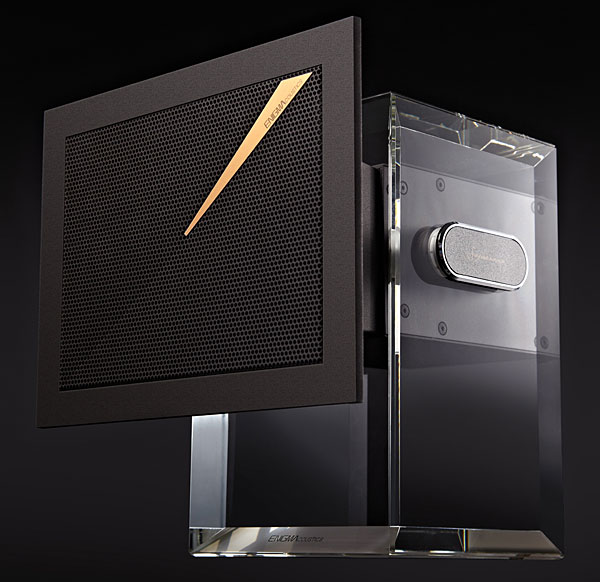
For Jason Victor Serinus, one of the highlights of the 2013 T.H.E. Show in Newport Beach, California, was the public debut of the Sopranino—a horn-loaded, self-polarized, electrostatic supertweeter from EnigmAcoustics. In his report, Jason wrote about the sound of a pair of Sopraninos used atop Magico V3 speakers: "only folks with severe hearing loss would have missed how the sound opened up when the Sopranino was switched in." Well, as you can read later, I don't have hearing loss, and I did also hear an improvement with the Sopranino. So when I visited the Californian company's dem room at the 2014 Consumer Electronics Show, in Las Vegas, I asked for review samples.
The Sopranino
Costing $3690/pair, the Sopraninos come in a handsome wooden box. The EnigmAcoustics people have obviously learned from Apple the importance of presentation—the experience of unpacking a high-end audio product should presage the sound quality to come. The Sopranino is equally well presented. A rectangular gray enclosure has a short horn at its front with a mouth measuring 6" wide by 4" high, and is mounted within a frame made from pure white, crystal-like glass. The base of the frame is faced with felt, so the supertweeter can be easily set atop the owner's main speaker. The horn mouth is covered by a cloth grille, with a flash pointing up to the left or right to indicate the channel with which each Sopranino is to be used. On the rear of the enclosure are two brass WBT binding posts; a rotary switch with settings marked Low, Mid, and High; and a toggle switch, marked Gain, offering settings of "0" and "–3dB." The rotary switch's markings correspond to high-pass filter frequencies of 8, 10, and 12kHz. This filter operates with a second-order, 12dB/octave slope; the Sopranino is connected in parallel with the main speaker so that it adds to rather than replaces the output of that speaker's tweeter.
The primary factor in the Sopranino's design is that it uses a self-polarized electrostatic diaphragm and doesn't, therefore, need an external DC voltage supply. Such diaphragms, known as electrets, are commonly used in microphones, but this is the first time I have encountered an electret used in a loudspeaker. The PTFE electret diaphragm measures 4.75" wide by 3.5" high, and is said to be 25µm thick with a moving mass of just 1.6 milligrams. This material was developed by Taiwanese institutions, primarily National Taiwan University and the Taiwan Industrial Technology and Research Institute. EnigmAcoustics licenses this technology and, to make it suitable for high-end audio applications, sandwiches the diaphragm between two acoustically transparent stators of copper-coated fiberglass, for push-pull operation. A custom-made transformer steps up the input signal to the high voltages required to produce an adequate sound-pressure level.
Although the Sopraninos can be used on top of the main speakers, EnigmAcoustics offers dedicated stands for $600/pair. These have a 13" by 10" base covered with tempered glass, and a solid-aluminum pillar and top plate. The stand height is adjustable in six steps from 36" to 48". At the end of the review period, EnigmAcoustics shipped a pair of stands for me to use with the Sopraninos, but unfortunately too late for me to try them.
Listening
I initially set the EnigmAcoustics Sopraninos atop the pair of Joseph Audio Perspective loudspeakers I am reviewing for a future issue of Stereophile. This placed the center of each horn 41.5" from the ground, which was 5" above the height of my ears when I sit in my listening chair. I therefore raised the backs of the Sopraninos so that the horns were aimed directly at my ears. The front of each Sopranino was vertically aligned with the dome tweeter of the Joseph speaker it sat on; because the Josephs' tweeters are connected in positive acoustic polarity, I connected the Sopraninos with the same polarity.
But before I did any listening to music, I felt that I needed to check my upper-frequency hearing. After all, there would seem little point in proceeding with a review of a supertweeter if my hearing cut off at a frequency lower than the unit's passband.
The last time I had my hearing professionally tested by an audiologist, it appeared that I had a slight loss of sensitivity around 3kHz, though this was still within the formal bounds of "normal hearing." Standard audiology tests stop at 8kHz, but I informally test my hearing every month when I measure loudspeakers. Using an Audio Precision System One analyzer, I sweep a tone from 50kHz down to 10Hz to measure impedance and electrical phase. For the past two decades I have started to hear the tone at around 16kHz, but my cutoff has recently dropped somewhat—I am no longer bothered by the line whistle at 15.625kHz that emanates from the few CRT-based TVs I encounter.
Using the Audeze LCD-X headphones I had purchased after reviewing them in March, I set a comfortable playback level with a tone at 1kHz. I then increased the frequency of the tone in steps of first 1kHz, then 100Hz. I could still hear a discrete tone at 14,800Hz, but above 15kHz I could hear nothing but a slight click when I turned the signal generator on and off. If I boosted the level a little, I could just detect the presence of 15kHz, but not as a tone—more like a pressure. I think it fair, therefore, to say that 14.8kHz is the current upper limit of my hearing sensitivity. This is actually high for someone my age (66 this month), but this might be related to two things: that I take care of my hearing, and that I have had asthma my entire life. (Some researchers have reported a connection between asthma and increased high-frequency hearing sensitivity.) In some of the graphs in this review's "Measurements" sidebar, I have marked my 14.8kHz limit with a vertical green line.
My initial auditioning of the Sopraninos was done on a Sunday, first without the Joseph speakers hooked up. I set the supertweeters' high-pass filters to 8kHz and their Gain (sensitivity) to "0" dB, to give myself the maximum chance of hearing anything. Even so, much of the time there was not a lot to hear. Pink noise from Editor's Choice (CD, Stereophile STPH015-2) confirmed that the Sopraninos were operating, and with recordings of percussion, acoustic guitars, and orchestral violins I could hear a "wispiness" akin to the whispering of distant mosquitos. With spoken voice, there was nothing to be heard; with singing voices, only faint ghosts were audible.
I connected the Joseph speakers and, in that first hour, listened to as many different kinds of music as I could. To my surprise, given the low level of sound produced by the Sopraninos alone, I ended up increasing the high-pass filter settings to 10kHz. The Sopraninos operate in parallel with the main speakers' tweeters, and the region between 8 and 10kHz sounded a little too steely at the 8kHz setting. I then used the Perspective+Sopranino combination, driven by the Pass Labs XA60.5 amplifiers, for all my routine listening for the next week's worth of evenings. For whatever reason, the system sounded good—but I wasn't doing any critical listening, only enjoying my music after each day's work.
Come Saturday morning, I disconnected the Sopranino supertweeters and relistened to some of the music I'd enjoyed earlier in the week. I can't claim that I heard a night-and-day difference. In fact, the system still sounded good. Just not quite as good.
Thinking I might hear a more definite difference with a different pair of speakers, I replaced the Joseph Perspectives with my 1978 pair of Rogers BBC LS3/5As. Setting the Rogers minimonitors atop 24"-high Celestion speaker stands and the Sopraninos atop the Rogerses placed the center of each Enigma horn the same 41.5" above the floor, so again I raised the backs of the supertweeters a little. Though the LS3/5A's woofer is connected in inverted acoustic polarity, its tweeter is polarity correct, so again I connected the Sopraninos in positive acoustic polarity. With these speakers, the 12kHz filter setting sounded optimal, and I left the Gain at 0dB, despite the LS3.5A's lower sensitivity.
 I began with the Pass Labs monoblocks, but replaced them with the MBL Corona C15s I also review in this issue, which exerted better control over the LS3/5As' upper bass. (Neither amplifier had a problem driving the impedance of the Rogers/Sopranino combination.) But with both amplifiers, when I listened to "I Used to Be a King," from Graham Nash's Songs for Beginners (24-bit/48kHz ALAC files ripped from DVD-A, Atlantic/Rhino R2 35257-2), both ride and hi-hat cymbals sounded more realistic—more like struck bronze than shaped and textured white noise. The cymbals were also in better balance with Phil Lesh's bass guitar with the supertweeters hooked up, and, to my surprise, the LS3/5As' very slightly nasal character seemed diminished. And while this song played through the minimonitors lacked the magnificence I'd come to expect from the Wilson Alexias and Vivid Giya G3s I'd been using prior to the Josephs and Rogerses, the LS3/5As with EnigmAcoustics Sopraninos offered a small hint of it, though of course within a much smaller dynamic window.
EnigmAcoustics describes the Sopranino as recovering "the ambience present in all recordings," and as "effectively [delivering] ambience while only adding a touch of 'sparkle' to the high end of the most well-designed tweeters." The LS3/5As have always been imaging champs, but with the Sopraninos, their presentation acquired even more solidity. The individual voices in Tim Takach's arrangement of Sting's "Valparaiso," performed by Minnesotan male-voice choir Cantus on their There Lies the Home (24/44.1 ALAC files from CD master, Cantus CTS-1206), were more identifiable, even in the unison opening section. The voices were also set farther back in the ambience of the Washington Pavilion in Sioux Falls, South Dakota, where I had recorded them. It's an overused word, but my thesaurus gave me no choice but palpable to describe what I was hearing with this recording.
The space around the shaker and congas at the beginning and end of Lyle Lovett's atmospheric "North Dakota" from his Live in Texas (ALAC file ripped from CD, Curb/MCA MCAD-11964), acquired more tangibility with the Sopraninos helping out the LS3/5As. When Rickie Lee Jones starts singing harmony in the song's chorus, she was unambiguously placed to the left of and slightly behind Lovett. And when she softly scats at the end of the song, she can be heard to take another couple of steps back. Delicious.
As I began writing this review, listening again to the music I'd used to form my opinions as I did so, I felt the effect of the Sopraninos was less than I had expected. I played pink noise to check what was going on—as you'll read in the "Measurements" sidebar, the right-channel supertweeter was no longer outputting signal above 15kHz. The Reviewer's Curse had struck again! But this leaves me with a question: How could I have perceived a problem when the fault was eliminating frequencies I can't hear and leaving intact those I could?
Summing up
I began with the Pass Labs monoblocks, but replaced them with the MBL Corona C15s I also review in this issue, which exerted better control over the LS3/5As' upper bass. (Neither amplifier had a problem driving the impedance of the Rogers/Sopranino combination.) But with both amplifiers, when I listened to "I Used to Be a King," from Graham Nash's Songs for Beginners (24-bit/48kHz ALAC files ripped from DVD-A, Atlantic/Rhino R2 35257-2), both ride and hi-hat cymbals sounded more realistic—more like struck bronze than shaped and textured white noise. The cymbals were also in better balance with Phil Lesh's bass guitar with the supertweeters hooked up, and, to my surprise, the LS3/5As' very slightly nasal character seemed diminished. And while this song played through the minimonitors lacked the magnificence I'd come to expect from the Wilson Alexias and Vivid Giya G3s I'd been using prior to the Josephs and Rogerses, the LS3/5As with EnigmAcoustics Sopraninos offered a small hint of it, though of course within a much smaller dynamic window.
EnigmAcoustics describes the Sopranino as recovering "the ambience present in all recordings," and as "effectively [delivering] ambience while only adding a touch of 'sparkle' to the high end of the most well-designed tweeters." The LS3/5As have always been imaging champs, but with the Sopraninos, their presentation acquired even more solidity. The individual voices in Tim Takach's arrangement of Sting's "Valparaiso," performed by Minnesotan male-voice choir Cantus on their There Lies the Home (24/44.1 ALAC files from CD master, Cantus CTS-1206), were more identifiable, even in the unison opening section. The voices were also set farther back in the ambience of the Washington Pavilion in Sioux Falls, South Dakota, where I had recorded them. It's an overused word, but my thesaurus gave me no choice but palpable to describe what I was hearing with this recording.
The space around the shaker and congas at the beginning and end of Lyle Lovett's atmospheric "North Dakota" from his Live in Texas (ALAC file ripped from CD, Curb/MCA MCAD-11964), acquired more tangibility with the Sopraninos helping out the LS3/5As. When Rickie Lee Jones starts singing harmony in the song's chorus, she was unambiguously placed to the left of and slightly behind Lovett. And when she softly scats at the end of the song, she can be heard to take another couple of steps back. Delicious.
As I began writing this review, listening again to the music I'd used to form my opinions as I did so, I felt the effect of the Sopraninos was less than I had expected. I played pink noise to check what was going on—as you'll read in the "Measurements" sidebar, the right-channel supertweeter was no longer outputting signal above 15kHz. The Reviewer's Curse had struck again! But this leaves me with a question: How could I have perceived a problem when the fault was eliminating frequencies I can't hear and leaving intact those I could?
Summing up
There is no doubt in my mind that EnigmAcoustics' beautifully made and finished Sopraninos made a subtle but genuine improvement in the sound of my system with both the loudspeakers with which I tried them. There was a sense of loss every time I disconnected the supertweeters, the imaging losing some of that addictive palpability. But yes, at $3690/pair, plus $600 for the dedicated stands if needed, the Sopranino is an expensive means of achieving a small if worthwhile improvement to the sound of one's system. And I am not sure how much of that improvement will be audible if the owner's hearing cuts off at a lower frequency than mine. There is also the issue of the amplifier with which it is used being fazed by the Sopranino's impedance (footnote 1). An audition will be mandatory prior to purchase.
But with that proviso, I recommend the Sopranino. I haven't come across anything like it before. I'm going to miss them.
Footnote 1: In an e-mail in which he had sent me technical information about the Sopranino, EnigmAcoustics' Wei Chang wrote: "The low impedance in Sopranino is characterized by its step-up transformer as needed for electrostatic speakers. We've not had any user experiencing issues utilizing modern transistor-based well-designed amps driving 12kHz at 3 ohms. Nevertheless, our engineering team is developing a higher-impedance step-up transformer in order to eradicate any potential issue and ease customers' concerns."
Costing $3690/pair, the Sopraninos come in a handsome wooden box. The EnigmAcoustics people have obviously learned from Apple the importance of presentation—the experience of unpacking a high-end audio product should presage the sound quality to come. The Sopranino is equally well presented. A rectangular gray enclosure has a short horn at its front with a mouth measuring 6" wide by 4" high, and is mounted within a frame made from pure white, crystal-like glass. The base of the frame is faced with felt, so the supertweeter can be easily set atop the owner's main speaker. The horn mouth is covered by a cloth grille, with a flash pointing up to the left or right to indicate the channel with which each Sopranino is to be used. On the rear of the enclosure are two brass WBT binding posts; a rotary switch with settings marked Low, Mid, and High; and a toggle switch, marked Gain, offering settings of "0" and "–3dB." The rotary switch's markings correspond to high-pass filter frequencies of 8, 10, and 12kHz. This filter operates with a second-order, 12dB/octave slope; the Sopranino is connected in parallel with the main speaker so that it adds to rather than replaces the output of that speaker's tweeter.
I initially set the EnigmAcoustics Sopraninos atop the pair of Joseph Audio Perspective loudspeakers I am reviewing for a future issue of Stereophile. This placed the center of each horn 41.5" from the ground, which was 5" above the height of my ears when I sit in my listening chair. I therefore raised the backs of the Sopraninos so that the horns were aimed directly at my ears. The front of each Sopranino was vertically aligned with the dome tweeter of the Joseph speaker it sat on; because the Josephs' tweeters are connected in positive acoustic polarity, I connected the Sopraninos with the same polarity.
I began with the Pass Labs monoblocks, but replaced them with the MBL Corona C15s I also review in this issue, which exerted better control over the LS3/5As' upper bass. (Neither amplifier had a problem driving the impedance of the Rogers/Sopranino combination.) But with both amplifiers, when I listened to "I Used to Be a King," from Graham Nash's Songs for Beginners (24-bit/48kHz ALAC files ripped from DVD-A, Atlantic/Rhino R2 35257-2), both ride and hi-hat cymbals sounded more realistic—more like struck bronze than shaped and textured white noise. The cymbals were also in better balance with Phil Lesh's bass guitar with the supertweeters hooked up, and, to my surprise, the LS3/5As' very slightly nasal character seemed diminished. And while this song played through the minimonitors lacked the magnificence I'd come to expect from the Wilson Alexias and Vivid Giya G3s I'd been using prior to the Josephs and Rogerses, the LS3/5As with EnigmAcoustics Sopraninos offered a small hint of it, though of course within a much smaller dynamic window.
EnigmAcoustics describes the Sopranino as recovering "the ambience present in all recordings," and as "effectively [delivering] ambience while only adding a touch of 'sparkle' to the high end of the most well-designed tweeters." The LS3/5As have always been imaging champs, but with the Sopraninos, their presentation acquired even more solidity. The individual voices in Tim Takach's arrangement of Sting's "Valparaiso," performed by Minnesotan male-voice choir Cantus on their There Lies the Home (24/44.1 ALAC files from CD master, Cantus CTS-1206), were more identifiable, even in the unison opening section. The voices were also set farther back in the ambience of the Washington Pavilion in Sioux Falls, South Dakota, where I had recorded them. It's an overused word, but my thesaurus gave me no choice but palpable to describe what I was hearing with this recording.
There is no doubt in my mind that EnigmAcoustics' beautifully made and finished Sopraninos made a subtle but genuine improvement in the sound of my system with both the loudspeakers with which I tried them. There was a sense of loss every time I disconnected the supertweeters, the imaging losing some of that addictive palpability. But yes, at $3690/pair, plus $600 for the dedicated stands if needed, the Sopranino is an expensive means of achieving a small if worthwhile improvement to the sound of one's system. And I am not sure how much of that improvement will be audible if the owner's hearing cuts off at a lower frequency than mine. There is also the issue of the amplifier with which it is used being fazed by the Sopranino's impedance (footnote 1). An audition will be mandatory prior to purchase.
Footnote 1: In an e-mail in which he had sent me technical information about the Sopranino, EnigmAcoustics' Wei Chang wrote: "The low impedance in Sopranino is characterized by its step-up transformer as needed for electrostatic speakers. We've not had any user experiencing issues utilizing modern transistor-based well-designed amps driving 12kHz at 3 ohms. Nevertheless, our engineering team is developing a higher-impedance step-up transformer in order to eradicate any potential issue and ease customers' concerns."















