

Sidebar 3: Measurements
I used DRA Labs' MLSSA system and a calibrated DPA 4006 microphone to measure the EnigmAcoustics (Enigma from now on) Sopranino's frequency response in the farfield, and an Earthworks QTC-40 for the spatially averaged room responses. It was difficult to estimate the Sopranino's voltage sensitivity, as I usually calculate this with a 20kHz bandwidth and, as you will see, the Enigma supertweeter's output is mainly higher than that frequency. But the sensitivity below 20kHz appears to be 87dB/2.83V/m, with the switch reducing this by the specified 3dB.
Fig.1 shows the Sopranino's electrical impedance (solid traces) and electrical phase (dotted traces) with the 12dB/octave high-pass crossover filter set (from top to bottom, impedance; from bottom to top, phase) to 12, 10, and 8kHz. The impedance above 14kHz averages 2.5 ohms, the magnitude increasing below 12, 10, and 8kHz, respectively, and is not significantly affected by the 3dB sensitivity pad. The phase angle becomes very capacitive about an octave below each nominal crossover frequency, but that won't be an issue because the Sopranino's magnitude increases with decreasing frequency. However, with the 8kHz filter setting, there is a very high inductive phase angle between 7 and 12kHz, a region where the impedance magnitude drops to less than 2 ohms. This makes the Sopranino very difficult to drive at this setting, though it's fair to point out that a lot of music has limited energy in this region.
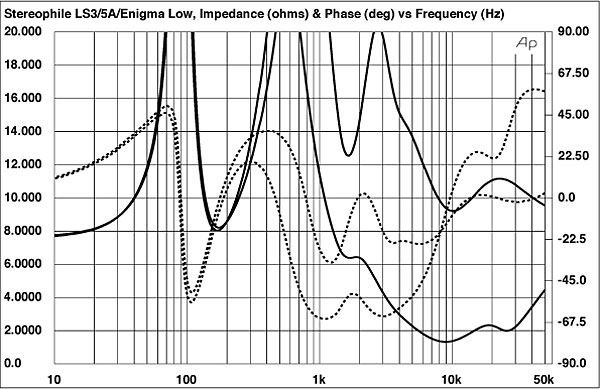
 The Sopranino won't be used on its own, of course, so I measured the impedance of the combination of the Enigma tweeter in parallel with the 1978 BBC LS3/5A that I used for some of my auditioning. The worst-case result, with the supertweeter's filter set to 8kHz, is shown in fig.2. The top solid trace shows the impedance of the LS3/5A alone, the lower solid trace the impedance of the combination. Although this version of the BBC's LS3/5A is a 16 ohm design, the Sopranino steadily decreases the impedance above 1kHz, reaching a minimum magnitude of just 1.33 ohms at 9kHz. Fortunately, the phase angle of the combination (bottom dotted trace below 100Hz, top dotted trace above 8kHz) is low in this region. Still, it reaches +47° at 30kHz and –64° at 3kHz, frequencies where the magnitude is still low, at 2 and 4 ohms, respectively. The phase angle is a little more benign with the Sopranino's filter set to 12kHz (not shown), but those wanting to try the Sopranino will need to be sure of using an amplifier than has no problem driving such low impedances.
.jpg)
 I performed my usual spatially averaged in-room response measurements with the Sopraninos sitting atop a pair of Joseph Audio Perspective speakers. The blue trace in fig.5 shows the averaged response of the Josephs at my listening position; the red trace shows what happened when I added the Sopraninos set to 8kHz and 0dB gain. Again, the vertical green line shows the 14.8kHz cutoff of my hearing sensitivity. There is 1–2dB greater output between 7 and 15kHz with the supertweeters, which I could hear, and a major boost in response between 15 and 30kHz, which I couldn't hear. (I plotted these responses to 40kHz rather than my usual 30kHz.)


Fig.1 EnigmAcoustics Sopranino, electrical impedance (solid) and phase (dashed) with Gain set to "0" and crossover to (magnitude from top to bottom at 500Hz, phase from bottom to top at 1kHz): 12kHz, 10kHz, 8kHz (2 ohms/vertical div.).
Fig.2 Rogers BBC LS3/5A with EnigmAcoustics Sopranino set to 8kHz and "0," electrical impedance (solid) and phase (dashed) (2 ohms/vertical div.).
Turning to acoustic measurements, fig.3 shows the Sopranino's farfield frequency response averaged across a 30° horizontal window centered on the middle of the horn. I have added a vertical green line to this graph at 14.8kHz to indicate the HF cutoff of my hearing at normal listening levels. The filter was set to 10kHz for this measurement, and you can see that the supertweeter's output plateaus between 10 and 15kHz, then rapidly rises to reach a level 17dB higher at the 30kHz limit of this graph. Interestingly, this rise in response sort of matches the typical loss of hearing sensitivity with increasing frequency, at least up to 20kHz. Sort of. Setting the crossover to 8kHz increases the response below 10kHz by a couple of dB, while setting it to 12kHz reduces the level at 10kHz by 5dB (not shown).
Fig.3 EnigmAcoustics Sopranino, anechoic response on axis at 50" with crossover set to 10kHz, averaged across 30° horizontal window and corrected for microphone response.
The Sopranino's lateral dispersion with the crossover set to 10kHz is shown in fig.4 (actual responses shown). The supertweeter's output falls off rapidly to the sides. The vertical dispersion (not shown) is similar. Listeners need to arrange the Sopraninos' placements so that they sit with their ears on axis.
Fig.4 EnigmAcoustics Sopranino, lateral response family at 50" with crossover set to 10kHz, from back to front: responses 90–5° off axis, on-axis response, responses 5–90° off axis.
Fig.5 Joseph Audio Perspective, spatially averaged, 1/6-octave response in JA's listening room (blue), and with EnigmAcoustics Sopranino set to 8kHz and "0" (red).
Turning to the time domain, the Sopranino's step response (fig.6) indicates that it is connected in positive acoustic polarity. Whether or not its output adds to or subtracts from that of the main speaker's tweeter can be adjusted by inverting the Sopranino's polarity. As anticipated, the supertweeter's cumulative spectral-decay plot (fig.7) is very clean.
Fig.6 EnigmAcoustics Sopranino, step response on tweeter axis at 50" with crossover set to 10kHz (2ms time window, 30kHz bandwidth).
Fig.7 EnigmAcoustics Sopranino, cumulative spectral-decay plot on tweeter axis at 50" with crossover set to 10kHz (0.15ms risetime).
As I mentioned in my "Listening" comments, as subtle as I felt the effect of the Sopranino sometimes was, toward the end of the review period it suddenly got more subtle. I redid the in-room measurements, this time using my BBC LS3/5As. Fig.8 shows the response at the positions of my ears of the right (blue) and left (red) channels. It appears that the right Sopranino was no longer outputting energy above 15kHz, though it was still operating below that frequency. Perhaps, when they receive the review samples, EnigmAcoustics can examine what went wrong.—John Atkinson
Fig.8 Rogers BBC LS3/5A with EnigmAcoustics Sopranino set to 8kHz and "0," 1/6-octave response of right (blue) and left (red) speakers at the listening seat.















