Forget sissy foot tapping. I believe completely in the value of involuntary lap drumming, head bobbing, and ecstatic fist pumping. These actions signify that I am in sync with the music, that I got my ears wide open and my mojo workin'. And when I find myself synced up and delirious, I play the same records over and over. (Yes, I was that neighbor you hated.) I've been playing, over and over, David Byrne's Eno-produced score for Twyla Tharp's The Catherine Wheel (LP, Sire 3645), and especially the penultimate two tracks, "What a Day That Was" and "Big Blue Plymouth (Eyes Wide Open)." I used the new Vinnie Rossi LIO integrated amplifier (review to come), and when I got to the "(Eyes Wide Open)" part I babbled like a fiend in a forest. My feet stomped, my head swayed back and forth, my fists pounded—and at the end, when the synths kicked in, my cheeks were soaked with tears. "See the little girl with her eyes rolled back in her head . . ."
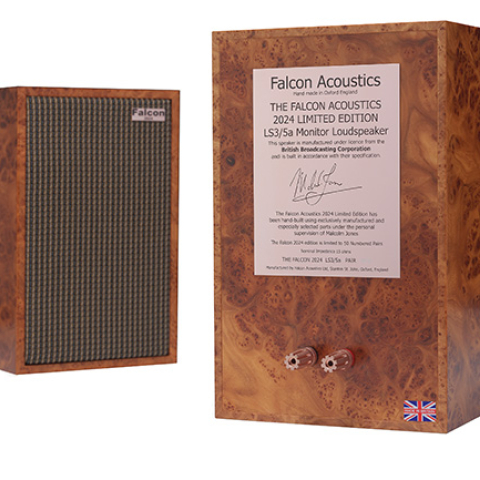
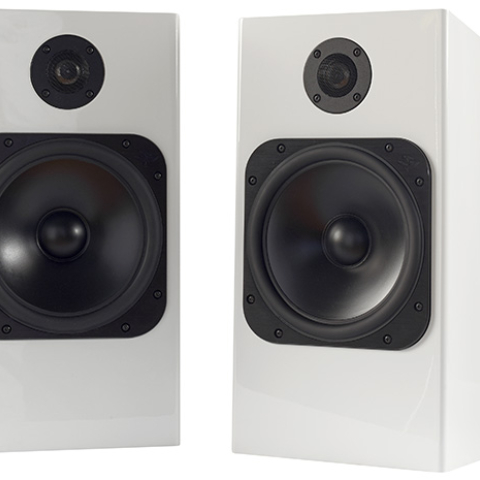
These little speakers didn't just open my ears. True to their legendary status as the first box speaker that could actually image, the Falcon LS3/5a's projected—on a spectacularly big, airy soundstage—crystalline images that were sharp and sweet. Big orchestral recordings were so gigantic I could feel the expanding kettledrum waves tickling the walls of concert halls.
Bright emitting tubes
I've had the Falcon Acoustics LS3/5a's for several months and have powered them with every amp in the house. They played enjoyably well with all—with one exception. Class-D made these hyper-responsive, 15-ohm speakers sound dry, slightly hard, and more generalized than I like. Class-D amps awoke that napping bass bump and turned the slightly rising treble into a distraction. The LS3/5a has always been an exceptionally amp-friendly speaker, not because it makes mediocre amps sound good, but for quite the opposite reason: The LS3/5a excels at letting you hear exactly what your amp really sounds like.
 Like all previous LS3/5a's, the Falcons sang their best with lower-powered class-A or class-AB amps. A supersweet, unusually liquid-sounding, class-AB MOSFET amp—such as the 25Wpc Vinnie Rossi LIO integrated—could bring this antique design into the 21st century. The Falcon-Rossi combo delivered lively, grainless magic, and showed me just how neutral and "invisible" these minimonitors could be. But . . .
Like dogs begging for treats, what the 15-ohm Falcons really wanted was a tube amp with a 16-ohm tap.
My 22Wpc Line Magnetic LM518 IA amp, with its 845 tubes, responded perfectly to that desire. The minute I hooked it up, the Falcon's tone colors doubled in saturation. Steve Davis of Big Ear Consulting, Falcon Acoustics' US importer, says he uses a PrimaLuna DiaLogue Premium EL34 power amp, which—unlike PrimaLuna's DiaLogue Premium HP integrated, reviewed by Robert Deutsch in Stereophile in December 2014—has 16-ohm taps. I've used my 30-year-old Rogers LS3/5a's (serial nos. 23035A/B) with single-ended 300B and push-pull 2A3 amps and have never felt a need for more juice. I didn't have one to try for this review, but every push-pull, 6BQ5/EL84 amplifier I used sounded LSD-spiderweb spectacular! Push-pull 6L6/5881 tubes + LS3/5a is a classic combo I can almost guarantee you'll enjoy. Meanwhile, my Line Magnetic LM518 IA tubed amp made such rich, strong, fantastically detailed, super-lively sound that I used it for all of the listening described below.
The scene was rockin'
Like all previous LS3/5a's, the Falcons sang their best with lower-powered class-A or class-AB amps. A supersweet, unusually liquid-sounding, class-AB MOSFET amp—such as the 25Wpc Vinnie Rossi LIO integrated—could bring this antique design into the 21st century. The Falcon-Rossi combo delivered lively, grainless magic, and showed me just how neutral and "invisible" these minimonitors could be. But . . .
Like dogs begging for treats, what the 15-ohm Falcons really wanted was a tube amp with a 16-ohm tap.
My 22Wpc Line Magnetic LM518 IA amp, with its 845 tubes, responded perfectly to that desire. The minute I hooked it up, the Falcon's tone colors doubled in saturation. Steve Davis of Big Ear Consulting, Falcon Acoustics' US importer, says he uses a PrimaLuna DiaLogue Premium EL34 power amp, which—unlike PrimaLuna's DiaLogue Premium HP integrated, reviewed by Robert Deutsch in Stereophile in December 2014—has 16-ohm taps. I've used my 30-year-old Rogers LS3/5a's (serial nos. 23035A/B) with single-ended 300B and push-pull 2A3 amps and have never felt a need for more juice. I didn't have one to try for this review, but every push-pull, 6BQ5/EL84 amplifier I used sounded LSD-spiderweb spectacular! Push-pull 6L6/5881 tubes + LS3/5a is a classic combo I can almost guarantee you'll enjoy. Meanwhile, my Line Magnetic LM518 IA tubed amp made such rich, strong, fantastically detailed, super-lively sound that I used it for all of the listening described below.
The scene was rockin'
Remember 7" 45s? Remember Bobby "Boris" Pickett's "Monster Mash" (Garpax 45-44167), originally released in October 1962? As I hunkered down in my candlelit Bed-Stuy bunker, the surreal vision of the Line Magnetics' thoriated-tungsten–bright emitters and the vivid sounds of Boris and his Crypt-Kickers took mesmerizing hold of me. This is a weird recording. The drum kit is strangely small and distant, but the boiling, bubbling beaker hangs directly in front of my face. Pickett's voice was more richly toned and tangible than I ever dreamed possible. Even the little drum kit sounded quite real. Countless times I have played a mono recording of Vladimir Horowitz attacking Beethoven's best-known piano sonata, "Moonlight," Op.27 No.2 in c#, with full-tilt romantic vigor (LP, RCA LM-2009). Each time, I hear something new. With the Falcons and Ortofon's CG 25 DI II cartridge, I discovered a meteor shower of startling dynamic contrasts. A couple of times I felt as if flashbulbs were going off. The Falcon LS3/5a is less than a foot tall, but the pair of them gave Horowitz's piano a vivid, large-scale presence. Microcontrasts and microdynamics were as good as I could imagine. When I played this recording through the KEF LS50s—designed in homage to the LS3/5a—they couldn't match the Falcons' light-speed–free expression, transparency, or tonal purity.
Not long ago, a friend played me McLemore Avenue, Booker T. & the M.G.'s mostly instrumental riff on the Beatles' Abbey Road (LP, Stax STS-2027). It sounded so smooth, liquid, and Hammond B3 colorful, I felt I was sliding along a greasy Memphis sidewalk in 1970. My friend's hi-fi is beyond eccentric. It includes an old SoundCraftsman equalizer and some PP-6L6–powered Ampex "suitcase" speakers, and it made McLemore sound like a reference recording to die for. Once I got my head outa the back cover—it shows a drunken black man ogling a white chick's legs—I realized that every rhythm change, every snare pop, every Donald "Duck" Dunn bass riff was dripping in irony and sarcasm. By the time I made it through the three Beatles medleys on side 1, I was convinced that I had to go home and buy this LP on eBay—that night.
When my "Near Mint" Stax beauty arrived, I immediately played it. It sounded like crap. The tone was sour. The rhythms were not ironically funky. I was already writing for Stereophile, so occasionally, after installing a new amp or speakers, I would pull out McLemore Avenue to hear if it sounded better. It never did.
Countless times I have played a mono recording of Vladimir Horowitz attacking Beethoven's best-known piano sonata, "Moonlight," Op.27 No.2 in c#, with full-tilt romantic vigor (LP, RCA LM-2009). Each time, I hear something new. With the Falcons and Ortofon's CG 25 DI II cartridge, I discovered a meteor shower of startling dynamic contrasts. A couple of times I felt as if flashbulbs were going off. The Falcon LS3/5a is less than a foot tall, but the pair of them gave Horowitz's piano a vivid, large-scale presence. Microcontrasts and microdynamics were as good as I could imagine. When I played this recording through the KEF LS50s—designed in homage to the LS3/5a—they couldn't match the Falcons' light-speed–free expression, transparency, or tonal purity.
Not long ago, a friend played me McLemore Avenue, Booker T. & the M.G.'s mostly instrumental riff on the Beatles' Abbey Road (LP, Stax STS-2027). It sounded so smooth, liquid, and Hammond B3 colorful, I felt I was sliding along a greasy Memphis sidewalk in 1970. My friend's hi-fi is beyond eccentric. It includes an old SoundCraftsman equalizer and some PP-6L6–powered Ampex "suitcase" speakers, and it made McLemore sound like a reference recording to die for. Once I got my head outa the back cover—it shows a drunken black man ogling a white chick's legs—I realized that every rhythm change, every snare pop, every Donald "Duck" Dunn bass riff was dripping in irony and sarcasm. By the time I made it through the three Beatles medleys on side 1, I was convinced that I had to go home and buy this LP on eBay—that night.
When my "Near Mint" Stax beauty arrived, I immediately played it. It sounded like crap. The tone was sour. The rhythms were not ironically funky. I was already writing for Stereophile, so occasionally, after installing a new amp or speakers, I would pull out McLemore Avenue to hear if it sounded better. It never did.
 Until right now. Listening to it and looking at the cover, I feel as if I'm seeing the whole of 1960s white America through the eyes and heart of a black man. In reverie, I'm standing on the corner of East McLemore and College Avenues. I can see Stax's "SOULSVILLE USA" sign, and I finally understand what I was once too young to grasp. Why is my mind suddenly opening up? Because the Falcon LS3/5as are doing their righteous thing.
Today, McLemore Avenue sounds way better—and much less distorted—than it did at my friend's house. Steve Cropper's guitar is alive, talking beautifully and tangibly present. Booker T. is holding a B3 chord until I completely grasp its meaning. The Human Timekeeper (Al Jackson Jr.) is pounding it down for human rights. And the Falcons are demonstrating that Memphis soul always sounds best, and box speakers always sound their least peculiar, when the tonal balance and boogie factor are sly, sultry, and right on!
Conclusions
Until right now. Listening to it and looking at the cover, I feel as if I'm seeing the whole of 1960s white America through the eyes and heart of a black man. In reverie, I'm standing on the corner of East McLemore and College Avenues. I can see Stax's "SOULSVILLE USA" sign, and I finally understand what I was once too young to grasp. Why is my mind suddenly opening up? Because the Falcon LS3/5as are doing their righteous thing.
Today, McLemore Avenue sounds way better—and much less distorted—than it did at my friend's house. Steve Cropper's guitar is alive, talking beautifully and tangibly present. Booker T. is holding a B3 chord until I completely grasp its meaning. The Human Timekeeper (Al Jackson Jr.) is pounding it down for human rights. And the Falcons are demonstrating that Memphis soul always sounds best, and box speakers always sound their least peculiar, when the tonal balance and boogie factor are sly, sultry, and right on!
Conclusions
I felt a little naãve for even attempting to tell this story. At this point, there's precious little to debate or describe about the merits of the BBC LS3/5a minimonitor design. And surely, the world doesn't need yet another long review of yet another licensed incarnation of it. The only relevant question is whether or not Falcon Acoustics' LS3/5a is better than earlier LS3/5a's in some unmeasurable but listener-tangible way. Could this 21st-century incarnation, made by a couple of old farts, possibly play music more accurately or more enjoyably than my 30-year-old Rogers LS3/5a's, and all the Harbeth, Spendor, Chartwell, etc. iterations that came before it? I doubt I'm qualified to fully answer that question—I haven't heard them all. But I do know that the Falcons make my old Rogerses sound a tad drowsy and fuzzy, like a cartridge with too many miles on it. (Perhaps I'm responding to a fresh tweeter with a slightly stronger response.) The Falcon is livelier and sings more clearly than any other LS3/5a I've heard. To my ears, this new, hypercrafted edition seems more "invisible," better toned, less "miserably" distorted or "peculiar" sounding, than any other moderately priced loudspeaker I've used in my home—ever. The Falcon LS3/5a has returned me to my roots, and served as a powerful reminder of the joys and beauties that a simple, accurate, easy-to-drive loudspeaker coupled to a charming low-powered amplifier can provide.
I never experienced the original red-tape BBC prototypes. I can only imagine what they may have sounded like. But I've used and enjoyed many different variations of the LS3/5a, and can say, with relative Herbcertainty, that the Falcon Acoustics might just be the best production LS3/5a ever made. Only time and the legions of LS3/5a faithful can say for sure.
I've had the Falcon Acoustics LS3/5a's for several months and have powered them with every amp in the house. They played enjoyably well with all—with one exception. Class-D made these hyper-responsive, 15-ohm speakers sound dry, slightly hard, and more generalized than I like. Class-D amps awoke that napping bass bump and turned the slightly rising treble into a distraction. The LS3/5a has always been an exceptionally amp-friendly speaker, not because it makes mediocre amps sound good, but for quite the opposite reason: The LS3/5a excels at letting you hear exactly what your amp really sounds like.
Like all previous LS3/5a's, the Falcons sang their best with lower-powered class-A or class-AB amps. A supersweet, unusually liquid-sounding, class-AB MOSFET amp—such as the 25Wpc Vinnie Rossi LIO integrated—could bring this antique design into the 21st century. The Falcon-Rossi combo delivered lively, grainless magic, and showed me just how neutral and "invisible" these minimonitors could be. But . . .
Like dogs begging for treats, what the 15-ohm Falcons really wanted was a tube amp with a 16-ohm tap.
My 22Wpc Line Magnetic LM518 IA amp, with its 845 tubes, responded perfectly to that desire. The minute I hooked it up, the Falcon's tone colors doubled in saturation. Steve Davis of Big Ear Consulting, Falcon Acoustics' US importer, says he uses a PrimaLuna DiaLogue Premium EL34 power amp, which—unlike PrimaLuna's DiaLogue Premium HP integrated, reviewed by Robert Deutsch in Stereophile in December 2014—has 16-ohm taps. I've used my 30-year-old Rogers LS3/5a's (serial nos. 23035A/B) with single-ended 300B and push-pull 2A3 amps and have never felt a need for more juice. I didn't have one to try for this review, but every push-pull, 6BQ5/EL84 amplifier I used sounded LSD-spiderweb spectacular! Push-pull 6L6/5881 tubes + LS3/5a is a classic combo I can almost guarantee you'll enjoy. Meanwhile, my Line Magnetic LM518 IA tubed amp made such rich, strong, fantastically detailed, super-lively sound that I used it for all of the listening described below.
Remember 7" 45s? Remember Bobby "Boris" Pickett's "Monster Mash" (Garpax 45-44167), originally released in October 1962? As I hunkered down in my candlelit Bed-Stuy bunker, the surreal vision of the Line Magnetics' thoriated-tungsten–bright emitters and the vivid sounds of Boris and his Crypt-Kickers took mesmerizing hold of me. This is a weird recording. The drum kit is strangely small and distant, but the boiling, bubbling beaker hangs directly in front of my face. Pickett's voice was more richly toned and tangible than I ever dreamed possible. Even the little drum kit sounded quite real.
Countless times I have played a mono recording of Vladimir Horowitz attacking Beethoven's best-known piano sonata, "Moonlight," Op.27 No.2 in c#, with full-tilt romantic vigor (LP, RCA LM-2009). Each time, I hear something new. With the Falcons and Ortofon's CG 25 DI II cartridge, I discovered a meteor shower of startling dynamic contrasts. A couple of times I felt as if flashbulbs were going off. The Falcon LS3/5a is less than a foot tall, but the pair of them gave Horowitz's piano a vivid, large-scale presence. Microcontrasts and microdynamics were as good as I could imagine. When I played this recording through the KEF LS50s—designed in homage to the LS3/5a—they couldn't match the Falcons' light-speed–free expression, transparency, or tonal purity.
Not long ago, a friend played me McLemore Avenue, Booker T. & the M.G.'s mostly instrumental riff on the Beatles' Abbey Road (LP, Stax STS-2027). It sounded so smooth, liquid, and Hammond B3 colorful, I felt I was sliding along a greasy Memphis sidewalk in 1970. My friend's hi-fi is beyond eccentric. It includes an old SoundCraftsman equalizer and some PP-6L6–powered Ampex "suitcase" speakers, and it made McLemore sound like a reference recording to die for. Once I got my head outa the back cover—it shows a drunken black man ogling a white chick's legs—I realized that every rhythm change, every snare pop, every Donald "Duck" Dunn bass riff was dripping in irony and sarcasm. By the time I made it through the three Beatles medleys on side 1, I was convinced that I had to go home and buy this LP on eBay—that night.
Until right now. Listening to it and looking at the cover, I feel as if I'm seeing the whole of 1960s white America through the eyes and heart of a black man. In reverie, I'm standing on the corner of East McLemore and College Avenues. I can see Stax's "SOULSVILLE USA" sign, and I finally understand what I was once too young to grasp. Why is my mind suddenly opening up? Because the Falcon LS3/5as are doing their righteous thing.
Today, McLemore Avenue sounds way better—and much less distorted—than it did at my friend's house. Steve Cropper's guitar is alive, talking beautifully and tangibly present. Booker T. is holding a B3 chord until I completely grasp its meaning. The Human Timekeeper (Al Jackson Jr.) is pounding it down for human rights. And the Falcons are demonstrating that Memphis soul always sounds best, and box speakers always sound their least peculiar, when the tonal balance and boogie factor are sly, sultry, and right on!
I felt a little naãve for even attempting to tell this story. At this point, there's precious little to debate or describe about the merits of the BBC LS3/5a minimonitor design. And surely, the world doesn't need yet another long review of yet another licensed incarnation of it. The only relevant question is whether or not Falcon Acoustics' LS3/5a is better than earlier LS3/5a's in some unmeasurable but listener-tangible way. Could this 21st-century incarnation, made by a couple of old farts, possibly play music more accurately or more enjoyably than my 30-year-old Rogers LS3/5a's, and all the Harbeth, Spendor, Chartwell, etc. iterations that came before it? I doubt I'm qualified to fully answer that question—I haven't heard them all. But I do know that the Falcons make my old Rogerses sound a tad drowsy and fuzzy, like a cartridge with too many miles on it. (Perhaps I'm responding to a fresh tweeter with a slightly stronger response.) The Falcon is livelier and sings more clearly than any other LS3/5a I've heard. To my ears, this new, hypercrafted edition seems more "invisible," better toned, less "miserably" distorted or "peculiar" sounding, than any other moderately priced loudspeaker I've used in my home—ever. The Falcon LS3/5a has returned me to my roots, and served as a powerful reminder of the joys and beauties that a simple, accurate, easy-to-drive loudspeaker coupled to a charming low-powered amplifier can provide.