I used DRA Labs' MLSSA system and a calibrated DPA 4006 microphone to measure the Focal AriaK2936's frequency response in the farfield, and an Earthworks QTC-40 mike for the nearfield responses. (The Earthworks microphone's capsule has a diameter of just ¼", so it doesn't present a significant obstacle to each radiator's output.) The loudspeaker's manual recommends that the listener's ears should be the same height as the tweeter, so I used the tweeter axis for the farfield measurements.
Focal specifies the Aria 936's sensitivity as a high 92dB/2.83V/m. My estimate was slightly lower, at 90dB(B)/2.83V/m, but this is still usefully higher than average. The Aria 936's impedance is specified as 8 ohms, with a minimum magnitude of 2.8 ohms. Using MLSSA and checking with Dayton Audio's DATS V2, I found that the impedance magnitude (fig.1, solid trace) remains above 8 ohms below 25Hz and in the mid-treble. The minimum value was 2.75 ohms between 100Hz and 135Hz. However, the electrical phase angle (dashed trace) is occasionally high when the magnitude is low. For example, there is a combination of 4 ohms and –60° at 80Hz, which will increase the loudspeaker's demand for current from amplifiers in a region where music can have high levels of energy. The EPDR (footnote 1) drops below 2 ohms in three regions—27–38Hz, 65– 141Hz, and 363–895Hz—with minimum values of 1.8 ohms at 32Hz and 0.97 ohms between 87Hz and 90Hz. The K2 Aria 936 must be used with amplifiers that don't have problems driving 2 ohm loads (footnote 2). In addition, with tube amplifiers that have high output impedances, the shape of the Focal's impedance magnitude trace implies that the low treble will sound exaggerated.

Other than one at 24kHz, which was due to the metal-diaphragm tweeter's primary breakup mode, the traces in fig.1 are free from the small discontinuities that would imply that there are resonances of some kind present. However, when I investigated the enclosure's vibrational behavior with a plastic-tape accelerometer, I did find some resonant modes. For example, two resonant modes were present on the sidewalls level with the middle woofer, one at 289Hz and a slightly stronger one at 441Hz (fig.2). These were also present at lower levels at other places on the sidewalls, and a single resonance at 668Hz was present on the back wall. All the modes were both relatively low in level and had a high Q (Quality Factor), which will mitigate any audible effects.

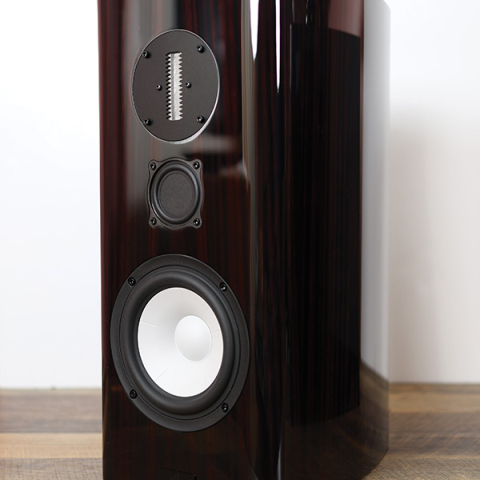
A saddle is centered on 41Hz in the impedance magnitude trace, which suggests that this is the tuning frequency of the two small ports on the front baffle and the larger, downward-firing one on the speaker's base. The minimum-motion notch in the woofers' summed output (fig.3, blue trace; the three woofers appear to behave identically), which is when the back pressure from the port resonance holds the woofer cone still, lies at the same frequency. The outputs of all three ports were very similar. Their nearfield output (fig.3, red trace) peaks broadly, in textbook manner, between 30Hz and 100Hz. The upper-frequency rolloff is clean, though some low-level liveliness can be seen at 800Hz.
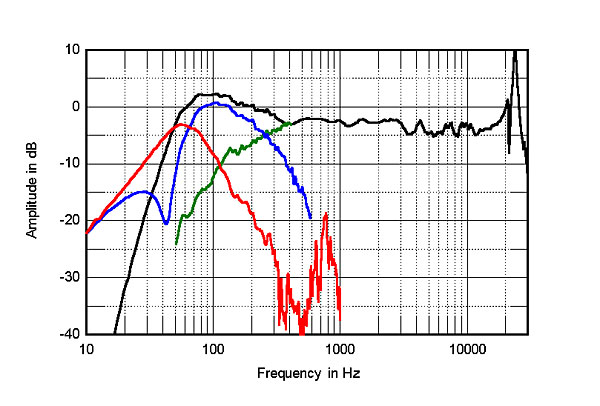
The black trace below 300Hz in fig.3 is the complex sum of the nearfield midrange, woofer, and port responses. There is the usual peak in the upper bass due to the nearfield measurement technique, but the speaker appears to be tuned to be maximally flat. The woofers cross over to the midrange unit (fig.3, green trace) at the specified 260Hz. Higher in frequency in fig.3, the Aria 936's farfield response, averaged across a 30° horizontal window centered on the tweeter axis, is commendably flat and even, though with a very slight lack of energy in the mid-treble. (This may well have contributed to my estimate of the loudspeaker's sensitivity being slightly lower than the specification.) Repeating the measurement with the grille in place reduced the level in the presence region by a couple of dB and introduced some narrow suckouts in the top two audio octaves, these due to reflections of the tweeter's output from the grille. The tweeter diaphragm's main resonance results in a very high but very narrow peak in the response at 24kHz.
Fig.4 shows the Aria 936's horizontal dispersion, normalized to the response without the grille on the tweeter axis, which thus appears as a straight line. The loudspeaker's radiation pattern is generally smooth and even, though there is a slight lack of energy off-axis at the top of the midrange unit's passband. The dispersion widens in the treble region where the on-axis response is a little depressed, which should result in an even treble balance in-room. The tweeter became very directional in its top octave, however.

Fig.5 shows the Focal's vertical dispersion, again normalized to the response on the tweeter axis. With the Aria 936 mounted on its base and spikes, its tweeter is a high 42" from the floor, and I understand that Robert Schryer auditioned the speakers with his ears just below the midrange unit. At the 9.5' listening distance, this would be equivalent to listening less than 5° below the tweeter axis, and you can see from fig.5 that the response RS experienced would be identical to that on the tweeter axis. A small suckout centered on 4.4kHz develops more than 5° above the tweeter axis, but as the specified crossover frequency between the midrange unit and tweeter is 3.1kHz, I doubt that this will be due to cancellation of their outputs in the crossover region.

Turning to the time domain, the Aria 936's step response on the tweeter axis (fig.6) reveals that the tweeter and midrange unit are both connected in inverted acoustic polarity, the woofers in positive polarity. The decay of the tweeter's step smoothly blends with the negative-going start of the midrange unit's step, and the decay of the midrange unit's step blends smoothly with the positive-going start of the woofers' step. This implies optimal implementation of the crossover. Other than the prominent ridge of delayed energy at the tweeter's resonant frequency, the Aria 936's cumulative spectral-decay plot (fig.7) is clean.


The Focal Aria K2 936's measured performance indicates excellent audio engineering.—John Atkinson
Footnote 1: EPDR is the resistive load that gives rise to the same peak dissipation in an amplifier's output devices as the loudspeaker. See "Audio Power Amplifiers for Loudspeaker Loads," JAES, Vol.42 No.9, September 1994, and stereophile.com/reference/707heavy/index.html.
Footnote 2: The Aria's high sensitivity will mitigate this difficult load to a degree.