

As Stereophile's true cub reporter—sorry, Herb Reichert, you're senior staff!—I work in the domestic fields of the high-end audio landscape. Meanwhile, my fellow Stereophile correspondents trot the globe, attending international audio shows, experiencing all the sweet spots offered by such far-flung locales as Munich, Montreal, and Northamptonshire, UK. Am I complaining? Not! But when an audio show of merit invades New York City, still the capital of the civilized world, you can believe I'm there on opening day, pen and pad in hand. The first rooms on my must-visit list usually include Audio Note UK, DeVore Fidelity, MBL—and, when the gear is warm and the good vibes flowing, as they usually are, Wes Bender Studio NYC.
Consider the typical high-end presentation at an audio show: machines clad in cool-to-the-touch brushed aluminum and other scientifically validated materials, voluptuous women beckoning you into suites hosted by men in suits, and sound and music that may be good, bad, or indifferent.
Wes Bender Studio NYC? Totally different experience. At the 2016 New York Audio Show, Bender provided booze, fun, and high-octane sounds. When I walked into Suite 814 of the Park Lane Hotel, Bender and GamuT's US distributor, Michael Vamos, were partying with the Rolling Stones, Santana's Abraxas (on Mobile Fidelity 45rpm LPs), Blood, Sweat & Tears, and singer Vanessa Fernandez's album of Led Zeppelin covers, When the Levee Breaks. A washtub overflowed with iced Hacker-Pschorr Weisse NaturtrÅb (a naturally cloudy hefeweizen, or yeasted wheat beer). I couldn't hear everything Bender was saying, but clearly audible were "crazy," "damned shame," and "buy the ticket, man!" Vamos, who resembles the 1970s actor Jan-Michael Vincent, pointed at the tub o' beer. In one corner of the suite, AudioStream.com's Michael Lavorgna, the ever-sly Jana Dagdagan (Stereophile's editorial coordinator), and AudioQuest communications VP (and former Stereophile staffer) Stephen Mejias smiled at me like characters from La Dolce Vita. ZZ Top's "Jesus Just Left Chicago" blasted the boogie. The sound of Bender's all-Gamut system—the center of this surreal, volume-pounding scene—was truly fascinating.
Along the room's long wall, GamuT's RS3i stand-mounted speakers ($20,990/pair) were getting their mojo workin' via the company's D3i dual-mono line-stage preamplifier ($8380), D200i dual-mono stereo amplifier ($13,990), and CD3 CD player ($7990), all connected via GamuT Reference interconnects, speaker cables, and power cords. Analog goodness was provided by a Pear Audio Blue Kid Thomas turntable with Cornet 2 tonearm ($7995), Pear Audio Blue Classic phono stage ($1995), Pear Audio external power supply ($1995), and a Transfiguration Proteus cartridge ($5,999). This mighty system provided gusto and glory, music bouncing off the walls with true force, unerring musicality, and heartfelt fun. I wanted more!
But I was on a quest for the absolute integrated amp. I asked Vamos if GamuT offered a high-powered model of such design. They do: the Di150 LE dual-mono integrated amplifier.
Design
GamuT's Di150 LE (for Limited Edition) is a Danish-built, 59.4-lb, aluminum-encased powerhouse that outputs 180Wpc into 8 ohms, 360Wpc into 4 ohms, or an-ear challenging 700Wpc into 2 ohms. The Di150 boasts a frequency response of 10Hz–50kHz, ±0.1dB—none too shabby! At its center is a circuit topology introduced by GamuT's founder and designer, Ole Lund Christensen.
In the early 1980s, GamuT made amplifiers for Denmark's professional recording studios. Forgoing the usual banks of transistors, which he believed only smeared the music, Christensen instead sourced massive negative-positive-negative MOSFET transistors used in industrial welding, using only one or two per rail. Eventually, GamuT sold these N-channel MOSFET amps to high-end devotees across Europe.
Michael Vamos led me deeper down the rabbit hole of N-channel MOSFET design: "Many amps use up to 48 transistors per channel, which creates a lot of sonic and signal compromises," Vamos claimed. "Whenever you use more than one transistor, they're never matched exactly, and they will sound different. When you listen, especially in the midrange, you will get a phase issue. The transistors aren't reproducing exactly the same in order to get all the power; they're slightly different. That will muddy the signal. But if only one transistor is reproducing the sound, then it will only reproduce the signal.
 "The GamuT MOSFET is ten times the volume of the biggest hi-fi transistor," he continued. "And they're both NPNs, which eliminates the difference of having a positive and a negative transistor. Each NPN is technically and sonically the same. That eliminates crossover distortion." (footnote 1)
Benno Meldgaard, GamuT's chief of design, wrote in an e-mail that "GamuT's single MOSFET is class-A/B design, biased to 14 watts class-A. This is to run the transistors at an optimum temperature that results in the best sound. GamuT also includes NPN bipolar transistors capable of putting out 25 watts of power which drive the huge [N-channel] MOSFET output transistors. And the two [500VA] toroidal transformers contribute greatly to the solid sound quality. [In] the GamuT design, both the negative and the positive rail have . . . MOSFETs that sound exactly [the] same, which results in a shorter pathway, with less components in the pathway, which gives a very low distortion of even-order harmonics."
Description and Setup
"The GamuT MOSFET is ten times the volume of the biggest hi-fi transistor," he continued. "And they're both NPNs, which eliminates the difference of having a positive and a negative transistor. Each NPN is technically and sonically the same. That eliminates crossover distortion." (footnote 1)
Benno Meldgaard, GamuT's chief of design, wrote in an e-mail that "GamuT's single MOSFET is class-A/B design, biased to 14 watts class-A. This is to run the transistors at an optimum temperature that results in the best sound. GamuT also includes NPN bipolar transistors capable of putting out 25 watts of power which drive the huge [N-channel] MOSFET output transistors. And the two [500VA] toroidal transformers contribute greatly to the solid sound quality. [In] the GamuT design, both the negative and the positive rail have . . . MOSFETs that sound exactly [the] same, which results in a shorter pathway, with less components in the pathway, which gives a very low distortion of even-order harmonics."
Description and Setup
What couldn't be easily driven was my body as, one stairstep at a time, I upended and turned over—and over and over—the Di150's large wooden crate, until I reached my seventh-floor Manhattan crib. Said crate rolled into said crib, I then had trouble releasing the secret panel that would reveal precisely how to uncrate the Di150 LE. After much cursing and sweating on my part, the amplifier sprouted from its sarcophagus of roughhewn wood. I removed the eight stainless-steel screws that affix the Di150 LE's heavy top plate to its enclosure and peered into its inner workings. Dominating the interior are two massive, Danish-made Noratel toroidal transformers, positioned next to four oversized RIFA capacitors. A handful of smaller Vishay capacitors populate two horizontal circuit boards. The long control rod of an Alps potentiometer ("a special low-resistance version, creating 10dB better signal-to-noise ratio," per Vamos) visually halves the amp's interior. Unusual for any amplifier, no Zobel network is used on the Di150's speaker outputs to keep the amp stable.
 Substantial but svelte, heavy-duty but manageable, the Di150 LE slid, with effort, into my Salamander rack, looking quite out of place below my green Shindo Laboratory preamp and power amp. GamuT recommends 100 hours of break-in, which I accomplished via Apple iTunes Shuffle. Thereafter, I left the Di150 powered on 24/7.
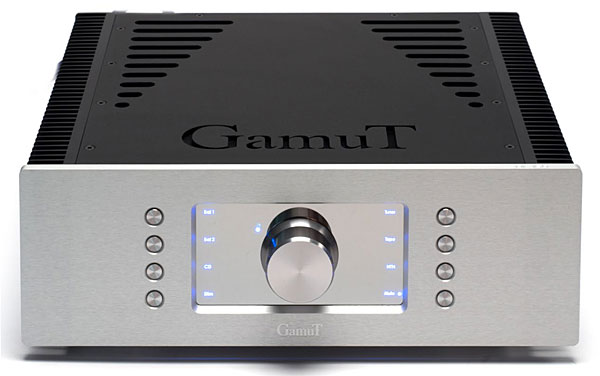
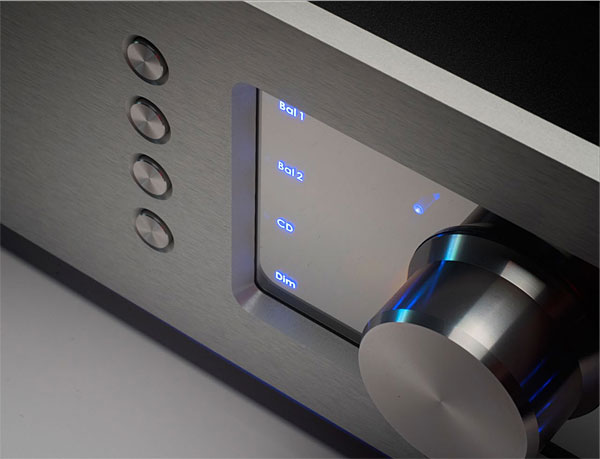
The Di150 LE may be a hulking machine, but I believe it would find its place in any décor. Its silver faceplate is offset by a black case—both formal and flashy—and dominated by a large volume-control knob at the center of its display. Flanking the display are two columns of four silver pushbuttons each: on the left, Balance 1, Balance 2, CD, and Dim; on the right, Tuner, Tape, HTH, and Mute. (A tiny toggle switch on the amplifier's rear panel enables HTH—presumably for Home Theater—mode, in which the Di150's preamplifier section is bypassed so that the user can insert a processor—or, according to Vamos, another preamp, the Di150 then functioning as only a power amp.) These controls, including Volume, are duplicated on a remote-control handset (included). Though rather cheap-looking, the remote handled all functions without a hitch—and unlike some fancier remotes, its batteries never fell out.
Substantial but svelte, heavy-duty but manageable, the Di150 LE slid, with effort, into my Salamander rack, looking quite out of place below my green Shindo Laboratory preamp and power amp. GamuT recommends 100 hours of break-in, which I accomplished via Apple iTunes Shuffle. Thereafter, I left the Di150 powered on 24/7.
The Di150 LE may be a hulking machine, but I believe it would find its place in any décor. Its silver faceplate is offset by a black case—both formal and flashy—and dominated by a large volume-control knob at the center of its display. Flanking the display are two columns of four silver pushbuttons each: on the left, Balance 1, Balance 2, CD, and Dim; on the right, Tuner, Tape, HTH, and Mute. (A tiny toggle switch on the amplifier's rear panel enables HTH—presumably for Home Theater—mode, in which the Di150's preamplifier section is bypassed so that the user can insert a processor—or, according to Vamos, another preamp, the Di150 then functioning as only a power amp.) These controls, including Volume, are duplicated on a remote-control handset (included). Though rather cheap-looking, the remote handled all functions without a hitch—and unlike some fancier remotes, its batteries never fell out.
Footnote 1: A quasi-complementary output stage doesn't intrinsically eliminate crossover distortion, which requires the correct application of output-stage bias current. But the fact that the two N-channel transistors are by definition perfectly matched does, I believe, confer better open-loop linearity.–John Atkinson
GamuT's Di150 LE (for Limited Edition) is a Danish-built, 59.4-lb, aluminum-encased powerhouse that outputs 180Wpc into 8 ohms, 360Wpc into 4 ohms, or an-ear challenging 700Wpc into 2 ohms. The Di150 boasts a frequency response of 10Hz–50kHz, ±0.1dB—none too shabby! At its center is a circuit topology introduced by GamuT's founder and designer, Ole Lund Christensen.
"The GamuT MOSFET is ten times the volume of the biggest hi-fi transistor," he continued. "And they're both NPNs, which eliminates the difference of having a positive and a negative transistor. Each NPN is technically and sonically the same. That eliminates crossover distortion." (footnote 1)
What couldn't be easily driven was my body as, one stairstep at a time, I upended and turned over—and over and over—the Di150's large wooden crate, until I reached my seventh-floor Manhattan crib. Said crate rolled into said crib, I then had trouble releasing the secret panel that would reveal precisely how to uncrate the Di150 LE. After much cursing and sweating on my part, the amplifier sprouted from its sarcophagus of roughhewn wood. I removed the eight stainless-steel screws that affix the Di150 LE's heavy top plate to its enclosure and peered into its inner workings. Dominating the interior are two massive, Danish-made Noratel toroidal transformers, positioned next to four oversized RIFA capacitors. A handful of smaller Vishay capacitors populate two horizontal circuit boards. The long control rod of an Alps potentiometer ("a special low-resistance version, creating 10dB better signal-to-noise ratio," per Vamos) visually halves the amp's interior. Unusual for any amplifier, no Zobel network is used on the Di150's speaker outputs to keep the amp stable.
Substantial but svelte, heavy-duty but manageable, the Di150 LE slid, with effort, into my Salamander rack, looking quite out of place below my green Shindo Laboratory preamp and power amp. GamuT recommends 100 hours of break-in, which I accomplished via Apple iTunes Shuffle. Thereafter, I left the Di150 powered on 24/7.
The Di150 LE may be a hulking machine, but I believe it would find its place in any décor. Its silver faceplate is offset by a black case—both formal and flashy—and dominated by a large volume-control knob at the center of its display. Flanking the display are two columns of four silver pushbuttons each: on the left, Balance 1, Balance 2, CD, and Dim; on the right, Tuner, Tape, HTH, and Mute. (A tiny toggle switch on the amplifier's rear panel enables HTH—presumably for Home Theater—mode, in which the Di150's preamplifier section is bypassed so that the user can insert a processor—or, according to Vamos, another preamp, the Di150 then functioning as only a power amp.) These controls, including Volume, are duplicated on a remote-control handset (included). Though rather cheap-looking, the remote handled all functions without a hitch—and unlike some fancier remotes, its batteries never fell out.
Footnote 1: A quasi-complementary output stage doesn't intrinsically eliminate crossover distortion, which requires the correct application of output-stage bias current. But the fact that the two N-channel transistors are by definition perfectly matched does, I believe, confer better open-loop linearity.–John Atkinson















