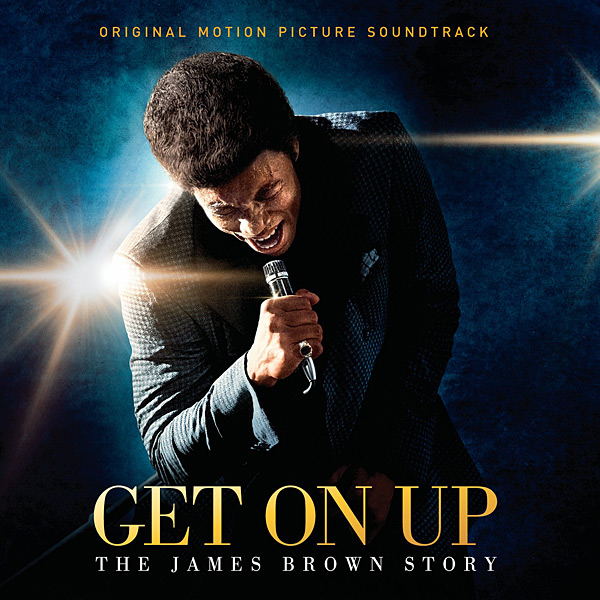
It’s clearly time for a complete rethink of the music biopic format. When a cherubic, large eyed child appears early on in Get On Up, I let out an involuntary groan. It was Ray all over again. But actually it wasn’t because the new James Brown biopic has none of the resonance of that fine film which admittedly is one of the icons of the music biopic genre along with Great Balls of Fire and Walk The Line.
Let’s start with what works. Chadwick Boseman, who played Jackie Robinson in 42 does an admirable job with Brown’s electrifying stage presence. He’s got the splits, the shuffles and that out and back thing Brown always did with the mike stand, down cold. If you don’t know Brown or his music, these scenes are reason enough to go to the see the film.
Beyond that, Get On Up is a mess. The opening sequence which cuts between a latter day Brown drugged up in Georgia, being fired upon during his 1968 visit to Vietnam and his tumultuous childhood in the South Carolina woods is a confusing, first year in film school disaster. From there the biographical bits which surround the musical numbers are often simplistic in the extreme, episodic as hell and in some spots, just plain wrong. Boseman, who plays Brown as fairly grim and humorless when he’s offstage, is hamstrung by a disjointed, overly ambitious, oddly dumb script by Jez and John–Henry Butterworth that tries too hard to pack too much into a 138 minute film and so reverts to telling rather than showing. A telling slice of Brown’s history, as opposed to trying to cover the whole of his life, would have been a better approach. The great overarching revelation of the film, “James Don’t Need Nobody…Oh Wait, He Does,” is a pretty thin foundation to build a biopic on. And again, Boseman literally speaks lines to that effect. Telling not showing: the sure sign of an inexperienced or untalented storyteller.
The lead actor here is however responsible for one of the film’s major problems: you cannot understand what Boseman as Brown is saying about a third of the time. Too many good lines come across as unintelligible. Boseman, who obviously stuffed his lower lip and cheeks full of something, whispers, runs his words together and does not enunciate clearly, none of which were an issue with the real life James Brown. While this device may have worked for Marlon Brando in the The Godfather, it does not work here.
Worst of all, at least through my music editor lenses, the film spends virtually no time on how Brown came up with his utterly unique music. In only one brief episode, a rehearsal in New Orleans—which not surprisingly is the best scene in the entire film—is Brown shown with his band, devising his deconstructed funk, which as Boseman mentions in the film’s opening scene, is a part of almost all the rhythmic popular music being written and recorded today. I can’t help but think that Spike Lee who was originally slated to direct might have done better. Perhaps acclaimed documentarian Alex Gibney will do better in his upcoming Brown documentary, Mr. Dynamite.