I reviewed GoldenEar Technology's first speaker, the Triton Two ($2999.98; all prices per pair), in February 2012. It was and is an outstandingly good speaker, but I thought then that if GoldenEar would apply the same expertise to the design of a speaker with fewer cost constraints, the results could be better still. Sandy Gross, president and CEO of GoldenEar, must have been thinking along similar lines when he named the speaker Triton Two, leaving One for a more ambitious future product.
But the Triton One was slow in coming. Meanwhile, in the three years following my review, the Triton Two remained the top GoldenEar model as it was joined by: two lower-priced floorstanders, the Triton Three ($1999.98) and Triton Seven ($1399.98); two bookshelf models, the Aon 2 ($799.98) and Aon 3 ($999.98); and some home-theater speakers and subwoofers.
I can understand why GoldenEar took their time in coming up with the Triton One. When you have a speaker as successful as the Triton Two, the expectations for any model above it will be correspondingly greater.
Well, the Triton One is here at last—and I was eager to hear if it would prove worth the wait.
Description and Design
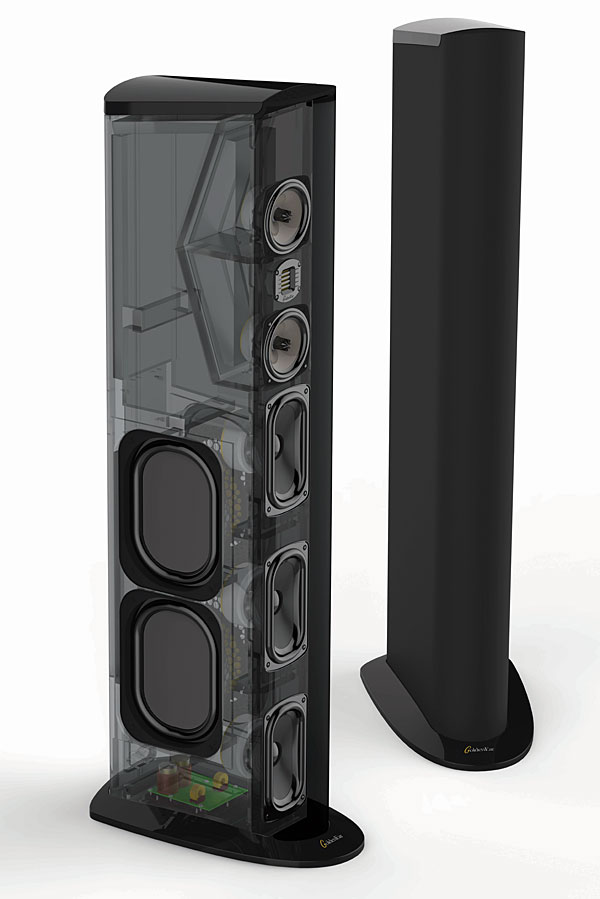
If you've seen the Triton Two, imagine a speaker that's the same general shape but a little taller, a little wider, and a little deeper—that's the Triton One, at 54" high by 8" wide by 165/8" deep, 80 lbs, and $4999.98/pair. I find it sleek, and like the fact that its looks don't draw too much attention to the speaker, but I know that some consider the Triton series too plain looking. The cloth-covered look has worked well for some highly successful speakers, such as the Vandersteen 2 and the Quad ESL-63. However, if you want your speakers to look like fine furniture, the Triton One may not be to your taste. The Triton One's cloth wrap hides an impressive array of technology. Like the Two, it's a three-way design with a powered, passive-radiator-loaded subwoofer section, and features GoldenEar's version of the famed Heil Air-Motion Transformer, called a High-Velocity Folded Ribbon tweeter. However, the Triton One is not just an inflated Two. The engineering team—headed by Bob Johnston, under the direction of Sandy Gross and with input from Gross's business partner, Don Givogue—examined every part of the Two's design, and considered how improvements could be made. According to Gross, "the basic plan was to make the One more dynamic, with even better bass and more refined at the same time."
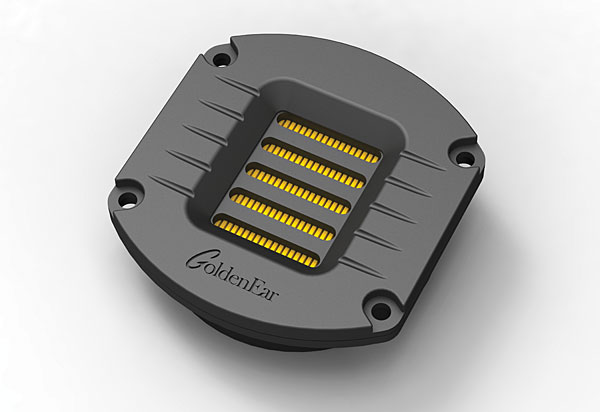 A list of the differences between the Triton One and Two:
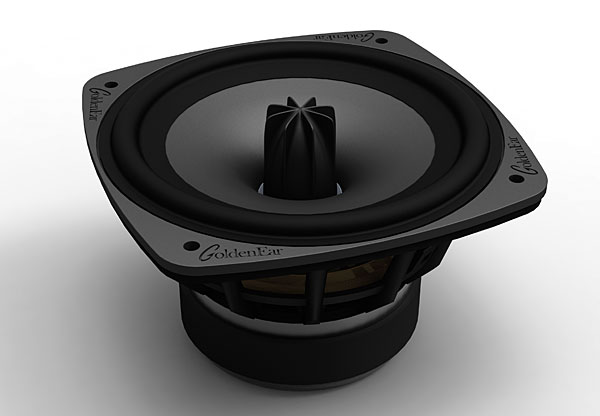
The One's upper-bass/midrange drivers are 5.25" vs the Two's 4.5", which allows the crossover frequency to be lowered from 160 to 100Hz. These drivers have correspondingly larger internal chambers than in the Two.
The One's cabinet is larger, with thicker walls; it's better damped and better braced.
The One's passive cones and baskets are stiffer than the Two's.
The One has three 5" by 9" long-throw bass drivers, vs two in the Two.
The One has four 7" by 10" passive radiators, vs two in the Two.
The One's crossover is a balanced design, which, among other things, is claimed to reduce the stray capacitance in the magnetic gap.
Considerable development of the DSP circuitry that's part of the hybrid passive/active crossover between the One's woofers and upper-bass/midrange drivers has allowed the crossover to now be phase perfect, says GoldenEar.
The One's DSP uses 56- rather than 48-bit processing, and the sample rate has been raised from 96 to 192kHz, both for measurably lower noise and distortion.
The Triton One's subwoofer amplifier has an output of 1600W vs the Two's 1200W, and its damping factor is significantly improved. Instead of using a single large power supply, the One's sub amp uses a separate, small supply for each circuit section, which is said to prevent signal coupling between sections.
Setup
A list of the differences between the Triton One and Two:
The One's upper-bass/midrange drivers are 5.25" vs the Two's 4.5", which allows the crossover frequency to be lowered from 160 to 100Hz. These drivers have correspondingly larger internal chambers than in the Two.
The One's cabinet is larger, with thicker walls; it's better damped and better braced.
The One's passive cones and baskets are stiffer than the Two's.
The One has three 5" by 9" long-throw bass drivers, vs two in the Two.
The One has four 7" by 10" passive radiators, vs two in the Two.
The One's crossover is a balanced design, which, among other things, is claimed to reduce the stray capacitance in the magnetic gap.
Considerable development of the DSP circuitry that's part of the hybrid passive/active crossover between the One's woofers and upper-bass/midrange drivers has allowed the crossover to now be phase perfect, says GoldenEar.
The One's DSP uses 56- rather than 48-bit processing, and the sample rate has been raised from 96 to 192kHz, both for measurably lower noise and distortion.
The Triton One's subwoofer amplifier has an output of 1600W vs the Two's 1200W, and its damping factor is significantly improved. Instead of using a single large power supply, the One's sub amp uses a separate, small supply for each circuit section, which is said to prevent signal coupling between sections.
Setup
The Triton Ones were set up in my listening room in about the same positions other speakers have occupied (footnote 1). Sandy Gross came by to help set them up, tweaking the speakers' distances from the front and side walls and their angles of toe-in.
The Triton One is provided with spikes, though I didn't install these until the speakers' positions were finalized. But when all spikes were fully screwed into the speakers' bottom plates, Gross felt the angle was not optimal—when I sat down to listen, the tweeter axes fired somewhat over my head. The solution was to lean the Ones a bit forward, which he achieved by leaving their spikes installed at the back of each speaker, but using only the smaller rubber feet at the front.
 The Triton One has only one control: for subwoofer level. Setting this is mostly a matter of personal preference. I kept tweaking it, and eventually settled on a setting in the middle of the range.
I drove the Triton Ones with a McIntosh Labs MC275LE, a tubed power amplifier that has the easy-on-the-ears smoothness that is the hallmark of the best tube electronics, but without any of the rolling off of tonality at the top and bottom of the audioband that impairs resolution—descriptors that also apply to my preamplifier, a Convergent Audio Technology SL-1 Renaissance. Rated at 70Wpc but generally known to produce about 90W, the MC275LE had more than enough power to drive these speakers to levels that were about as high as I could tolerate.
Sound
The Triton One has only one control: for subwoofer level. Setting this is mostly a matter of personal preference. I kept tweaking it, and eventually settled on a setting in the middle of the range.
I drove the Triton Ones with a McIntosh Labs MC275LE, a tubed power amplifier that has the easy-on-the-ears smoothness that is the hallmark of the best tube electronics, but without any of the rolling off of tonality at the top and bottom of the audioband that impairs resolution—descriptors that also apply to my preamplifier, a Convergent Audio Technology SL-1 Renaissance. Rated at 70Wpc but generally known to produce about 90W, the MC275LE had more than enough power to drive these speakers to levels that were about as high as I could tolerate.
Sound
Once I begin a review, I try to keep as a constant every potentially confounding variable that could influence my evaluation of the product. I don't change components in the system during a review—but this time I had to make an exception. The problem was with my digital source: an Ayre Acoustics CX-7eMP CD player. I was in the initial phase of break-in and casual listening when the Ayre began to make a purring sound when playing a disc. This would continue until I stopped the player. Sometimes the purring would go away for a while—and then come back again. There was no obvious effect on the sound, but I couldn't be sure that it wasn't having some subtle effect, and it wouldn't be fair to the Triton One to review it with a source component that may not have been working properly. I ended up replacing the Ayre CX-7eMP with PS Audio's DirectStream DAC (DS) and its companion PerfectWave Memory Player CD/DVD transport (PW); the full story of my experience with the DS and the PW can be found in my Follow-Up review of the DirectStream, elsewhere in this issue. As I was simultaneously reviewing the Triton One and the PS Audio combo. I had to periodically switch my focus from the speakers to the CD player, noting any changes in sound as I explored the performance of the PS Audio components, and considering what those changes told me about the sound of the speaker.
Footnote 1: For a picture of my room, see the sidebar to my review of the Focal Aria 936, in November 2014, .
If you've seen the Triton Two, imagine a speaker that's the same general shape but a little taller, a little wider, and a little deeper—that's the Triton One, at 54" high by 8" wide by 165/8" deep, 80 lbs, and $4999.98/pair. I find it sleek, and like the fact that its looks don't draw too much attention to the speaker, but I know that some consider the Triton series too plain looking. The cloth-covered look has worked well for some highly successful speakers, such as the Vandersteen 2 and the Quad ESL-63. However, if you want your speakers to look like fine furniture, the Triton One may not be to your taste. The Triton One's cloth wrap hides an impressive array of technology. Like the Two, it's a three-way design with a powered, passive-radiator-loaded subwoofer section, and features GoldenEar's version of the famed Heil Air-Motion Transformer, called a High-Velocity Folded Ribbon tweeter. However, the Triton One is not just an inflated Two. The engineering team—headed by Bob Johnston, under the direction of Sandy Gross and with input from Gross's business partner, Don Givogue—examined every part of the Two's design, and considered how improvements could be made. According to Gross, "the basic plan was to make the One more dynamic, with even better bass and more refined at the same time."
A list of the differences between the Triton One and Two:
The One's upper-bass/midrange drivers are 5.25" vs the Two's 4.5", which allows the crossover frequency to be lowered from 160 to 100Hz. These drivers have correspondingly larger internal chambers than in the Two.
The One's cabinet is larger, with thicker walls; it's better damped and better braced.
The One's passive cones and baskets are stiffer than the Two's.
The One has three 5" by 9" long-throw bass drivers, vs two in the Two.
The One has four 7" by 10" passive radiators, vs two in the Two.
The One's crossover is a balanced design, which, among other things, is claimed to reduce the stray capacitance in the magnetic gap.
Considerable development of the DSP circuitry that's part of the hybrid passive/active crossover between the One's woofers and upper-bass/midrange drivers has allowed the crossover to now be phase perfect, says GoldenEar.
The Triton Ones were set up in my listening room in about the same positions other speakers have occupied (footnote 1). Sandy Gross came by to help set them up, tweaking the speakers' distances from the front and side walls and their angles of toe-in.
The Triton One has only one control: for subwoofer level. Setting this is mostly a matter of personal preference. I kept tweaking it, and eventually settled on a setting in the middle of the range.
I drove the Triton Ones with a McIntosh Labs MC275LE, a tubed power amplifier that has the easy-on-the-ears smoothness that is the hallmark of the best tube electronics, but without any of the rolling off of tonality at the top and bottom of the audioband that impairs resolution—descriptors that also apply to my preamplifier, a Convergent Audio Technology SL-1 Renaissance. Rated at 70Wpc but generally known to produce about 90W, the MC275LE had more than enough power to drive these speakers to levels that were about as high as I could tolerate.
Once I begin a review, I try to keep as a constant every potentially confounding variable that could influence my evaluation of the product. I don't change components in the system during a review—but this time I had to make an exception. The problem was with my digital source: an Ayre Acoustics CX-7eMP CD player. I was in the initial phase of break-in and casual listening when the Ayre began to make a purring sound when playing a disc. This would continue until I stopped the player. Sometimes the purring would go away for a while—and then come back again. There was no obvious effect on the sound, but I couldn't be sure that it wasn't having some subtle effect, and it wouldn't be fair to the Triton One to review it with a source component that may not have been working properly. I ended up replacing the Ayre CX-7eMP with PS Audio's DirectStream DAC (DS) and its companion PerfectWave Memory Player CD/DVD transport (PW); the full story of my experience with the DS and the PW can be found in my Follow-Up review of the DirectStream, elsewhere in this issue. As I was simultaneously reviewing the Triton One and the PS Audio combo. I had to periodically switch my focus from the speakers to the CD player, noting any changes in sound as I explored the performance of the PS Audio components, and considering what those changes told me about the sound of the speaker.
Footnote 1: For a picture of my room, see the sidebar to my review of the Focal Aria 936, in November 2014, .