

Sidebar 3: Measurements
I used DRA Labs' MLSSA system and a calibrated DPA 4006 microphone to measure the GoldenEar Triton One's frequency response in the farfield, and an Earthworks QTC-40 for the nearfield responses. The Triton One has a very high specified voltage sensitivity of 92dB/2.83V/m. My B-weighted estimate was 91.3dB(B), which is within experimental error of the specification.
The One's nominal impedance is specified as being "compatible with 8 ohms." The solid trace in fig.1 reveals that the impedance magnitude ranges between 3 and 6 ohms for much of the audioband, with minimum values of 3 ohms at 301Hz and 3.1 ohms at 4.2kHz. As tends to be the case with a design using a passive high-pass filter with a fairly low corner frequency, the electrical phase angle becomes increasingly capacitive below that frequency; although the impedance magnitude rapidly increases below 100Hz, mitigating the effect of that phase angle, there is still a combination of 4.1 ohms and –50° at 100Hz, which will require a good 4 ohm–rated amplifier to drive the speaker to acceptably high levels.
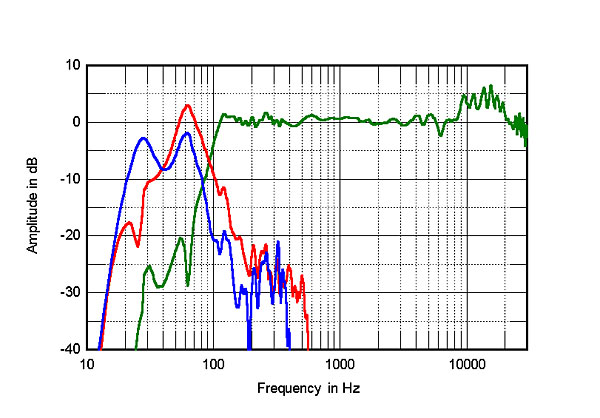
 The green trace in fig.2 shows the quasi-anechoic response on the GoldenEar's tweeter axis at 50", averaged across a 30° horizontal window and spliced at 300Hz to the midrange units' output measured in the nearfield. Other than a boost of up to 5dB between 9 and 20kHz, the Triton One's farfield response is extremely flat. I suspect that the slight comb filtering evident in the top octave results from reflections of the tweeter's output by the metal-mesh grille, which is held away from the baffle. This should have no audible consequences, given the ear's reduced sensitivity in this region.
 How audible is that top-octave peak? RD did note that he "would avoid combining these speakers with components whose intrinsic sound is on the bright side: the Triton Ones will let you hear it." However, looking at the One's lateral-dispersion plot (fig.3), which is normalized to the tweeter-axis response, it appears that the speaker's output declines rapidly to its sides above 10kHz. This will tend to produce a flat top-octave balance in rooms of small to medium size. However, this graph also reveals a small degree of off-axis flare at the top of the midrange units' passband that might correlate with RD's comment above. In the vertical plane (fig.4), a sharply defined suckout centered on 1176Hz develops 10° above the tweeter axis, which I suspect is an interference effect between the two midrange units. To get the most neutral balance from the Triton One, listeners should sit with their ears within a ±5° window centered on the tweeter axis, which is 40" above the floor with the speaker on its base.

 Turning to the time domain, the GoldenEar's step response on the tweeter axis (fig.5) indicates that the all the drivers are connected in positive polarity; the smooth blend between the units' steps indicates optimal crossover design. As suspected earlier, a reflection of the tweeter's output can be seen just before the 4.5ms mark, which results in the top-octave comb filtering noted earlier, as well as a degree of low-level hash above 12kHz in the Triton One's cumulative spectral-decay plot (fig.6). Overall, however, the initial decay in this graph is superbly clean.


Fig.1 GoldenEar Triton One, electrical impedance (solid) and phase (dashed) (2 ohms/vertical div.).
Because a "sock" covers the Triton One's carcass, it wasn't possible to make meaningful measurements of the enclosure's vibrational behavior. However, the impedance traces are free from the small discontinuities that would suggest the presence of resonances and I note that Robert Deutsch found both that the speaker's cabinet was less lively than he remembered from the Triton Two, and that any resonances were almost always masked by the music.
Fig.2 GoldenEar Triton One, anechoic response on tweeter axis at 50", averaged across 30° horizontal window and corrected for microphone response, with nearfield responses of midrange units (green), woofers (red), passive radiators (blue), respectively plotted below 300Hz, 500Hz, 300Hz.
The midrange drive-units cover a wide range, not rolling off until 120Hz or so in the upper bass. The three racetrack-shaped woofers (red trace) cover a much narrower bandpass, peaking between 50 and 70Hz, and the four passive radiators (blue trace) are tuned to a low 25Hz and peak between 20 and 40Hz. Though there is a second peak in the radiators' output, I suspect that this is crosstalk in the measurement from the woofers' output. The responses of both the woofers and the radiators roll off below the latter's tuning frequency with a much faster slope than the usual reflex 24dB/octave, but the Triton One otherwise offers respectably low bass extension.
Fig.3 GoldenEar Triton One, lateral response family at 50", normalized to response on tweeter axis, from back to front: differences in response 90–5° off axis, reference response, differences in response 5–90° off axis.
Fig.4 GoldenEar Triton One, vertical response family at 50", normalized to response on tweeter axis, from back to front: differences in response 15–5° above axis, reference response, differences in response 5–10° below axis.
Fig.5 GoldenEar Triton One, step response on tweeter axis at 50" (5ms time window, 30kHz bandwidth).
Fig.6 GoldenEar Triton One, cumulative spectral-decay plot on tweeter axis at 50" (0.15ms risetime).
To judge from its measured performance, Sandy Gross and Bob Johnston have produced another finely engineered loudspeaker.—John Atkinson















