 Listening:
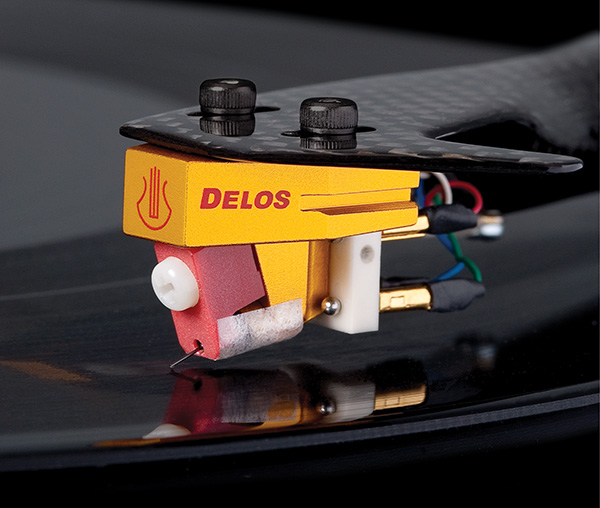
 I began my Lyra Delos trials by mounting it on a
DS Audio HS-001 headshell attached to my
Sorane SA-1.2 tonearm and connected with AudioQuest's 1.2m, 60pF
Yosemite tonearm cable to a
PrimaLuna EVO 100 phono preamplifier. I set VTF to precisely 1.75gm, as recommended. During break-in, which took no fewer than 40 sides, I experimented with shunt MC preamp loading of 100, 200, and 500 ohms. They all sounded similarly dryish, with extraordinary bass resolution and pristine focus. I settled on a 100 ohm load because that was the quietest and most relaxed. Two hundred ohms was more spirited and put more body in piano sound. The 500 ohm setting was the most alive and upbeat but also the most brittle.
Next, I tried the Delos into the fixed-at-50-ohm JFET MC input on
SunValley's EQ 1616D phono equalizer. Inexplicably, the Delos's character went from lean and polished to something fleshier and more sensuous. With the Lyra–SunValley combo, Sun Ra, Yusef Lateef, and Jerome Sabbagh came through as classic jazz musicians with hands and bodies and discernable temperaments.
After 40 sides, the Delos began to sing in its mature voice. Recognizing this set my mind to wondering how the Lyra would fare connected to
MoFi's MasterPhono phono stage.
For no reason I can point to, I was experiencing a Lyra cartridge that was not sounding like any Lyra cartridge I ever heard. With the MasterPhono's voltage input shunted to 100 ohms, this combo spun my head around. Sound density and plasticity dominated my attention.
With MoFi's MasterPhono, the Delos sounded more immediate and physical than it had with the EVO 100. This was evidenced by Elly Ameling singing
Bach Cantatas (Philips LP 6500 014). It felt like she was standing between my speakers at approximately her real height, her voice powering my room and mesmerizing my mind.

With every cartridge I audition, there is always at least one album where my brain realizes that none of my other cartridges could make this disc sound better than it is sounding right then. With the Delos, there were many, but the first I encountered was Jerome Sabbagh's
Heart (
Analogue Tone Factory ATF 001). Most extraordinary was how clean, natural, and complete the leading edges of Joe Martin's bass notes came through. I've played this superbly recorded album many times, and there was no doubt the Delos was pumping the record up, emphasizing all the right stuff. The 50Hz– 500Hz range was spectacularly detailed and vivid in a manner that made the
Dynavector XX2a playing the same album seem too tightly wound. The Delos's perfect traction through the bass and lower midrange added weighty realism to Martin's bass and Sabbagh's sax that I was not getting with the XX2a or with Hana's Umami Blue.
With moving coil cartridges, the choice of magnetic materials—alnico, neodymium, or platinum alloy, for example—affects what I perceive as the "finish" on the sounds it makes. As I imagine it, cartridge magnets express their crystalline structure as grain and their permeability as a tangible force that tints and polishes the cartridge's own transparency. Historically, I've favored alnico, as in
Hana's Umami Blue and the
Dynavector XX2a, but 700 hours with the
Koetsu Rosewood Signature Platinum taught me to appreciate platinum alloy magnets, and 200 hours with the
Benz Micro Gullwing SLR brought me into the neodymium fold. It's subtle, but each of these materials present empty space, texture, and viscosity differently. One of my golden-eared cartridge-collector buddies raves about the "raw musicality" of his Lyra Olympos, which was made with a platinum-alloy magnet salvaged from a donor Parnassus. His other cartridge is an new old stock Koetsu Black from 1980.
If you already own a Lyra Delos, I encourage you to track down a copy of
Béla Bartók: Deux Images & Two Rhapsodies for Violin and Orchestra on Bartok Records (Bartok Records BR-307). Loaded at 50 ohms through SunValley's EQ1616D MC input, the Delos did not sound like a hi-fi cartridge. It disappeared behind waves of Bartók's intoxicating tones. Equalized by the almost-free SunValley phono equalizer ($985 for the kit), this recording came through sounding robust and rhapsodic.
Fifty ohms should be too much loading, but through the SunValley, the Delos sounded meatier than it did at 100 ohms with Mobile Fidelity's Master Phono. With the EQ1616D, the Delos punched harder with a heavier fist than it did with my more expensive preamps loaded at a value closer to what's recommended. I can't explain what I heard, but I speculated: Loaded at 50 ohms, Lyra's Delos might be
Lenz-law clamping down on mistracking, which is cleaning up the treble and fortifying the bass. Or?
Throughout my auditions, I experienced a constant subliminal sense that the Delos was assembled with extraordinary precision. It felt like a well-tuned (very small) F1 engine. Jonathan Carr says the Lyra design is able to keep the angles between the magnetic circuit, signal coils, and core aligned during playback. My auditions supported that claim.
Though I struggled to grasp the emotional content of Gerald Finzi's art, one composer and record I've never struggled to understand is Ludwig van Beethoven's visionary
Grosse Fuge in B-flat major, Op.133, played by the Budapest String Quartet (Columbia LP ML 4587). With the Delos, this stunning mono recording sounded raw, fresh, and crisply drawn in eye-popping three-dimensionality. It has never sounded better.
 vs Dynavector XX2a: They're Gonna put the White House on the moon, soon! You are truly of the Sun—everyone!
Gilles Peterson Presents Sun Ra And His Arkestra
vs Dynavector XX2a: They're Gonna put the White House on the moon, soon! You are truly of the Sun—everyone!
Gilles Peterson Presents Sun Ra And His Arkestra (Strut/IK7 Records 125LP) is a two-LP album featuring 16 tracks that French deejay-influencer Gilles Peterson says "lifted him up." My memory is sketchy, but I think Le Sony'r Ra (the artist's chosen legal name; Sun Ra is his stage name), his Space Trio, and other musician friends were all interested in "spirit things" and hung out with Black Nationalist occultists on the South Side of Chicago.
This aspect of Sun Ra appealed strongly to my childhood pal Fred Marko, who hated the "
Playboy Jazz" his father listened to. Fred told me to buy every Sun Ra record I could find. "Ra's not uppity," he said. "He keeps his feet on the street with us simple people while channeling extraterrestrials." I believe Ra was on earth to show us something marvelous, and Gilles Peterson's collection is proof of my assertion.
I am not sure how it happened, but all these diverse Sun Ra tracks, spanning three decades beginning in the '50s, sounded squeaky-remastered clean and unusually corporeal. This album came out in 2015, and the cover says it was made "from original masters." The digital restoration was performed by Irwin Chusid and Michael D. Anderson, and the Delos made a good show of their ministrations. At 100 ohms through MoFi's Master Phono, the Delos's signature clarity exposed every bead and sequin in Ra's robe. Every scintillating cymbal smash. Every spoken word and piano note. And Ra's immense psychic presence, which was what I came looking for.
Before this $2195 Lyra appeared, I'd been breaking in Dynavector's new, similarly priced
XX2a ($2250), a permeability-enhanced version of the
XX2 MKII. With the XX2a, high frequencies are distinctly purer and sharper focused than they are with my well-worn XX2 MKII. Dynavector's new annealing process delivers an improved transparency that positions the XX2a very close to the Delos in that parameter. This clarity parity makes comparison with the Lyra Delos difficult. I mean, if they both play equally clear and well-sorted, what am I to discuss? Feelings?
Well if I must...
The chief differences between the XX2a and the Delos lay in how each cartridge makes me feel while playing my discs. In my system, the XX2a generates a cool race car vibe that drags me into rhythms and flow. It presents active energy forms in a way that's fun to watch, especially on bluegrass and gospel. The Delos's main virtues are its exquisite transparency and well-formed dimensionality that encourage dreamy contemplation.
After finishing that comparison, I began wondering how the Delos's low 8.2 ohm impedance would respond to a zero-ohm load.
 Current drive:
 When I connected the Dynavector XX2a's 6 ohm impedance to Sutherland Engineering's $3800
SUTZ transimpedance head amp, it turned off the Dynavector's nitromethane and reduced its blower pressure—just a little. What current drive gave in return was to make recordings sound smoother, more relaxed, darker, quieter, and more visually attractive. But maybe not more exciting.
In dramatic contrast, Sutherland's SUTZ head amp
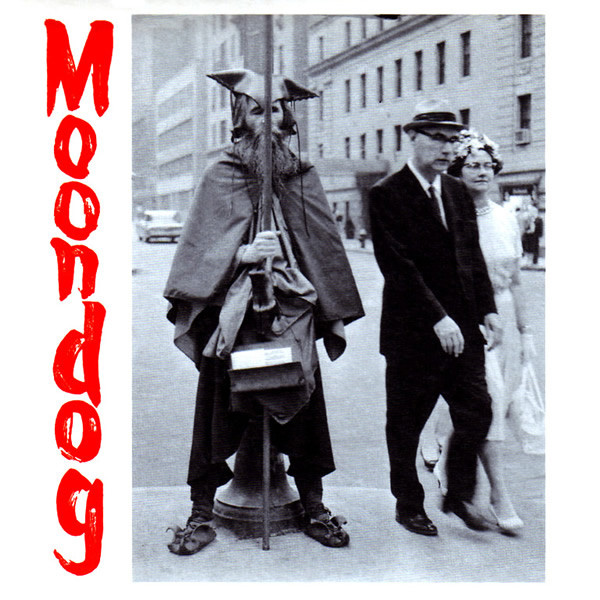
supercharged the Lyra. Now the Delos is the cartridge with the blower and nitro. I've played my copy of Moondog's
The Viking of Sixth Avenue (2LP, Honest John Records HJRLP18) on scores of fancy systems with rare expensive cartridges, but it never sounded more colorful, vibrant, or immediate than it sounded with the Delos, Ron Sutherland's SUTZ headamp, and
PrimaLuna's EVO 100 phono stage. I swear, 80% of the details I was noticing, I'd never noticed before. Think
Alice in Wonderland psychedelic.
SUTs: More complete details of my step-up transformer escapade will have to wait for another Dream, but for the sake of a proper cartridge review, I tried Lyra's Delos with a variety of MC step-up transformers including a high-nickel EMIA with copper wire and a discontinued Koetsu. Both transformers sounded clean and clear, but the SUT that grabbed me hardest was the Lundahl LL1931 Ag.
When I connected this silver-wire–wound 1:8 amorphous-core SUT to the PrimaLuna MM phono preamp (footnote 7), the resultant sound outwalloped, outjumped, outclarified, and outquieted all the other SUTs. And once again, I don't know why.
My experiences with MC head amps and SUTs have taught me not to get caught up in numbers or rote textbook explanations of how things interact. I've learned that MC cartridge loading is more complex, subtle, and unpredictable than ratios and formulas can predict.
Speaking of unpredictable ...
Variability: Describing the sound character of a phono cartridge is a humorously unfeasible task. There are no fewer than 164 ways I can mount it, align it, connect it, load it, and amplify it. But the fun of trying is that I can join the chorus of praise that keeps important products in production and in the public's eye.
I asked to review the Lyra Delos because I wanted to know what it felt like to use a Lyra, and I noticed it had fallen off
Stereophile's Recommended Components list. I noticed also that Lyra had only one product on that list: the
Atlas λ Lambda, which costs a lofty $13,195. I thought it necessary to spread the Lyra word among my more proletarian comrades.
More than anything, my auditions showed how day-in, day-out charismatic the Delos can be. It sounded like a fine-tuned supercartridge under a wide range of loading conditions. Its ability to probe deep and resolve finely never made me shy away from poorly recorded discs. In my system, it made every disc sound exciting.
These traits secure the Lyra Delos's position as a classic evergreen product that will be a first-round inductee to the Hi-Fi Hall of Fame
Footnote 7: Used with a 47k ohm MM phono preamp, this produces an effective load of 734 ohms. That's on the light side of what's recommended.