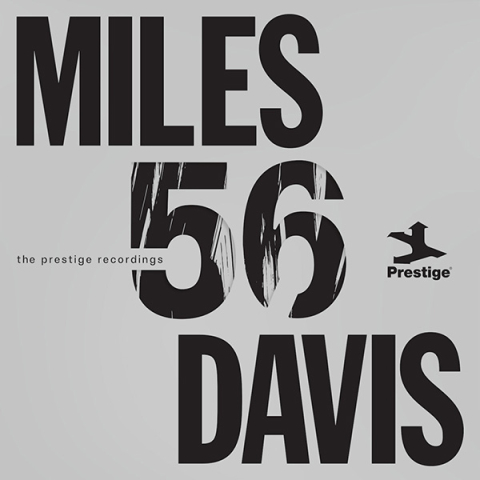
Miles Davis: Miles '56: The Prestige Recordings
Miles Davis, trumpet; Sonny Rollins, John Coltrane, tenor saxophone; Tommy Flanagan, Red Garland, piano; Paul Chambers, bass; Art Taylor, Philly Joe Jones, drums
Craft 7274563/4, CR00693 (3 CDs, 4 LPs, 24/192 PCM files). 1956/2026. Nick Phillips, Bob Weinstock, prods.; Paul Blakemore, Jamie Howarth, John Chester, Rudy Van Gelder, engs.
Performance *****
Sonics ***** Following Miles '54 and Miles '55, Craft's previous 70th anniversary box-set reissues of Davis's Prestige recordings, this year's concluding set, which coincides with the centennial of the great trumpeter's birth, consists mostly of material first released on the classic LPs Cookin', Relaxin', Workin', and Steamin'. Ironically, these brilliant albums, arguably the ne plus ultra of modern jazz, were recorded at a pair of off-the-cuff marathon sessions made to fulfill Davis's contract obligations to Prestige after he signed with Columbia. This music has been reissued repeatedly over the years, with nearly every incarnation sounding incrementally better than the preceding one. Restored from the original analog tapes by Jamie Howarth's Plangent Process to minimize wow and flutter, this edition (when auditioned on CD or hi-rez files) has even more brightness and presence than the mid-2000s CD remastering by Rudy Van Gelder, the original recording and mastering engineer.
The first three tracks were recorded earlier by Van Gelder at a March 1956 pickup session with Sonny Rollins, Tommy Flanagan, Paul Chambers, and Art Taylor and issued that year on Davis's album Collectors' Items. The rest, recorded in May and October, feature what's become known as Davis's "first great quintet," with John Coltrane, Red Garland, Chambers, and Philly Joe Jones. All but one of these May/October tracks were divvied up among the four albums mentioned above, all issued between 1957 and 1961; the lone outlier, "'Round Midnight," was issued on Miles Davis and the Modern Jazz Giants in 1959. During the same period, Columbia released such Davis albums as Milestones, Kind of Blue, and Sketches of Spain, enabling Prestige to capitalize on the major label's promotion.
The collection kicks off with Dave Brubeck's wistful composition "In Your Own Sweet Way," popularized more by Davis than by Brubeck himself, who recorded it a month later. Davis cut the same number again a month after Brubeck's recording, and the juxtaposition of these two renditions, both here, offers a comparison of the Rollins and Coltrane ensembles. Each saxophonist plays in a hard-bop vein—Rollins with a deeper, more relaxed tone, Coltrane edgier and more emphatic—while the trumpeter plays with cool lyricism on both takes, sighing pensively through his signature Harmon mute. Another duplicated tune, recorded in a mellow groove with Rollins as "Vierd Blues" and at a more urgent tempo with Coltrane as "Trane's Blues," has all three horn players blowing elegant, straight-ahead blues, each in his own distinctive individual style.
Muted and unmuted, Davis plays with self-assured swagger throughout, caressing ballads, bopping blues. He puts his sophisticated stamp on standards, showtunes, and originals. He dusts the cobwebs off old chestnuts, shifting "Diane," written to accompany a silent movie, from waltz to common time and turning Sammy Fain's 1939 composition "Something I Dreamed Last Night" from teary to dreamy. He breathes new life into familiar stage and screen songs like "When I Fall in Love," "Surrey with the Fringe on Top" (inspired by Ahmad Jamal's version), and, of course, "My Funny Valentine," which became a staple of Davis's concert repertoire. He pays homage to Dizzy Gillespie on "Woody'n You" and "Salt Peanuts," echoing Dizzy's squeals and squiggles in a smoother tone. He tips his hat to Thelonious Monk on "Well, You Needn't" and "'Round Midnight" and to Sonny Rollins on "Oleo" and "Airegin." He pays unattributed tribute to Eddie "Cleanhead" Vinson on "Tune Up" and "Four," with Miles dubiously credited as composer.
Although the same age as Davis, Coltrane had yet to record as leader. While Davis's (early) style was established, Trane's was still in flux. Firmly grounded in bebop, he waxes lyrical on "It Could Happen to You" and "'Round Midnight" and stretches toward the modal explorations soon to come on "Well, You Needn't" and "I Could Write a Book." He lays out on most of the ballads but displays a romantic flair on "You're My Everything." Garland shows the influence of Ahmad Jamal, a Davis favorite, with spare chording and airy solos, particularly on "Ahmad's Blues," where both horns lay out, Chambers bows a melodic solo, and Jones trades fours with the piano and bass. The 21-year-old Chambers is never less than rock solid, comping with innovative harmonic substitutions whether walking the blues or underpinning a ballad. Jones drives the band with unflagging verve, his tasteful brushwork, crisp cymbal attack, and deft snare-drum accents crackling with intensity, and he solos explosively on the accelerated "Salt Peanuts."
There's a consistent excellence to the entire set, with too many highlights to mention. The communication among the musicians seems clairvoyant, honed through club performances to the point that no rehearsals were necessary, yet every track except "The Theme" was captured in a single take. The CD sound is crisp and clean, as clear as could be hoped for from a mid-1950s recording. The LPs sound cloudier, heavier in the bass register but not obtrusively so. The first three tracks—recorded, as mentioned, in an earlier session—sound noticeably fuller and richer than the others despite having been recorded by the same engineer at the same studio. This reviewer lacks the equipment and perhaps the ear to properly evaluate the Plangent Process, but the tones seem pure enough. In any case, it's easy to be transported by this superb music and forget about the fine points of the audio.—Larry Birnbaum
Miles Davis, trumpet; Sonny Rollins, John Coltrane, tenor saxophone; Tommy Flanagan, Red Garland, piano; Paul Chambers, bass; Art Taylor, Philly Joe Jones, drums
Craft 7274563/4, CR00693 (3 CDs, 4 LPs, 24/192 PCM files). 1956/2026. Nick Phillips, Bob Weinstock, prods.; Paul Blakemore, Jamie Howarth, John Chester, Rudy Van Gelder, engs.
Performance *****
Sonics ***** Following Miles '54 and Miles '55, Craft's previous 70th anniversary box-set reissues of Davis's Prestige recordings, this year's concluding set, which coincides with the centennial of the great trumpeter's birth, consists mostly of material first released on the classic LPs Cookin', Relaxin', Workin', and Steamin'. Ironically, these brilliant albums, arguably the ne plus ultra of modern jazz, were recorded at a pair of off-the-cuff marathon sessions made to fulfill Davis's contract obligations to Prestige after he signed with Columbia. This music has been reissued repeatedly over the years, with nearly every incarnation sounding incrementally better than the preceding one. Restored from the original analog tapes by Jamie Howarth's Plangent Process to minimize wow and flutter, this edition (when auditioned on CD or hi-rez files) has even more brightness and presence than the mid-2000s CD remastering by Rudy Van Gelder, the original recording and mastering engineer.