Sidebar 3: Measurements
For logistical reasons, I tested a different sample of the Gryphon Ethos (serial number 0110009) from the one that JVS auditioned but was assured that the two samples came from the same production batch. I performed the testing with my Audio Precision SYS2722 system (see the January 2008 "As We See It") using its AES/EBU and S/PDIF digital outputs, test tones on CD, and USB data sourced from my MacBook Pro running on battery power, with Pure Music 3.0 playing WAV and AIFF test-tone files. All the testing was performed with the player's upsampling turned off. Before I played test CDs, I leveled the Gryphon's chassis with its three feet; a bubble level is provided for this purpose.
The player's error correction was good—no glitches were audible in the player's output until the single gaps in the data spiral on the Pierre Verany Digital Test CD reached 1.5mm in length. (The "Red Book" Compact Disc standard requires only that a player cope with gaps of up to 0.2mm.) The AES/EBU and S/PDIF inputs locked to datastreams with sample rates up to 192kHz, the USB input would handle 32-bit data sampled up to 384kHz. Apple's USB Prober utility identified the player as "Ethos USB" from "Gryphon Audio Designs ApS," with the serial number "413-001." The Gryphon's USB port operated in the optimal isochronous asynchronous mode.
The maximum output level from the unbalanced output was 2.16V, slightly higher than the CD standard's 2V. As usual, the maximum balanced output level was exactly twice the unbalanced, at 4.32V. Both outputs preserved absolute polarity (ie, were noninverting) with the remote control's Invert button set to Off. Though higher than specified, the unbalanced output impedance was still a very low 30 ohms across the audioband; the balanced impedance was a low 59 ohms, again at all audio frequencies.
The Gryphon's impulse response varied considerably according to which of the seven reconstruction filters had been selected. With Filter 1, described in the manual as "slow roll-off, minimum-phase," the impulse response was a short minimum-phase type (fig.1). Filter 2, described as "slow roll-off, linear-phase," had an extremely short linear-phase response (fig.2). Filters 3, 5, and 7 all had similar long, linear-phase impulse responses (fig.3), with ringing present either side of the peak. Jason's preferred filter, the hybrid Filter 4, has a small amount of ringing before the peak, with more ringing following it (fig.4). This response is very similar to that of the Hybrid filter offered by the Pro-Ject Pre-Box-S2 (footnote 1). Filter 6 was a long minimum-phase type (fig.5).


 With 44.1kHz data (fig.10), Filter 4 starts to roll off a little above 10kHz but then drops like a stone around 17kHz. It also has some passband ripple, which is generally felt not to be a good thing, as do the frequency responses at 96kHz and 192kHz in this graph. Filters 1–3 have similar audioband responses to Filter 4. Although Filter 5 is flat to 20kHz with CD data, it has more passband ripple than Filter 4. Filters 6 and 7 are textbook fast-rolloff above 20kHz (fig.11). The Gryphon player doesn't apply deemphasis to preemphasized CDs, which results in a boost in the treble reaching 8.5dB at the top of the audioband. Fortunately, preemphasized CDs are very rare these days.

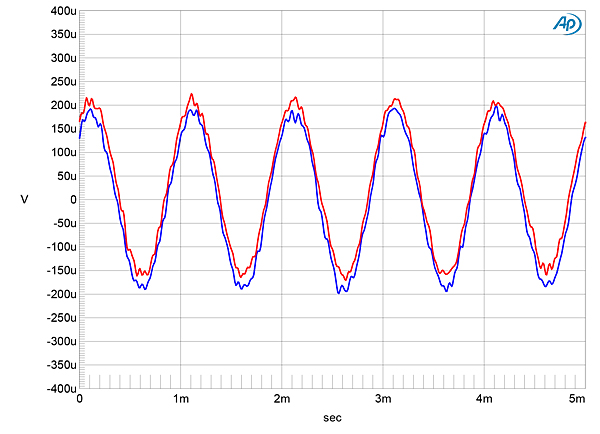
 Channel separation (not shown) was superb, at >120dB in both directions below 1kHz, decreasing to a still-superb 103dB at 20kHz. The analog noise floor was extremely low in level (fig.12), and the only power-supply–related artifacts present lie at or below –125dB ref. 0dBFS. Increasing the bit depth from 16 to 24 with a dithered 1kHz tone at –90dBFS sourced from the USB port lowered the noise floor by 23dB (fig.13). Though the low-level supply-related spuriae can still be seen, this reduction in noise suggests the Ethos offers a resolution close to 20 bits, which is excellent. With undithered data representing a 1kHz tone at exactly –90.31dBFS (fig.14), the waveform is symmetrical and the three DC voltage levels described by the data are well defined, with no DC offset present. With 24-bit data at the same level, the Ethos outputs an almost-perfect sinewave, despite the lack of dither (fig.15).




 Finally, when I tested the Gryphon Ethos with 16-bit J-Test data (fig.19), all the odd-order harmonics of the LSB- level, low-frequency squarewave lie at the correct levels (sloping green line). No sidebands can be seen. With 24-bit J-Test data (fig.20), the noise floor was low.

 The Gryphon Ethos offers excellent audio engineering, though its sonic character will be dependent on which reconstruction filter is in use.—John Atkinson
Footnote 1: See fig.6 here.
Fig.1 Gryphon Ethos, Filter 1, impulse response (one sample at 0dBFS, 4ms time window).
Fig.2 Gryphon Ethos, Filter 2, impulse response (one sample at 0dBFS, 4ms time window).
Fig.3 Gryphon Ethos, Filter 3, impulse response (one sample at 0dBFS, 4ms time window).
Fig.4 Gryphon Ethos, Filter 4, impulse response (one sample at 0dBFS, 4ms time window).
Fig.5 Gryphon Ethos, Filter 6, impulse response (one sample at 0dBFS, 4ms time window).
Reconstruction filters with different impulse responses can behave similarly in the frequency domain. Tested with white noise sampled at 44.1kHz, the Gryphon's output with the minimum-phase Filter 1 (fig.6, red and magenta traces) was almost identical to that of the linear-phase Filter 2. Both began to roll off in the top audio octaves and exhibited a slow decline in output at ultrasonic frequencies, the aliased image at 25kHz of a full-scale 19.1kHz tone (blue and cyan traces) suppressed by around 25dB. With Filter 5, described as an "apodizing" filter, the output rolled off very quickly above 20kHz (fig.7, red and magenta traces), reaching the noise floor at the Nyquist frequency of 22.05kHz, this indicated by the vertical green line. Filter 3, a "brickwall" type, behaves identically. Filter 4 also reaches full stop-band suppression by the Nyquist frequency (fig.8) but starts rolling off earlier than Filters 3 and 5. Filters 6 and 7 have identical ultrasonic rolloffs but reach the stop-band noise floor around 24kHz (fig.9).
Fig.6 Gryphon Ethos, Filter 1, wideband spectrum of white noise at –4dBFS (left channel red, right magenta) and 19.1kHz tone at 0dBFS (left blue, right cyan), with CD data (20dB/vertical div.).
Fig.7 Gryphon Ethos, Filter 5, wideband spectrum of white noise at –4dBFS (left channel red, right magenta) and 19.1kHz tone at 0dBFS (left blue, right cyan), with CD data (20dB/vertical div.).
Fig.8 Gryphon Ethos, Filter 4, wideband spectrum of white noise at –4dBFS (left channel red, right magenta) and 19.1kHz tone at 0dBFS (left blue, right cyan), with CD data (20dB/vertical div.).
Fig.9 Gryphon Ethos, Filters 6 & 7, wideband spectrum of white noise at –4dBFS (left channel red, right magenta) and 19.1kHz tone at 0dBFS (left blue, right cyan), with CD data (20dB/vertical div.).
Fig.10 Gryphon Ethos, Filter 4, frequency response at –12dBFS into 100k ohms with data sampled at: 44.1kHz (left channel green, right gray), 96kHz (left cyan, right magenta), 192kHz (left blue, right red) (0.5dB/vertical div.).
Fig.11 Gryphon Ethos, Filter 7, frequency response at –12dBFS into 100k ohms with data sampled at: 44.1kHz (left channel green, right gray), 96kHz (left cyan, right magenta), 192kHz (left blue, right red) (0.5dB/vertical div.).
Fig.12 Gryphon Ethos, spectrum with noise and spuriae of dithered 1kHz tone at 0dBFS (left channel blue, right red) (20dB/vertical div.).
Fig.13 Gryphon Ethos, spectrum with noise and spuriae of dithered 1kHz tone at –90dBFS with 24-bit data (left channel blue, right red) and 16-bit data (left cyan, right magenta) (20dB/vertical div.).
Fig.14 Gryphon Ethos, Filter 5, waveform of undithered 16-bit, 1kHz sinewave at –90.31dBFS (left channel blue, right red).
Fig.15 Gryphon Ethos, Filter 5, waveform of undithered 24-bit, 1kHz sinewave at –90.31dBFS (left channel blue, right red).
The spectra in figs. 4–6 indicate that the Ethos has low levels of harmonic distortion. With the player driving a full-scale, 24-bit, 50Hz tone into 100k ohms (fig.16), the third harmonic is the highest in level but lies at –80dB (0.01%). The second harmonic is higher in the right channel (red trace) than the left (blue) but is still more than 20dB lower in level. These harmonics didn't increase in level when I reduced the load impedance to a punishing 600 ohms, suggesting that the Ethos has a bombproof output stage. When I tested the Gryphon for intermodulation distortion with an equal mix of 19 and 20kHz tones, actual intermodulation was extremely low, though different amounts of aliased image energy appeared in the audioband depending on which filter was in use. This can be seen with the slow-rolloff Filter 2, for example (fig.17), though the levels of the spuriae are still extremely low. With Jason's preferred Filter 4, there are no aliased images present in the audioband (fig.18).
Fig.16 Gryphon Ethos, spectrum of 50Hz sinewave (DC–1kHz) at 0dBFS into 100k ohms (left channel blue, right red; linear frequency scale).
Fig.17 Gryphon Ethos, Filter 1, HF intermodulation spectrum (DC–30kHz), 19+20kHz at 0dBFS into 100k ohms (left channel blue, right red; linear frequency scale).
Fig.18 Gryphon Ethos, Filter 4, HF intermodulation spectrum (DC–30kHz), 19+20kHz at 0dBFS into 600 ohms (left channel blue, right red; linear frequency scale).
Fig.19 Gryphon Ethos, high-resolution jitter spectrum of analog output signal, 11.025kHz at –6dBFS, sampled at 44.1kHz with LSB toggled at 229Hz: CD data (left channel blue, right red). Center frequency of trace, 11.025kHz; frequency range, ±3.5kHz.
Fig.20 Gryphon Ethos, high-resolution jitter spectrum of analog output signal, 11.025kHz at –6dBFS, sampled at 44.1kHz with LSB toggled at 229Hz: 24-bit AES/EBU data (left channel blue, right red). Center frequency of trace, 11.025kHz; frequency range, ±3.5kHz.
Footnote 1: See fig.6 here.