The Q350s really liked tubes, especially push-pull EL34s. With the PrimaLuna Prologue Premium stereo amplifier ($2199) and preamplifier ($2199), the modest KEFs' bass was less taut, but they delivered a fleshy, organic-feeling midrange and elegant, delectable highs. The PrimaLuna amplification had a satisfying way of filling out the Q350's tendency toward thinness. The combo made male and female voices—such as those of Furia Zanasi and Ximena Biondo of La Chimera, in their Buenos Aires Madrigal: Argentine Tangos & Italian Madrigals (CD, MA M063A)—feel more embodied and tonally complex, more engaging. The PrimaLuna was my favorite amp with the Q350s; more than the others, it made music feel deeper, fuller, more probing, more whole. Tavener's Eis Thanaton was most comprehensible with this amp.
Erudition—Enter the KEF LS50
After a week of listening only to the Q350s, I switched back to KEF's LS50s, driven by the PrimaLuna ProLogue Premium amplifier. The first difference I noticed was how pure, solid, and properly damped the LS50s sounded. Bass was more forceful and detailed, but not as expansive or reaching as low as with the Q350s. The firm quiet of the LS50s made the Q350s sound slightly noisy and wispy. Conversely, my weeklong familiarity with the Q350s caused me to perceive the LS50s as sounding ever so slightly thick, over-damped, and restrained. In contrast, the Q350s seemed quicker and more mercurial than the LS50s. The Q350s didn't appear to suppress music's inner currents as much as the LS50s did.
Still, each time I reinstall the LS50s, I appreciate them more. Today, as I compared them with their lower-cost sibling, they seemed one of the most impressive bits of speaker engineering of the 21st century.
After a few agreeable LP sides, I put on a CD of Tavener's Eternity's Sunrise, performed by the choir and orchestra of the Academy of Ancient Music, Paul Goodwin directing (CD, Harmonia Mundi 907231). This recording is dominated by two sopranos, a baritone, and, a violin. The LS50's balanced purity directed my attention to the precision of this recording. It served up those cavernous spaces that Tavener uses to frame his meditations. High soprano notes were attractively supple and tangible, demanding scrutiny and admiration.
 I switched back to the Q350s and found myself admiring something different.
I was using the AMG Giro G9 turntable ($9900) with a Koetsu Rosewood Standard cartridge ($3495, review in the works) driving the Tavish Design Adagio phono stage ($1690), a Rogue RH-5 preamplifier ($2495), and Pass Labs' ridiculously solid and transparent XA25 amplifier. I swear I could almost count the separate voices in the choir. What the Q350s did with Grayston Burgess and the Purcell Consort's Now Make We Merthe: Medieval Carols (LP, Argo ZRG 526) was even more impressive: They put living medieval persons in front of the microphones, and made these Christmas carols from the 12th through 15th centuries seem right-here-and-now present and contemporary—not quaint, canned, or antique.
I felt a little bad that I didn't have my Linn Sondek LP12 in the system, or at least a British-made amplifier—that was how British Benjamin Britten's anti-war opera, Owen Wingrave, based on a short story by Henry James, felt through the KEF Q350s. This spectacular 1971 recording, in which Britten himself conducts the English Chamber Orchestra (2 LPs, London OS 26224), was made near the height of the Vietnam War, and features the same cast as in the first live performance, with Dame Janet Baker and Peter Pears, and Benjamin Luxon in the title role. I enjoy this opera because it is English, and because I identify with Owen as he defies his family's traditions and refuses to enlist in the military. "War should be a crime!" he laments. I completely agree. His refusal to fight costs him first his inheritance, then his life.
The performances and recording quality of Owen Wingrave showed me the full measure of the Q350s' ability to open a window on the recording venue, London's Kingsway Hall. When I switched from the LS50s to the Q350s, the dimensions of the soundstage didn't significantly change, but the sense of air became less dense. Unfortunately, that less dense air also seemed a bit dusty, and the performers less dense and defined. Instrumental and vocal tones became less saturated. But to its credit, the Q350s' sound felt more direct, open, and fundamentally truthful than the LS50s.
A Revelation
I switched back to the Q350s and found myself admiring something different.
I was using the AMG Giro G9 turntable ($9900) with a Koetsu Rosewood Standard cartridge ($3495, review in the works) driving the Tavish Design Adagio phono stage ($1690), a Rogue RH-5 preamplifier ($2495), and Pass Labs' ridiculously solid and transparent XA25 amplifier. I swear I could almost count the separate voices in the choir. What the Q350s did with Grayston Burgess and the Purcell Consort's Now Make We Merthe: Medieval Carols (LP, Argo ZRG 526) was even more impressive: They put living medieval persons in front of the microphones, and made these Christmas carols from the 12th through 15th centuries seem right-here-and-now present and contemporary—not quaint, canned, or antique.
I felt a little bad that I didn't have my Linn Sondek LP12 in the system, or at least a British-made amplifier—that was how British Benjamin Britten's anti-war opera, Owen Wingrave, based on a short story by Henry James, felt through the KEF Q350s. This spectacular 1971 recording, in which Britten himself conducts the English Chamber Orchestra (2 LPs, London OS 26224), was made near the height of the Vietnam War, and features the same cast as in the first live performance, with Dame Janet Baker and Peter Pears, and Benjamin Luxon in the title role. I enjoy this opera because it is English, and because I identify with Owen as he defies his family's traditions and refuses to enlist in the military. "War should be a crime!" he laments. I completely agree. His refusal to fight costs him first his inheritance, then his life.
The performances and recording quality of Owen Wingrave showed me the full measure of the Q350s' ability to open a window on the recording venue, London's Kingsway Hall. When I switched from the LS50s to the Q350s, the dimensions of the soundstage didn't significantly change, but the sense of air became less dense. Unfortunately, that less dense air also seemed a bit dusty, and the performers less dense and defined. Instrumental and vocal tones became less saturated. But to its credit, the Q350s' sound felt more direct, open, and fundamentally truthful than the LS50s.
A Revelation
This is when, as an experiment, I replaced the massive, 24"-high Sound Anchor Signature stands I'd been using to support the Q350s with the elegant TonTräger Reference hardwood stands ($1395/pair). Skinny as sticks, the 24"-high TonTrägers weigh only 6 lbs and can be lifted with a finger (footnote 2).
Guess what?
The Q350s' less-than-perfectly-clean air got a whole lot cleaner. Less dusty-foggy. Those cabinet vibrations I'd felt under my hands were reduced. Bass became purer, more effectively detailed. Music felt more relaxed, focused, and three-dimensional—even at high volumes.
Opera recordings make excellent tools for assessing amps and speakers. Britten's Owen Wingrave made easy work of showing what the Q350s could and could not do. In addition to the lower-distortion fresh-air effect, the new stands let the Q350s show just how precisely they could pinpoint the positions of singers on the stage.
This improvement in the Q350s' sound was so conspicuous that I never returned to my iron anchors. (KEF recommends using their own 24"-high, 10.3-lb Performance Speaker Stands, which sell for $399.99/pair; these were not submitted with the Q350 review samples.)
LS3/5a Comparisons
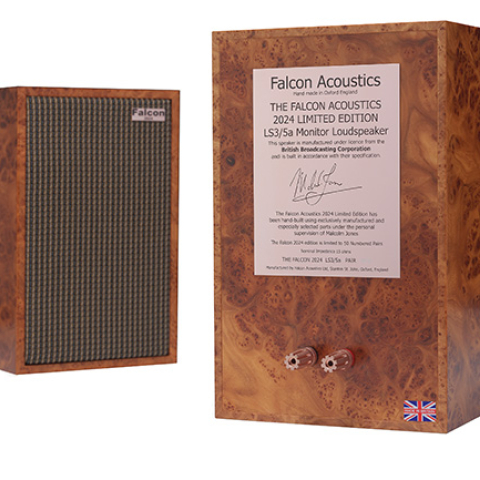
The three versions I have of the BBC's classic LS3/5a minimonitor are all of the same size, weight, and construction quality, and measure as identically as any three speakers could. But they sound surprisingly different. Each in turn sat on the TonTräger stands in the same positions in my room. The Falcon LS3/5a ($2995/pair) is the most uncolored, most precise loudspeaker in my bunker collection. I own the pair of them, they're my primary reference, and I'll never let them go. But I hadn't used the Falcons in a while, and had forgotten how refined, descriptive, and naturally toned they are. When I switched from the KEF Q350s to the Falcons, still using the TonTräger stands, it was as if someone had vacuumed the last vestiges of fog from the space surrounding Janet Baker's voice. With Elvis Presley's first-ever recording, "My Happiness," from A Boy from Tupelo: The Complete 1953–1955 Recordings (3 CDs, RCA/Legacy 8985-41773-2), Elvis seemed even more three-dimensional. When audiophiles speak of resolution, they usually mean seeing and hearing into the performing space and down into the recording's noise floor. This type of resolution is the Falcons' specialty. When I compared them with the Q350s, I realized that it was also one of the KEFs' best traits.
My infatuation with the Stirling Broadcast LS3/5a V2 ($1990/pair) is based entirely on its greater fullness at the bottom and the liquid flow of its sound. It makes the Falcon LS3/5a sound slightly dry and tipped up in comparison. Compared to both the Stirling and Falcon LS3/5a's, my original "white badge," 15-ohm Rogers LS3/5a seemed a little sluggish and fuzzy.
But the Stirling is the most different-sounding of the three BBCs—and the one that sounded most like the KEF Q350. The Stirling LS3/5a V2 and the Q350 each produced a more relaxed warmth than the Rogers or Falcon, and, for reasons I don't quite understand, a larger soundstage.
I am a student and admirer of British boxes, but if I could keep only one, I would keep the LS50—but only when I'm an audio reviewer. The LS50 is a benchmark for accurate octave-to-octave energy balance and tonal neutrality—a reference-quality speaker if ever there was one. If I were just Herb, listening alone in my bunker, I'd keep the Stirling LS3/5a V2s because they make me forget audiophilia. If I were Herb the amp builder, I'd keep the Falcons because they're the most revealing of whatever drives them. If I wanted only to impress other audiophiles, I'd keep my collectible 1984 Rogers. But if I lived with my romantic partner, I'd keep the KEF Q350s, because they reproduced the widest range of music—including techno, bluegrass, reggae, and pop—in a musically satisfying way.
Conclusions
Early in this review process I realized that KEF's Q350 is not the poor person's LS50, but has a unique goodness of its own. Comparing the two KEFs became a case study in the fundamental ways speaker enclosures and crossover slopes can affect the sound character of the drivers they support. To my ears, dense, highly damped boxes and/or steep-sloped crossovers can sound subliminally thick and restrained. In contrast, lightly damped boxes with first-order crossovers add some loose, not-so-subliminal noise to the midrange—but they can also jump, sound expansive, and dance like Fred and Ginger. The KEF Q350 is a lively and open-sounding loudspeaker. It delivers appealing tone, taut and satisfying bass, excellent boogie factor, and a feeling of sophistication—all at a very low price. Highly recommended.
Footnote 2: The TonTräger Audio Reference stands were designed to support Harbeth's Monitor 30.2 Anniversary Edition speakers, to be reviewed next month.
After a week of listening only to the Q350s, I switched back to KEF's LS50s, driven by the PrimaLuna ProLogue Premium amplifier. The first difference I noticed was how pure, solid, and properly damped the LS50s sounded. Bass was more forceful and detailed, but not as expansive or reaching as low as with the Q350s. The firm quiet of the LS50s made the Q350s sound slightly noisy and wispy. Conversely, my weeklong familiarity with the Q350s caused me to perceive the LS50s as sounding ever so slightly thick, over-damped, and restrained. In contrast, the Q350s seemed quicker and more mercurial than the LS50s. The Q350s didn't appear to suppress music's inner currents as much as the LS50s did.
I switched back to the Q350s and found myself admiring something different.
I was using the AMG Giro G9 turntable ($9900) with a Koetsu Rosewood Standard cartridge ($3495, review in the works) driving the Tavish Design Adagio phono stage ($1690), a Rogue RH-5 preamplifier ($2495), and Pass Labs' ridiculously solid and transparent XA25 amplifier. I swear I could almost count the separate voices in the choir. What the Q350s did with Grayston Burgess and the Purcell Consort's Now Make We Merthe: Medieval Carols (LP, Argo ZRG 526) was even more impressive: They put living medieval persons in front of the microphones, and made these Christmas carols from the 12th through 15th centuries seem right-here-and-now present and contemporary—not quaint, canned, or antique.
This is when, as an experiment, I replaced the massive, 24"-high Sound Anchor Signature stands I'd been using to support the Q350s with the elegant TonTräger Reference hardwood stands ($1395/pair). Skinny as sticks, the 24"-high TonTrägers weigh only 6 lbs and can be lifted with a finger (footnote 2).
The three versions I have of the BBC's classic LS3/5a minimonitor are all of the same size, weight, and construction quality, and measure as identically as any three speakers could. But they sound surprisingly different. Each in turn sat on the TonTräger stands in the same positions in my room. The Falcon LS3/5a ($2995/pair) is the most uncolored, most precise loudspeaker in my bunker collection. I own the pair of them, they're my primary reference, and I'll never let them go. But I hadn't used the Falcons in a while, and had forgotten how refined, descriptive, and naturally toned they are. When I switched from the KEF Q350s to the Falcons, still using the TonTräger stands, it was as if someone had vacuumed the last vestiges of fog from the space surrounding Janet Baker's voice. With Elvis Presley's first-ever recording, "My Happiness," from A Boy from Tupelo: The Complete 1953–1955 Recordings (3 CDs, RCA/Legacy 8985-41773-2), Elvis seemed even more three-dimensional. When audiophiles speak of resolution, they usually mean seeing and hearing into the performing space and down into the recording's noise floor. This type of resolution is the Falcons' specialty. When I compared them with the Q350s, I realized that it was also one of the KEFs' best traits.
Early in this review process I realized that KEF's Q350 is not the poor person's LS50, but has a unique goodness of its own. Comparing the two KEFs became a case study in the fundamental ways speaker enclosures and crossover slopes can affect the sound character of the drivers they support. To my ears, dense, highly damped boxes and/or steep-sloped crossovers can sound subliminally thick and restrained. In contrast, lightly damped boxes with first-order crossovers add some loose, not-so-subliminal noise to the midrange—but they can also jump, sound expansive, and dance like Fred and Ginger. The KEF Q350 is a lively and open-sounding loudspeaker. It delivers appealing tone, taut and satisfying bass, excellent boogie factor, and a feeling of sophistication—all at a very low price. Highly recommended.
Footnote 2: The TonTräger Audio Reference stands were designed to support Harbeth's Monitor 30.2 Anniversary Edition speakers, to be reviewed next month.