The La Scalas' sound varies remarkably depending on amplification, and they demand and reward high quality; the prospect of them being driven by a big-box-store receiver fills me with sadness. Choosing the right amplifier to use with them wasn't entirely straightforward and required a fair amount of trial and error. The Klipsches' sky-high sensitivity may suggest otherwise, but a single measurement never tells the whole story. I listened to them with five amplifiers controlled by the superbly transparent and tuneful PrimaLuna EVO 400 line stage; here's what I heard.
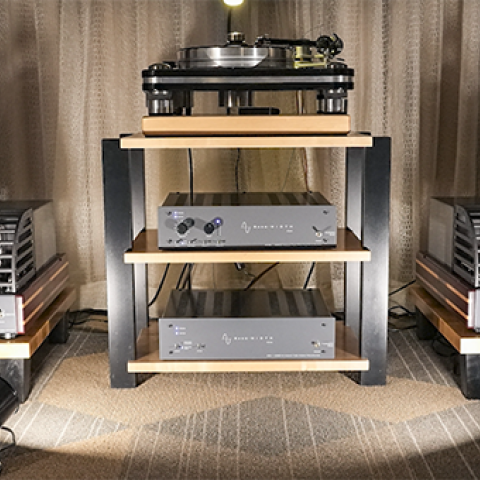
Ayre AX-5 Twenty: The Ayre is a lush and musically compelling solid state amplifier, but through the La Scalas it sounded pretty analytical, buttoned-up, and dry. Though one shouldn't generalize from limited experience, I'm going to: The La Scalas love tubes.
Oliver Sayes SET with 307a output tubes: This fairly "tubey" sounding design, producing 6W per channel, emitted beautiful tone, but in this application it lacked resolution and sounded a bit gooey. And while it made copious bass, that bass was poorly defined and slow. The La Scalas seemed to want a more neutral tonal balance and more grip.

Western Electric 91E: The big Western resolved scads of detail and sounded both liquid and well-controlled. Well, nearly. On "Lively Up Yourself " from Bob Marley's Natty Dread (LP Island ILPS 9281), Aston "Family Man" Barrett's electric bass sounded a bit listless, lagging behind the rest of the music. And the 91E couldn't quite unlock the highest level of dynamic expression the speakers are capable of. To generalize again, those wishing to drive the La Scalas with a low-powered (sub-20W) tube amplifier, particularly of the single-ended persuasion, may not get stellar results. Try them together before buying.
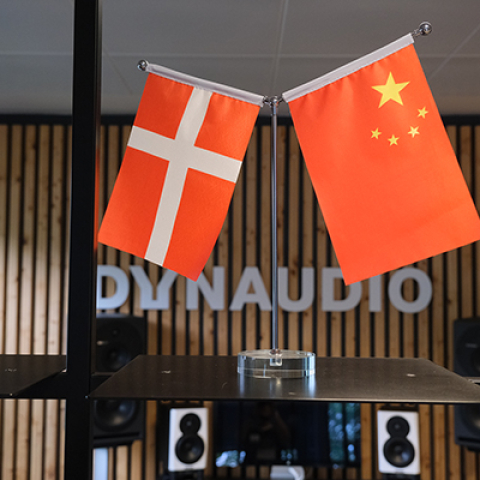
Line Magnetic LM-845IA: The swaggering 22W made by the ferociously hot 845 triodes in this amplifier proved a fantastic match for the Klipsches. Barrett's bass notes landed like the jabs of a welterweight, and the recording danced and strutted in a most convincing fashion. The Chinese amp also created a smooth, utterly grainless sound with saturated tone colors and unraveled lots of ambient information without drawing undue attention to it in the manner of some more analytical amps. Wooo!
Manley Mahi Mahi: Especially in Ultralinear mode, with the negative feedback set to minimum, these push-pull EL84 monoblocks from EveAnna Manley succeeded in squeezing maximum dynamics from the La Scalas while imbuing recordings with gorgeous color, pace, and all the detail you might wish for. Compared to the Line Magnetic, they presented an even more propulsive, harder hitting sound, sacrificing just a bit of liquidity, texture, and presence. Another goosebump-inducing match.

Engagement
Now that you know something about how the La Scalas sound, you may be wondering about a more pressing issue: How do they communicate music? For me, sound quality and musical engagement are tied up most directly in the experience of dynamics: It's in the infinite gradations of intensity that intent and meaning in music are most acutely expressed. In "God Is in the Nuances," the most thought-provoking article I've read in this magazine, Markus Sauer (footnote 2) quotes (and somewhat awkwardly translates) French audio and music journalist Jean-Marie Piel, who describes this connection with more elan and poetry than I can muster:
"The essence of a [musical] interpretation lies in working on the infinitely small—be it an attack on a note held back for a fraction of a second (perceptible if the preceding note is reproduced neither too short nor too long), or be it a note that develops in itself; or, on a larger level, a crescendo or diminuendo encompassing several notes—all of which gives music a sense of direction, its palpable dynamics, its quivering life, and all of which, in the end, lies in the nuances.
"Which explains, by the way, why certain old loudspeakers with a very high sensitivity and thus a very high precision in the rendition of dynamics, especially of very small signals—just like certain tube amplifiers with very simple circuits—and despite more or less obvious colorations and the omission of an octave or two, manage to reproduce with disturbing fidelity all the emotional intensity of an interpretation. Which should give our designers something to think about, and convince them that the musically more important kind of dynamics is that which loses itself in silence, not the kind that turns into noise."
The La Scalas' remarkable sonic realism would be pointless if they weren't also masterful at revealing the "quivering life" Piel is talking about. Luckily, they excel at excavating the musical drama of a recording, allowing records to startle and engage with more regularity than the vast majority of speakers of any size and price. Through them the music breathes, shouts, and whispers.
I live in a loft, or essentially a single large room. On a recent morning, I put on a recording of Ali Akbar Khan playing Rag Alam Bhairav, a morning raga, as quiet background music while doing some stretching and working out. Though I was trying to focus on my stubbornly inflexible joints, I became so enthralled by the sarod's woody resonance and amber tone, and by the kaleidoscopic shadings of sound and meaning that Khan extracted from it, that I ended up sitting on the floor and listening to the music lunge and dance until the 28-minute track was over.
This level of engagement characterized my time with the La Scalas. After some listening sessions, I was so emotionally wrung out that I felt tired and needed to walk away from music for a while.

Last year, at Jim Austin's urging, I began a series of reviews to explore whether I could find what I loved about my 1967 Altec Valencias in a current-production speaker. The California-made Altecs excel at dynamic expression and scale, yet the larger La Scalas lap them in both categories, simply offering more. These speakers from Arkansas (whose design predates the Valencias) also energize my loft in a more satisfying way, perhaps due to their greater sensitivity and directionality. The Altecs, in turn, sound a bit more natural and reproduce drums with more snap and presence. They have a little more filigree and soul. Yet the La Scalas are even more adept at musical drama and spectacle and have proven second to none at making me turn off my phone and listen.
The Klipsch La Scalas have been in constant production for 59 years, longer than all but a tiny handful of audio products, and this is surely not an accident. (Happily, it also means that secondhand examples, available for a fraction of their current price, are relatively common.) They aren't perfect, and they require a large room and a suitable amplifier, but they offer the closest thing I've heard to a musical performance taking place in my home. They do this as reliably with solo viola as they do with Minor Threat. Best of all, they provide as direct a route as I've found to hours of musical engagement—to embodying what Sakuma-san described as "endless energy with sorrow," to which I would add love, rage, humor, and elation. $13,198 is an investment, but it will buy you some of the most sonically irrepressible and musically communicative speakers in the known cosmos. They just may sustain you for life.
Footnote 2: Markus Sauer was a valued contributor to Stereophile. Sadly, he passed away in 2015.—John Atkinson