

Ten years ago, the average consumer was unaware that he or she needed an e-book reader. Since that time, neither those people nor the authors whose books they consume have changed very much. But the people in between have grown restless and unsatisfied, and it is they who call the tune. Consequently, many of you have gone from owning books to sort of, kind of owning books (and sort of, kind of not).
Just as the publishing industry has devised a new way to empty your wallet, so has the record industry found a new way to entice you into buying Kind of Blue for the umpteenth time (footnote 1). That's depressing. But, on the bright side, the latest way of buying digital music has ushered in a new way of playing digital music at home: through a perfectionist-quality digital-to-analog converter with a USB input. And because that technology brings with it a new and honestly better way to listen to CDs—by playing them as perfectly ripped files, without waking the noisy and cognitively challenged guard dog of error correction—I am inclined to simply, in the words of onetime Texas gubernatorial candidate and Petroleum Hall of Fame inductee Clayton Williams, lie back and enjoy it.
And so another promising variation on a new and fruitful formula has come my way, this time from the same region of the present Italy (footnote 2) that gave us Nicolï Amati, Andrea Guarneri, and Antonio Stradivari. Lector Strumenti Audio, a 32-year-old company that made a splash in the US not long ago with tubed CD players that received praise for both their musicality and their reasonable prices, has introduced their Digitube S-192 ($3595), a multiple-input D/A converter that is decidedly USB-friendly, and whose model name gives a clue to its reportedly high-resolution performance.
Description
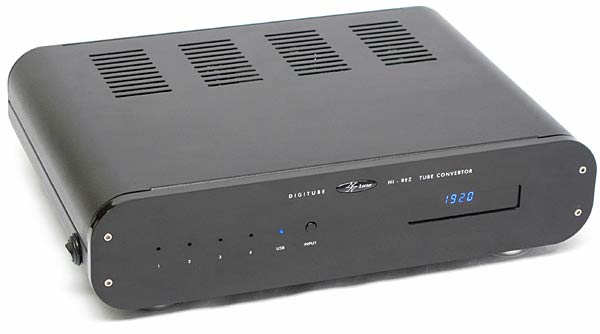
The Lector Digitube S-192 is built into a chassis that's well styled without silly excess. A two-piece steel clamshell comprises the major portion of the enclosure, with steel front and rear panels and a sedately pretty faceplate of acrylic, with a tinted window for the digital display. The faceplate also includes a small pushbutton for toggling through input choices—the Digitube's only user control, apart from its side-mounted rocker power switch—and a row of five blue LEDs to indicate which input is currently in use. These correspond with five sets of rear-mounted input jacks: two electrical S/PDIF (RCA, BNC), one optical S/PDIF (TosLink), one AES/EBU (XLR), and, of course, one USB (Type B). The well-finished chassis, supported by three nicely made alloy-and-rubber isolation feet, is filled with a total of seven circuit boards, on the largest of which are the power-supply and audio-output components—the latter including the pair of ECC81 dual-triode tubes that account for another portion of the Lector's name. Two boards adjacent to the rear panel handle the digital-input chores, the smaller built around a Tenor TE8802L USB streaming controller chip. Yet another board plays host to a 32-bit AK4397 DAC chip from Japan's Asahi Kasei Microdevices Corporation (AKM), supported by an AKM AK4113VF digital audio receiver chip. The parts quality is very good throughout, and I was impressed that current-to-voltage conversion appears to be handled by discrete resistors. In contrast with the makers of other recent source components, Lector has eschewed the use of a switching power supply, opting instead for a more traditional supply built around a toroidal mains transformer of reasonable size and apparently good quality. An unusually hefty, hand-terminated, detachable AC cord is supplied as standard.
Installation and setup
The well-finished chassis, supported by three nicely made alloy-and-rubber isolation feet, is filled with a total of seven circuit boards, on the largest of which are the power-supply and audio-output components—the latter including the pair of ECC81 dual-triode tubes that account for another portion of the Lector's name. Two boards adjacent to the rear panel handle the digital-input chores, the smaller built around a Tenor TE8802L USB streaming controller chip. Yet another board plays host to a 32-bit AK4397 DAC chip from Japan's Asahi Kasei Microdevices Corporation (AKM), supported by an AKM AK4113VF digital audio receiver chip. The parts quality is very good throughout, and I was impressed that current-to-voltage conversion appears to be handled by discrete resistors. In contrast with the makers of other recent source components, Lector has eschewed the use of a switching power supply, opting instead for a more traditional supply built around a toroidal mains transformer of reasonable size and apparently good quality. An unusually hefty, hand-terminated, detachable AC cord is supplied as standard.
Installation and setup
I used the Lector Digitube S-192 as a line-level source in my usual system, with Shindo's Masseto preamplifier and Corton-Charlemagne mono amplifiers, and with Altec Valencia and DeVore Fidelity Orangutan O/96 loudspeakers (having recently purchased my review samples of the latter). USB cables were a 1m length of AudioQuest's high-value Carbon and a 2m-long Wireworld Revision—the latter a gesture toward at least minimal parity with my current digital reference, the Halide DAC HD, which is hardwired with 2m of WireWorld's Starlight USB cable. The tubed Lector ran slightly but not excessively warm to the touch.
In addition to using the Digitube as a USB-input converter, I also tried two of its remaining four inputs: TosLink, driven by my Apple iMac's PCM audio output, and RCA coaxial, driven by the non-DSD digital output of my Sony SCD-777ES SACD/CD player. But I primarily relied on the Lector Digitube as a USB source with my iMac, using Stephen Booth's Decibel (v1.2.11) music-playback software for all music files and Apple iTunes for streaming FM broadcasts. Regarding the latter, and while noting the unsuitability of MP3 files for most reviewing chores, let me also note that WCKR, my favorite Internet radio station, sounded fine through the Lector, with sufficient sonic presence that the cowbell in Bix Beiderbecke's 1927 recording of "I'm More than Satisfied" made my own cognitively challenged dog bark from the other room.
The Digitube S-192 is supplied with a CD-R containing a user's manual and the various device drivers required for Windows installations. A driver is not required for Apple OS X systems, but in my first few installation attempts I noted that my iMac had difficulty finding the Digitube. Lector anticipates this—the manual advises users so confounded to simply break and remake the USB connection. I did, and that worked just fine, the Lector now appearing in OS X's Sound/Output window as a selection named "lector-a." After those minor early difficulties, my computer seldom failed to recognize the Lector, even after multiple un- and re-installations for review purposes.
The Lector Digitube S-192 otherwise performed without apparent flaw during its time in my system, its only idiosyncrasy being a rather too audible relay, the clicking of which could be heard from across the room when I manually changed tracks. The sound didn't disrupt the music, of course, but it got a bit old after a while.
Listening
Right off the bat, and in comparison with the far less expensive Halide Design DAC HD ($450), the Lector Digitube S-192 had a more powerful, more "physical" bottom end and, to an even greater extent, a more extended treble range. The latter quality brought with it a greater-than-average capacity for conveying texture, which served well the very sweetest and highest-quality recordings—and made a small handful of noisy ones a bit less pleasant. An example of the latter was "I'm Not the One," from the Black Keys' Brothers (ripped from CD, Nonesuch 523994), the grungier textures in which were laid a little too bare for my tastes, compelling me to switch from the mildly relentless Altec horns to the more civilized DeVore O/96s for the remainder of my listening. That said, the Lector did an exceptional job of communicating the impact of the kick drum, and the subtler nuances of force in the electric bass lines.
Footnote 1: I intend no condescension. Ten years ago, I was unaware that I needed handmade braided leaders for my fly-fishing lines, a conical-burr grinder for my coffee, and another guitar. Who could have seen those coming? Footnote 2: It wasn't until 1870, well after the time of the historically great luthiers of Cremona, that Italy went from being a loose collection of city-states to the present unified nation.
The Lector Digitube S-192 is built into a chassis that's well styled without silly excess. A two-piece steel clamshell comprises the major portion of the enclosure, with steel front and rear panels and a sedately pretty faceplate of acrylic, with a tinted window for the digital display. The faceplate also includes a small pushbutton for toggling through input choices—the Digitube's only user control, apart from its side-mounted rocker power switch—and a row of five blue LEDs to indicate which input is currently in use. These correspond with five sets of rear-mounted input jacks: two electrical S/PDIF (RCA, BNC), one optical S/PDIF (TosLink), one AES/EBU (XLR), and, of course, one USB (Type B).
The well-finished chassis, supported by three nicely made alloy-and-rubber isolation feet, is filled with a total of seven circuit boards, on the largest of which are the power-supply and audio-output components—the latter including the pair of ECC81 dual-triode tubes that account for another portion of the Lector's name. Two boards adjacent to the rear panel handle the digital-input chores, the smaller built around a Tenor TE8802L USB streaming controller chip. Yet another board plays host to a 32-bit AK4397 DAC chip from Japan's Asahi Kasei Microdevices Corporation (AKM), supported by an AKM AK4113VF digital audio receiver chip. The parts quality is very good throughout, and I was impressed that current-to-voltage conversion appears to be handled by discrete resistors. In contrast with the makers of other recent source components, Lector has eschewed the use of a switching power supply, opting instead for a more traditional supply built around a toroidal mains transformer of reasonable size and apparently good quality. An unusually hefty, hand-terminated, detachable AC cord is supplied as standard.
Installation and setupI used the Lector Digitube S-192 as a line-level source in my usual system, with Shindo's Masseto preamplifier and Corton-Charlemagne mono amplifiers, and with Altec Valencia and DeVore Fidelity Orangutan O/96 loudspeakers (having recently purchased my review samples of the latter). USB cables were a 1m length of AudioQuest's high-value Carbon and a 2m-long Wireworld Revision—the latter a gesture toward at least minimal parity with my current digital reference, the Halide DAC HD, which is hardwired with 2m of WireWorld's Starlight USB cable. The tubed Lector ran slightly but not excessively warm to the touch.
Right off the bat, and in comparison with the far less expensive Halide Design DAC HD ($450), the Lector Digitube S-192 had a more powerful, more "physical" bottom end and, to an even greater extent, a more extended treble range. The latter quality brought with it a greater-than-average capacity for conveying texture, which served well the very sweetest and highest-quality recordings—and made a small handful of noisy ones a bit less pleasant. An example of the latter was "I'm Not the One," from the Black Keys' Brothers (ripped from CD, Nonesuch 523994), the grungier textures in which were laid a little too bare for my tastes, compelling me to switch from the mildly relentless Altec horns to the more civilized DeVore O/96s for the remainder of my listening. That said, the Lector did an exceptional job of communicating the impact of the kick drum, and the subtler nuances of force in the electric bass lines.
Footnote 1: I intend no condescension. Ten years ago, I was unaware that I needed handmade braided leaders for my fly-fishing lines, a conical-burr grinder for my coffee, and another guitar. Who could have seen those coming? Footnote 2: It wasn't until 1870, well after the time of the historically great luthiers of Cremona, that Italy went from being a loose collection of city-states to the present unified nation.















