

Manufacturer's Comments
Editor: Thanks to Herb Reichert and John Atkinson for the thorough write-up of the Studio HD. It is stimulating to see measurements in a review once again. Stereophile's online archives provide a great service to the audiophile largely owing to your consistent measurements over the years.
Stereophile's measurements of the Studio HD rang a familiar bell for me. Recalling remarkably similar frequency-response contours and spectral-decay plots from the various versions of the longstanding www.stereophile.com/content/bbc-ls35a-loudspeaker-stirling-measurements">LS3/5a over the years prods me to acknowledge that it was not I who specified the voicing of the Studio HD. It was the recording and broadcasting industry consistently telling us how the monitor needed to perform: When close-miking with cardioids, proximity effect fattens the lower mids. However, on playback the mixing engineers still want a monitor that portrays the rhythm and drive without sounding puffy in the lower midrange. The similarities of the Studio HD to other successful monitors are not coincidental.
For such studio nearfield use, the Treble switch is trimmed downward. In midfield use, the speaker is best loaded about 22" from the wall behind it on 28"-high stands, with little or no toe-in. The Bass trim switch can be activated as placement approaches a sidewall. Fig.1 shows the change in response from 50" to a listener distance of 120". Diffraction loss from the small baffle is shown, while low-frequency room gain aids the spectral balance.
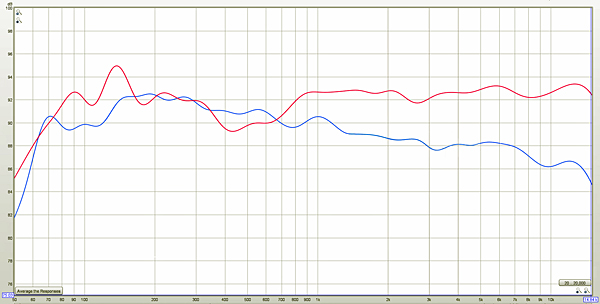
Fig.1 Legacy Audio Studio HD, 1/3-octave reverberant-field power response 50" from speaker (red) and 120" from speaker (blue) when speaker is placed 22" from wall behind it, 38" from sidewall, in 20' L by 14' W by 9' H room with carpeted floor.
Finally, just as John suggested, the second-order high-pass filter allows higher SPLs without damage to the woofer.—Bill Dudleston, Chief Engineer/Founder
Legacy Audio














