

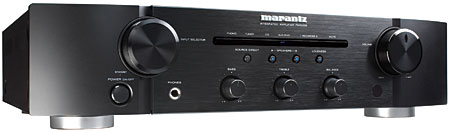
A fairly intense electric jazz group is a good test of an amplifier's ability to render a coherent sonic picture with realistic pacing. The middle section of "Ice Crushing at All Speeds," from my jazz quartet Attention Screen's Live at Otto's Shrunken Head (CD, Stereophile STPH020-2), features a forceful, driving rhythm from drummer Mark Flynn playing his entire kit, juxtaposed against a moaning ostinato bass line by Chris Jones that challenges Flynn's rhythmic statement. It all hung together through the Marantz, just as it did on stage the night we recorded it.
 But, you say, how well can a 40Wpc integrated produce high-level dynamic slam with such revealing speakers as the Monitor Audio Silver RS6 and the Epos M5? At one point I was playing the Marantz for an audiophile friend, Andy Slusar, who eyed it with suspicion: "How much is this thing? How many watts? I won't be convinced until you put on some loud rock music that dynamically stresses the unit." So I cranked up "Vrooom," from King Crimson's Thrak (CD, Discipline KCCDX01), at a level exceeding 95dB. After the thundering dynamic opening had almost knocked me off my seat, I was able to follow the individual lines of Trey Gunn's bass and Tony Levin's Chapman stick clearly and separately, with nary a trace of compression or congestion in the fortissimo passages. Mr. Slusar: "Okay, you convinced me. The amp is remarkable."
Still, I was skeptical that a $450 integrated, however well made and with however many features, could also include a high-quality phono stage. I expected to hear the sound of a throwaway phono stage. I was wrong. I ended up spending nearly half my time with the Marantz listening to vinyl—I was so pleased with its sound that I just kept playing black disc after black disc.
Overall, the PM5003's moving-magnet phono stage is cut from the same sonic cloth as the amplifier's overall sound when processing digital signals. I was particularly taken by its rich, uncolored midrange as I reveled in the verisimilitude of well-recorded women's voices. Janis Ian on Between the Lines (LP, Columbia PC 33394), Doris Day on Cutting Capers (LP, Columbia CL1232), Annie Haslam on Renaissance's Scheherazade and Other Stories (LP, Sire SASD 7510)—all were rich and silky. High-frequency transients were as impressive as they were with CD sources. The broad range of timbres in Jamie Muir's lightning-fast percussive passages on King Crimson's Larks' Tongues in Aspic (UK LP, Island LPS 9230) were perfectly reproduced, with no smearing, blunted edges, or high-frequency rolloff.
At the other end of the audioband, Chris Jones puts deep bass synth and electronic percussion blasts front and center in his "Midnight Sun" (45rpm 12" single, Surface Tension STNS002), and the PM5003 rendered them in true lease-breaking, cuff-flapping fashion (footnote 1). Finally, in densely recorded, highly modulated passages such as the interplay of saxophonist Wayne Shorter and drummer Steve Gadd during Shorter's frantic solo in the title track of Steely Dan's Aja (LP, ABC AA1006), the Marantz's phono stage exhibited perfectly clean pacing and a coherent presentation of the passage.
Why shouldn't I spend more money on something else?
But, you say, how well can a 40Wpc integrated produce high-level dynamic slam with such revealing speakers as the Monitor Audio Silver RS6 and the Epos M5? At one point I was playing the Marantz for an audiophile friend, Andy Slusar, who eyed it with suspicion: "How much is this thing? How many watts? I won't be convinced until you put on some loud rock music that dynamically stresses the unit." So I cranked up "Vrooom," from King Crimson's Thrak (CD, Discipline KCCDX01), at a level exceeding 95dB. After the thundering dynamic opening had almost knocked me off my seat, I was able to follow the individual lines of Trey Gunn's bass and Tony Levin's Chapman stick clearly and separately, with nary a trace of compression or congestion in the fortissimo passages. Mr. Slusar: "Okay, you convinced me. The amp is remarkable."
Still, I was skeptical that a $450 integrated, however well made and with however many features, could also include a high-quality phono stage. I expected to hear the sound of a throwaway phono stage. I was wrong. I ended up spending nearly half my time with the Marantz listening to vinyl—I was so pleased with its sound that I just kept playing black disc after black disc.
Overall, the PM5003's moving-magnet phono stage is cut from the same sonic cloth as the amplifier's overall sound when processing digital signals. I was particularly taken by its rich, uncolored midrange as I reveled in the verisimilitude of well-recorded women's voices. Janis Ian on Between the Lines (LP, Columbia PC 33394), Doris Day on Cutting Capers (LP, Columbia CL1232), Annie Haslam on Renaissance's Scheherazade and Other Stories (LP, Sire SASD 7510)—all were rich and silky. High-frequency transients were as impressive as they were with CD sources. The broad range of timbres in Jamie Muir's lightning-fast percussive passages on King Crimson's Larks' Tongues in Aspic (UK LP, Island LPS 9230) were perfectly reproduced, with no smearing, blunted edges, or high-frequency rolloff.
At the other end of the audioband, Chris Jones puts deep bass synth and electronic percussion blasts front and center in his "Midnight Sun" (45rpm 12" single, Surface Tension STNS002), and the PM5003 rendered them in true lease-breaking, cuff-flapping fashion (footnote 1). Finally, in densely recorded, highly modulated passages such as the interplay of saxophonist Wayne Shorter and drummer Steve Gadd during Shorter's frantic solo in the title track of Steely Dan's Aja (LP, ABC AA1006), the Marantz's phono stage exhibited perfectly clean pacing and a coherent presentation of the passage.
Why shouldn't I spend more money on something else?
You can indeed spend more than the Marantz PM5003's price of $449.95 and get much better sound. I compared the PM5003 to my trusty Creek 5350SE integrated amplifier (now known as the Creek Classic), which, at $1695, costs more than three times as much. The Creek was much more delicate throughout the entire audioband, with smoother, more extended highs and cleaner sibilants. Low-level dynamic nuances were more linear through the Creek, which also packed more of a wallop at the upper end of the dynamic spectrum. There was also a greater sense of ease with the Creek, most noticeable with vocal recordings. At the low end of the audioband, the 5350SE's midbass was a bit cleaner and extended deeper than the Marantz's.
Still, the Marantz sounded uncolored, with many strengths and no glaring weaknesses. Compared to the Creek, however, the PM5003 had, overall, a slightly grainy texture with all recordings—a relative lack of refinement. The Creek and Marantz were both like dress shirts of fine Egyptian cotton, with the Creek professionally laundered and the Marantz hand-ironed at home. The Marantz is good enough to wear to work, but for the job interview, you'd want to dress up in the Creek.
Just keep in mind that these impressions resulted from listening to a system whose associated components are much more expensive than what the typical purchaser is likely to hook up to the PM5003; the differences between the Marantz and the Creek 5350SE will likely be less audible with less expensive associated gear.
If I buy the Marantz, how will I stand?
You'll stand mighty proud. The Marantz PM5003 is a stunning achievement: an uncolored, revealing, well-built gem with more features than anyone could possibly ask for at the price. I'd almost go so far as to suggest that all well-heeled audiophiles buy one, just to create a benchmark in their minds for what's available for $450 from today's talented electronics designers. I plan to keep my sample around for a while, as I seek out other components to couple with it as candidates to be included in complete two-channel systems that are highly revealing and musical but that retail for a total of no more than $1000. That ought to keep you youts happy for a while.
Footnote 1: Chris Jones, the bassist of my jazz quartet Attention Screen, is a film composer in his day job, and also releases original electronic music in the dubstep genre.
But, you say, how well can a 40Wpc integrated produce high-level dynamic slam with such revealing speakers as the Monitor Audio Silver RS6 and the Epos M5? At one point I was playing the Marantz for an audiophile friend, Andy Slusar, who eyed it with suspicion: "How much is this thing? How many watts? I won't be convinced until you put on some loud rock music that dynamically stresses the unit." So I cranked up "Vrooom," from King Crimson's Thrak (CD, Discipline KCCDX01), at a level exceeding 95dB. After the thundering dynamic opening had almost knocked me off my seat, I was able to follow the individual lines of Trey Gunn's bass and Tony Levin's Chapman stick clearly and separately, with nary a trace of compression or congestion in the fortissimo passages. Mr. Slusar: "Okay, you convinced me. The amp is remarkable."
Still, I was skeptical that a $450 integrated, however well made and with however many features, could also include a high-quality phono stage. I expected to hear the sound of a throwaway phono stage. I was wrong. I ended up spending nearly half my time with the Marantz listening to vinyl—I was so pleased with its sound that I just kept playing black disc after black disc.
You can indeed spend more than the Marantz PM5003's price of $449.95 and get much better sound. I compared the PM5003 to my trusty Creek 5350SE integrated amplifier (now known as the Creek Classic), which, at $1695, costs more than three times as much. The Creek was much more delicate throughout the entire audioband, with smoother, more extended highs and cleaner sibilants. Low-level dynamic nuances were more linear through the Creek, which also packed more of a wallop at the upper end of the dynamic spectrum. There was also a greater sense of ease with the Creek, most noticeable with vocal recordings. At the low end of the audioband, the 5350SE's midbass was a bit cleaner and extended deeper than the Marantz's.
You'll stand mighty proud. The Marantz PM5003 is a stunning achievement: an uncolored, revealing, well-built gem with more features than anyone could possibly ask for at the price. I'd almost go so far as to suggest that all well-heeled audiophiles buy one, just to create a benchmark in their minds for what's available for $450 from today's talented electronics designers. I plan to keep my sample around for a while, as I seek out other components to couple with it as candidates to be included in complete two-channel systems that are highly revealing and musical but that retail for a total of no more than $1000. That ought to keep you youts happy for a while.
Footnote 1: Chris Jones, the bassist of my jazz quartet Attention Screen, is a film composer in his day job, and also releases original electronic music in the dubstep genre.















