

Dinesh Paliwal, CEO of Harman International Industries, was addressing engineers and the audio press in a crowded conference room at the opening of Harman Luxury Audio's new Engineering Center of Excellence (ECOE), in Shelton, Connecticut. Paliwal singled out as the ECOE's first beneficiary the Mark Levinson brand, with the goal of revitalizing it as Harman's flagship marque. (Other brands in the HII stable include Harman Kardon, Infinity, JBL, Crown, AKG, Lexicon, and Revel.) To achieve this, he gave the ECOE team access to Harman's R&D budget of $400 million; brought on Todd Eichenbaum, formerly of Krell, to be its Director; and hired 11 more engineers.
Paliwal spoke with pride of the facility's output of six new Mark Levinson models in the past 24 months, and pointed with pleasure at the No.536 monoblock amplifier. I smiled: I was already scheduled to review it.
The Monoblock Legacy
The No.536's design fits into a solid tradition of Mark Levinson monoblocks that began in about 1977 with the ML-2, a 25W, class-A amplifier weighing 80 lbs and costing $6490/pair, and that established the design pattern for subsequent ML monoblocks: big, heavy, voltage stable regardless of load, delivering high amounts of current—and expensive. After Madrigal bought Mark Levinson, in 1984, ML produced bigger, more powerful, more costly monoblocks, including the 100W No.20.6 and the 150W No.33H. In 2008, the Harman Specialty Group, which had purchased Mark Levinson from Madrigal, upped the ante with the No.53, a 500W monoblock with a pulse-width-modulated output stage. Paliwal had asked the ECOE to design a "middle-tier" monoblock at half the No.53's list price of $50,000/pair. The result is the class-AB No.536, at $30,000/pair.
Circuit Design
According to Todd Eichenbaum, the No.536's design is new from the ground up. Its signal paths are fully discrete and fully differential, and it has a mirror-imaged circuit topology with high bias current. The No.536's voltage and driver stages are based on the gain stage of the No.585 integrated amplifier. The No.536's output stage is biased to operate in class-A up to 3W. The No.536's overall gain structure was designed to have linear open-loop performance before negative feedback is applied. This was accomplished by meticulously setting the open-loop gain and bandwidth of the output circuit using precision resistors and capacitors. Once that was achieved, additional resistors were used to add the feedback network. Eichenbaum tuned this design to exhibit no latching, ringing, or oscillating when the No.536 is driven into hard clipping, nor does it round off the waveform. The waveform does exhibit the usual flat top when clipped, but is otherwise clean. Harman specifies the No.536 as outputting 400W into 8 ohms or 800W into 4 ohms, and remaining stable into 2 ohms.
Harman calls the No.536's design Pure Path, an umbrella term used across the Mark Levinson product line—including in the No.526 preamplifier—indicating a direct-coupled signal path, voltage gain and drive stages that use folded cascode circuits and operate in class-A, and the use of minimal feedback and high bias-current settings in the output stage. The folded cascode circuits—built with junction field-effect transistors (JFETs) and bipolar junction transistors (BJTs)—are included to achieve high gain, low noise, wide bandwidth, and excellent linearity.
Construction
The No.536's overall gain structure was designed to have linear open-loop performance before negative feedback is applied. This was accomplished by meticulously setting the open-loop gain and bandwidth of the output circuit using precision resistors and capacitors. Once that was achieved, additional resistors were used to add the feedback network. Eichenbaum tuned this design to exhibit no latching, ringing, or oscillating when the No.536 is driven into hard clipping, nor does it round off the waveform. The waveform does exhibit the usual flat top when clipped, but is otherwise clean. Harman specifies the No.536 as outputting 400W into 8 ohms or 800W into 4 ohms, and remaining stable into 2 ohms.
Harman calls the No.536's design Pure Path, an umbrella term used across the Mark Levinson product line—including in the No.526 preamplifier—indicating a direct-coupled signal path, voltage gain and drive stages that use folded cascode circuits and operate in class-A, and the use of minimal feedback and high bias-current settings in the output stage. The folded cascode circuits—built with junction field-effect transistors (JFETs) and bipolar junction transistors (BJTs)—are included to achieve high gain, low noise, wide bandwidth, and excellent linearity.
Construction
Todd Eichenbaum had walked me through the No.536's layout at the 2017 Consumer Electronics Show. Its case of extruded 6063-T5 (aircraft-grade) aluminum measures 17.25" wide by 7.65" high (with feet attached) by 21" deep; openings in the bottom and top plates vent heat and make internal cooling fans unnecessary. The output-stage circuits are mounted on the inner surfaces of the heatsinks. The component quality is tops, and the bulletproof build quality should last a century. Like all Mark Levinson gear, the 100lb No.536 is made in the US. Eichenbaum removed the No.536's top plate and pointed out that the rectifiers and filter capacitors are directly attached to the output-stage subassemblies, to make the electrical connections short and direct. Second, each of the two output stages handles both inverting and non-inverting signals, which allows each stage to draw current evenly and simultaneously from both the positive and negative supply rails, to maximize the amount of power available to the amplifier. Although each No.536 drives only one channel, it uses two fully differential, class-AB, 400W output stages in a bridged configuration to bolster its current output. This helps the amplifier remain stable into loads of 2 ohms. Each output stage has 12 discrete TO-264 bipolar power transistors (each rated at 15A, 260V, 200W), and 12 discrete TO-220 bipolar driver transistors.
 Each of the No.536's two high-current power supplies contains eight discrete, high-speed TO-220 Schottky rectifiers and 18 paralleled filter capacitors. Including both power supplies, the total storage capacitance of the No.536's 36 filter capacitors is 169,200µF. Just behind the front panel is a single, low-noise, 1800VA toroidal power transformer with separate secondary windings for each output stage.
The No.536 includes the protection design described in my review of the Mark Levinson No.585 integrated amplifier in December 2015, scaled up for the No.536's greater voltages and current handling. It uses redundant pathways—ie, direct connections to the amplifier circuitry itself, as well as to the microprocessor, which monitors the amplifier's operation for ultimate reliability under all conditions. To protect the amplifier and loudspeaker attached to it, the No.536 continuously monitors the heatsink temperature (as a fail-safe, there's also a second temperature sensor on each heatsink), internal operating temperature, power-supply rail voltage, the output current relative to the output-transistor operating voltage, the output voltage, and the output DC level. The No.536 is prevented from overheating by thermal switches inside the power-transformer housing. Recoverable faults—ie, faults that do not indicate amplifier damage—include overheating, incorrect AC input, DC detected at the input, and short circuits across the speaker terminals.
External Features and Controls
Each of the No.536's two high-current power supplies contains eight discrete, high-speed TO-220 Schottky rectifiers and 18 paralleled filter capacitors. Including both power supplies, the total storage capacitance of the No.536's 36 filter capacitors is 169,200µF. Just behind the front panel is a single, low-noise, 1800VA toroidal power transformer with separate secondary windings for each output stage.
The No.536 includes the protection design described in my review of the Mark Levinson No.585 integrated amplifier in December 2015, scaled up for the No.536's greater voltages and current handling. It uses redundant pathways—ie, direct connections to the amplifier circuitry itself, as well as to the microprocessor, which monitors the amplifier's operation for ultimate reliability under all conditions. To protect the amplifier and loudspeaker attached to it, the No.536 continuously monitors the heatsink temperature (as a fail-safe, there's also a second temperature sensor on each heatsink), internal operating temperature, power-supply rail voltage, the output current relative to the output-transistor operating voltage, the output voltage, and the output DC level. The No.536 is prevented from overheating by thermal switches inside the power-transformer housing. Recoverable faults—ie, faults that do not indicate amplifier damage—include overheating, incorrect AC input, DC detected at the input, and short circuits across the speaker terminals.
External Features and Controls
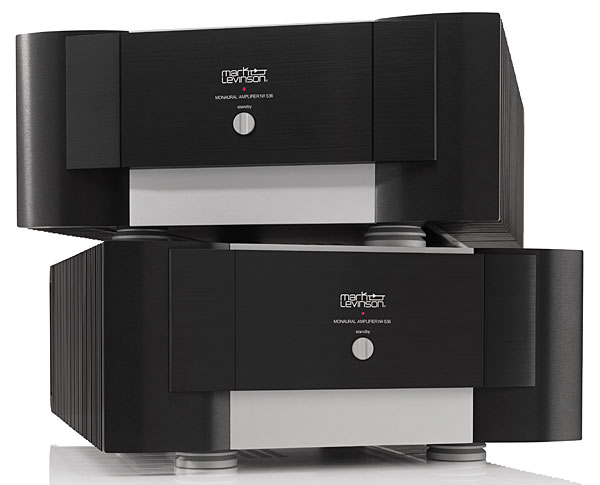
The No.536 has Mark Levinson's usual black case with multiple heatsink fins running along each side, and its silver-and-black faceplate trim is reminiscent of my ca-1999 No.334 stereo amplifier. The front panel has only a single button; this toggles the amplifier between On and Standby when the rear-panel Power switch is turned on. Above this is an LED that indicates the operating status: steady red when the amplifier is fully turned on, flashing red while the amplifier is in Standby, steady blue as the amplifier starts up from a reset, and flashing blue while an update is being installed. This same LED also indicates fault conditions: When it continuously flashes white, the No.536 has entered into Safe Protection Mode because of a recoverable fault that can either correct itself (amplifier temperature over safe limit) or be fixed by the owner (speaker terminals shorted together). If it glows a steady white, the fault is nonrecoverable: an output transistor is damaged, or DC is detected at the output (but not at the input); the No.536 will not restart until it is serviced by a Mark Levinson technician.
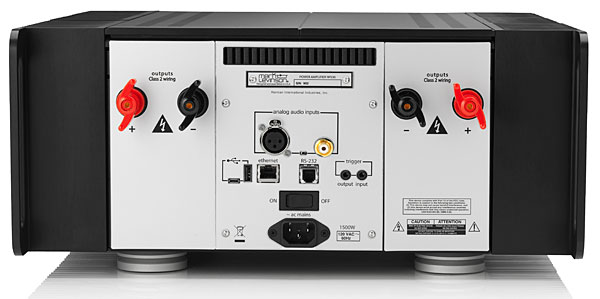 On the rear panel is the main power switch. Just above sits a row of control and connectivity inputs, including: USB-A, for upgrading the firmware; USB-micro, for accessing the internal webpage; RS-232, for connection to a computer with a serial port; jacks for trigger inputs and outputs; and an RJ-45 connector for an Ethernet link. Single RCA and XLR input connectors are next, flanking a small toggle switch that selects between them. At the top is a row of four speaker terminals with Hurricane binding posts.
The No.536's design fits into a solid tradition of Mark Levinson monoblocks that began in about 1977 with the ML-2, a 25W, class-A amplifier weighing 80 lbs and costing $6490/pair, and that established the design pattern for subsequent ML monoblocks: big, heavy, voltage stable regardless of load, delivering high amounts of current—and expensive. After Madrigal bought Mark Levinson, in 1984, ML produced bigger, more powerful, more costly monoblocks, including the 100W No.20.6 and the 150W No.33H. In 2008, the Harman Specialty Group, which had purchased Mark Levinson from Madrigal, upped the ante with the No.53, a 500W monoblock with a pulse-width-modulated output stage. Paliwal had asked the ECOE to design a "middle-tier" monoblock at half the No.53's list price of $50,000/pair. The result is the class-AB No.536, at $30,000/pair.
According to Todd Eichenbaum, the No.536's design is new from the ground up. Its signal paths are fully discrete and fully differential, and it has a mirror-imaged circuit topology with high bias current. The No.536's voltage and driver stages are based on the gain stage of the No.585 integrated amplifier. The No.536's output stage is biased to operate in class-A up to 3W.
The No.536's overall gain structure was designed to have linear open-loop performance before negative feedback is applied. This was accomplished by meticulously setting the open-loop gain and bandwidth of the output circuit using precision resistors and capacitors. Once that was achieved, additional resistors were used to add the feedback network. Eichenbaum tuned this design to exhibit no latching, ringing, or oscillating when the No.536 is driven into hard clipping, nor does it round off the waveform. The waveform does exhibit the usual flat top when clipped, but is otherwise clean. Harman specifies the No.536 as outputting 400W into 8 ohms or 800W into 4 ohms, and remaining stable into 2 ohms.
Harman calls the No.536's design Pure Path, an umbrella term used across the Mark Levinson product line—including in the No.526 preamplifier—indicating a direct-coupled signal path, voltage gain and drive stages that use folded cascode circuits and operate in class-A, and the use of minimal feedback and high bias-current settings in the output stage. The folded cascode circuits—built with junction field-effect transistors (JFETs) and bipolar junction transistors (BJTs)—are included to achieve high gain, low noise, wide bandwidth, and excellent linearity.
Todd Eichenbaum had walked me through the No.536's layout at the 2017 Consumer Electronics Show. Its case of extruded 6063-T5 (aircraft-grade) aluminum measures 17.25" wide by 7.65" high (with feet attached) by 21" deep; openings in the bottom and top plates vent heat and make internal cooling fans unnecessary. The output-stage circuits are mounted on the inner surfaces of the heatsinks. The component quality is tops, and the bulletproof build quality should last a century. Like all Mark Levinson gear, the 100lb No.536 is made in the US. Eichenbaum removed the No.536's top plate and pointed out that the rectifiers and filter capacitors are directly attached to the output-stage subassemblies, to make the electrical connections short and direct. Second, each of the two output stages handles both inverting and non-inverting signals, which allows each stage to draw current evenly and simultaneously from both the positive and negative supply rails, to maximize the amount of power available to the amplifier. Although each No.536 drives only one channel, it uses two fully differential, class-AB, 400W output stages in a bridged configuration to bolster its current output. This helps the amplifier remain stable into loads of 2 ohms. Each output stage has 12 discrete TO-264 bipolar power transistors (each rated at 15A, 260V, 200W), and 12 discrete TO-220 bipolar driver transistors.
Each of the No.536's two high-current power supplies contains eight discrete, high-speed TO-220 Schottky rectifiers and 18 paralleled filter capacitors. Including both power supplies, the total storage capacitance of the No.536's 36 filter capacitors is 169,200µF. Just behind the front panel is a single, low-noise, 1800VA toroidal power transformer with separate secondary windings for each output stage.
The No.536 includes the protection design described in my review of the Mark Levinson No.585 integrated amplifier in December 2015, scaled up for the No.536's greater voltages and current handling. It uses redundant pathways—ie, direct connections to the amplifier circuitry itself, as well as to the microprocessor, which monitors the amplifier's operation for ultimate reliability under all conditions. To protect the amplifier and loudspeaker attached to it, the No.536 continuously monitors the heatsink temperature (as a fail-safe, there's also a second temperature sensor on each heatsink), internal operating temperature, power-supply rail voltage, the output current relative to the output-transistor operating voltage, the output voltage, and the output DC level. The No.536 is prevented from overheating by thermal switches inside the power-transformer housing. Recoverable faults—ie, faults that do not indicate amplifier damage—include overheating, incorrect AC input, DC detected at the input, and short circuits across the speaker terminals.
External Features and ControlsThe No.536 has Mark Levinson's usual black case with multiple heatsink fins running along each side, and its silver-and-black faceplate trim is reminiscent of my ca-1999 No.334 stereo amplifier. The front panel has only a single button; this toggles the amplifier between On and Standby when the rear-panel Power switch is turned on. Above this is an LED that indicates the operating status: steady red when the amplifier is fully turned on, flashing red while the amplifier is in Standby, steady blue as the amplifier starts up from a reset, and flashing blue while an update is being installed. This same LED also indicates fault conditions: When it continuously flashes white, the No.536 has entered into Safe Protection Mode because of a recoverable fault that can either correct itself (amplifier temperature over safe limit) or be fixed by the owner (speaker terminals shorted together). If it glows a steady white, the fault is nonrecoverable: an output transistor is damaged, or DC is detected at the output (but not at the input); the No.536 will not restart until it is serviced by a Mark Levinson technician.
On the rear panel is the main power switch. Just above sits a row of control and connectivity inputs, including: USB-A, for upgrading the firmware; USB-micro, for accessing the internal webpage; RS-232, for connection to a computer with a serial port; jacks for trigger inputs and outputs; and an RJ-45 connector for an Ethernet link. Single RCA and XLR input connectors are next, flanking a small toggle switch that selects between them. At the top is a row of four speaker terminals with Hurricane binding posts.















