Sidebar 1: An Interview with Charlie Randall
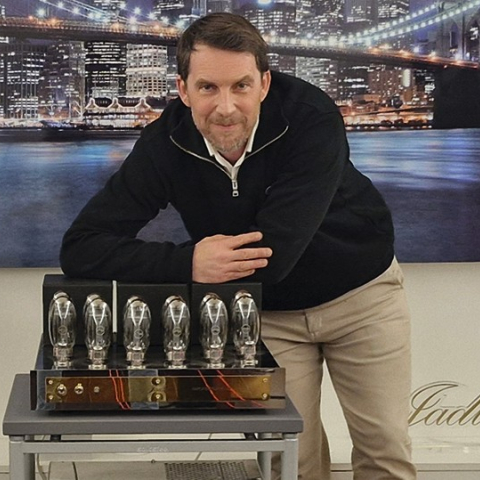
After being shown through McIntosh Laboratory's factory, in Binghamton, New York, where I saw the integration of cutting-edge and well-established technologies with outstanding quality control, I visited a bit with Charlie Randall, who first arrived at McIntosh as a college-student apprentice in 1985, and 16 years later was appointed President of the company. I first asked him how things are at McIntosh, given the ongoing parade of new formats—portable this, streaming that?
Charlie Randall: Really good. A lot of people thought that streaming, liquid music, iPhones, etc., would be the death of the industry. I think it's just the opposite. More and more people are rediscovering music. Just the availability they have in content now, compared to the way they used to have to do it. The only thing they're missing is waiting for your mom to run you to the record store—on the way home in the back seat, at least you could read about the music.
Sasha Matson: McIntosh's current design and engineering processes—is it a team approach, or are individuals in charge?
Randall: On the amplifier side, we have four people. All the product planning is a team approach. We might average a new model every five years. What we look for, if we are replacing an existing model, is what can we do to enhance the performance? McIntosh has a history of power creep: make it bigger, make it bigger. The problem is, especially in class-A/B, once you get up to 1200W, you can't pull any more power out of the wall without using more than one line cord.
Matson: How many patents does McIntosh currently hold?
Randall: In excess of 40, might be as many as 50. Here's a piece of trivia for you that a lot of people don't know: The blue in the McIntosh meter is trademarked, which is very difficult to get.
Matson: What do you say to some critics who talk about a "McIntosh sound"—voicing things a certain way: bumped presence region, the upper midrange, etc.?
Randall: Obviously, it's going to differ between solid-state and vacuum tubes. It's our heritage. Vacuum tubes, it's just inherent that there is more second-order distortion. We are going to work on a crazy amplifier towards the end of this year that will bring both worlds together. From a performance standpoint, it is purely subjective—it's what you like to listen to. I like them both. I think vacuum tubes do a better job in some areas, and solid-state, same way.
Matson: There is a strength and a bigness to the sound of the MC462 that I am really liking. You feel it even though the meters are just sitting there—it's not like I'm cranking it crazy loud.
Randall: One thing that's hard to see, just looking at the meters, is dynamic headroom. Even though the average response on the meters might be somewhere between 4W and 12W, if there is a demanding part that's inside there that the meter can't respond to that quickly, the amplifier has ample reserve to reproduce it. That's part of the openness and bigness that most people hear from McIntosh amplifiers, and especially the MC462. It's the same way with a car—you can't say a two-cylinder is better than an eight-cylinder.
Matson: Pricing in the High End?
Randall: Just from economies of scale, we can keep our prices much less than what we consider to be a high-end competitor. Because of the volume we are doing, we can buy at a more reasonable price. And the more you do in-house, you are saving costs inherent to using sub-suppliers.
Matson: Style and history?
Randall: Love it or hate it, it's us. We can't change it. The customer that buys a piece of Mac today, and tomorrow they want to add to it, we are always consistent about being backward-compatible, both in terms of how it works and how it looks. We make subtle changes.
Matson: What kind of listener do you think would enjoy an amplifier like the MC462?
Randall: Our design philosophy around the sound and the performance is just to be transparent. By that I mean, when any artist does a final mix of a recording and they sign off on it, that is their signature saying, "This is what I wanted it to sound like." Any audio designer should literally try to be as transparent as possible and let the artist's recording speak for itself.
Matson: Do you and your colleagues voice the final results with music, not only bench measurements?
Randall: Yes. With the McIntosh experience of 70 years now, and what we know from both a listening standpoint and measurements, we can pretty much tell if it is going to sound good. I think it's important for the customer to understand both. One thing they should not get hung up on is what it's going to sound like just from what they can read in the specifications. You are not going to be able to tell what that amplifier sounds like by just reading a number.
McIntosh Laboratory MC462 power amplifier An Interview with Charlie Randall

Company Info
ARTICLE CONTENTS
- Log in or register to post comments