Sidebar 4: Measurements
I performed a full set of measurements on the McIntosh MC462, using my Audio Precision SYS2722 system (see the January 2008 "As We See It"). Before doing any testing, I preconditioned the MC462 by running its 8 ohm output at one-third power for 30 minutes into 8 ohms—thermally the worst case for an amplifier with a class-AB or class-B output stage. At the end of that time the heatsinks were very hot, at 158.6°F (70.3°C). I usually precondition amplifiers for an hour, but I was concerned that the MC462 would get even hotter.
The McIntosh's voltage gain varied according to which output Autoformer tap was used and whether the balanced or unbalanced inputs were used. From the balanced inputs, the 8 ohm tap's gain into 8 ohms was a lower-than-usual 22.9dB, the 4 ohm tap's gain lower at 20.4dB, and the 2 ohm's even lower, at 17.4dB. The gains using the unbalanced input were 6dB higher rather than 6dB lower; the latter is usually the case. All three sets of outputs preserved absolute polarity (ie, were non-inverting), the XLR jacks being wired with pin 2 hot, the modern standard.
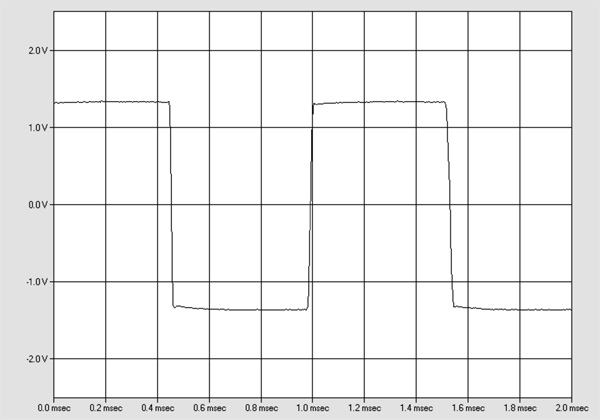
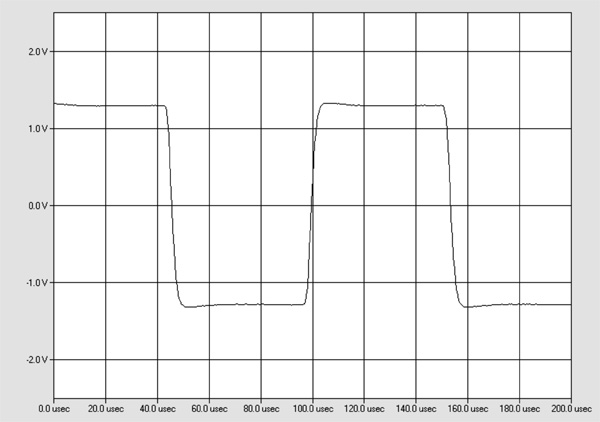
The MC462's unbalanced input impedance measured very close to the specified 22k ohms from 20Hz to 20kHz. The balanced input impedance was twice the unbalanced, as expected. The output impedance was lowest from the 8 ohm Autoformer tap, at 0.09 ohm at 20Hz and 1kHz, rising to 0.13 ohm at 20kHz. The 4 ohm tap's output impedance was almost twice that of the 8 ohm tap—not what I was expecting—while the 2 ohm tap's was 0.14 ohm at low and middle frequencies, rising to 0.185 ohm at the top of the audioband. As a result, the response with our standard simulated loudspeaker varied by ±0.2dB (fig.1, gray trace). The channels' levels match to within 0.1dB, and the audioband response into 8 ohms (blue and red traces) and 4 ohms (cyan, magenta) is flat up to 20kHz. Into 2 ohms (green trace), a slight top-octave rolloff reaches –0.4dB at 20kHz. The MC462 reproduced a 1kHz squarewave with short risetimes and flat tops and bottoms (fig.2), suggesting that the amplifier's use of output transformers doesn't affect its low-frequency reproduction. A 10kHz squarewave was reproduced without overshoot or ringing (fig.3).

 McIntosh specifies the MC462 as being able to deliver 450Wpc (26.5dBW) into a load matched to the nominal output Autoformer tap. With clipping defined as being when the THD+noise reaches 1%, fig.6 indicates that the MC462 exceeded its specification even with both channels driven, its 8 ohm output clipping at 516Wpc into 8 ohms (27.1dBW). The trace in this graph stops at 1%, as that is when the amplifier's protection was triggered. Into 4 ohms (fig.7), the McIntosh's 8 ohm output clipped at 720Wpc (25.6dBW). It's fair to note that I don't hold the wall voltage constant for this test; with both channels clipping into 4 ohms, the wall voltage had dropped from 121 to 115.4V. The MC462's 2 ohm output delivered 190Wpc (22.8dBW) with both channels driven into 8 ohms at 1% THD+N, 298Wpc with both channels driven into 4 ohms (21.7dBW, fig.8), and 536W (21.3dBW) with one channel driven into 2 ohms (fig.9).
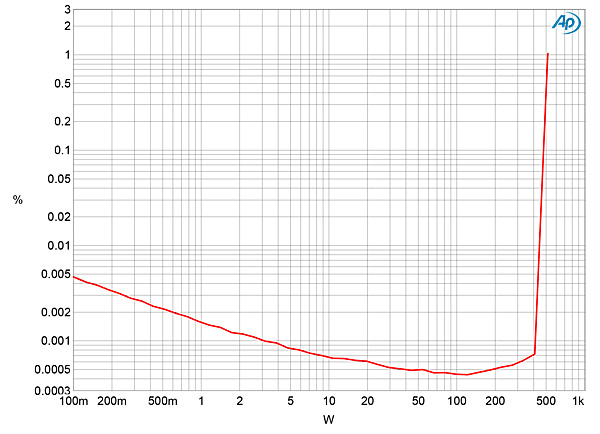


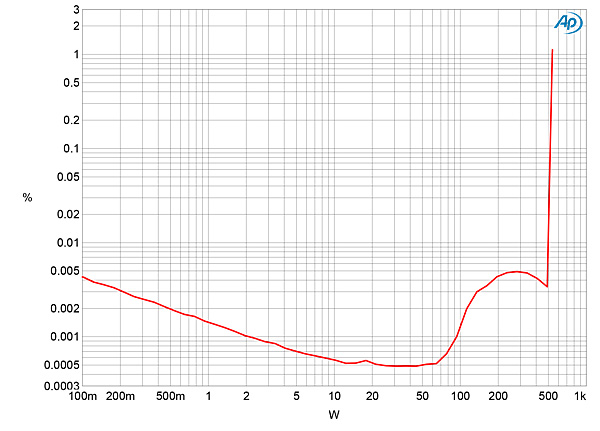

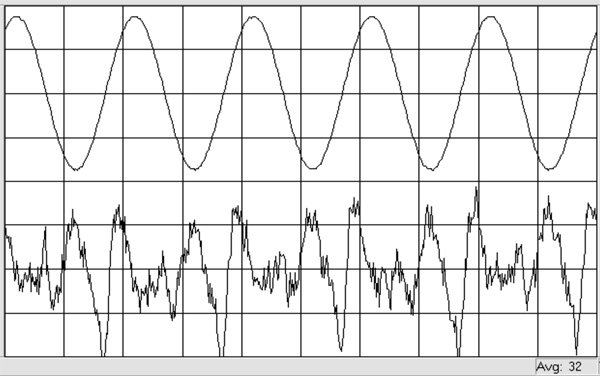
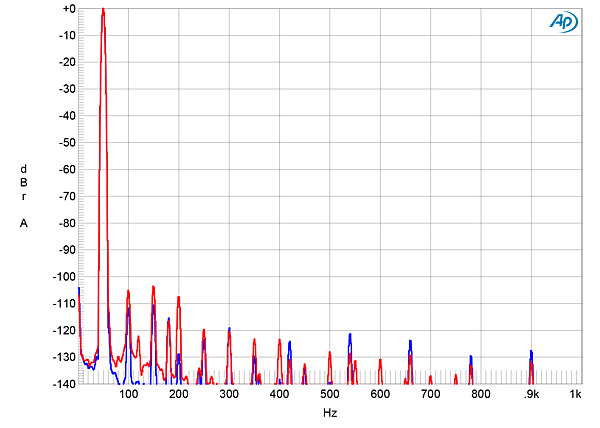

Fig.1 McIntosh MC462 (2 ohm output), frequency response at 2.83V into: simulated loudspeaker load (gray), 8 ohms (left channel blue, right red), 4 ohms (left cyan, right magenta), 2 ohms (red) (1dB/vertical div.).
Fig.2 McIntosh MC462 (2 ohm output), small-signal, 1kHz squarewave into 8 ohms.
Fig.3 McIntosh MC462 (8 ohm output), small-signal, 10kHz squarewave into 8 ohms.
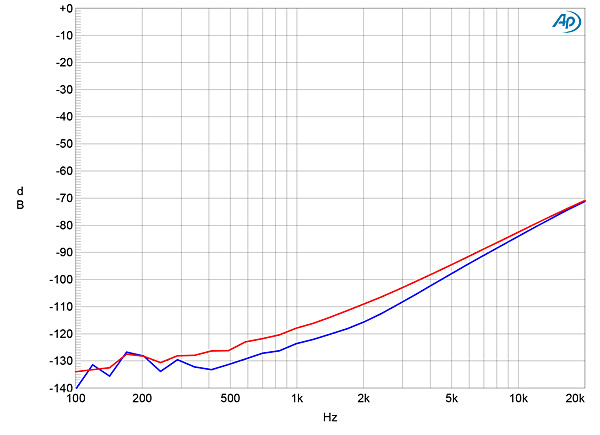
The McIntosh MC462's channel separation (fig.4) was superb, measuring close to 120dB in both directions below 1kHz, though it did decrease to 70dB at 20kHz, due to capacitive coupling between the channels at some point in the circuit. The wideband, unweighted signal/noise ratio, ref. 2.83V and measured at the highest-gain output (8 ohms) and with the balanced input shorted to ground, was equally superb, at 87dB. This ratio improved to 96.2dB when the measurement bandwidth was restricted to the audioband, and to 99.6dB when A-weighted. Spectral analysis of the MC462's noise floor (fig.5) revealed spuriae at 60Hz and its odd-order harmonics, these due to magnetic interference from the AC power transformer. All of these spuriae are very low in level, however, and will not be audible.
Fig.4 McIntosh MC462 (8 ohm output), channel separation.
Fig.5 McIntosh MC462 (8 ohm output), spectrum of 1kHz sinewave, DC–1kHz, at 1W into 8 ohms (linear frequency scale).
Fig.6 McIntosh MC462 (8 ohm output), both channels driven, distortion (%) vs 1kHz continuous output power into 8 ohms.
Fig.7 McIntosh MC462 (8 ohm output), both channels driven, distortion (%) vs 1kHz continuous output power into 4 ohms.
Fig.8 McIntosh MC462 (2 ohm output), both channels driven, distortion (%) vs 1kHz continuous output power into 4 ohms.
Fig.9 McIntosh MC462 (2 ohm output), both channels driven, distortion (%) vs 1kHz continuous output power into 2 ohms.
Figs. 6–9 indicate that distortion is extremely low, lying below the noise floor at powers below 30W or so. I therefore plotted how the THD+N changed with frequency from the 8 ohm output at a level of 28.3V, equivalent to 100W into 8 ohms and 200W into 4 ohms, where I could be sure I was looking at distortion rather than noise. The result (fig.10) reveals that the THD into 8 ohms (blue and red traces) and 4 ohms (cyan, magenta) rises above 1kHz, but still remains below 0.007%. I haven't shown the THD+N trace into 2 ohms from this output, because it was >2% in the midrange and treble and >3% in the bass at 28.3V, which is equivalent to 400W into 2 ohms. The moral: Match the MC462's nominal output to the lowest impedance magnitude of the loudspeaker used.
Fig.10 McIntosh MC462 (8 ohm output), THD+N (%) vs frequency at 28.3V into: 8 ohms (left channel blue, right red), 4 ohms (left cyan, right magenta).
The distortion signature is primarily of the second and third harmonics (fig.11); these components are very low in level, even at high powers (fig.12), though the right channel (red trace) had slightly more distortion than the left (blue). Tested with an equal mix of 19 and 20kHz tones at high power into 8 ohms from the 8 ohm output, the levels of higher-order intermodulation products were extremely low (fig.13), and the second-order difference product at 1kHz lay at a "roots-of-the-universe" –114dB (0.0002%).
Fig.11 McIntosh MC462 (8 ohm output), 1kHz waveform at 50Wpc into 8 ohms, 0.00056% THD+N (top); distortion and noise waveform with fundamental notched out (bottom, not to scale).
Fig.12 McIntosh MC462 (8 ohm output), spectrum of 50Hz sinewave, DC–1kHz, at 100Wpc into 8 ohms (linear frequency scale).
Fig.13 McIntosh MC462 (8 ohm output), HF intermodulation spectrum, DC–30kHz, 19+20kHz at 100Wpc peak into 8 ohms (linear frequency scale).
Summing up the McIntosh MC462's measured performance is easy: It is an extraordinarily well-engineered, exceptionally powerful amplifier.—John Atkinson