For the second consecutive year, Hi-Res Audio made a major statement on the main floor of the Venetian Hotel via a large Ballroom exhibit and star-studded panels. How many non-audiophiles took the time to explore beyond their schedule of meetings, conferences, and gizmo gatherings, I do not know. But the impact of two presentations per day, and the special press presentation by Neil Young (reported on earlier), will live on in reports and recorded footage of the events.
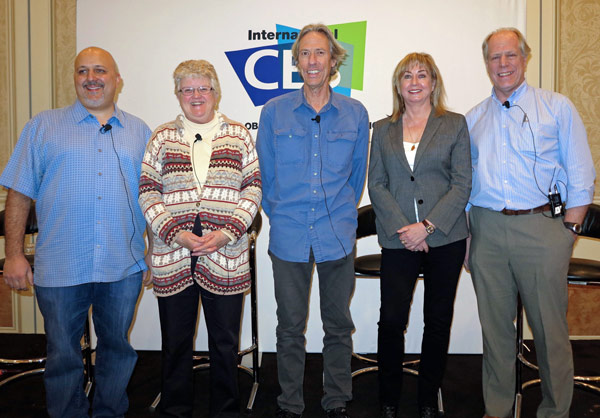
Although I was unable to attend "Hi-Res for Mobile Lifestyles," moderated by Rob Sabin of Sound & Vision, which included representatives from AudioQuest, Astell & Kern, Sony, and Audeze, I did take in "Meet the Hi-Res Music Creators." Moderated by recording engineer Maureen Droney (pictured fourth, going left to right), Senior Executive Director of the Producers & Engineers wing of The Recording Academy (the Grammy people), the panel consisted of four major engineers who record multiple genres in hi-res.
On the left in the photo is Rob Friedrich of Five/Four Productions. A lifelong musician, Friedrich was an early DSD-adopter at Telarc, and has won two Grammys plus a Latin Grammy for his recordings. One of his current projects involves preserving audio recordings at the Library of Congress. Of hi-res, he stated, "We can actually deliver to you what we hear in the studio."
Proceeding to the right, next comes Leslie Ann Jones, director of Music and Scoring at Skywalker Sound. Jones has scored a Grammy for Best Engineered Classical. She began to record in 24/96 ten years ago in order to get "as close to the sound that we hear in our studios. I went through the purist phase where I wouldn't turn a knob or move a mike, but now I believe that my work is about enabling a recording to sound as the artist wishes it to sound. We've spent 20 years focused on convenience; now, just as with fast food and home convenience, people are returning to recreational listening."
Ryan Ulyate, a feted producer/engineer whose legacy includes recording Ringo Starr, currently works with Tom Petty. Ulyate is behind the forthcoming hi-res release of the entire Tom Petty catalog. "When you play the hi-res versions of these recordings," he said, "you'll hear what the band heard and approved." He also confirmed that he prepares different mixes for CD, which often end up on iTunes—"we try not to ruin it too much"—than for hi-res downloads, which are 7dB quieter. "People think CDs sound better than hi-res files simply because the CD is 6–7dB louder. You need to turn the volume up on hi-res recordings in order for people to hear the difference."
Last in the photo (after Droney) stands the most familiar figure to show attendees and Stereophile followers: hi-res recording engineer/pioneer/professor Mark Waldrep of AIX Records and iTrax.com. Waldrep released the world's first music DVDs in 1997. A firm believer in 24/96 stereo and multi-channel, he eschews EQ and compression, and asserts that he can record greater dynamic range with hi-res digital than with analog tape.
Early in the discussion, Waldrep stated that reliable assurance of provenance is essential for maintaining quality in the realm of hi-res downloads. Later on, he acknowledged that many artists don't understand what hi-res recording can offer until they hear it for themselves. "Once they hear the difference, it sells itself," he said.
Jones stated flat out that, for her and others, "Hi-res has made recreation music listening enjoyable again." She noted that she now downloads hi-res music from HDTracks that she previously only had on LP, never having bought the CD transfers because of their sonic limitations.
Droney, who had prepared so many questions for the panelists that she left no time for Q&A, shared her excitement over Bob Ludwig's hi-res remasters of Bruce Springsteen's catalog. "I've heard things on those recordings that I've never heard before," she declared.
At discussion's end, Ulyate came full circle by stating "Hi-res has made my job easier because I know that people will be able to hear what I hear in the studio." Friedrich put the icing on the cake by stating, "Recording in hi-res is easier. I just need to set the level."