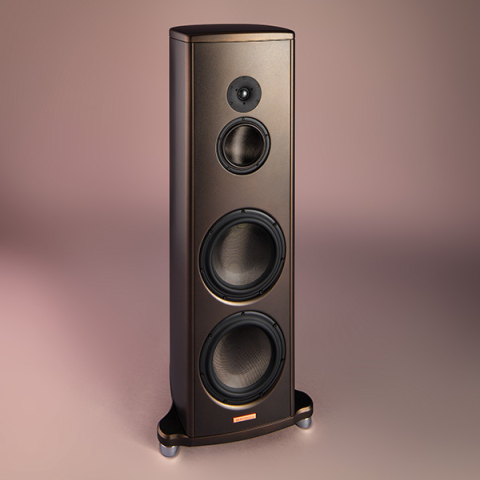
I measured the Monitor Audio Silver 500 7G's farfield behavior with DRA Labs' MLSSA system, an Earthworks microphone preamplifier, and a calibrated DPA 4006 microphone. I used an Earthworks QTC-40 mike, with its small ¼"-diameter capsule, to measure the nearfield responses of the loudspeaker drive units and ports.
The Silver 500 7G's sensitivity is specified as a high 90.5dB/2.83V/m, which was confirmed by my estimate. Monitor Audio specifies the Silver 500 7G's impedance as 8 ohms, with a minimum magnitude of 4.1 ohms at 150Hz. Measured with Dayton Audio's DATS V2 system, the impedance magnitude (fig.1, solid trace) remained above 4 ohms for the entire audioband, with a minimum value of 4.23 ohms at 153Hz. The EPDR (footnote 1) drops below 3 ohms between 81Hz and 135Hz, a region where music can have high levels of energy, with a minimum value of 2.12 ohms at 102Hz. The Silver 500 7G should be used with amplifiers that are comfortable with 4 ohm loads, but any drive difficulty will be ameliorated by the speaker's high sensitivity.
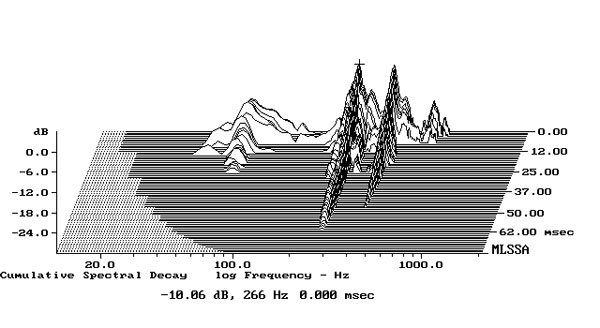
There is a slight discontinuity between 200Hz and 300Hz in the impedance traces in fig.1, suggesting a resonance of some kind in that region. I investigated the enclosure's vibrational behavior with a plastic-tape accelerometer and found a single mode at 266Hz on the top panel and sidewalls. It was also present on the front baffle below the woofers (fig.2), where it was joined by another resonance at 410Hz. These modes are relatively low in level, however.
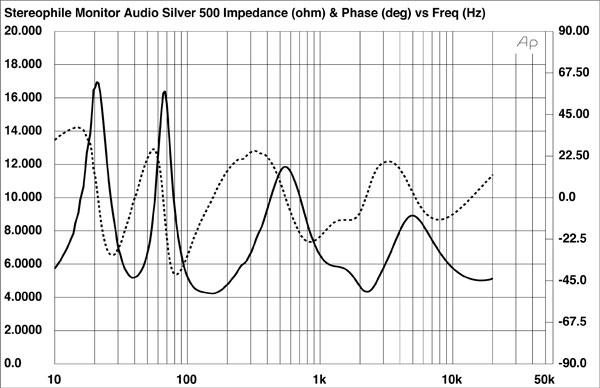
The saddle centered on 39Hz in the impedance magnitude trace is related to the tuning frequency of the two ports on the Monitor Audio's rear panel. These ports behave identically; their summed nearfield output is shown as the red trace in fig.3. The response peaks in textbook manner at the tuning frequency, and the upper-frequency rolloff is clean. The blue trace below 350Hz shows the nearfield response of the woofers, which behave identically. The notch at 39Hz is due to the back pressure from the port resonance holding their cones stationary, and the bump in the upper bass will be due to the nearfield measurement technique, which assumes that the woofers are mounted in a true infinite baffle, ie, one that extends to infinity in both planes.
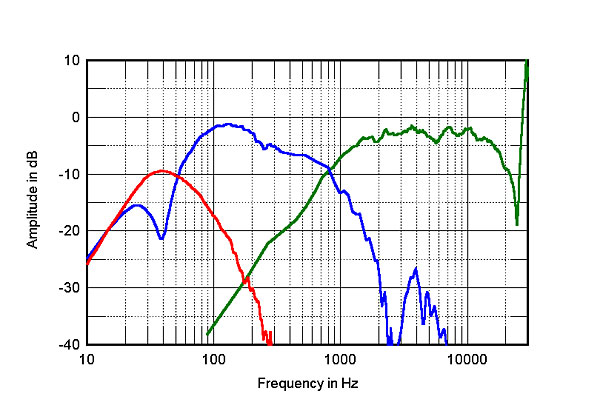
In the farfield (blue trace above 350Hz), the woofers cross over to the midrange unit and tweeter (fig.3, green trace) close to the specified 800Hz. The farfield output of the midrange and tweeter is even from 2kHz to 16kHz but slopes down above that frequency beneath the tweeter's high-Q, high-level dome resonance at 29kHz. Fig.4 shows the Silver 500 7G's farfield response averaged across a 30° horizontal window centered on the tweeter axis. The response is impressively even from 300Hz to 11kHz. The tweeter is 39" from the floor, 3" higher than the average ear height of a seated listener. Repeating the farfield response measurement averaged across a 30° horizontal window centered on the midrange axis gave an identical result.

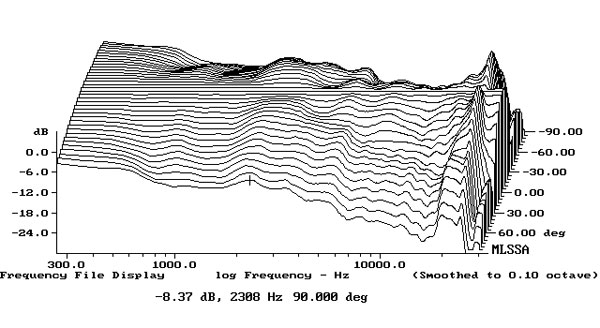
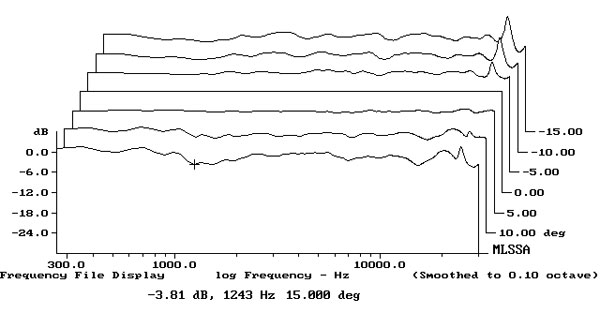
The Silver 500 7G's horizontal dispersion is shown in fig.5, with the off-axis traces normalized to the response on the tweeter axis. There is a slight lack of energy to the loudspeaker sides at the top of the midrange unit's passband, and the tweeter's radiation pattern narrows in its top octaves. However, the contour lines are evenly spaced, which correlates with stable stereo imaging. Fig.6 shows the Monitor Audio's vertical dispersion, again normalized to the response on the tweeter axis. The speaker's even farfield response is maintained over a wide ±10° vertical window.
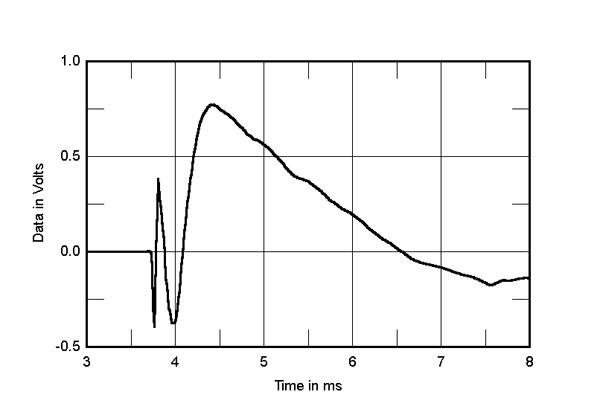
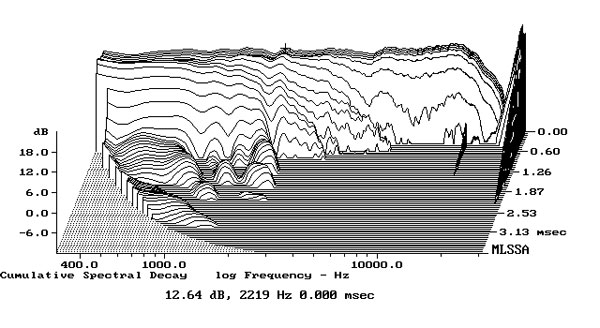
In the time domain, the Silver 500 7G's step response on the tweeter axis (fig.7) shows that the tweeter and midrange unit are connected in negative acoustic polarity, the woofers in positive acoustic polarity. The decay of each drive-unit's step smoothly blends into the start of the step of the unit next lower in frequency, which implies optimal crossover implementation. The Silver 500 7G's cumulative spectral-decay plot (fig.8) is superbly clean.
The Monitor Audio Silver 500 7G's measured performance is superb. That it achieves this level of performance at an affordable price is even more commendable.—John Atkinson
Footnote 1: EPDR is the resistive load that gives rise to the same peak dissipation in an amplifier's output devices as the loudspeaker. See "Audio Power Amplifiers for Loudspeaker Loads," JAES, Vol.42 No.9, September 1994, and stereophile.com/reference/707heavy/index.html.