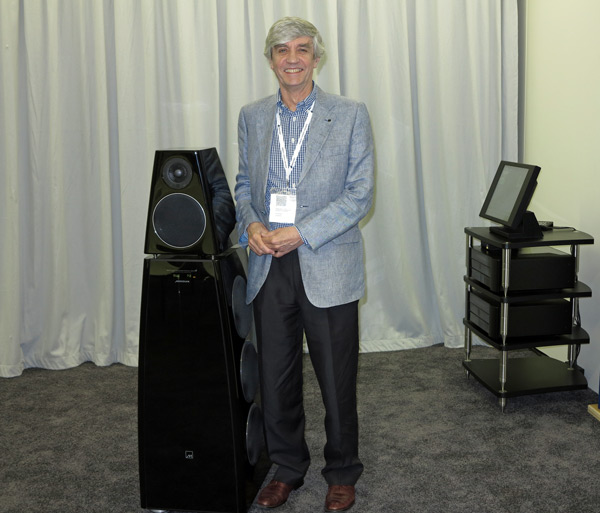
An entire page of the High End magazin was devoted to an introduction to Meridian's MQA (Master Quality Authenticated) technology. Bob Stuart, who with Peter Craven, invented MQA, spent a generous amount of time with me discussing both the latest developments with the process, and some of the scientific research behind it.
Already, Arcam, Onkyo Music, 2L, Roon, and Tidal have signed on as MQA supporters, and over 100 potential business partners have been identified. Nonetheless, MQA's launch has been delayed 1–2 months because there's "something" Meridian is adding to increase its flexibility for streaming. Expect MQA 1.0 in June. More than 100 companies have signed up with Meridian to offer MQA decoding in their products, "from the tiniest companies to some of the biggest in the world," Bob said. The next major announcement is scheduled for the IFA show in Berlin in early September.
"We took the view that since MQA is so important to the music industry, we want everyone to participate so we can all cross the road together. So we had to gear up for the launch."
MQA Ltd. a new company that is separate from Meridian's core business, is dedicated to using MQA to make recorded music better to listen to. The company is based on the philosophy, "If you want to reproduce the sound of music in the studio, you have to control it from the beginning to the end, and take the whole chain into account."
One key aspect of the company's work is applying the principles of neuroscience to the realm of product engineering. Stuart contests that the latest research shows that we are far more sensitive to timing than to frequency. In addition, our hearing is totally adaptable to and tuned into the sounds of nature and the environment, with the ability to hear when sounds stop and decay crucial to survival. In the end, according to Stuart, timing accuracy is even more important than sampling rate when it comes to music reproduction.
Asked who was authenticating the master quality of MQA, Stuart responded, "We're putting the tools in the hands of the producer, artist, or recording engineer. When there is no one available, as may be the case with archival material, we put the power in the copyright owner's hands." The goal, with new recordings, is to authenticate them right after the mastering process. With the push of a button, sound and mastering engineers will be able to hear what the customer will hear on home systems, iPhones, over earbuds, etc...
"We want to recreate the analog sound of the actual performance," Stuart said. "Most studios are frustrated with the sound that comes about with the transfer of their material from A to D and then back from D to A. MQA's goal is to achieve high temporal precision throughout a chain that was not designed to provide it."
At the end of our talk, Stuart took me into the temporarily empty MQA demo room for a listen. Alas, the large room was so heavily damped in order to ameliorate room-related problems that I found myself uninvolved in what was playing. I'm not sure why, but I have yet to hear MQA demmed in a space and/or system whose open and extended top and bottom and liquid presentation approximate the sound I hear in wet (as opposed to dry) performance venues.