

MQA Hierarchy
In the majority of our communication so far we have described one variant of MQA, while at the same time pointing out that the concepts, bitstream and system is hierarchical. What do we mean by that?
In fact MQA is hierarchical in a number of ways:
The number of channels can be scaled upwards from 2.
For music sampled at rates of 2x or higher, the playback sample rate can be optimised hierarchically by determining the 'unfolding' to suit the platform.
The transmission rate can be scaled to be 1x, 2x, 4x or 8x. We have concentrated our communication on 1x transmission because it is completely effective for distributing the commercial recordings of today. A 1x transmission rate affords low data rates and the highest backward compatibility. There are a few limitations for extreme recordings.
For archive or extreme distribution the transmission rate can be doubled or quadrupled, in which case the frequency response and bandwidth are extended proportionally (footnote 9).
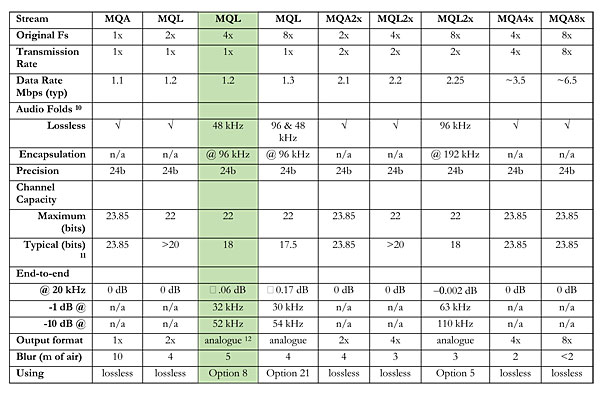
The Table below summarises different file types (all generically called MQA). An MQL file will have an original sample rate at least twice the transmission rate and contain one lossless fold. It may also include an encapsulation fold.
Footnote 9: Although the archive should have no limit, current playback systems that can reproduce above 50kHz with temporal precision are incredibly rare and still inside laboratories.
Footnote 10: Examples given for 48kHz family. The frequencies noted are audio frequencies not sampling rate.
Footnote 11: Typical music recordings. Note: the quoted number is channel capacity; subtractive shaping can increase this dynamic range by up to 3 bits in the 'audio band.' Note: For 1x 16b typical channel capacity is 15.9 bits.
Footnote 12: The mastering engineer can typically select options for 19.5—23-bit noise-floor below 24kHz.
Footnote 13: Analogue specification using 'Reference Hierarchical DAC.'
Footnote 14: Note: for a typical 192kHz PCM channel, equivalent post-blur is ten times higher (approximately 50m of air) and between 200–400µs of pre-blur.
Footnote 9: Although the archive should have no limit, current playback systems that can reproduce above 50kHz with temporal precision are incredibly rare and still inside laboratories.















