Sidebar 2: Recordings in the Round
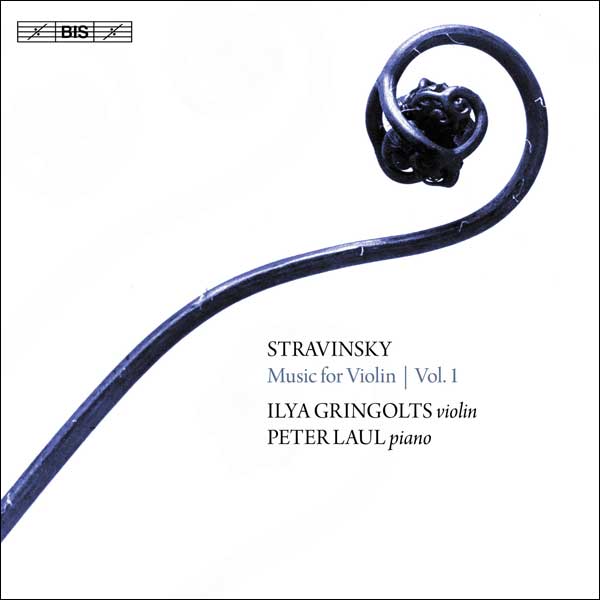
Stravinsky: Music for Violin, Vols. 1 & 2
Vol.1: Pastorale; Excerpts from L'Oiseau de Feu; Chanson russe from Mavra; Danse russe from Pétrouchka; Suite from Pulcinella; Duo Concertant; Excerpts from Le Rossignol; "La Marseillaise" (de Lisle)
Ilya Gringolts, violin; Peter Laul, piano
BIS 2245 (SACD/CD). Vol.2: Pastorale; Ballad; Suite Italienne from Pulcinella; Divertimento from The Fairy's Kiss; Apollo's Variation from Apollon Musagète; Violin Concerto; Elégie; Tango (arr. Dushkin)
Ilya Gringolts, violin; Peter Laul, piano; Galicia Symphony Orchestra, Dima Slobodeniouk
BIS 2275 (SACD/CD). In the home I grew up in, Stravinsky's The Rite of Spring was one of only three classical recordings we had. I first latched on to the pounding drums and awesome orchestral outbursts, which conjured images of dinosaurs in my child's mind. Gradually, as I listened to it over the years, I grew fascinated by the rhythms and how Stravinsky made surprising transitions from one to another, and how deftly he layered multiple meters and themes. Now I realize that while it was the brilliant orchestration skills Stravinsky had learned from Rimsky-Korsakov that had originally sucked me in, it was the melodic and rhythmic complexity that kept my attention, and it is these qualities in Stravinsky's later neoclassical works and arrangements that are celebrated in these discs by the violinist Ilya Gringolts.
 Vol.1 is devoted to works for violin and piano, Vol.2 to pieces for solo violin with other instruments and ensembles, and both begin with the Pastorale, in different arrangements. The duo version on Vol.1 is played with a classical restraint that emphasizes the interplay of the two instruments, while in the scoring for violin, oboe, English horn, clarinet, and bassoon on Vol.2, Gringolts plays with a fuller tone that meshes with the ripeness of the winds, resulting in a slightly more Romantic sound. That same distinction applies to the suites from Pulcinella, one per disc, and typifies the loving attention that Gringolts and his associates lavish on all of these pieces, to ensure that each is distinctly and optimally performed.
Vol.1 presents arrangements of more familiar tunes, including excerpts from The Firebird, Mavra, Pétrouchka, Pulcinella, and Le Rossignol—and Stravinsky's arrangement of "La Marseillaise"! Gringolts and pianist Peter Laul are brilliant, and while I can't say that these rearrangements are the equivalents of the original versions of these works, they reveal subtle details of melody and nuance that are less obvious in the full orchestrations, and I found them refreshing and equally appealing. "La Marseillaise" ends the disc on a deadpan but tongue-in-cheek note.
Vol.1 is devoted to works for violin and piano, Vol.2 to pieces for solo violin with other instruments and ensembles, and both begin with the Pastorale, in different arrangements. The duo version on Vol.1 is played with a classical restraint that emphasizes the interplay of the two instruments, while in the scoring for violin, oboe, English horn, clarinet, and bassoon on Vol.2, Gringolts plays with a fuller tone that meshes with the ripeness of the winds, resulting in a slightly more Romantic sound. That same distinction applies to the suites from Pulcinella, one per disc, and typifies the loving attention that Gringolts and his associates lavish on all of these pieces, to ensure that each is distinctly and optimally performed.
Vol.1 presents arrangements of more familiar tunes, including excerpts from The Firebird, Mavra, Pétrouchka, Pulcinella, and Le Rossignol—and Stravinsky's arrangement of "La Marseillaise"! Gringolts and pianist Peter Laul are brilliant, and while I can't say that these rearrangements are the equivalents of the original versions of these works, they reveal subtle details of melody and nuance that are less obvious in the full orchestrations, and I found them refreshing and equally appealing. "La Marseillaise" ends the disc on a deadpan but tongue-in-cheek note.
 On Vol.2, the Suite Italienne, Divertimento, and Violin Concerto are presented in their familiar versions, but, as on Vol.1, Gringolts's sensitivity and care infuse his playing with freshness and life. While these works have already been honored with many wonderful performances on disc, these performances are competitive with any I've heard.
I listened to both volumes in multichannel DSD as well as multichannel 24-bit/96kHz FLAC (downloaded from eClassical.com), and with equal enjoyment. In both, Gringolts's violin is front and center, sounding about 15' away from my listening position. Laul's piano, too, was right there, the sounds of both instruments inhabiting just enough acoustic ambience that I felt my listening room extended far enough to include them. With the larger but still small ensembles on Vol.2, the soundfield widened and deepened enough to accommodate them. In general, the perspective was close and immediate, but natural and not aggressive. The result was that I had the feeling of a realistic and revealing presence.
Hurrah! Now for Vol.3—how about a new L'Histoire du Soldat?—Kalman Rubinson
On Vol.2, the Suite Italienne, Divertimento, and Violin Concerto are presented in their familiar versions, but, as on Vol.1, Gringolts's sensitivity and care infuse his playing with freshness and life. While these works have already been honored with many wonderful performances on disc, these performances are competitive with any I've heard.
I listened to both volumes in multichannel DSD as well as multichannel 24-bit/96kHz FLAC (downloaded from eClassical.com), and with equal enjoyment. In both, Gringolts's violin is front and center, sounding about 15' away from my listening position. Laul's piano, too, was right there, the sounds of both instruments inhabiting just enough acoustic ambience that I felt my listening room extended far enough to include them. With the larger but still small ensembles on Vol.2, the soundfield widened and deepened enough to accommodate them. In general, the perspective was close and immediate, but natural and not aggressive. The result was that I had the feeling of a realistic and revealing presence.
Hurrah! Now for Vol.3—how about a new L'Histoire du Soldat?—Kalman Rubinson
Vol.1: Pastorale; Excerpts from L'Oiseau de Feu; Chanson russe from Mavra; Danse russe from Pétrouchka; Suite from Pulcinella; Duo Concertant; Excerpts from Le Rossignol; "La Marseillaise" (de Lisle)
Ilya Gringolts, violin; Peter Laul, piano
BIS 2245 (SACD/CD). Vol.2: Pastorale; Ballad; Suite Italienne from Pulcinella; Divertimento from The Fairy's Kiss; Apollo's Variation from Apollon Musagète; Violin Concerto; Elégie; Tango (arr. Dushkin)
Ilya Gringolts, violin; Peter Laul, piano; Galicia Symphony Orchestra, Dima Slobodeniouk
BIS 2275 (SACD/CD). In the home I grew up in, Stravinsky's The Rite of Spring was one of only three classical recordings we had. I first latched on to the pounding drums and awesome orchestral outbursts, which conjured images of dinosaurs in my child's mind. Gradually, as I listened to it over the years, I grew fascinated by the rhythms and how Stravinsky made surprising transitions from one to another, and how deftly he layered multiple meters and themes. Now I realize that while it was the brilliant orchestration skills Stravinsky had learned from Rimsky-Korsakov that had originally sucked me in, it was the melodic and rhythmic complexity that kept my attention, and it is these qualities in Stravinsky's later neoclassical works and arrangements that are celebrated in these discs by the violinist Ilya Gringolts.
Vol.1 is devoted to works for violin and piano, Vol.2 to pieces for solo violin with other instruments and ensembles, and both begin with the Pastorale, in different arrangements. The duo version on Vol.1 is played with a classical restraint that emphasizes the interplay of the two instruments, while in the scoring for violin, oboe, English horn, clarinet, and bassoon on Vol.2, Gringolts plays with a fuller tone that meshes with the ripeness of the winds, resulting in a slightly more Romantic sound. That same distinction applies to the suites from Pulcinella, one per disc, and typifies the loving attention that Gringolts and his associates lavish on all of these pieces, to ensure that each is distinctly and optimally performed.
Vol.1 presents arrangements of more familiar tunes, including excerpts from The Firebird, Mavra, Pétrouchka, Pulcinella, and Le Rossignol—and Stravinsky's arrangement of "La Marseillaise"! Gringolts and pianist Peter Laul are brilliant, and while I can't say that these rearrangements are the equivalents of the original versions of these works, they reveal subtle details of melody and nuance that are less obvious in the full orchestrations, and I found them refreshing and equally appealing. "La Marseillaise" ends the disc on a deadpan but tongue-in-cheek note.
On Vol.2, the Suite Italienne, Divertimento, and Violin Concerto are presented in their familiar versions, but, as on Vol.1, Gringolts's sensitivity and care infuse his playing with freshness and life. While these works have already been honored with many wonderful performances on disc, these performances are competitive with any I've heard.