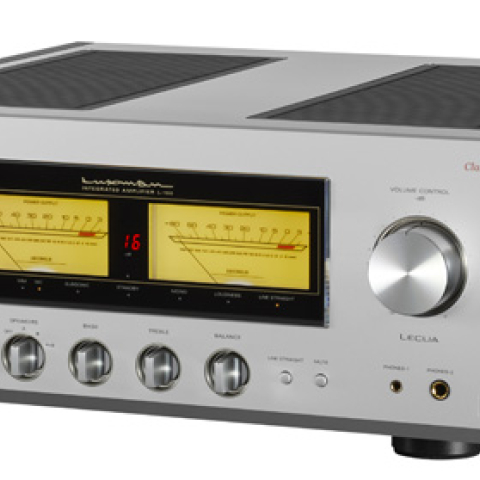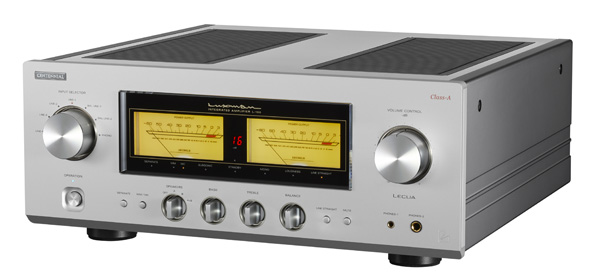
Before diving into Luxman's new L-100 Centennial integrated amplifier ($11,995)—which marks the Japanese firm's 100th year in business—I did what any audio reviewer with a paper trail does: I read my past Luxman reportage.
May 2018: the L-509X integrated amplifier ($9495), 120Wpc into 8 ohms, loaded with every imaginable sonic bell and whistle. My verdict: "One of the most intimate-sounding, dynamic, texturally nuanced, truthful purveyors of music of my experience. ... I could happily live with the Luxman L-509X till kingdom come."
February 2024: the L-509Z integrated amplifier ($12,495), Luxman's reigning flagship, which took over my NYC digs like a happy houseguest. Same power specs as the 509X, kindred circuit topology, a beefed-up phono stage, and 28 sculpted, honeycomb-meshed top-panel vents that glowed like sonic jewelry.
The new L-100 Centennial uses similar design language and is in the same price neighborhood as its 509 siblings. There is overlap in their specification sheets. So is the L-100 a genuine centennial statement or just a 509 in a new suit?
The 100th Anniversary Amplifier
I asked Luxman Head of Sales Izumi Saito to explain the differences between the L-100 and the L-509s X and Z. She started by explaining the company's design goals for the Centennial amplifier. "For our 100th anniversary," Saito wrote in an email, "our absolute goal was to create an amplifier capable of bringing the life and emotion of music to the highest possible level. We received countless requests from passionate audiophiles around the world for a modern, pure class-A integrated amplifier that incorporates Luxman's latest technologies."
Those technologies include a new version of LIFES 1.1 (the latest Luxman Integrated Feedback Engine System), LECUA1000 (the latest Luxman Electronically Controlled Ultimate Attenuator), an output stage with Darlington bipolar transistors, a custom EI-core power transformer and custom filter capacitors, and Luxman's peel-coat circuit boards.
I asked Saito how these Luxman technologies and components differ in the L-100. "LIFES 1.1 combines the open, natural, and effortless sound often associated with non-feedback amplifiers with the low distortion and stability of conventional feedback amplifiers," Saito stated. "The circuit consists of three main stages: the main amplifier, an error amplifier, and a current-amplification stage. ... The open-loop gain is 29.3dB, while the closed-loop gain is 29.0dB. That means the actual amount of negative feedback is only about 0.3dB. Despite using almost no feedback, it delivers fundamental performance that matches—or even exceeds—that of conventional high-feedback amplifier designs." (footnote 1)
"For the new LIFES 1.1, we paralleled the input FETs (field effect transistors) in the error amplifier, redesigned the gain distribution throughout the circuit, and optimized the bias circuitry. These improvements further reduced distortion across the entire frequency range and improved the signal/noise ratio. The improvements are measurable: Total harmonic distortion at 1kHz was reduced from 0.003% to 0.002%, at 100Hz from 0.002% to 0.001%, and at 20kHz from 0.007% to 0.006%."
I then asked how Luxman's familiar LECUA volume control changed in the L-100. For one, Luxman eliminated the pesky clicking sounds I recalled from its siblings.
"Our LECUA attenuator detects the exact moment when the audio signal passes through 0 volts—the zero-crossing point—and switches the attenuator only at that instant," Saito replied. "This allows volume changes to occur virtually silently. For the L-100, we developed a new countermeasure that suppresses and isolates even the extremely small noise generated by the zero-cross detection circuit itself. As a result, we've achieved an even higher level of signal purity."
 As noted, the L-100 operates in class-A, 20Wpc into 8 ohms and 40Wpc into 4 ohms. In a chat, Randy Bingham of US importer-distributor Rhythm Audio told Stereophile that these are the class-A values—that its output power at clipping is considerably higher. Measurements should show how much higher. This implies that the L-100 is, strictly speaking, a class-AB amplifier heavily biased into class-A. Which, if true, says nothing bad about the device: Assuming it meets its output-power specs, it runs to 20Wpc into 8 ohms and 40Wpc into 4 ohms in pure class-A.
"By optimizing the rated output to 20Wpc, we were able to operate the output stage with a lower supply voltage," Saito explained. "This allowed us to design a highly efficient thermal management system that safely dissipates the heat of pure class-A operation without requiring an enclosure as large as the L-509Z. We carefully balanced output power, operating voltage, and heat dissipation to achieve the ideal class-A performance in a more compact chassis."
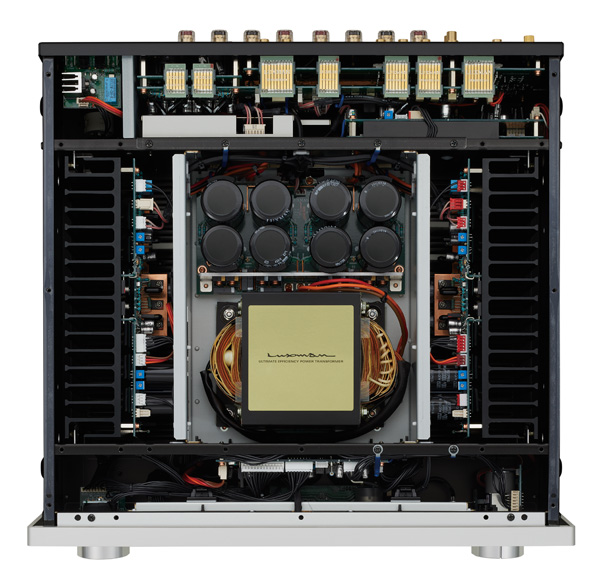
The custom EI-core transformer in the L-100's power supply was developed jointly with Homerun Electric Co., Ltd. Its eight custom 10,000µF filter capacitors were manufactured for Luxman by Nippon Chemi-Con Corporation. "These are exactly the same premium-grade capacitors used in our flagship L-509Z, so there has been no compromise in the quality of the power supply," Saito stated. "The L-100's signal wiring uses custom-made oxygen-free copper (OFC) conductors without any plating. By avoiding plated surfaces, we preserve the most natural conductivity possible."
Like the L-509Z, the L-100 uses a three-stage Darlington-connected bipolar transistor circuit, but here in a quadruple-parallel push-pull configuration (footnote 2). For the input stage, Luxman selected transistors from Isahaya Electronics, "known for their excellent low-noise characteristics," Saito said. For the second stage and output stage, Toshiba transistors, "which offer strong current delivery and a very natural, honest sound quality," were employed.
Like the earlier Luxman integrateds, the L-100 uses peel-coat PCB technology for its circuit boards. Circuit boards' copper traces are covered with a layer that insulates and resists solder. In the peel-coat process, this layer is selectively removed in the audio signal paths "to minimize the parasitic capacitance that can subtly affect sound quality." "Peel-coat" sounds like a Farberware frying pan sales gimmick but reportedly has audible benefits.
Likely of more audible consequence is the quality of the boards themselves. "The circuit board itself uses the same premium-grade glass-epoxy material as our flagship L-509Z," Saito added, "but the copper trace layout has been designed completely from scratch and optimized specifically for the electrical characteristics of the L-100." 100µm circuit-board traces lower resistance by 2/3 relative to the traces found on lower-quality boards. Luxman also rounds off sharp angles in its circuit-board traces. They say this practice was adopted "to achieve smooth signal transmission." I don't know if it helps, but it can't hurt.
At $11,995, the L-100 is priced just below the L-509Z. Were compromises made?
As noted, the L-100 operates in class-A, 20Wpc into 8 ohms and 40Wpc into 4 ohms. In a chat, Randy Bingham of US importer-distributor Rhythm Audio told Stereophile that these are the class-A values—that its output power at clipping is considerably higher. Measurements should show how much higher. This implies that the L-100 is, strictly speaking, a class-AB amplifier heavily biased into class-A. Which, if true, says nothing bad about the device: Assuming it meets its output-power specs, it runs to 20Wpc into 8 ohms and 40Wpc into 4 ohms in pure class-A.
"By optimizing the rated output to 20Wpc, we were able to operate the output stage with a lower supply voltage," Saito explained. "This allowed us to design a highly efficient thermal management system that safely dissipates the heat of pure class-A operation without requiring an enclosure as large as the L-509Z. We carefully balanced output power, operating voltage, and heat dissipation to achieve the ideal class-A performance in a more compact chassis."
The custom EI-core transformer in the L-100's power supply was developed jointly with Homerun Electric Co., Ltd. Its eight custom 10,000µF filter capacitors were manufactured for Luxman by Nippon Chemi-Con Corporation. "These are exactly the same premium-grade capacitors used in our flagship L-509Z, so there has been no compromise in the quality of the power supply," Saito stated. "The L-100's signal wiring uses custom-made oxygen-free copper (OFC) conductors without any plating. By avoiding plated surfaces, we preserve the most natural conductivity possible."
Like the L-509Z, the L-100 uses a three-stage Darlington-connected bipolar transistor circuit, but here in a quadruple-parallel push-pull configuration (footnote 2). For the input stage, Luxman selected transistors from Isahaya Electronics, "known for their excellent low-noise characteristics," Saito said. For the second stage and output stage, Toshiba transistors, "which offer strong current delivery and a very natural, honest sound quality," were employed.
Like the earlier Luxman integrateds, the L-100 uses peel-coat PCB technology for its circuit boards. Circuit boards' copper traces are covered with a layer that insulates and resists solder. In the peel-coat process, this layer is selectively removed in the audio signal paths "to minimize the parasitic capacitance that can subtly affect sound quality." "Peel-coat" sounds like a Farberware frying pan sales gimmick but reportedly has audible benefits.
Likely of more audible consequence is the quality of the boards themselves. "The circuit board itself uses the same premium-grade glass-epoxy material as our flagship L-509Z," Saito added, "but the copper trace layout has been designed completely from scratch and optimized specifically for the electrical characteristics of the L-100." 100µm circuit-board traces lower resistance by 2/3 relative to the traces found on lower-quality boards. Luxman also rounds off sharp angles in its circuit-board traces. They say this practice was adopted "to achieve smooth signal transmission." I don't know if it helps, but it can't hurt.
At $11,995, the L-100 is priced just below the L-509Z. Were compromises made?
 "Rather than investing in cosmetic luxuries, we simplified certain external elements," Saito said. "For example, unlike the L-509Z, the L-100 does not use the very expensive custom-machined, Mount Fuji–inspired control knob. Instead, we redirected that budget into the internal components that have the greatest influence on sound quality. In other words, we chose to invest where listeners can actually hear the difference.
"For many years, Luxman used high-quality analog electronic switches because they offered the best balance of performance and sound quality," Saito continued. "However, we finally found a relay that outperformed those analog switches in sonic performance. That allowed us to adopt relay switching throughout the L-100 without compromising signal purity." The new relay switching "contributes directly to a more vivid, energetic, and highly detailed musical presentation.
"In other words, while the L-100 offers a simpler user interface, the core analog performance remains very much flagship-level," Saito insisted. "Listeners can enjoy the same high standard of analog playback, with outstanding musicality, low noise, and rich detail, without feeling that they're compromising on sound quality."
Of importance to me—since I evaluate components mainly via vinyl playback—the L-100's MC/MM phono stage doesn't cheap out. It is based on the same circuit architecture as the one in the L-509Z. The only functional difference, I was told, is that the L-100 lacks the L-509Z's adjustable MC load resistance. Instead, Luxman optimized a fixed impedance value of 100 ohms, a decent match for most moving coil cartridges. It worked for me and mine.
The L-100 was developed by Luxman's core engineering team: Masakazu Nagatsuma, who led the sound design; Kunihiko Koki, responsible for the electrical design; and Yasuhito Omori, who oversaw the mechanical design. Like all Luxman equipment, the L-100 was made in Japan. Luxman operates three production facilities located near its headquarters in Kanagawa Prefecture.
"Our high-end flagship products are not assembled on a mass-production line," Saito wrote. "Instead, we use a cell production system, where highly skilled master craftsmen build each unit by hand with exceptional precision. This highest level of production is handled by a carefully selected team of four specialists, who assemble, inspect, and fine-tune each unit one by one, with great care and pride."
"Rather than investing in cosmetic luxuries, we simplified certain external elements," Saito said. "For example, unlike the L-509Z, the L-100 does not use the very expensive custom-machined, Mount Fuji–inspired control knob. Instead, we redirected that budget into the internal components that have the greatest influence on sound quality. In other words, we chose to invest where listeners can actually hear the difference.
"For many years, Luxman used high-quality analog electronic switches because they offered the best balance of performance and sound quality," Saito continued. "However, we finally found a relay that outperformed those analog switches in sonic performance. That allowed us to adopt relay switching throughout the L-100 without compromising signal purity." The new relay switching "contributes directly to a more vivid, energetic, and highly detailed musical presentation.
"In other words, while the L-100 offers a simpler user interface, the core analog performance remains very much flagship-level," Saito insisted. "Listeners can enjoy the same high standard of analog playback, with outstanding musicality, low noise, and rich detail, without feeling that they're compromising on sound quality."
Of importance to me—since I evaluate components mainly via vinyl playback—the L-100's MC/MM phono stage doesn't cheap out. It is based on the same circuit architecture as the one in the L-509Z. The only functional difference, I was told, is that the L-100 lacks the L-509Z's adjustable MC load resistance. Instead, Luxman optimized a fixed impedance value of 100 ohms, a decent match for most moving coil cartridges. It worked for me and mine.
The L-100 was developed by Luxman's core engineering team: Masakazu Nagatsuma, who led the sound design; Kunihiko Koki, responsible for the electrical design; and Yasuhito Omori, who oversaw the mechanical design. Like all Luxman equipment, the L-100 was made in Japan. Luxman operates three production facilities located near its headquarters in Kanagawa Prefecture.
"Our high-end flagship products are not assembled on a mass-production line," Saito wrote. "Instead, we use a cell production system, where highly skilled master craftsmen build each unit by hand with exceptional precision. This highest level of production is handled by a carefully selected team of four specialists, who assemble, inspect, and fine-tune each unit one by one, with great care and pride."
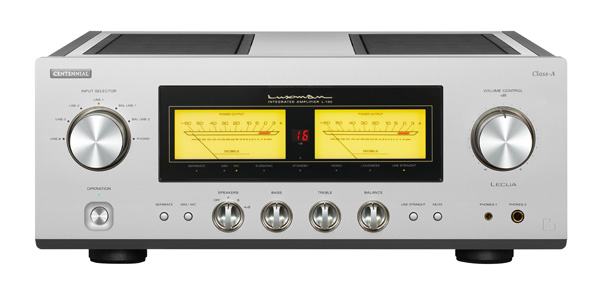
 Now that we know what's inside the L-100, how about the cosmetics? The L-100 stands 17.3" wide, 7" high, and 17.9" deep and weighs 56 lb, though it felt heavier to my noisy knees. It features a 3mm-thick aluminum top panel with integrated polycarbonate ventilation panels for heat resistance and efficient airflow. The 5mm-thick extruded aluminum front and side panels have a fine, bead-blasted finish. The chassis combines 1.2mm baked-coated steel panels with 1.2mm black zinc–plated steel, creating a mechanically stable structure that minimizes unwanted vibration. "The choice of materials and the thickness of each panel were carefully optimized to achieve optimal vibration control," Saito explained.
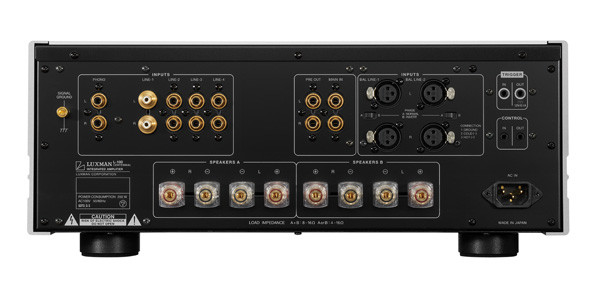
The high-quality parts array continues with precision-machined aluminum knobs, Shinohara Keiki Seisakusho VU meters, Emuden Musen Co., Ltd., RCA jacks, Neutrik XLRs, and Hong Kong–made MultiBiz speaker terminals. The L-100 includes the same remote control supplied with the L-507Z. It's lightweight, fits my hand comfortably, and has highly legible controls and a power button. On the other hand, the boxy design recalls a 1967 Magnavox TV remote.
Setup
Now that we know what's inside the L-100, how about the cosmetics? The L-100 stands 17.3" wide, 7" high, and 17.9" deep and weighs 56 lb, though it felt heavier to my noisy knees. It features a 3mm-thick aluminum top panel with integrated polycarbonate ventilation panels for heat resistance and efficient airflow. The 5mm-thick extruded aluminum front and side panels have a fine, bead-blasted finish. The chassis combines 1.2mm baked-coated steel panels with 1.2mm black zinc–plated steel, creating a mechanically stable structure that minimizes unwanted vibration. "The choice of materials and the thickness of each panel were carefully optimized to achieve optimal vibration control," Saito explained.
The high-quality parts array continues with precision-machined aluminum knobs, Shinohara Keiki Seisakusho VU meters, Emuden Musen Co., Ltd., RCA jacks, Neutrik XLRs, and Hong Kong–made MultiBiz speaker terminals. The L-100 includes the same remote control supplied with the L-507Z. It's lightweight, fits my hand comfortably, and has highly legible controls and a power button. On the other hand, the boxy design recalls a 1967 Magnavox TV remote.
Setup
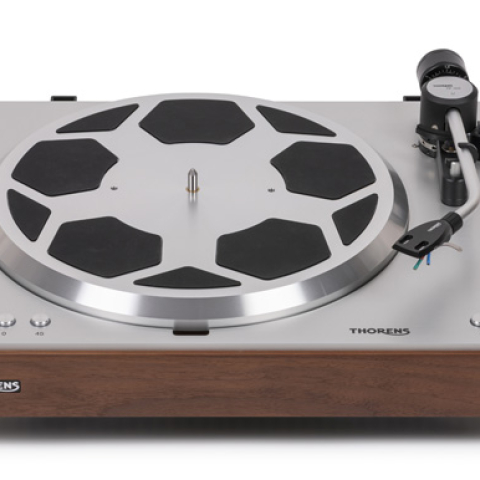
Luxman includes what Art Dudley, in his review of the Luxman CL-1000 preamp, characterized as "an owner's manual that suggests a manufacturer who gives a shit about the customer and who realizes that anyone who spends this much money on a single audio product might be presumed to have more than a passing interest in how the thing works." Every Luxman manual I've read is clear and comprehensible. The L-100 manual was no exception. I slid the portly L-100 onto a lower shelf of my Salamander rack so that it could mate with the J.Sikora Standard Max Supreme turntable on the top rack. Later, I put the L-100 on a sturdy wooden stool so that I could listen with my Thorens TD 124 turntable and its Korf TA-SF9R tonearm, which ended up getting most of the playing time. The L-100 has a recommended break-in period of 150 hours, so I dug into my wall of dusty CDs and put two on repeat through my cheap'n'crusty Tascam CD player: the British library music compilation The Sound Gallery Volume One (Scamp SCP 9707-2) and Squarepusher's drum-and-bass treatise Feed Me Weird Things (Rephlex CAT037CD).
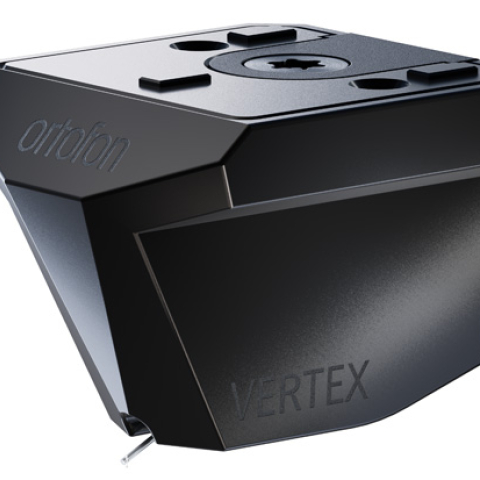
Cartridge-wise, two new moving coils—Ortofon's MC X30 ($779.99) and Sumiko's Oriole ($1699)—ran straight into the L-100's phono stage. The L-100 exposed their differences gleefully: the X30 coherent, physical, no-nonsense; the Oriole spinning gossamer, exacting treble in a more romantic, seductive line.
 Listening
I wanted to play some ear-shredding rawk through the Luxman. The Foo Fighters' 2011 45rpm double album Wasting Light (LP, Roswell Records 88697 84493 1) provided a potent starting point. The album was recorded entirely analog, with eight hands on the faders for the final mix. "I am no stranger to tape," Dave Grohl told me in an interview for Electronic Musician (footnote 3). "Call me dumb, but the simple signal path of a microphone to a tape machine makes perfect sense to me." Amen.
On "Bridge Burning," the L-100's 20 class-A watts drove the 90dB-sensitive >DeVore Fidelity Super Nines like a call to war. The Foo's pummeling dual-guitar carnage, cannon-blast drums, and densely packed soundstage bristled with visceral attack. The L-100 (and the record player, the DeVores, and ancillary stuff) confronted me with a seamless wall of hard rock energy at 200mph. If the L-100 could crank rock with this much crunch and headroom (with the right speakers), I wondered what it would do with orchestral scale.
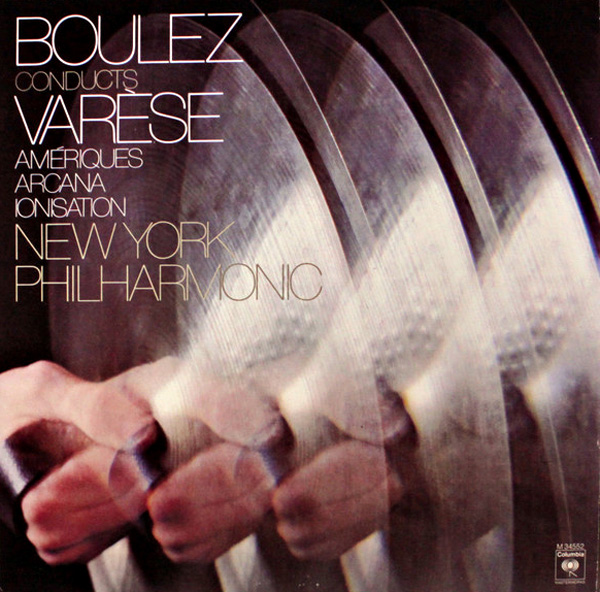
The Sumiko cartridge tore into Boulez Conducts Varèse with the New York Philharmonic (LP, Columbia Masterworks M 34552). This is a percussion jamboree apparently miked from the 25th row. Through the Luxman, it snapped with fast, crisp yet silky transients and tone that was chocolatey if dry. Rhythms crisscrossed as the amp mapped every inch of Manhattan Center's scale and depth. (Every Luxman I've reviewed has played with outstanding scale, layering, and separation, but the L-100 was better.) Notes flew like sunspots flaring off the sun—this thing is a PRaT king.
 Whatever the genre, the L-100 lent music aliveness and speed, a sense that the music was present and palpable in the room.
True to its class-A lineage, the L-100 conveyed a sense of note purity and note flow, with a real sense of musicians engaged in space. The L-100 seemed to float images into the room, not simply between the speakers.
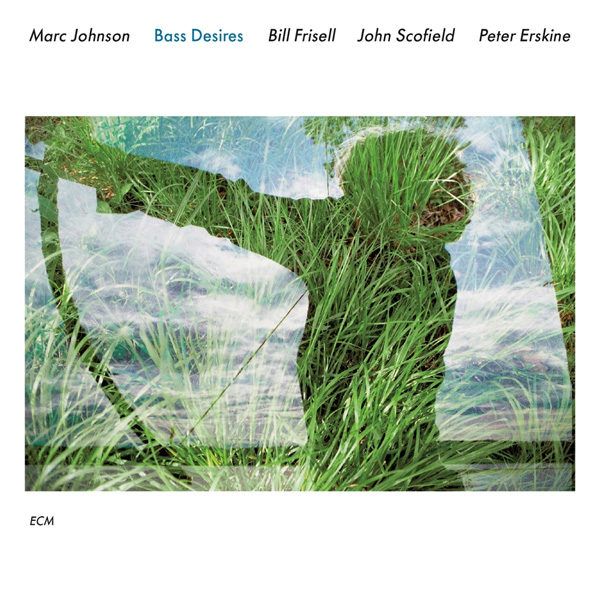
Jazz supergroup Bass Desires' debut (LP, ECM 1299) may date from 1986, but it still hits like a gut punch. Their take on Coltrane's "Resolution" is a cathartic blast of rhythmic risk and scalding interplay. The Luxman dug into the tune's small-studio intimacy while letting the big effects bloom: cathedral-length decay, seismic low end, crisp treble-to-midrange detail, and exacting resolution pushed to 11. Marc Johnson's acoustic bass hit with mass and articulation. Bill Frisell and John Scofield's twin guitars shrieked like baby monsters. Peter Erskine bruised everything within earshot. The soundstage was huge, 3D, and spatially stunning. The Luxman's speed, force, and acute tone locked into dramatic imaging and made untangling the music's complexity a breeze. Instruments occupied my room practically carved from space. I heard no smear or distortion. I did occasionally perceive what seemed to me an overtight grip, a slight mechanicalness compared to, say, the ease of a tubed class-A SET. That's picking a nit, if I'm honest.
Whatever the genre, the L-100 lent music aliveness and speed, a sense that the music was present and palpable in the room.
True to its class-A lineage, the L-100 conveyed a sense of note purity and note flow, with a real sense of musicians engaged in space. The L-100 seemed to float images into the room, not simply between the speakers.
Jazz supergroup Bass Desires' debut (LP, ECM 1299) may date from 1986, but it still hits like a gut punch. Their take on Coltrane's "Resolution" is a cathartic blast of rhythmic risk and scalding interplay. The Luxman dug into the tune's small-studio intimacy while letting the big effects bloom: cathedral-length decay, seismic low end, crisp treble-to-midrange detail, and exacting resolution pushed to 11. Marc Johnson's acoustic bass hit with mass and articulation. Bill Frisell and John Scofield's twin guitars shrieked like baby monsters. Peter Erskine bruised everything within earshot. The soundstage was huge, 3D, and spatially stunning. The Luxman's speed, force, and acute tone locked into dramatic imaging and made untangling the music's complexity a breeze. Instruments occupied my room practically carved from space. I heard no smear or distortion. I did occasionally perceive what seemed to me an overtight grip, a slight mechanicalness compared to, say, the ease of a tubed class-A SET. That's picking a nit, if I'm honest.
 I put on Frank Sinatra's In the Wee Small Hours (Capitol Records W 581). Frank's voice was utterly convincing and superbly intimate. Tones were pure. Images were visceral.
I put on the Oscar Peterson Trio + The Singers Unlimited's In Tune (LP, MPS Records MB 20905). Vocal layering was gorgeous. The music glowed with trippy explicitness.
Boards of Canada's Inferno (LP, Warp Records WARPLP496X) pumped hard and surrounded me, woozy atmospherics swirling with thick, weighty bass drum thuds underneath.
I changed directions, put on the Keith Jarrett Trio's "The Song Is You" from Still Live (LP, ECM 835 008-1). The Luxman gave refreshingly good insight into the trio's swing with clarity, grace, and gumption.
A mint second pressing of the Beatles' Please Please Me (LP, Parlophone PMC 1202) sucked me in with its crispness and low-end drive.
Intimacy. Separation. Deep bass. Musical flow and drive. The L-100 outplayed every memory I had of its Luxman siblings. It consistently delivered extended treble, a clear midrange with a touch of warmth, and deep bass that, while not as weighty and atmospheric as a good tube amp's, was always clear, taut, and punchy. Full-bodied and engaging, the L-100 brought exceptional layering, imaging, and speed, with a relentless sense of musical momentum and drive, while recovering subtle details in the wholeness of a large dimensional space. This is a landmark product for Luxman.
I put on Frank Sinatra's In the Wee Small Hours (Capitol Records W 581). Frank's voice was utterly convincing and superbly intimate. Tones were pure. Images were visceral.
I put on the Oscar Peterson Trio + The Singers Unlimited's In Tune (LP, MPS Records MB 20905). Vocal layering was gorgeous. The music glowed with trippy explicitness.
Boards of Canada's Inferno (LP, Warp Records WARPLP496X) pumped hard and surrounded me, woozy atmospherics swirling with thick, weighty bass drum thuds underneath.
I changed directions, put on the Keith Jarrett Trio's "The Song Is You" from Still Live (LP, ECM 835 008-1). The Luxman gave refreshingly good insight into the trio's swing with clarity, grace, and gumption.
A mint second pressing of the Beatles' Please Please Me (LP, Parlophone PMC 1202) sucked me in with its crispness and low-end drive.
Intimacy. Separation. Deep bass. Musical flow and drive. The L-100 outplayed every memory I had of its Luxman siblings. It consistently delivered extended treble, a clear midrange with a touch of warmth, and deep bass that, while not as weighty and atmospheric as a good tube amp's, was always clear, taut, and punchy. Full-bodied and engaging, the L-100 brought exceptional layering, imaging, and speed, with a relentless sense of musical momentum and drive, while recovering subtle details in the wholeness of a large dimensional space. This is a landmark product for Luxman.
 The Luxman meets the Voxativ Ampeggio 2025s
The 94dB-sensitive Voxativ Ampeggio 2024 drew even more wonders from the L-100. Synergistic and dynamic, the speaker's single full-range 8" driver brought remarkable detail, crispness, bass density, and fullness from every record I played. It felt like moving from the fifth row to the first: Nuance and subtlety were amplified, served up with intimacy, palpability, and overflowing texture. Bass was less taut but more atmospheric.
The Luxman drives the Volti Audio Luceras
Considering the Volti's 99dB sensitivity, with a 15" woofer, and its horn-loaded tweeter and midrange driver, you'd expect the Lucera> and the Luxman to hit it off, and they did. The Lucera cozied up to the Luxman like two peas in a pod. The soundfield was enormous; the Luxman fully engaged the horns to reveal even more of its silken treble. The midrange became a mite gummy, while the bass grew big enough to swallow me whole. Synergy, indeed. Compared with the Audio Note UK OTO Phono SE Signature
In for review, this classic Audio Note SE integrated amplifier puts out 10Wpc in class-A with four EL84 tubes, Audio Note copper-foil capacitors, 1W Nichrome resistors, and Kaisei electrolytic capacitors. The Audio Note played with more loose-limbed swagger, more continuity and flow, and an even greater sense of musicians inhabiting space, of music blooming into the room. It did what good tube amps do. But it couldn't match the Luxman's grand soundstage: Notes were slightly smeared. Imaging was more diffuse. The Audio Note also lacks the Luxman's dual binding posts, remote, MC phono input, tone controls, Line Direct and Loudness functions, and ran just 10Wpc to the Luxman's 20.
Summing up
Eleven thousand, nine hundred and ninety-five dollars is a lot of money. Who's the customer for this expensive integrated amplifier from a legacy Japanese brand? I'd say it's built for longtime Luxman devotees—those who love the house sound, the impressive layering and separation, grand soundstages, and dynamic splendor. It's also for listeners who prefer solid state to tube amplification, since this is very much the former. Its mountain of controls, including tone controls about which I've said little, is a selling point in its own right. The L-100's attributes are many, its faults practically nonexistent. It's the best Luxman I've heard, a long stride beyond the SQ-N150 integrated I raved over in 2019, an all-tube product that shook me. It's Luxman's celebration of 100 years and the latest, greatest evolution of the 509 series. It comes very highly recommended.
Footnote 1: Presumably Saito is referring to measured performance, of the sort feedback tends to improve and that tends to look inferior in no- and low-feedback amplifiers. Footnote 2: A Darlington transistor is two bipolar transistors connected so that the emitter of the first drives the base of the second, with both collectors tied together. The pair behaves as a single transistor, but since the current gains multiply, the current gain is very much higher. Disadvantages include doubling the base-emitter voltage drop and slower switching.
Footnote 3: See fooarchive.com/features/electronicmusician11.htm.
I asked Luxman Head of Sales Izumi Saito to explain the differences between the L-100 and the L-509s X and Z. She started by explaining the company's design goals for the Centennial amplifier. "For our 100th anniversary," Saito wrote in an email, "our absolute goal was to create an amplifier capable of bringing the life and emotion of music to the highest possible level. We received countless requests from passionate audiophiles around the world for a modern, pure class-A integrated amplifier that incorporates Luxman's latest technologies."
As noted, the L-100 operates in class-A, 20Wpc into 8 ohms and 40Wpc into 4 ohms. In a chat, Randy Bingham of US importer-distributor Rhythm Audio told Stereophile that these are the class-A values—that its output power at clipping is considerably higher. Measurements should show how much higher. This implies that the L-100 is, strictly speaking, a class-AB amplifier heavily biased into class-A. Which, if true, says nothing bad about the device: Assuming it meets its output-power specs, it runs to 20Wpc into 8 ohms and 40Wpc into 4 ohms in pure class-A.
"Rather than investing in cosmetic luxuries, we simplified certain external elements," Saito said. "For example, unlike the L-509Z, the L-100 does not use the very expensive custom-machined, Mount Fuji–inspired control knob. Instead, we redirected that budget into the internal components that have the greatest influence on sound quality. In other words, we chose to invest where listeners can actually hear the difference.
Now that we know what's inside the L-100, how about the cosmetics? The L-100 stands 17.3" wide, 7" high, and 17.9" deep and weighs 56 lb, though it felt heavier to my noisy knees. It features a 3mm-thick aluminum top panel with integrated polycarbonate ventilation panels for heat resistance and efficient airflow. The 5mm-thick extruded aluminum front and side panels have a fine, bead-blasted finish. The chassis combines 1.2mm baked-coated steel panels with 1.2mm black zinc–plated steel, creating a mechanically stable structure that minimizes unwanted vibration. "The choice of materials and the thickness of each panel were carefully optimized to achieve optimal vibration control," Saito explained.
Luxman includes what Art Dudley, in his review of the Luxman CL-1000 preamp, characterized as "an owner's manual that suggests a manufacturer who gives a shit about the customer and who realizes that anyone who spends this much money on a single audio product might be presumed to have more than a passing interest in how the thing works." Every Luxman manual I've read is clear and comprehensible. The L-100 manual was no exception. I slid the portly L-100 onto a lower shelf of my Salamander rack so that it could mate with the J.Sikora Standard Max Supreme turntable on the top rack. Later, I put the L-100 on a sturdy wooden stool so that I could listen with my Thorens TD 124 turntable and its Korf TA-SF9R tonearm, which ended up getting most of the playing time. The L-100 has a recommended break-in period of 150 hours, so I dug into my wall of dusty CDs and put two on repeat through my cheap'n'crusty Tascam CD player: the British library music compilation The Sound Gallery Volume One (Scamp SCP 9707-2) and Squarepusher's drum-and-bass treatise Feed Me Weird Things (Rephlex CAT037CD).
ListeningI wanted to play some ear-shredding rawk through the Luxman. The Foo Fighters' 2011 45rpm double album Wasting Light (LP, Roswell Records 88697 84493 1) provided a potent starting point. The album was recorded entirely analog, with eight hands on the faders for the final mix. "I am no stranger to tape," Dave Grohl told me in an interview for Electronic Musician (footnote 3). "Call me dumb, but the simple signal path of a microphone to a tape machine makes perfect sense to me." Amen.
Whatever the genre, the L-100 lent music aliveness and speed, a sense that the music was present and palpable in the room.
I put on Frank Sinatra's In the Wee Small Hours (Capitol Records W 581). Frank's voice was utterly convincing and superbly intimate. Tones were pure. Images were visceral.
The Luxman meets the Voxativ Ampeggio 2025sThe 94dB-sensitive Voxativ Ampeggio 2024 drew even more wonders from the L-100. Synergistic and dynamic, the speaker's single full-range 8" driver brought remarkable detail, crispness, bass density, and fullness from every record I played. It felt like moving from the fifth row to the first: Nuance and subtlety were amplified, served up with intimacy, palpability, and overflowing texture. Bass was less taut but more atmospheric.
Considering the Volti's 99dB sensitivity, with a 15" woofer, and its horn-loaded tweeter and midrange driver, you'd expect the Lucera> and the Luxman to hit it off, and they did. The Lucera cozied up to the Luxman like two peas in a pod. The soundfield was enormous; the Luxman fully engaged the horns to reveal even more of its silken treble. The midrange became a mite gummy, while the bass grew big enough to swallow me whole. Synergy, indeed. Compared with the Audio Note UK OTO Phono SE Signature
In for review, this classic Audio Note SE integrated amplifier puts out 10Wpc in class-A with four EL84 tubes, Audio Note copper-foil capacitors, 1W Nichrome resistors, and Kaisei electrolytic capacitors. The Audio Note played with more loose-limbed swagger, more continuity and flow, and an even greater sense of musicians inhabiting space, of music blooming into the room. It did what good tube amps do. But it couldn't match the Luxman's grand soundstage: Notes were slightly smeared. Imaging was more diffuse. The Audio Note also lacks the Luxman's dual binding posts, remote, MC phono input, tone controls, Line Direct and Loudness functions, and ran just 10Wpc to the Luxman's 20.
Eleven thousand, nine hundred and ninety-five dollars is a lot of money. Who's the customer for this expensive integrated amplifier from a legacy Japanese brand? I'd say it's built for longtime Luxman devotees—those who love the house sound, the impressive layering and separation, grand soundstages, and dynamic splendor. It's also for listeners who prefer solid state to tube amplification, since this is very much the former. Its mountain of controls, including tone controls about which I've said little, is a selling point in its own right. The L-100's attributes are many, its faults practically nonexistent. It's the best Luxman I've heard, a long stride beyond the SQ-N150 integrated I raved over in 2019, an all-tube product that shook me. It's Luxman's celebration of 100 years and the latest, greatest evolution of the 509 series. It comes very highly recommended.
Footnote 1: Presumably Saito is referring to measured performance, of the sort feedback tends to improve and that tends to look inferior in no- and low-feedback amplifiers. Footnote 2: A Darlington transistor is two bipolar transistors connected so that the emitter of the first drives the base of the second, with both collectors tied together. The pair behaves as a single transistor, but since the current gains multiply, the current gain is very much higher. Disadvantages include doubling the base-emitter voltage drop and slower switching.