Sidebar 3: Measurements
I used DRA Labs' MLSSA system and a calibrated DPA 4006 microphone to measure the NEAT Acoustics Iota Alpha's frequency response in the farfield, and an Earthworks QTC-40 for the nearfield responses. The first challenge I faced was deciding on which axis I should place my microphone for the farfield measurements. Sitting on its spikes, the Iota Alpha is 19" high, and its tweeter is just 17" from the floor. However, the section of the front baffle on which the tweeter and midrange unit are mounted is canted back at 30°, which aims those units directly at the ears of a listener seated a reasonable distance away. I therefore chose to make my primary response measurements on an axis perpendicular to the baffle, with the microphone pointed at the tweeter.
As might be expected from its small size, the Iota Alpha offers a low voltage sensitivity, my estimate being 83dB(B)/2.83V, which is 3dB lower than the manufacturer's claim. Looking at the NEAT's plot of impedance magnitude and electrical phase angle against frequency (fig.1), while the Iota Alpha is specified as a 4 ohm load, the impedance remains above 6 ohms for almost the entire audioband, dropping to 4 ohms only below 50Hz, and reaching 3.6 ohms at 10Hz. As the electrical phase angle is generally benign, I would venture to say that an 8 ohm–rated amplifier would have no difficulty driving the Iota.


 Higher in frequency in fig.3, the Iota Alpha's response is even overall, with many small peaks balanced by small suckouts and the tweeter rolling off sharply above 15kHz or so. However, the narrow peak just above 3kHz raised my eyebrows, and may well correlate with KM's having noticed an occasional nasality.
Fig.4 shows the NEAT's lateral dispersion, referenced to the tweeter-axis response: the off-axis differences on the midrange unit's side of the baffle are shown to the rear, those on the tweeter side's to the front. As is to be expected with two drive-units mounted side by side, a suckout develops in their crossover region to the speaker's sides—this appears to be set at 2.75kHz rather than the specified 5kHz—more on the midrange unit's side than on the tweeter's. This suggests that the mirror-imaged Iota Alphas be set up with the tweeters on their inside edges. Though the reflections from the room's sidewalls will thus have insufficient energy between 2 and 4kHz, this might work against the audibility of that on-axis peak in the presence region. The tweeter has very limited dispersion in the vertical plane (fig.5); to get a full measure of top-octave energy, you should sit within a ±5° window centered on the tweeter axis.
Higher in frequency in fig.3, the Iota Alpha's response is even overall, with many small peaks balanced by small suckouts and the tweeter rolling off sharply above 15kHz or so. However, the narrow peak just above 3kHz raised my eyebrows, and may well correlate with KM's having noticed an occasional nasality.
Fig.4 shows the NEAT's lateral dispersion, referenced to the tweeter-axis response: the off-axis differences on the midrange unit's side of the baffle are shown to the rear, those on the tweeter side's to the front. As is to be expected with two drive-units mounted side by side, a suckout develops in their crossover region to the speaker's sides—this appears to be set at 2.75kHz rather than the specified 5kHz—more on the midrange unit's side than on the tweeter's. This suggests that the mirror-imaged Iota Alphas be set up with the tweeters on their inside edges. Though the reflections from the room's sidewalls will thus have insufficient energy between 2 and 4kHz, this might work against the audibility of that on-axis peak in the presence region. The tweeter has very limited dispersion in the vertical plane (fig.5); to get a full measure of top-octave energy, you should sit within a ±5° window centered on the tweeter axis.


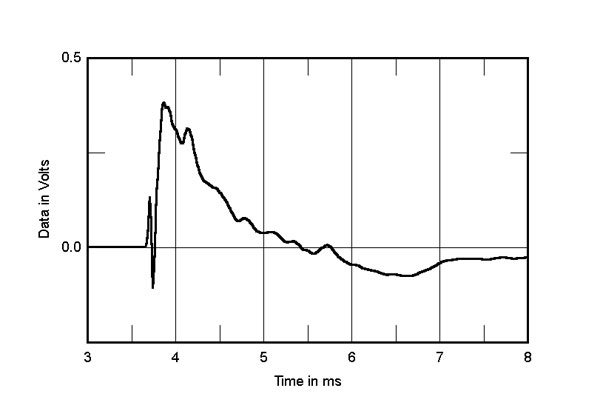

Fig.1 NEAT Iota Alpha, electrical impedance (solid) and phase (dashed) (5 ohms/vertical div.).
Fig.1 reveals a small discontinuity just below 500Hz in each of the traces, implying the existence of some kind of resonant mode. Investigating the enclosure's vibrational behavior with a simple plastic-tape accelerometer, I found a fairly strong mode at 465Hz on the rear panel and front baffle (fig.2), and another, stronger mode at 684Hz. You can also see that the baffle "pumps" a little at one of the port's tuning frequencies.
Fig.2 NEAT Iota Alpha, cumulative spectral-decay plot calculated from output of accelerometer fastened to center of front baffle (MLS driving voltage to speaker, 7.55V; measurement bandwidth, 2kHz).
One of the port's tuning frequencies? As you can see from the red trace in fig.3, the rear-facing port behaves in a more complex way than the norm. While the downward-firing woofer has a sharply defined minimum-motion notch at 51Hz in its output (blue trace), instead of peaking at that frequency, the port has peaks both below and above it. Though there is a third peak at 400Hz in the port's output, this is well down in level and should have no effect on sound quality. As I had for the impedance measurement, I measured the woofer's nearfield output with the speaker raised, on its spikes, the necessary 1.5" from the floor; it covers a narrow bandpass of 80–140Hz, while the midrange unit (green trace) rolls off with the 12dB/octave slope typical of a sealed enclosure below 200Hz, which is higher than the specified 80Hz. The black trace below 200Hz in fig.3 is the complex sum of the three nearfield responses; it peaks dramatically between 70 and 120Hz, with a sharp rolloff below 40Hz. I note that while Ken Micallef didn't remark on the NEAT's low frequencies being boomy, he several times referred to its bass being "soft." With the Iota Alpha's lack of bass extension, it needs to be used relatively close to the wall behind it to get enough low-frequency weight, as KM found.
Fig.3 NEAT Iota Alpha, anechoic response on tweeter axis perpendicular to baffle at 50", averaged across 30° horizontal window and corrected for microphone response, with nearfield responses of midrange unit (green), woofer (blue), port (red), plotted in the ratios of the square roots of their radiating areas, and complex sum of the nearfield responses plotted below 300Hz.
Fig.4 NEAT Iota Alpha, lateral response family at 50", normalized to response on tweeter axis, from back to front: differences in response 90–5° off axis on midrange side, reference response, differences in response 5–90° off axis on tweeter side.
Fig.5 NEAT Iota Alpha, vertical response family at 50", normalized to response on tweeter axis, from back to front: differences in response 45–5° above axis, reference response, differences in response 5–45° below axis.
Looking at the NEAT's performance in the time domain, its step response on the tweeter axis (fig.6) reveals that all three drive-units are connected in positive acoustic polarity, with the tweeter's output leading that of the midrange unit and woofer. There are some ripples in the decay of the midrange unit's step that the Iota Alpha's cumulative spectral-decay plot (fig.7) reveals to be associated with that on-axis peak just above 3kHz. However, while the initial decay of the speaker's sound is relatively clean (other than at 3.24kHz), several other lower-level ridges of delayed energy are visible in the treble.
Fig.6 NEAT Iota Alpha, step response on tweeter axis at 50" (5ms time window, 30kHz bandwidth).
Fig.7 NEAT Iota Alpha, cumulative spectral-decay plot on tweeter axis at 50" (0.15ms risetime).
KM loved how this attractive little speaker sounded, and its shape and small size make it domestically very friendly; however, I was disappointed by its measured performance.—John Atkinson