

Sidebar 3: Measurements The NHT's impedance (fig.1) stays between 4 and 6 ohms over much of the audioband, with a dip to 3.4 ohms at 54Hz but a moderately low phase angle overall. The combination of 6 ohms magnitude and 45 degrees phase angle at 40Hz might be too demanding for some receivers, but an amplifier rated into 4 ohms would be a good match for the speaker. My estimate of the 2.9's voltage sensitivity came in marginally higher than spec at 88dB/2.83V/m, meaning that even a 50W amplifier will drive it to quite high levels in a moderate-sized room. The peak at 30Hz in fig.1 indicates the 10" woofer's sealed-box tuning frequency. 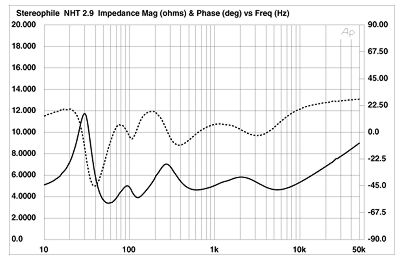 Fig.1 NHT 2.9, electrical impedance (solid) and phase (dashed). (2 ohms/vertical div.) Other than a slight glitch at the metal-dome tweeter's ultrasonic resonance frequency (a high 26kHz), the impedance traces were free from wrinkles indicating the presence of vibrational problems. Nevertheless, investigating the cabinet's behavior with a simple plastic-tape accelerometer indicated a strong panel resonance at 207Hz (fig.2), with others present at 120Hz and 310Hz. I would expect some lack of clarity in the lower midrange to result from these modes.
 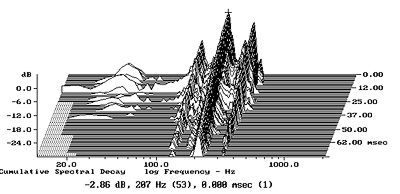 Fig.2 NHT 2.9, cumulative spectral-decay plot of accelerometer output fastened to side wall opposite woofer. (MLS driving voltage to speaker, 7.55V; measurement bandwidth, 2kHz.)
The NHT 2.9 covers the midrange and bass with three different drive-units; I was interested to see how these shared duties. This can be seen in fig.3, which shows their individual responses, measured in the nearfield. The woofer covers the bandpass covering the one and a half octaves between 35Hz and 100Hz, with the lower -6dB point at 33Hz. The woofer crosses over to the lower-midrange unit at 100Hz, as specified, though that unit hands over to the upper-midrange unit at 275Hz rather than the specified 350Hz. The actual crossover high-pass slopes appear to be third-order, 18dB/octave.
Fig.2 NHT 2.9, cumulative spectral-decay plot of accelerometer output fastened to side wall opposite woofer. (MLS driving voltage to speaker, 7.55V; measurement bandwidth, 2kHz.)
The NHT 2.9 covers the midrange and bass with three different drive-units; I was interested to see how these shared duties. This can be seen in fig.3, which shows their individual responses, measured in the nearfield. The woofer covers the bandpass covering the one and a half octaves between 35Hz and 100Hz, with the lower -6dB point at 33Hz. The woofer crosses over to the lower-midrange unit at 100Hz, as specified, though that unit hands over to the upper-midrange unit at 275Hz rather than the specified 350Hz. The actual crossover high-pass slopes appear to be third-order, 18dB/octave. 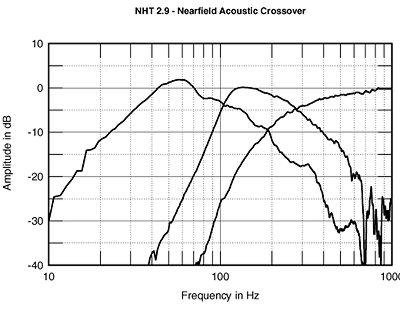 Fig.3 NHT 2.9, nearfield woofer, lower-midrange, and upper-midrange units. When these nearfield responses are summed in the proportion of the units' radiating diameters, and taking into account phase and the spacing between the woofer and the midrange units, there appears to be a slight lack of energy in the two octaves between 50Hz and 200Hz (fig.4). As TJN noted, when the 2.9s are positioned well away from the walls of the room, they sound quite lean. But this depression will fill in to a large extent when the speaker is moved closer to the wall behind it, and quite a lot of the setup time will be taken in balancing the bass/upper-midrange transition to sound even and neutral.
Fig.1 NHT 2.9, electrical impedance (solid) and phase (dashed). (2 ohms/vertical div.) Other than a slight glitch at the metal-dome tweeter's ultrasonic resonance frequency (a high 26kHz), the impedance traces were free from wrinkles indicating the presence of vibrational problems. Nevertheless, investigating the cabinet's behavior with a simple plastic-tape accelerometer indicated a strong panel resonance at 207Hz (fig.2), with others present at 120Hz and 310Hz. I would expect some lack of clarity in the lower midrange to result from these modes. Fig.2 NHT 2.9, cumulative spectral-decay plot of accelerometer output fastened to side wall opposite woofer. (MLS driving voltage to speaker, 7.55V; measurement bandwidth, 2kHz.) Fig.3 NHT 2.9, nearfield woofer, lower-midrange, and upper-midrange units. When these nearfield responses are summed in the proportion of the units' radiating diameters, and taking into account phase and the spacing between the woofer and the midrange units, there appears to be a slight lack of energy in the two octaves between 50Hz and 200Hz (fig.4). As TJN noted, when the 2.9s are positioned well away from the walls of the room, they sound quite lean. But this depression will fill in to a large extent when the speaker is moved closer to the wall behind it, and quite a lot of the setup time will be taken in balancing the bass/upper-midrange transition to sound even and neutral.














