Fig.4 NHT 2.9, anechoic response on upper-midrange tweeter axis at 50", averaged across 30 degrees horizontal window and corrected for microphone response, with the complex sum of the nearfield woofer and midrange-unit responses plotted below 400Hz.
TJN also commented on the NHT 2.9's highs as sounding "a bit bright, with a slight bite to the treble." Fig.4 does reveal that there is a smooth rising trend apparent on-axis from the midrange to 12kHz or so, broken by some extra energy in the low treble. The speaker's lateral dispersion on the upper-midrange axis (fig.5), however, is evenly balanced—the inner, woofer side of the off-axis family is shown to the front of this graph—though the excess of on-axis energy between 1 and 3kHz is accentuated on the speaker's outside edge. The 2.9's slight tendency to brightness will be exaggerated if it is positioned close to hard, reflective outside walls.

Fig.5 NHT 2.9, lateral response family at 50", normalized to response on upper-midrange axis, from back to front: differences in response 90 degrees-5 degrees off-axis on outside edge, reference response, differences in response 5 degrees-90 degrees off-axis on inside (woofer) edge.
All the previous farfield measurements were taken on the upper-midrange axis, which is 36" from the floor. (A survey performed many years ago by TJN indicated 36" to be the average height from the floor of a seated listener's ears.) The NHT's dispersion in the vertical plane (fig.6) shows that the speaker's balance doesn't change significantly between the tweeter axis and the top of the cabinet. But if you stand or sit in a very high chair, a large suckout develops in the crossover region between the upper-midrange unit and the tweeter, shown by the cursor position in this graph.

Fig.6 NHT 2.9, vertical response family at 50", from back to front: differences in response 15 degrees-5 degrees above upper-midrange axis, reference response, differences in response 5 degrees-10 degrees below upper-midrange axis.
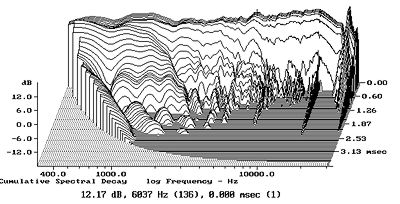
In the time domain, the 2.9's farfield step response (fig.7) reveals the tweeter and the upper-midrange unit to be connected with positive acoustic polarity, the lower-midrange unit with negative polarity. The woofer's contribution is too small to be seen on this graph, but it, too, is connected with inverted acoustic polarity. The NHT's cumulative spectral-decay plot (fig.8) is basically clean, suggesting a grain-free presentation.—
John Atkinson 
Fig.7 NHT 2.9, step response on upper-midrange axis at 50" (5ms time window, 30kHz bandwidth).