For a reviewer, deciding which products to write about is a tricky business. You want to do a professional job of evaluation, but you also want to be able to wrest maximum enjoyment from your music while you do so. Attending audio shows is where reviewers perform sonic triage, weeding out the products that aren't ready for prime time, and making a note of those they wish to invite home after the show.
Jason Victor Serinus and I had both been impressed by the sound of Nola's Metro Grand Reference Gold speakers at the 2013 Rocky Mountain Audio Fest, and Jason had repeated that positive experience at the 2014 Newport Beach show. I therefore asked Nola's Carl Marchisotto for review samples of this $33,000/pair loudspeaker.
The Metro Grand Reference Gold
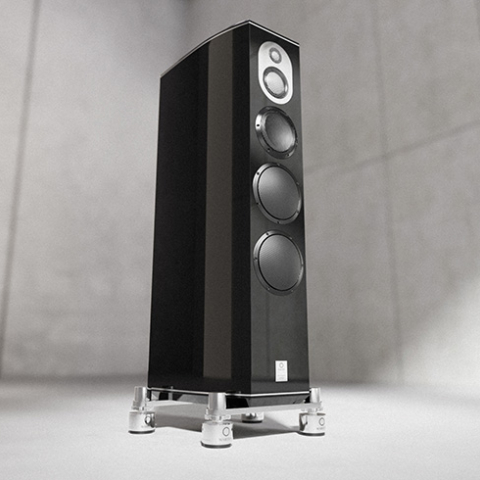
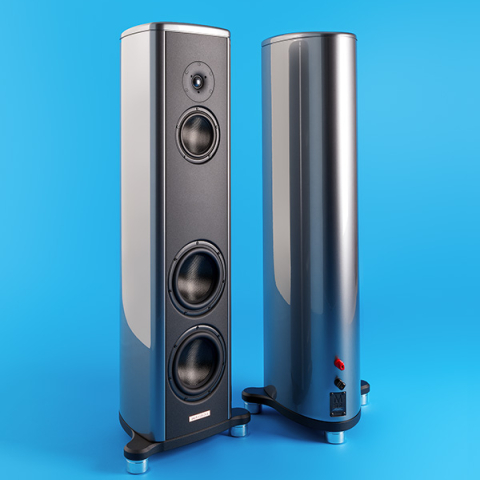
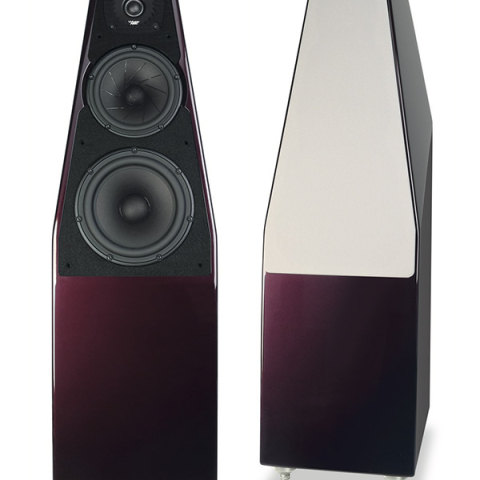
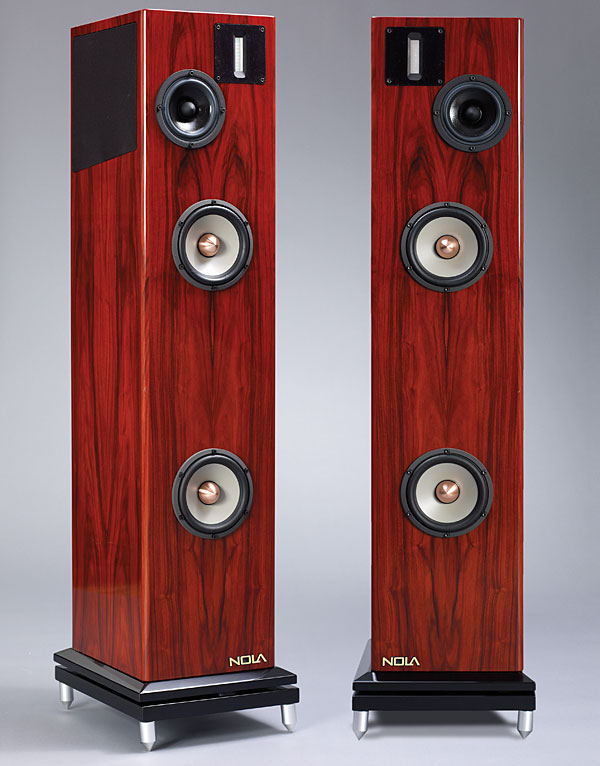
The Metro Grand Reference Gold is a development of the original Metro Grand Reference, itself trickled down from Nola's top-of-the-line Grand Reference VI and the Concert Grand Reference models. Occupying one square foot of floor space, the Metro Grand is a slim tower beautifully finished in high-gloss black. (High-gloss rosewood and other finishes are also available.)
Two of the well-regarded SEAS magnesium-alloy–cone 6.5" woofers are mounted on the front baffle, each loaded with its own asymmetrically proportioned, ported chamber, vented to the rear. Rather than the usual ferrite magnet, these drivers are each fitted with an expensive alnico magnet said to offer increased clarity and definition and lower distortion than ferrite. The cones are terminated with a substantial half-roll rubber surround, and, rather than a dustcap, there is a stationary copper phase plug, plated with gold, hence the speaker's name. The soft gold plating is applied not only for cosmetic reasons; it also damps parasitic vibrations within the plug.
The top quarter of the enclosure is actually an extension of the front baffle, open to the rear. On it are mounted a 4" laminated-cone midrange unit, this also having an alnico magnet, and an expensive ribbon tweeter manufactured in Serbia and featuring an aluminum diaphragm 2.5" by 0.4". The tweeter, which is claimed to extend to 100kHz, is mounted to the side of and above the midrange unit—the speakers are provided as a mirror-imaged pair—and a flat plate connects the top of the baffle to a pair of supporting posts at the speaker's rear.
 Electrical connection is via a single pair of high-quality copper binding posts on the enclosure's rear, and all internal connections are Nordost Mono-Filament Silver wire. The crossover, which uses proprietary polypropylene-silver-gold-oil capacitors and flat copper-ribbon coils, is implemented on three separate crossover boards. The enclosure sits on a double-platform, ball-bearing isolation base: the bottom plate is coupled to the floor with spiked feet, and the speaker sites on the top plate, which rests on ball bearings that ride in longitudinal grooves in the plate.
All in all, Nola's Metro Grand Reference Gold gives every impression of cost-no-object construction and design.
Setup
Electrical connection is via a single pair of high-quality copper binding posts on the enclosure's rear, and all internal connections are Nordost Mono-Filament Silver wire. The crossover, which uses proprietary polypropylene-silver-gold-oil capacitors and flat copper-ribbon coils, is implemented on three separate crossover boards. The enclosure sits on a double-platform, ball-bearing isolation base: the bottom plate is coupled to the floor with spiked feet, and the speaker sites on the top plate, which rests on ball bearings that ride in longitudinal grooves in the plate.
All in all, Nola's Metro Grand Reference Gold gives every impression of cost-no-object construction and design.
Setup
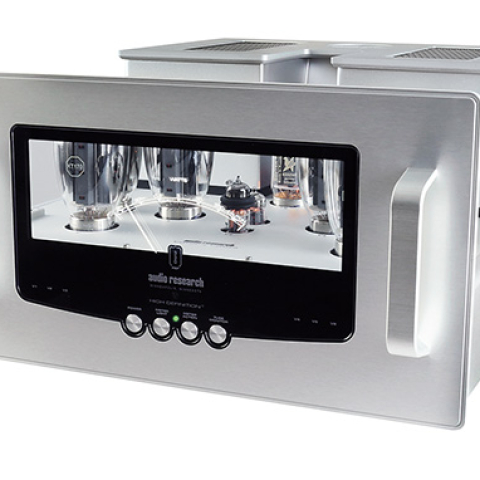
Rather than ship the review samples, Carl Marchisotto brought them over in person, along with 10' lengths of his preferred loudspeaker cable, Nordost Odin. (Though unfamiliar with the Odins, I did do some comparisons with the Kubala-Sosna Elation! cables I'd been using—see later.) Although he had also wanted to bring his Audio Research Reference 75 stereo power amplifier for me to use—an amplifier with which I was familiar, having used it for a while after it was reviewed by Bob Reina for the May 2013 issue of Stereophile—it was not available that day. Marchisotto therefore shipped it to me a couple of weeks later, along with a Nordost Odin AC cable fitted with the appropriate 20A IEC plug. Using a CD-R of his reference tracks, Marchisotto methodically moved each Metro Grand Reference Gold until he was satisfied that it was speaking with one voice across the audioband. He then placed each speaker on its ball-bearing–coupled base, did some confirming listening, and bade me farewell.
The speakers ended up facing straight ahead—no toe-in—in my approximately 25' by 16' room with the ribbon tweeters on their inside edges, which were 65" apart. The front baffles were 89" from the wall behind them and 98" from the listening seat. There was a slight asymmetry in the positioning: the left speaker was 39" from the front of the LP cabinets that face the left wall, the right speaker 51" from the front of the bookshelves that line the right wall.
Listening
My first impression of the Nolas after Carl Marchisotto had left, with the speakers driven by Pass Labs XA60.5 amplifiers, was of a rich, warm balance, with excellent low-frequency extension. Listening to the Budapest Festival Orchestra's fine performance, with Iv†n Fisher conducting, of Mahler's Symphony 4 (DSD64 file from SACD, Channel Classics CCS SA26109), the Metro Grand References produced an impressively detailed sweep of orchestral sound, with excellent weight to the punctuating double-bass line in the slow movement. It was hard to believe that four 6.5" woofers were capable of this impressive bass performance! I cued up a pipe-organ recording I'd made in Oregon last May, or Jonas Nordwall playing the Toccata from Widor's Organ Symphony 5 in Portland's First United Methodist Church (24-bit/88.2kHz AIFF file). This recording has very high levels of low frequencies, and the Metro Grands reproduced the bass-pedal notes with good clarity and weight.
The Metro Grand Reference Gold is a development of the original Metro Grand Reference, itself trickled down from Nola's top-of-the-line Grand Reference VI and the Concert Grand Reference models. Occupying one square foot of floor space, the Metro Grand is a slim tower beautifully finished in high-gloss black. (High-gloss rosewood and other finishes are also available.)
Electrical connection is via a single pair of high-quality copper binding posts on the enclosure's rear, and all internal connections are Nordost Mono-Filament Silver wire. The crossover, which uses proprietary polypropylene-silver-gold-oil capacitors and flat copper-ribbon coils, is implemented on three separate crossover boards. The enclosure sits on a double-platform, ball-bearing isolation base: the bottom plate is coupled to the floor with spiked feet, and the speaker sites on the top plate, which rests on ball bearings that ride in longitudinal grooves in the plate.
Rather than ship the review samples, Carl Marchisotto brought them over in person, along with 10' lengths of his preferred loudspeaker cable, Nordost Odin. (Though unfamiliar with the Odins, I did do some comparisons with the Kubala-Sosna Elation! cables I'd been using—see later.) Although he had also wanted to bring his Audio Research Reference 75 stereo power amplifier for me to use—an amplifier with which I was familiar, having used it for a while after it was reviewed by Bob Reina for the May 2013 issue of Stereophile—it was not available that day. Marchisotto therefore shipped it to me a couple of weeks later, along with a Nordost Odin AC cable fitted with the appropriate 20A IEC plug. Using a CD-R of his reference tracks, Marchisotto methodically moved each Metro Grand Reference Gold until he was satisfied that it was speaking with one voice across the audioband. He then placed each speaker on its ball-bearing–coupled base, did some confirming listening, and bade me farewell.
My first impression of the Nolas after Carl Marchisotto had left, with the speakers driven by Pass Labs XA60.5 amplifiers, was of a rich, warm balance, with excellent low-frequency extension. Listening to the Budapest Festival Orchestra's fine performance, with Iv†n Fisher conducting, of Mahler's Symphony 4 (DSD64 file from SACD, Channel Classics CCS SA26109), the Metro Grand References produced an impressively detailed sweep of orchestral sound, with excellent weight to the punctuating double-bass line in the slow movement. It was hard to believe that four 6.5" woofers were capable of this impressive bass performance! I cued up a pipe-organ recording I'd made in Oregon last May, or Jonas Nordwall playing the Toccata from Widor's Organ Symphony 5 in Portland's First United Methodist Church (24-bit/88.2kHz AIFF file). This recording has very high levels of low frequencies, and the Metro Grands reproduced the bass-pedal notes with good clarity and weight.