I followed the Widor with a CD that I bought following Sam Tellig's recommendation in his July "Sam's Space" column: a recital from London's Wigmore Hall by cellist Antonio Meneses and pianist Maria-João Pires (CD, Deutsche Grammophon 4790965). Pires's empathetic performance of Brahms's Op.117 Intermezzi has displaced my own recording, Intermezzo, of Robert Silverman performing these delicate piano works (CD, Stereophile STPH003-2). Again I was impressed by the Nola's bottom-octave clarity—the Metro Grand readily differentiated the pitches of the piano's octave-spaced B-flats below the bass staff at the end of the second Intermezzo. But as I listened to the entire CD, I became aware that some mid-frequency piano notes were being emphasized, and that there was a lack of midrange clarity to the sound of the cello in Schubert's Sonata for Arpeggione, D.821.
 I reached for my Editor's Choice (CD, Stereophile STPH016-2), put together more than a decade ago but still an invaluable diagnostic tool. The low-frequency, 1/3-octave warble tones were reproduced with full weight down to the 25Hz band, but, as always with speakers with excellent bass extension, the 32Hz warble tone was boosted by a room mode. The 20Hz warble tone was inaudible at normal listening levels. One oddity was that there was an audible rattle with the 100 and 32Hz warble tones. Some of the hex-head bolts securing the woofers to the baffles on both speakers were loose, so I tightened those, but to no effect. I further investigated using a sinewave generator, and it turned out that the rattle was coming from the ball-bearing–isolated base. At exactly 34Hz, the speaker shook—the rattle was due to the top part of the base sliding on the bearings and hitting the end stops. This resonance was of very high quality factor (Q), so would be unlikely to be excited by music, but it does suggest that this base doesn't provide a sufficiently effective mechanical ground for the Metro Grand's enclosure.
With the half-step–spaced toneburst track on Editor's Choice, the tones didn't speak as cleanly as I wished through the lower midrange, between 128 and 512Hz. Listening to the enclosure panels with a stethoscope, I could hear strong vibrational modes in this region on all surfaces other than the front baffle, as well as a low-level mechanical buzz from inside the speaker. The "lid" over the cabinet's open-baffle section was also very lively. I continued my auditioning with Acoustic Ballasts—canvas bags filled with lead shot—on the lids and a VPI Brick on top of the woofer sections; this silenced the buzzes, but didn't seem to reduce the amplitude of the cabinet vibrations, nor did it affect the frequency-specific shaking from the ball-bearing bases.
Substituting the ARC Reference 75 for the Pass Labs monoblocks resulted in an improvement in midrange tangibility, though the low frequencies lost a little extension. In Saturn, from Holst's The Planets, with Sir Adrian Boult conducting the London Philharmonic (CD, EMI CDM 7 690452), the arpeggiated double-bass tune at the start of the coda didn't speak quite as easily as it had with the solid-state amplifiers, though when it repeats, doubled by organ bass pedals, the Metro Grand References still let me feel the weight of the sound. However, there was a reticence to the Nola's sound—the climactic organ passage at the end of Uranus on this CD never sounded loud enough, especially with the ARC amplifier, even when I turned up the volume. On the plus side, the sound didn't become congested at high levels.
Even so, well-recorded drums generally sounded excellent through the Nolas, with impressive impact and weight. Mark Walker's driving tom-toms concluding "Too Rich for My Blood," from Patricia Barber's Café Blue (DSD rip from LP, Premonition 90760-1), sounded suitably powerful—as did Ginger Baker's toms in Thelonious Monk's "Straight, No Chaser," from the Ginger Baker Trio's Going Back Home (ALAC file ripped from CD, Atlantic 82652-2). More important, the Nola successfully differentiated the sounds of the drums on these recordings from the similarly pitched doubles basses of, respectively, Michael Arnopol and the late Charlie Haden.
Bill Frisell's fine electric guitar playing in "Straight, No Chaser" reminded me that it had been a long since I'd played his East West (ALAC files ripped from CD, Elektra Nonesuch). "A Hard Rain's A-Gonna Fall" starts with seemingly random noodling over a pedal D, from which the melody cautiously emerges. The Metro Grand Reference reproduced Frisell's guitar with excellent midrange clarity, and when it enters on the verse, Viktor Krauss's double bass had excellent weight. However, I kept feeling, as the song relentlessly grew in complexity and loudness through its almost 12 minutes, that Kenny Wollesen's cymbals lacked air. I had to sit upright to get more top-octave energy, but it was still not quite enough.
Alerted to this issue, I began to notice it with other recordings that have more subtle treble registers. I recently picked up a collection of arrangements for two pianos of works by Debussy and Ravel, performed by Vladimir and Vovka Ashkenazy and recorded by my friend Tony Faulkner (CD, Decca 478-1090). I love Ravel's La Valse, but had only ever heard it in its orchestral guise. The two-piano arrangement on this disc was musically convincing, with the Metro Grand References adding weight to the left-hand registers as the music swoops down to the lowest octaves. However, the sound of the pianos lacked air unless, again, I sat bolt upright.
I reached for my Editor's Choice (CD, Stereophile STPH016-2), put together more than a decade ago but still an invaluable diagnostic tool. The low-frequency, 1/3-octave warble tones were reproduced with full weight down to the 25Hz band, but, as always with speakers with excellent bass extension, the 32Hz warble tone was boosted by a room mode. The 20Hz warble tone was inaudible at normal listening levels. One oddity was that there was an audible rattle with the 100 and 32Hz warble tones. Some of the hex-head bolts securing the woofers to the baffles on both speakers were loose, so I tightened those, but to no effect. I further investigated using a sinewave generator, and it turned out that the rattle was coming from the ball-bearing–isolated base. At exactly 34Hz, the speaker shook—the rattle was due to the top part of the base sliding on the bearings and hitting the end stops. This resonance was of very high quality factor (Q), so would be unlikely to be excited by music, but it does suggest that this base doesn't provide a sufficiently effective mechanical ground for the Metro Grand's enclosure.
With the half-step–spaced toneburst track on Editor's Choice, the tones didn't speak as cleanly as I wished through the lower midrange, between 128 and 512Hz. Listening to the enclosure panels with a stethoscope, I could hear strong vibrational modes in this region on all surfaces other than the front baffle, as well as a low-level mechanical buzz from inside the speaker. The "lid" over the cabinet's open-baffle section was also very lively. I continued my auditioning with Acoustic Ballasts—canvas bags filled with lead shot—on the lids and a VPI Brick on top of the woofer sections; this silenced the buzzes, but didn't seem to reduce the amplitude of the cabinet vibrations, nor did it affect the frequency-specific shaking from the ball-bearing bases.
Substituting the ARC Reference 75 for the Pass Labs monoblocks resulted in an improvement in midrange tangibility, though the low frequencies lost a little extension. In Saturn, from Holst's The Planets, with Sir Adrian Boult conducting the London Philharmonic (CD, EMI CDM 7 690452), the arpeggiated double-bass tune at the start of the coda didn't speak quite as easily as it had with the solid-state amplifiers, though when it repeats, doubled by organ bass pedals, the Metro Grand References still let me feel the weight of the sound. However, there was a reticence to the Nola's sound—the climactic organ passage at the end of Uranus on this CD never sounded loud enough, especially with the ARC amplifier, even when I turned up the volume. On the plus side, the sound didn't become congested at high levels.
Even so, well-recorded drums generally sounded excellent through the Nolas, with impressive impact and weight. Mark Walker's driving tom-toms concluding "Too Rich for My Blood," from Patricia Barber's Café Blue (DSD rip from LP, Premonition 90760-1), sounded suitably powerful—as did Ginger Baker's toms in Thelonious Monk's "Straight, No Chaser," from the Ginger Baker Trio's Going Back Home (ALAC file ripped from CD, Atlantic 82652-2). More important, the Nola successfully differentiated the sounds of the drums on these recordings from the similarly pitched doubles basses of, respectively, Michael Arnopol and the late Charlie Haden.
Bill Frisell's fine electric guitar playing in "Straight, No Chaser" reminded me that it had been a long since I'd played his East West (ALAC files ripped from CD, Elektra Nonesuch). "A Hard Rain's A-Gonna Fall" starts with seemingly random noodling over a pedal D, from which the melody cautiously emerges. The Metro Grand Reference reproduced Frisell's guitar with excellent midrange clarity, and when it enters on the verse, Viktor Krauss's double bass had excellent weight. However, I kept feeling, as the song relentlessly grew in complexity and loudness through its almost 12 minutes, that Kenny Wollesen's cymbals lacked air. I had to sit upright to get more top-octave energy, but it was still not quite enough.
Alerted to this issue, I began to notice it with other recordings that have more subtle treble registers. I recently picked up a collection of arrangements for two pianos of works by Debussy and Ravel, performed by Vladimir and Vovka Ashkenazy and recorded by my friend Tony Faulkner (CD, Decca 478-1090). I love Ravel's La Valse, but had only ever heard it in its orchestral guise. The two-piano arrangement on this disc was musically convincing, with the Metro Grand References adding weight to the left-hand registers as the music swoops down to the lowest octaves. However, the sound of the pianos lacked air unless, again, I sat bolt upright.
 This was with the Nordost Odin speaker cables. Replacing them with my usual Kubala-Sosna Elation! cables seemed to take away more of the high treble. In my usual listening position, my ears are 36" from the floor. Sitting as upright as I could put my ears 41" high, which is still 4" below the center of the ribbon tweeters. I reached again for Editor's Choice and selected the dual-mono pink-noise track. In my usual position, the pink noise sounded smooth but a bit too mellow. As I rose in my seat, more top-octave energy became apparent, though the low treble began to sound slightly hollow. The image of the noise, which should be narrow and centrally placed, was also a little broader than usual.
Looking back through my listening notes, it doesn't appear that I played much rock music during the time the Nola Metro Grand Reference Golds were in my system. I've noted before that audio components tend to dictate the kind of music you play—the Nola's generally polite, rather mellow balance favored jazz and orchestral music over rock, although female singers—such as Patricia Barber on Café Blue—sounded extremely convincing.
Summing Up
This was with the Nordost Odin speaker cables. Replacing them with my usual Kubala-Sosna Elation! cables seemed to take away more of the high treble. In my usual listening position, my ears are 36" from the floor. Sitting as upright as I could put my ears 41" high, which is still 4" below the center of the ribbon tweeters. I reached again for Editor's Choice and selected the dual-mono pink-noise track. In my usual position, the pink noise sounded smooth but a bit too mellow. As I rose in my seat, more top-octave energy became apparent, though the low treble began to sound slightly hollow. The image of the noise, which should be narrow and centrally placed, was also a little broader than usual.
Looking back through my listening notes, it doesn't appear that I played much rock music during the time the Nola Metro Grand Reference Golds were in my system. I've noted before that audio components tend to dictate the kind of music you play—the Nola's generally polite, rather mellow balance favored jazz and orchestral music over rock, although female singers—such as Patricia Barber on Café Blue—sounded extremely convincing.
Summing Up
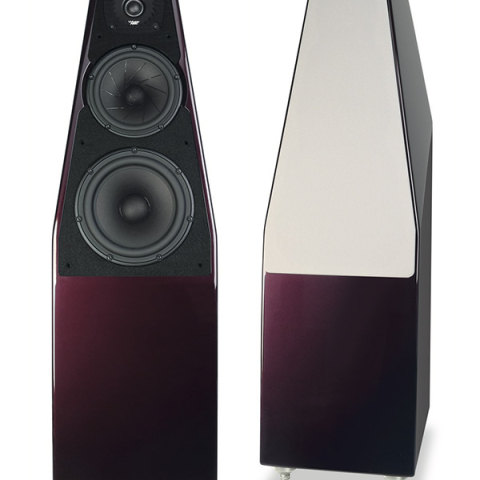
I actually enjoyed the Nola Metro Grand Reference Gold speakers. Their polite tonal balance took the edge off of older classical recordings, and as long as I didn't play the music loud, I could enjoy the speaker's positive attributes—the extended, weighty low frequencies, the pristine upper midrange, the rich tonal balance—without being reminded of its lack of clarity in the lower midrange and its subdued top octave. But what might be minor criticisms in a less-expensive speaker become significant in a model costing $33,000/pair. This is especially the case when you consider that the last two speakers I reviewed and recommended, the Joseph Audio Perspective and Triangle Signature Delta, respectively cost $13,000 and $8000/pair, and overall offered a better-balanced performance than the Metro Grand Reference. Promise unfulfilled, I'm afraid.
I reached for my Editor's Choice (CD, Stereophile STPH016-2), put together more than a decade ago but still an invaluable diagnostic tool. The low-frequency, 1/3-octave warble tones were reproduced with full weight down to the 25Hz band, but, as always with speakers with excellent bass extension, the 32Hz warble tone was boosted by a room mode. The 20Hz warble tone was inaudible at normal listening levels. One oddity was that there was an audible rattle with the 100 and 32Hz warble tones. Some of the hex-head bolts securing the woofers to the baffles on both speakers were loose, so I tightened those, but to no effect. I further investigated using a sinewave generator, and it turned out that the rattle was coming from the ball-bearing–isolated base. At exactly 34Hz, the speaker shook—the rattle was due to the top part of the base sliding on the bearings and hitting the end stops. This resonance was of very high quality factor (Q), so would be unlikely to be excited by music, but it does suggest that this base doesn't provide a sufficiently effective mechanical ground for the Metro Grand's enclosure.
With the half-step–spaced toneburst track on Editor's Choice, the tones didn't speak as cleanly as I wished through the lower midrange, between 128 and 512Hz. Listening to the enclosure panels with a stethoscope, I could hear strong vibrational modes in this region on all surfaces other than the front baffle, as well as a low-level mechanical buzz from inside the speaker. The "lid" over the cabinet's open-baffle section was also very lively. I continued my auditioning with Acoustic Ballasts—canvas bags filled with lead shot—on the lids and a VPI Brick on top of the woofer sections; this silenced the buzzes, but didn't seem to reduce the amplitude of the cabinet vibrations, nor did it affect the frequency-specific shaking from the ball-bearing bases.
This was with the Nordost Odin speaker cables. Replacing them with my usual Kubala-Sosna Elation! cables seemed to take away more of the high treble. In my usual listening position, my ears are 36" from the floor. Sitting as upright as I could put my ears 41" high, which is still 4" below the center of the ribbon tweeters. I reached again for Editor's Choice and selected the dual-mono pink-noise track. In my usual position, the pink noise sounded smooth but a bit too mellow. As I rose in my seat, more top-octave energy became apparent, though the low treble began to sound slightly hollow. The image of the noise, which should be narrow and centrally placed, was also a little broader than usual.
Looking back through my listening notes, it doesn't appear that I played much rock music during the time the Nola Metro Grand Reference Golds were in my system. I've noted before that audio components tend to dictate the kind of music you play—the Nola's generally polite, rather mellow balance favored jazz and orchestral music over rock, although female singers—such as Patricia Barber on Café Blue—sounded extremely convincing.
I actually enjoyed the Nola Metro Grand Reference Gold speakers. Their polite tonal balance took the edge off of older classical recordings, and as long as I didn't play the music loud, I could enjoy the speaker's positive attributes—the extended, weighty low frequencies, the pristine upper midrange, the rich tonal balance—without being reminded of its lack of clarity in the lower midrange and its subdued top octave. But what might be minor criticisms in a less-expensive speaker become significant in a model costing $33,000/pair. This is especially the case when you consider that the last two speakers I reviewed and recommended, the Joseph Audio Perspective and Triangle Signature Delta, respectively cost $13,000 and $8000/pair, and overall offered a better-balanced performance than the Metro Grand Reference. Promise unfulfilled, I'm afraid.