Measurements
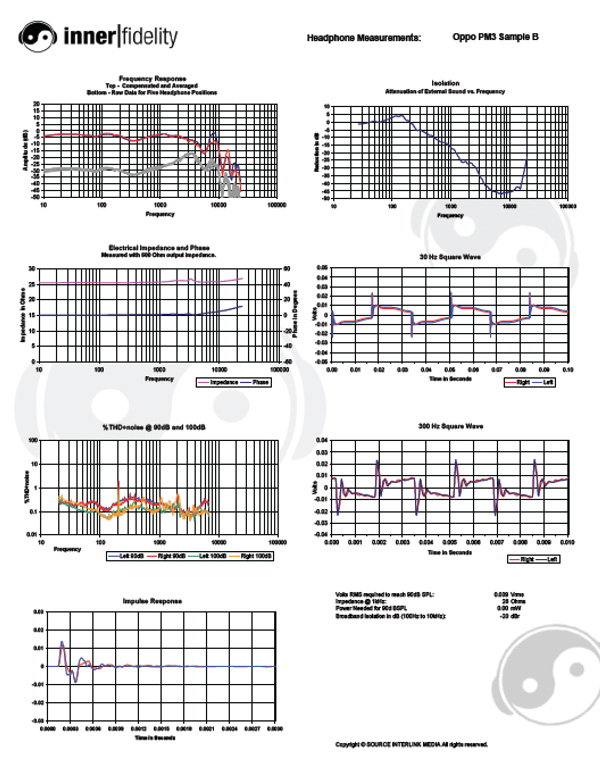 300Hz square wave shows a pretty significant overshoot of the initial edge; I attribute this to the slightly excessive FR peak at 3.2kHz. I would have expected this headphone to have an edgier quality looking at that spike, but I guess the frequency component of the feature is in just the right place for it to sound good even though it's a bit emphatic. There is a small second ring after the initial spike, but very little noise thereafter. Likewise, the impulse response looks a little slow to me, and there is some subsequent stuff, but it's generally pretty clean relative to most headphones. FWIW, I didn't hear any graininess in these cans.
Distortion is very low in the PM-3, and the 100dB curve lies at or below the 90dB curve indicating these cans can play loud well, which I did hear in listening. Impedance and phase are nearly flat, a characteristic common to planar magnetic headphones. Impedance is at 26 Ohms.
Isolation plot shows quite good isolation, these will cut down background noise well and others will have a difficult time hearing your music as leakage is quite low.
At 47mVrms to achieve 90dBspl, the Oppo PM-3 will play at satisfying levels with portable devices.
300Hz square wave shows a pretty significant overshoot of the initial edge; I attribute this to the slightly excessive FR peak at 3.2kHz. I would have expected this headphone to have an edgier quality looking at that spike, but I guess the frequency component of the feature is in just the right place for it to sound good even though it's a bit emphatic. There is a small second ring after the initial spike, but very little noise thereafter. Likewise, the impulse response looks a little slow to me, and there is some subsequent stuff, but it's generally pretty clean relative to most headphones. FWIW, I didn't hear any graininess in these cans.
Distortion is very low in the PM-3, and the 100dB curve lies at or below the 90dB curve indicating these cans can play loud well, which I did hear in listening. Impedance and phase are nearly flat, a characteristic common to planar magnetic headphones. Impedance is at 26 Ohms.
Isolation plot shows quite good isolation, these will cut down background noise well and others will have a difficult time hearing your music as leakage is quite low.
At 47mVrms to achieve 90dBspl, the Oppo PM-3 will play at satisfying levels with portable devices.
Click on graphs image to download .pdf for closer inspection.
It's worth mentioning at this point that I have now measured three PM-3s. The first one seemed to have erratic behavior at around 6-9kHz. I received a second pair for measurement some months after the first pair; this second pair did measure differently and did not exhibit the behavior. I then grew concerned because I didn't know if I was seeing an early sample that wasn't quite up to snuff or poor manufacturing tolerances, so I requested a third pair be overnighted to me. The third pair did quite closely match the performance of the second pair. My feeling is that I just receive an early pair the first time and manufacture had not been quite dialed in. All charts are available to view: Sample A; Sample B; and Sample C.
I've gone over the frequency response pretty comprehensively in the review itself, but to recap: The raw response shows a headphone not too sensitive to position on the head. Frequency response is very close to the Harman target response, deviating only in the bass rise extending slightly too far into the mid-range; the dip between 4-8kHz; the top octave is slightly too rolled off; and the peak at 3.2kHz might be a few dB too high. Regardless, I'd say this is the closest headphone I've seen to the target curve. See page two of this review for a Harman curve corrected frequency response.
30Hz square wave is a little misshapen by the pad bounce that can be seen in the frequency response curve between 80-200Hz. I've personally never been able to hear any problems due to the propensity of pads to resonate on the springiness of the foam...well, maybe the DT48 which has it to the extreme. Otherwise, the 30Hz wave shape is good staying above zero for its entire duration and with no sway back. Always good to glance over and look for bass distortion at this point, and notice very little evident with the PM-3. The PM-3 has good bass response at a level that doesn't draw attention to itself.