

 Sound Quality
The overall sound quality of the PM-3 is very good indeed. In fact, it may be the most neutral sounding headphone I've experienced. My previous standard in that regard was the NAD VISO HP50, which in comparison now sounds a bit warm and thick. If the PM-3 does deviate from neutral I'd say it had a bit of extra upper-bass/low-mid energy, a bit extra lower-treble, and is slightly rolled off in the top octave. I heard it as very slightly "U" shaped due to the slight upper-bass/low-mid and low treble peaks...initially. A slightly "U" shaped response means it should sound slightly exciting, but somehow they just don't to me. If anything, they sound slightly boring...again, just slightly. Problem is, for quite a while I really couldn't figure out what was going on that might give me that bland impression. The bass hits hard; mid-range is very well behaved with low distortion; treble seemed slightly forward in the presence region and slightly laid back in the top octave. But there was nothing blatantly obvious that I could figure out. Then, I was listening to Rickie Lee Jones album "Pop Pop" to the track "Dat Dere" and 18 second in the drummer starts some soft brushwork on the snare in the background. I was switching back and forth between the NAD VISO HP50 at the time and, BAM!, it hit me: The brushes on the snare sounded more withdrawn to me on the PM-3 than on the HP50. In words, I characterize this like the difference between "sss" and "th". In numbers, I'd say we're talking about the 4-8kHz region being a little subdued.
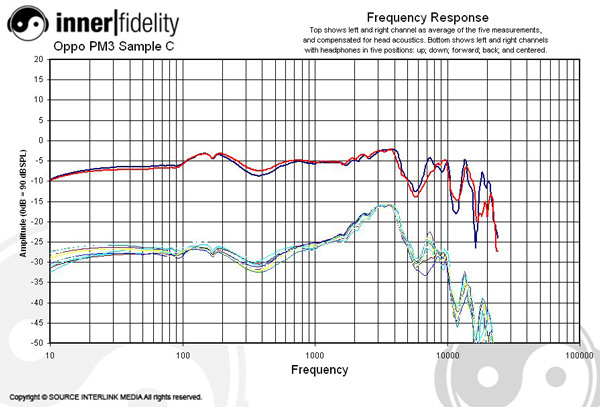
Raw ear drum response is the lower set of lines, which can be compared with Harman target response below. Upper curves show frequency response compensated with Harman target response.
For reference, I'll also post the Harman response curve (in black) here.

Harman target response (black trace) with characteristic features highlighted with additional axis.
The thing I'd like to point out is the gently rising section of the curve from 200Hz to 800Hz. Most headphones are flat, or even falling, in this area. What I hear on the PM-3 is that vocals have a very power presence to them. I hear a better balance between the singer's fundamental tone and the overtones of the voice giving it more strength. There also seems to be a better balance between the voice and the noises made by the mouth and throat—lip smacks, spittle in the throat, air passage through the nose, etc. Switching back to headphones without this rise seemed to deliver voices that were more distant sounding and less rich with information that made the voice organic and powerfully human. I'd love to hear from readers who might be able to make this comparison and express your experience with vocals. This sound is not common with headphones, so it's a bit new to me as well and feedback would be very interesting.
I don't think I've ever had a headphone come through the lab ticking so many boxes so confidently. Sound quality, styling, comfort, build quality, isolation, and accessorization are all very well executed for this price. The Oppo PM-3 may be the most well rounded headphone offering I've seen to date. On the other hand, it's a bit like going to a party with the honor roll students—straight A's and across-the-board competence can feel a little boring. A little missing info mid-treble and in the top octave has the PM-3 sounding just a bit laid back and closed in. Fortunately, a near ideal response, in my opinion, between 500Hz and 3kHz, delivers vocals with an organic balance I've rarely heard before. All-in-all, though lacking in that last bit of refinement and air (that's generally reserved for open acoustic headphones), the PM-3 is an extraordinarily competent sealed headphone.
 You betcha the PM-3 is going up on the Wall of Fame. It's going to knock off the Focal Spirit Professional, which seems to me the weakest on the page at the moment. I'll keep the SRH1540, HP50, and MSR7 up as they all have better resolving power. (The M100 stays for its basshead nature.)
Video
You betcha the PM-3 is going up on the Wall of Fame. It's going to knock off the Focal Spirit Professional, which seems to me the weakest on the page at the moment. I'll keep the SRH1540, HP50, and MSR7 up as they all have better resolving power. (The M100 stays for its basshead nature.)
VideoClick here if you can't see the video. Resources
Oppo Digital home page and PM-3 product page.
Head-Fi Reviews and threads here and here.















