

For audiophiles of a certain age, the mere mention of NAD Electronics' original 3020 integrated amplifier (1980, designed by Erik Edvardsen), or Adcom's GFA-555 stereo power amplifier (1985, designed by Nelson Pass), conjures up happy memories of audio's last Golden Age—an idyllic time when working stiffs could luxuriate in the same audio arcadia as bankers and brokers. Since then, few, if any, audio components have achieved that level of iconic high value. Which caused me to wonder: What would it take, nowadays, to manufacture a genuinely high-value audiophile product: one that delivers exciting, satisfying sound at a price most audiophiles can afford?
Just a few weeks ago, as a result of my time spent with Outlaw Audio's RR2160 receiver ($799), I learned the answer to that question: It takes a group of persons with the desire and ability to make a product that sounds conspicuously good, combined with the will to sell that good-sounding product at a reasonable price.
These days, such people are rare. Too many of today's audio manufacturers are toadies who aspire to sip Château Lafite Rothschild 1787 with princes and robber barons, not swill draft beer with the lumpenproletariat. Too many manufacturers would rather sell five pairs of loudspeakers for $500,000 each than 5000 pairs for $500 each. This type of Madame Déficit–style audio elitism currently rages out of control. I believe it is time for a revolution. Liberté, égalité, fraternité!
Outlaw Audio's founder, Peter Tribeman, has been a friend to the working class since his time at NAD, during the inception of the legendary 3020. In his 15 years with Outlaw, Tribeman has conscripted for his audio-manufacturing cadre people who recognize good sound and have a desire to sell it at a price that he, his partners, and every Outlaw Audio employee can actually afford.
Description
Outlaw Audio's website refers to the RR2160 ($799) as a "Retro Receiver," as "The Last Great Stereo Receiver," and as "the proud successor to the RR2150." I never heard the RR2150 but my trusted peeps tell me it was "amazing for the price." The solid-state RR2160 is built to supply up to 110W into 8 ohms and 165W into 4 ohms. These class-AB watts can be directed, alternatively or simultaneously, to two different pairs of loudspeakers. The RR2160 also has two subwoofer outputs, both with analog bass management. As a "retro" receiver, the RR2160 has an FM/AM tuner, a moving-magnet/moving-coil phono stage, tone controls, and speaker equalization to provide bass emphasis from 55, 65, or 85Hz down; as a modern receiver, it has front and rear USB inputs, an Ethernet port, an MP3 input, HD Radio, and a DAC.
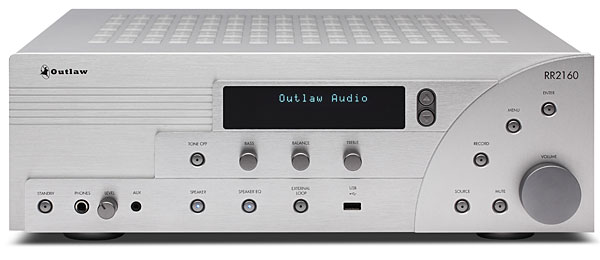
The RR2160's most obvious retro feature is its pseudo–art deco faceplate, whose naãve elegance and intelligent layout have seduced me. Every button, knob, and jack is clearly labeled. Everything a user might need to do—including network setup and display brightness—can be easily intuited without ever opening the well-written owner's manual or picking up the brushed aluminum remote control.
The front panel is arranged in ziggurat-like steps that are interrupted, in the right-most section, by a graceful arc that corrals the most frequently used controls: the large Volume knob, and buttons for Mute, Source, Record, Menu, and Enter. To the left of this arc, at the top of the panel, are the display and the attendant up and down buttons for selecting from the menu. Below the display are analog Bass, Balance, and Treble knobs, with a Tone Off button to remove these controls from the signal path. Running along the bottom of the faceplate, from left to right, are: a Standby button, a ¼" headphone jack, a headphone volume-control knob, a 3.5mm Aux jack for line-level input from a portable audio device, buttons for Speaker, Speaker EQ, and External Loop (the last for an external processor), and a USB port for storage devices of up to 16GB max. A small blue pinlight at the center of each button (though not the knobs) indicates that its function is active.
The solid-state RR2160 is built to supply up to 110W into 8 ohms and 165W into 4 ohms. These class-AB watts can be directed, alternatively or simultaneously, to two different pairs of loudspeakers. The RR2160 also has two subwoofer outputs, both with analog bass management. As a "retro" receiver, the RR2160 has an FM/AM tuner, a moving-magnet/moving-coil phono stage, tone controls, and speaker equalization to provide bass emphasis from 55, 65, or 85Hz down; as a modern receiver, it has front and rear USB inputs, an Ethernet port, an MP3 input, HD Radio, and a DAC.
The RR2160's most obvious retro feature is its pseudo–art deco faceplate, whose naãve elegance and intelligent layout have seduced me. Every button, knob, and jack is clearly labeled. Everything a user might need to do—including network setup and display brightness—can be easily intuited without ever opening the well-written owner's manual or picking up the brushed aluminum remote control.
The front panel is arranged in ziggurat-like steps that are interrupted, in the right-most section, by a graceful arc that corrals the most frequently used controls: the large Volume knob, and buttons for Mute, Source, Record, Menu, and Enter. To the left of this arc, at the top of the panel, are the display and the attendant up and down buttons for selecting from the menu. Below the display are analog Bass, Balance, and Treble knobs, with a Tone Off button to remove these controls from the signal path. Running along the bottom of the faceplate, from left to right, are: a Standby button, a ¼" headphone jack, a headphone volume-control knob, a 3.5mm Aux jack for line-level input from a portable audio device, buttons for Speaker, Speaker EQ, and External Loop (the last for an external processor), and a USB port for storage devices of up to 16GB max. A small blue pinlight at the center of each button (though not the knobs) indicates that its function is active.
 Listening
I powered up the Outlaw RR2160 and let it cook for five days. Then, to get a feel for the quality of its amplifier, tone controls, and Speaker EQ, I used front-end components with which I was familiar. I connected Schiit Audio's Yggdrasil DAC ($2299) and AMG's Giro G9 turntable ($10,000), with an EMT DST 75 MC cartridge ($1950) driving an Auditorium 23 step-up transformer ($999) and Tavish Design Adagio tubed phono stage ($1690) into the Outlaw's line-level analog inputs. That's $16,938 worth of palace-level music sources prompting a working-class, $799 audio receiver! I then wired the Outlaw to a pair of the most yeomanlike, true-of-tone, small loudspeakers I know: Stirling Broadcast's LS3/5a V2 ($1990/pair).
The first record I played was the Grateful Dead's 1970 classic, American Beauty (LP, Warner Bros. WS 1893). I use this record frequently to check gear for naturalness of tone and low distortion. Unfortunately for the humble Outlaw, it had been immediately preceded in my system by HiFiMan's EF1000 amplifier ($12,000; see "Gramophone Dreams" in this issue), and in my ensuing automatic and unavoidable comparisons, the RR2160 sounded small and uncolorful. Voices and instruments were sculpted, slightly forward, and tangibly present, but in a jukebox-like way.
Happily, after a few hours, the RR2160's power supply seemed to get more traction, and those initial shortcomings were replaced by a generously big, warm, articulate sound. Fully broken in, the Outlaw's sound through the Stirling LS3/5a V2s wasn't as spacious or as solid as those speakers usually sound with the First Watt J2 or PrimaLuna ProLogue Premium amplifiers, but it was equally rich and luxurious.
As usual for a small speaker, what there was of the LS3/5a V2s' bottom octaves was noticeably low-energy—until I pushed the Outlaw's Speaker EQ button, which boosts the output by 6dB "at and below a selected frequency": 55, 65, or 80Hz. The RR2160's manual recommends that you "Select an EQ setting that is either at the speaker's lowest frequency or one notch above it." The 65Hz choice made Jerry Garcia and Pigpen sound more like they should.
The next night, again with the Stirlings, I played Puente Celeste's Nama (CD, MA Recordings M084A), but now the RR2160 had too much bass—the sound was fat and billowy. I turned off Speaker EQ, listened again, and now every track on Nama felt nicely formed and naturally detailed. Bass was clean but lean. As I listened, I speculated about the Outlaw's reproduction of bass energy.
Outlaw Audio's website refers to the RR2160 ($799) as a "Retro Receiver," as "The Last Great Stereo Receiver," and as "the proud successor to the RR2150." I never heard the RR2150 but my trusted peeps tell me it was "amazing for the price."
The solid-state RR2160 is built to supply up to 110W into 8 ohms and 165W into 4 ohms. These class-AB watts can be directed, alternatively or simultaneously, to two different pairs of loudspeakers. The RR2160 also has two subwoofer outputs, both with analog bass management. As a "retro" receiver, the RR2160 has an FM/AM tuner, a moving-magnet/moving-coil phono stage, tone controls, and speaker equalization to provide bass emphasis from 55, 65, or 85Hz down; as a modern receiver, it has front and rear USB inputs, an Ethernet port, an MP3 input, HD Radio, and a DAC.
ListeningI powered up the Outlaw RR2160 and let it cook for five days. Then, to get a feel for the quality of its amplifier, tone controls, and Speaker EQ, I used front-end components with which I was familiar. I connected Schiit Audio's Yggdrasil DAC ($2299) and AMG's Giro G9 turntable ($10,000), with an EMT DST 75 MC cartridge ($1950) driving an Auditorium 23 step-up transformer ($999) and Tavish Design Adagio tubed phono stage ($1690) into the Outlaw's line-level analog inputs. That's $16,938 worth of palace-level music sources prompting a working-class, $799 audio receiver! I then wired the Outlaw to a pair of the most yeomanlike, true-of-tone, small loudspeakers I know: Stirling Broadcast's LS3/5a V2 ($1990/pair).















