

Sidebar 3: Measurements
I measured the Outlaw Audio RR2160 using my Audio Precision SYS2722 system (see the January 2008 "As We See It"). After I'd run the amplifier for an hour with both channels driving 1kHz at one-third power into 8 ohms, its top panel above the internal heatsinks was very hot, at 122°F (50°C). The maximum voltage gain at 1kHz from the speaker terminals into 8 ohms measured 42.1dB for the line inputs. The line inputs preserved absolute polarity (ie, were non-inverting), as did the phono input set to both MM and MC and all the digital inputs. The line-input impedance was a usefully high 48k ohms at low and middle frequencies, dropping inconsequentially to 39k ohms at 20kHz.
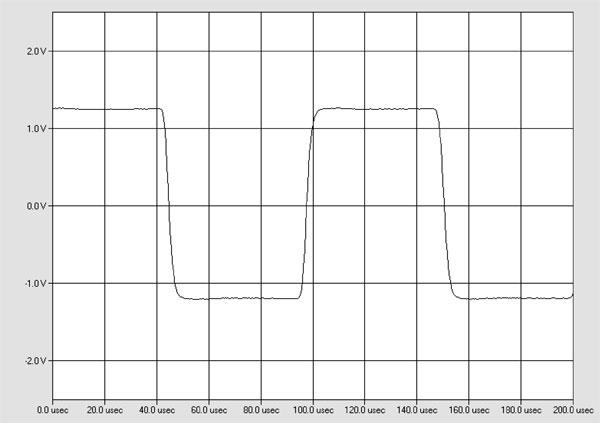
To my surprise, the volume control for the headphone output is in series with the main volume control. It can therefore be used to set the RR2160's gain for a specific pair of headphones, with the main volume control used as normal for headphone listening. The output impedance from the headphone jack was an extremely low 0.5 ohm, which will be optimal for driving low-impedance 'phones. Measured at the speaker terminals, the output impedance was low at 0.16 ohm at 20Hz and 1kHz, rising slightly to 0.19 ohm at 20kHz. As a result, the variation in the RR2160's frequency response with our standard simulated loudspeaker, taken with the volume control set to its maximum, was just ±0.1dB (fig.1, gray trace). The other traces in this graph show the response into 8, 4, and 2 ohms. The left channel (blue and cyan traces) was 0.24dB higher than that of the right (red, magenta), and this slight channel imbalance was consistent at lower settings of the volume control. The amplifier's output drops by 3dB at a high 150kHz, and as a result, its reproduction of a 10kHz squarewave into 8 ohms (fig.2) had short risetimes and was free from overshoot or ringing. Figs. 1 and 2 were taken with the tone controls bypassed. Engaged, the bass and treble tone controls offered up to about 12.5dB boost or cut, centered on 30Hz and 3kHz (fig.3).


 Specified as delivering 110Wpc into 8 ohms (20.4dBW) and 165Wpc into 4 ohms (19.2dBW), both at 0.05% distortion, the RR2160 delivered significantly more power at our definition of clipping (1% THD+noise). Figs. 5 and 6 show how the THD+N percentage in the Outlaw's output varied with power into 8 and 4 ohms, respectively, and reveal that, with both channels operating, the amplifier clipped at 150Wpc into 8 ohms (21.75dBW) and 230Wpc into 4 ohms (20.6dBW). The THD+N percentage is very low below 10W into 8 ohms and 20W into 4 ohms.




 Channel separation via the digital inputs was around 85dB over most of the audioband, and the noise floor again had spuriae at 60Hz and its odd-order harmonics, though these all lay at or below –102dB. These spuriae can be seen at the left side of fig.13, which shows the spectra of the RR2160's Tape Out jacks while it reproduced a dithered 1kHz tone at –90dBFS with 16-bit (cyan and magenta traces) and 24-bit (blue, red) data. The increase in bit depth dropped the noise floor by up to 15dB, suggesting resolution of just over 18 bits. The waveform of an undithered tone at exactly –90.31dBFS was symmetrical (fig.14), with the three DC voltages described by the data well defined, though a slight degree of DC offset is visible in this graph. With undithered 24-bit data, the Outlaw output a well-defined, if rather noisy, sinewave (fig.15).


 I also examined the performance of the phono input at the fixed Tape Out jacks. The gain at 1kHz was 33.5dB in MM mode and 48.7dB in MC mode. The input impedance in MM mode ranged from 45k ohms at 20Hz and 1kHz to 39.3k ohms at 20kHz, but to my surprise was higher in MC mode, at 57.5k ohms at 20Hz and 1kHz, and 47k ohms at 20kHz. The RIAA error is shown in fig.17; the two channels match fairly closely, but the error increases at ultrasonic frequencies, suggesting that the Outlaw's phono stage incorporates the so-called "Neumann fourth pole," which I think can emphasize LP clicks, though the degree of boost at 100kHz is only about one third of the theoretically correct amount.
 The Outlaw's phono input featured very low distortion. With a 1kHz tone at 21mV input, 12dB higher than the standard MM level of 5mV and equivalent to an output at the Tape Out jacks of 1V, the only distortion harmonic that could be seen above the low noise floor was the second, at –110dB (0.0003%)! Intermodulation distortion (not shown) was also very low in level, the difference product at 1kHz resulting from an equal mix of 19 and 20kHz tones lying at –100dB (0.001%). The phono-overload margins, ref. 1kHz at 5mV, were the highest I have measured, at 32dB MM and 37dB MC, these margins consistent from 20Hz to 10kHz.
The Outlaw RR2160 offers a lot of power and considerable flexibility for an affordable price. I was somewhat disappointed by the measured performance of its digital inputs, but this was offset by the behavior of its superb phono stage.—John Atkinson
The Outlaw's phono input featured very low distortion. With a 1kHz tone at 21mV input, 12dB higher than the standard MM level of 5mV and equivalent to an output at the Tape Out jacks of 1V, the only distortion harmonic that could be seen above the low noise floor was the second, at –110dB (0.0003%)! Intermodulation distortion (not shown) was also very low in level, the difference product at 1kHz resulting from an equal mix of 19 and 20kHz tones lying at –100dB (0.001%). The phono-overload margins, ref. 1kHz at 5mV, were the highest I have measured, at 32dB MM and 37dB MC, these margins consistent from 20Hz to 10kHz.
The Outlaw RR2160 offers a lot of power and considerable flexibility for an affordable price. I was somewhat disappointed by the measured performance of its digital inputs, but this was offset by the behavior of its superb phono stage.—John Atkinson
Fig.1 Outlaw RR2160, frequency response at 2.83V into: simulated loudspeaker load (gray), 8 ohms (left channel blue, right red), 4 ohms (left cyan, right magenta), 2 ohms (green) (1dB/vertical div.).
Fig.2 Outlaw RR2160, small-signal 10kHz squarewave into 8 ohms.
Fig.3 Outlaw RR2160, tone-control response at 2.83V into 8 ohms with volume control set to "–20" and treble and bass controls each set to "0" and "±10" (left channel blue, right red; 5dB/vertical div.).
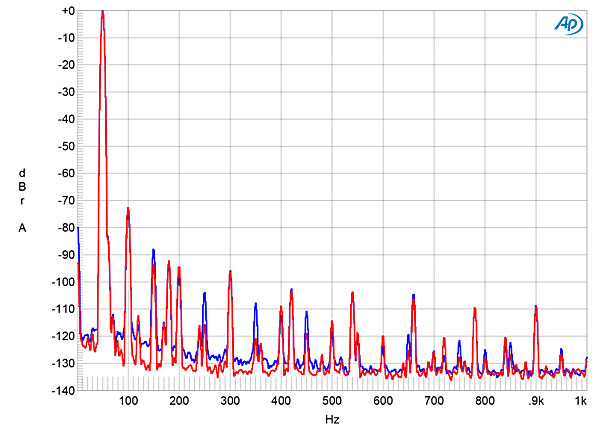
Channel separation via the line inputs (not shown) was good rather than great, at 72dB in both directions below 5kHz, decreasing very slightly at 20kHz. The unweighted, wideband signal/noise ratio, ref. 1W into 8 ohms with the input shorted but the volume control set to its maximum—the worst-case situation—was okay, at 70.7dB (average of both channels). Restricting the measurement bandwidth to the audioband improved the ratio to 79.3dB, while switching in an A-weighting filter gave ratios of 82.3dB (left channel) and 81.7dB (right). Fig.4 shows the low-frequency spectrum of the RR2160's output as it drove a 1kHz sinewave at 1W into 8 ohms. AC-supply–related components at 60Hz and its odd-order harmonics can be seen in both channels, probably due to magnetic leakage from the power transformer. While some spuriae can be seen in this graph at 120Hz and its harmonics, which will be due to internal grounding issues, these are all very much lower than the odd-order supply harmonics.
Fig.4 Outlaw RR2160, spectrum of 1kHz sinewave, DC–1kHz, at 1W into 8 ohms (left channel blue, right red; linear frequency scale).
Fig.5 Outlaw RR2160, distortion (%) vs 1kHz continuous output power into 8 ohms.
Fig.6 Outlaw RR2160, distortion (%) vs 1kHz continuous output power into 4 ohms.
Fig.7 shows how the THD+N percentage varies with frequency at 12.5V, which is equivalent to 19.5W into 8 ohms (blue and red traces) and 39W into 4 ohms (cyan, magenta). The rise in THD at higher frequencies is minimal, and the nature of the distortion is predominantly the subjectively innocuous second-harmonic (fig.8). Even at high power into 4 ohms, the RR2160 produced a low level of intermodulation products when driving an equal mix of 19 and 20kHz tones (fig.9), the 1kHz difference product lying at –84dB (0.006%).
Fig.7 Outlaw RR2160, THD+N (%) vs frequency at 12.5V into: 8 ohms (left channel blue, right red), 4 ohms (left cyan, right magenta).
Fig.8 Outlaw RR2160, spectrum of 50Hz sinewave, DC–1kHz, at 100W into 4 ohms (left channel blue, right red; linear frequency scale).
Fig.9 Outlaw RR2160, HF intermodulation spectrum, DC–24kHz, 19+20kHz at 100W peak into 4 ohms (left channel blue, right red; linear frequency scale).
Turning to the digital inputs, I examined their performance using the AP's coaxial S/PDIF output and the USB port of a MacBook Pro running Pure Music 3, measured with the volume control set to its maximum but at the Outlaw's fixed Tape Out outputs so that I wouldn't run the risk of damaging the receiver's output stage. A full-scale 1kHz tone resulted in a level of 1.91V at the Tape Out jacks and 2.43V at the Preamp Out jacks. With the volume control set to –20dB, the full-scale tone gave a level of 20.43V into 8 ohms at the speaker terminals, equivalent to 52.2W (17.2dBW). Given the amplifier's clipping power of 150W into the same load (21.75dBW), this suggests that the gain of the digital circuitry is higher than it need be, with a possible effect on the digital inputs' noise floor.
The RR2160's optical inputs operated with datastreams sampled up to 96kHz, the coaxial inputs up to 192kHz. The MacBook's AudMid and USB Prober apps revealed that the Outlaw's USB input operated with 24-bit integer data sampled at rates from 44.1 to 192kHz in the optimal isochronous asynchronous mode. The reconstruction filter is a conventional finite impulse-response (FIR) type (fig.10) with a response that rolled off rapidly above the audioband, reaching full attenuation at 24kHz with 44.1kHz data (fig.11, magenta and red traces). The aliased image at 25kHz of a full-scale 19.1kHz tone (cyan and blue traces) is almost completely suppressed, and while the second harmonic of the tone is visible in this graph, it lies at –86dB (0.005%). The frequency response of the Outlaw's digital inputs, measured with data sampled at 44.1, 96, and 192kHz (fig.12), followed the same shape above the audioband, interrupted by a sharp rolloff just below the two lower rates' Nyquist frequency (half the sample rate).
Fig.10 Outlaw RR2160, digital input, impulse response (one sample at 0dBFS, 44.1kHz sampling, 4ms time window).
Fig.11 Outlaw RR2160, digital input, wideband spectrum of white noise at –4dBFS (left channel red, right magenta) and 19.1kHz tone at 0dBFS (left blue, right cyan), with data sampled at 44.1kHz (20dB/vertical div.).
Fig.12 Outlaw RR2160, digital input, frequency response at –12dBFS into 100k ohms with data sampled at: 44.1kHz (left channel green, right gray), 96kHz (left cyan, right magenta), 192kHz (left blue, right red) (1dB/vertical div.).
Fig.13 Outlaw RR2160, digital input, spectrum with noise and spuriae of dithered 1kHz tone at –90dBFS with: 16-bit data (left channel cyan, right magenta), 24-bit data (left blue, right red) (20dB/vertical div.).
Fig.14 Outlaw RR2160, digital input, waveform of undithered 1kHz sinewave at –90.31dBFS, 16-bit TosLink data (left channel blue, right red).
Fig.15 Outlaw RR2160, digital input, waveform of undithered 1kHz sinewave at –90.31dBFS, 16-bit TosLink data (left channel blue, right red).
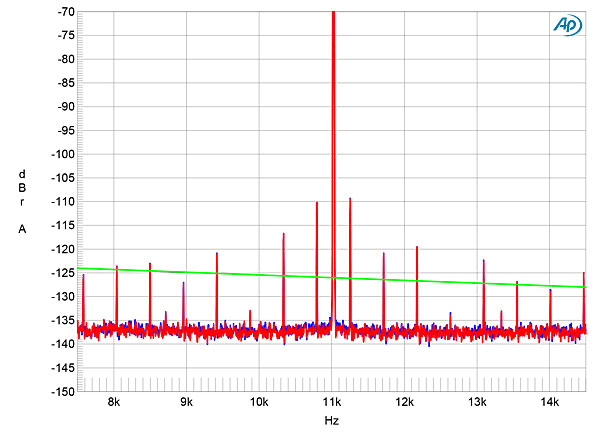
As was seen in fig.11, the RR2160's digital inputs offered low levels of harmonic distortion, and intermodulation was similarly very low. However, when I tested the inputs for their rejection of jitter with 16- and 24-bit J-Test data, the results were disappointing (fig.16), with accentuation of the sideband pair at ±229Hz and other sideband pairs above or below their correct levels, which are shown by the slanting green line in this graph.
Fig.16 Outlaw RR2160, digital input, high-resolution jitter spectrum of analog output signal, 11.025kHz at –6dBFS, sampled at 44.1kHz with LSB toggled at 229Hz: 16-bit TosLink data (left channel blue, right red). Center frequency of trace, 11.025kHz; frequency range, ±3.5kHz.
Fig.17 Outlaw RR2160, phono-stage response with RIAA correction (left channel blue, right red; 0.5dB/vertical div.).
Channel separation via the phono input (not shown) was very good, at >80dB in both directions, and the phono-input S/N ratios were also very good, at 75.7dB MM and 59dB MC (unweighted, wideband), 78.1dB MM and 62.2dB MC (unweighted, audioband), and 86dB MM and 69dB MC (A-weighted), all ref. 1kHz at 5mV MM and 500µV MC, and taken with the inputs shorted to ground.















