I used DRA Labs' MLSSA system, a calibrated DPA 4006 microphone to measure the Paradigm Founder 120H's frequency response in the farfield, and an Earthworks QTC-40 mike for the nearfield responses; both microphones were used with an Earthworks microphone preamplifier.
I usually measure a loudspeaker's farfield behavior level with its tweeter, which the 120H's manual suggests is the optimal axis: "For the most accurate and natural timbre, place front speakers so that their high-frequency drivers are approximately at ear level." However, with the Founder 120H sitting on its outrigger stands, the tweeter is 42" from the floor, which is significantly higher than the average listener's ear height of 36". I queried RvB what axis he had used for his auditioning. He responded that Paradigm's John Bagby had told him that the acoustic center of the speaker and the measurement plane they use is between the tweeter and midrange. I therefore performed the farfield measurements on this axis, which is 39" high. I refer to this axis in the following text as the "design axis," and all the measurements were taken without the grille.
The speakers' powered woofers were still equalized with the ARC filter settings that RvB had used. I performed a set of acoustic measurements on the left-hand speaker with his settings, then installed the ARC Genesis app on my MacBook Pro and connected one of its USB ports to the port on the back of the loudspeaker. I couldn't see how to bypass RvB's ARC profile for the woofers. I therefore created a new profile with the ARC USB microphone 12" from the middle woofer. This minimized the corrective changes made by ARC and would reveal the intrinsic behavior of the woofers and the downward-firing port. I then performed another set of response measurements.
Paradigm specifies the Founder 120H's anechoic sensitivity as a high 92dB/2.83V/m. My B-weighted estimate was slightly lower, at 90dB(B)/2.83V/m (footnote 1), though this is still higher than average. The Paradigm's impedance is specified as "compatible with 8 ohms." My impedance measurement (fig.1, solid trace), taken with Dayton Audio's DATS V2 system, drops below 8 ohms in the upper midrange and top two audio octaves, with a minimum value of 3.44 ohms at 600Hz. The large increase in impedance below 300Hz will be due to the high-pass filter used to eliminate low frequencies from the midrange unit.
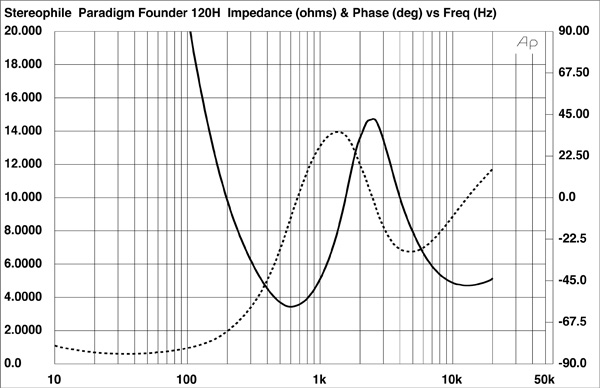
On the face of things, the Founder 120H would appear to be a relatively easy load for the partnering amplifier. However, the electrical phase angle (dotted trace) is high in a few regions and the effective resistance (EPDR, footnote 2) lies below 3 ohms over much of the audioband. The minimum EPDR is 1.5 ohms between 360Hz and 410Hz. The Founder 120H will work best with amplifiers that don't have problems driving low impedances, though the speaker's high sensitivity will reduce its need for current.
The traces in fig.1 are free from the wrinkles that would imply the presence of enclosure resonances. The enclosure did indeed seem well-damped when I rapped the panels with my knuckles; when I investigated their vibrational behavior with a plastic-tape accelerometer, what resonant modes were present were low in level (fig.2).
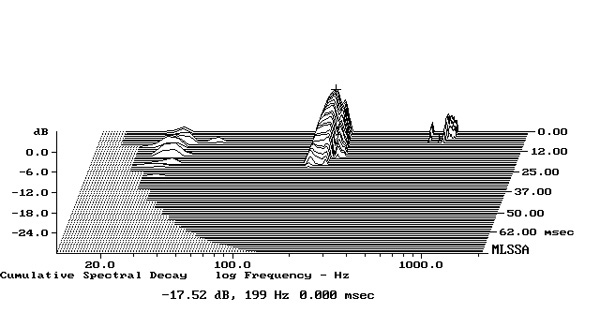
The port's response, measured in the nearfield and with my minimized ARC setting, is shown as the red trace in fig.3. The output peaks sharply at 24Hz, which will be the port's tuning frequency, and while the upper-frequency rolloff is smooth for the first three octaves, there is a strong resonant peak at 300Hz. I could hear this peak with the noise-like MLSSA signal with the upper-frequency drivers disconnected, but it doesn't seem to have much of an effect on the nearfield output of the woofers (blue trace). The woofers roll off sharply above 300Hz, crossing over to the midrange unit (green trace) a little higher than the specified 300Hz. The 120H's upper-frequency response on the design axis has a slight peak just below 1kHz, then rises in the mid- and high-treble regions, reaching +5dB in the top octave compared with the level at 1kHz. This graph reveals that the tweeter's fundamental dome resonance occurs at 27kHz, safely above the audioband.
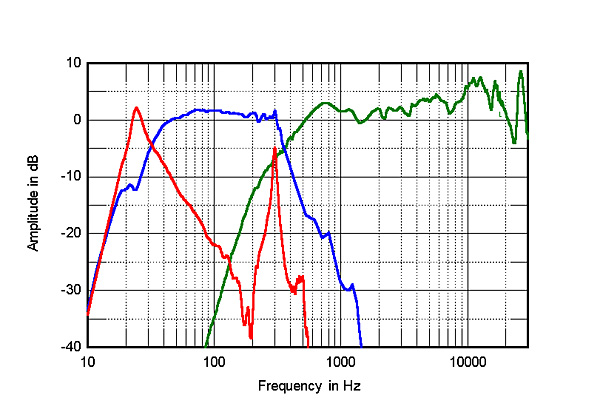
The black trace above 400Hz in fig.4 shows the Founder 120H's quasi-anechoic farfield response averaged across a 30° horizontal window centered on the design axis and spliced at 400Hz to the complex sum of the midrange, woofer, and port responses. The shape of the trace in the midrange and treble is similar to that in fig.3, though the peak in the top audio octave is slightly lower in level. The low-frequency response has only a slight boost due to the nearfield measurement technique and rolls off very sharply below the port tuning frequency. This implies that there is a high-pass filter in the woofer feed to protect the drive units from excessive infrasonic excursions.
The red trace in fig.4 shows the complex sum of the low-frequency nearfield responses with the ARC settings that RvB used to correct for his room acoustic problems. The differences between the red and black traces are minimal above 150Hz, but the red trace has two significant peaks between 50Hz and 150Hz and the low bass rolls off below 40Hz.
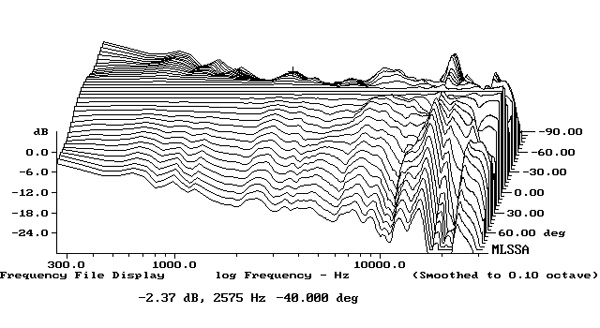
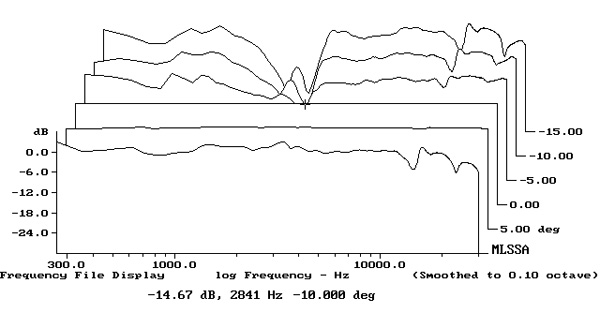
Fig.5 shows the Founder 120H's horizontal dispersion, normalized to the response on the design axis, which thus appears as a straight line. The off-axis behavior is well-controlled through the midrange and mid-treble, with the contour lines in this graph evenly spaced. Ridges and gullies appear to the speaker's sides in the top two audio octaves, which will be due to the peakiness in this region in the on-axis response smoothing out off-axis. The dispersion in the vertical plane is shown in fig.6. A suckout appears in the upper crossover region more than 5° above the design axis, but the response on the design axis is maintained 5° below that axis.
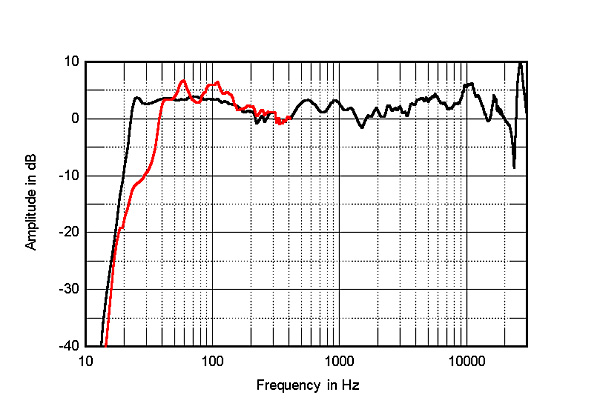
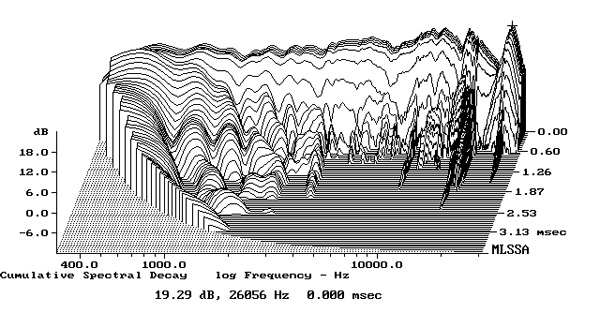
In the time domain, the Founder 120H's step response (fig.7) indicates that the tweeter and woofers are connected in negative acoustic polarity, the midrange unit in positive polarity. The decay of each unit's step coincides with the start of that of the next lower in frequency, which suggests optimal crossover implementation. The Paradigm's cumulative spectral-decay plot (fig.8) is commendably clean throughout the treble.
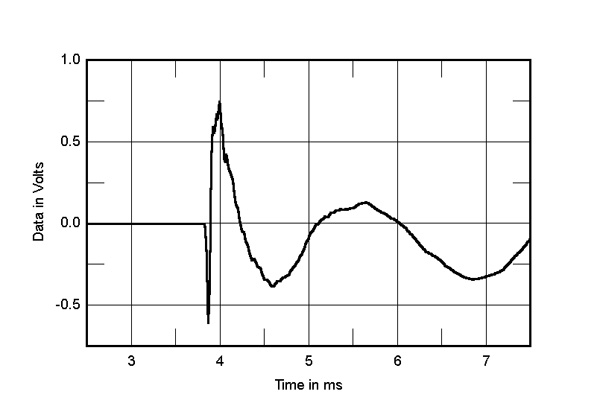
With the exception of that rising high-frequency response, the Paradigm Founder 120H offers excellent measured performance. I visited Paradigm's Canadian facility some years ago and was impressed by their engineering resources, which include an anechoic chamber. That exaggerated treble response must therefore be a design choice, perhaps to subjectively balance what appears from the step response to be a somewhat underdamped woofer alignment.—John Atkinson
Footnote 1: B-weighting reduces the effect of excessive energy at the frequency extremes on the calculated sensitivity. See my discussion of voltage sensitivity here and my reason for using this weighting here,
Footnote 2: EPDR is the resistive load that gives rise to the same peak dissipation in an amplifier's output devices as the loudspeaker. See "Audio Power Amplifiers for Loudspeaker Loads," JAES, Vol.42 No.9, September 1994, and stereophile.com/reference/707heavy/index.html.