

Listening to the A 21+ was eminently delightful and satisfying from the first note. I began by listening to a number of new piano recordings: Because the instrument has such a wide tonal range, and although it radiates sound directly from the strings and soundboard as well as from its entire body, it must be presented to the listener, live or via recording, as a unitary voice. I began with Francesco Piemontesi's marvelous "Orage" (Storm) from Book 1 ("Suisse") of Franz Liszt's Années de Pèlerinage (Orfeo ORF-C944182I, CD). From the top notes with their direct ping to the bottom tones that radiate from the entire surface of the piano, everything was in balance, tonally and dynamically. The lyrically ardent "Vallée d'Obermann" which follows is gripping.
By contrast, Alkan's Symphony for Solo Piano (SACD, BIS BIS-2465 SACD, auditioned from a 24/96 PCM download) is somewhat intellectual and a bit more emotionally distant. In a new recording by the surprising Paul Wee, a former child prodigy who has pursued a full-time career as "a leading junior barrister" in London, we hear it from a suitably more distant acoustical perspective. Wee and Alkan are all about complexity and its explication (as well as dizzying brilliance), and the clarity afforded by the A 21+ was revealing and provided an appropriate degree of focus.
What I heard from the Parasound A 21+, in these recordings and others, was transparency without highlighting or emphasis. As applied to larger ensembles, this enabled a more personal engagement with the performance and performers. In my long quest for satisfying performances of Gabriele Fauré's Requiem, I have waded through performances by large and small ensembles made in concert halls, studios, and cathedrals, and recorded in stereo and multichannel. I have been smitten with several, but a recent recording by the vocal group Ensemble Aedes, with the instrumentalists of the French orchestra Les Siècles, under the direction of Mathieu Romano, has captured me (Aparté 24/96 download; CD code is AP201). Through the A 21+, upon hearing the opening tones of the period brass and organ pedal emanating from the warm but not overly reverberant acoustic of l'Abbaye de Lessay, I felt an enveloping calm, and my anticipation was fully rewarded by this perfectly paced performance. Instruments and voices were delineated, individually and in choirs, with a relaxing purity via the A 21+'s grain-free treble. It wasn't simply a matter of what sounds right; it was that the sounds created by the A 21+ and my two Revel Studio/2 speakers did nothing wrong. There was nothing to disturb the illusion of a personal communication.
 How about 20th-century dynamics? Holst's The Planets might be the obvious choice, but, on a recent Reference Recordings release by the Kansas City Symphony conducted by Michael Stern (SACD, Reference Recordings RR-146), it is the less obvious suite of ballet music from the same composer's The Perfect Fool that I prefer. It, too, has big brass and bass drum as well as conciseness in its expression that takes advantage of more exotic percussion accents and some lovely solo turns for the viola and cello. As with all of Keith Johnson's RR recordings, the soundstage is huge and the dynamics are demo-quality: I could not resist turning it up. The A 21+ handled the task without stress and let me hear all the orchestral colors. (Don't let the impressive concluding thump startle you!)
Alison Krauss's delicate vocal on "Sister Rosetta Goes Before Us," from her and Robert Plant's Raising Sand (CD, Rounder 11661-9075-2, auditioned via Qobuz 16/44.1 PCM streaming), is boldly underscored by the bass beat. Slowly, other elements, including Plant's harmonizing, blend in and out, in what becomes a somewhat static but arresting picture. With the Parasound, that picture was spatially quite close and realistically present.
A few comparisons
How about 20th-century dynamics? Holst's The Planets might be the obvious choice, but, on a recent Reference Recordings release by the Kansas City Symphony conducted by Michael Stern (SACD, Reference Recordings RR-146), it is the less obvious suite of ballet music from the same composer's The Perfect Fool that I prefer. It, too, has big brass and bass drum as well as conciseness in its expression that takes advantage of more exotic percussion accents and some lovely solo turns for the viola and cello. As with all of Keith Johnson's RR recordings, the soundstage is huge and the dynamics are demo-quality: I could not resist turning it up. The A 21+ handled the task without stress and let me hear all the orchestral colors. (Don't let the impressive concluding thump startle you!)
Alison Krauss's delicate vocal on "Sister Rosetta Goes Before Us," from her and Robert Plant's Raising Sand (CD, Rounder 11661-9075-2, auditioned via Qobuz 16/44.1 PCM streaming), is boldly underscored by the bass beat. Slowly, other elements, including Plant's harmonizing, blend in and out, in what becomes a somewhat static but arresting picture. With the Parasound, that picture was spatially quite close and realistically present.
A few comparisons
The obvious comparison was with the Parasound A 31, a three-channel amp with specs almost identical to those of the original A 21 and fitted into the same chassis. I was struck with how the soundstage seemed a bit less focused with the A 31. Bass was comparable in balance but marginally softer and, although I did not think that the A 21+ was bright or tipped-up, there was less high-frequency noise on older CDs and lower resolution streams with the A 31. Overall, if the A 31's performance is on a par with that of the A 21, the A 21+ is a welcome successor.
Comparison to a pair of Benchmark AHB2 stereo amps, used as monoblocks ($2995 each), was more difficult. My immediate perception upon switching over to the Benchmarks was of a somewhat wider and deeper soundstage on the AHB2s. I thought that the AHB2 might have a little edge in midrange and treble resolution, but that was program-dependent. Treble balance on the two was similar, and both were more revealing of suboptimal program sources than the A 31. Both the AHB2s and the A 21+ were possessed of dynamic capabilities that exceeded my aural tolerances. The Benchmarks used as monoblocks seemed more taut and nimble at the low end than the Parasound. However, subjective evaluation of bass performance is undoubtedly influenced by speaker choice and placement, room acoustics, and personal preference.
 A single, stereo AHB2 was a game competitor to the A 21+ at a roughly similar price. It presented all the capabilities of the monoblocks except that, with some effort, I could push it to its power limits, while at the same levels, the new Parasound was unperturbed. A brief comparison with the Hegel C53 two-channel amp ($6000) suggested that it was probably most similar to the A 21+ in overall presentation and came closer in clout than the single stereo Benchmark.
Conclusions
A single, stereo AHB2 was a game competitor to the A 21+ at a roughly similar price. It presented all the capabilities of the monoblocks except that, with some effort, I could push it to its power limits, while at the same levels, the new Parasound was unperturbed. A brief comparison with the Hegel C53 two-channel amp ($6000) suggested that it was probably most similar to the A 21+ in overall presentation and came closer in clout than the single stereo Benchmark.
Conclusions
Over a span of weeks, the A 21+ was a constant companion and a bringer of musical enjoyment; compared with other amps on hand and in spite of a few sonic differences, the new Parasound was impossible to fault. That shouldn't be surprising at this point in time: Unless an amp designer imposes her will to suit a particular set of associated equipment or a particular acquired taste, the performance of modern amplifiers should and does converge.
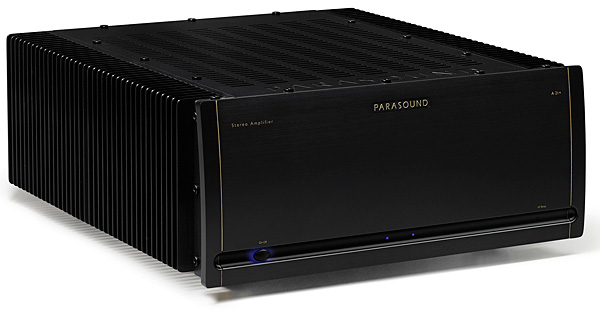
The Parasound A 21+ is remarkably powerful, transparent and quiet. As such, it imposes no constraints on one's desire to listen through it to the recorded performance or to experience the size, weight, and dynamics of the original event. It is large and heavy—probably of necessity, given its abilities—but it is also handsome and graced with useful connections and controls. Anyone in the market for a stereo power amp would be well advised to consider the Parasound A 21+, especially those who believe that they must spend more. With apologies to W.S. Gilbert, It is the very model of a modern power amplifier.
How about 20th-century dynamics? Holst's The Planets might be the obvious choice, but, on a recent Reference Recordings release by the Kansas City Symphony conducted by Michael Stern (SACD, Reference Recordings RR-146), it is the less obvious suite of ballet music from the same composer's The Perfect Fool that I prefer. It, too, has big brass and bass drum as well as conciseness in its expression that takes advantage of more exotic percussion accents and some lovely solo turns for the viola and cello. As with all of Keith Johnson's RR recordings, the soundstage is huge and the dynamics are demo-quality: I could not resist turning it up. The A 21+ handled the task without stress and let me hear all the orchestral colors. (Don't let the impressive concluding thump startle you!)
Alison Krauss's delicate vocal on "Sister Rosetta Goes Before Us," from her and Robert Plant's Raising Sand (CD, Rounder 11661-9075-2, auditioned via Qobuz 16/44.1 PCM streaming), is boldly underscored by the bass beat. Slowly, other elements, including Plant's harmonizing, blend in and out, in what becomes a somewhat static but arresting picture. With the Parasound, that picture was spatially quite close and realistically present.
A few comparisonsThe obvious comparison was with the Parasound A 31, a three-channel amp with specs almost identical to those of the original A 21 and fitted into the same chassis. I was struck with how the soundstage seemed a bit less focused with the A 31. Bass was comparable in balance but marginally softer and, although I did not think that the A 21+ was bright or tipped-up, there was less high-frequency noise on older CDs and lower resolution streams with the A 31. Overall, if the A 31's performance is on a par with that of the A 21, the A 21+ is a welcome successor.
A single, stereo AHB2 was a game competitor to the A 21+ at a roughly similar price. It presented all the capabilities of the monoblocks except that, with some effort, I could push it to its power limits, while at the same levels, the new Parasound was unperturbed. A brief comparison with the Hegel C53 two-channel amp ($6000) suggested that it was probably most similar to the A 21+ in overall presentation and came closer in clout than the single stereo Benchmark.
ConclusionsOver a span of weeks, the A 21+ was a constant companion and a bringer of musical enjoyment; compared with other amps on hand and in spite of a few sonic differences, the new Parasound was impossible to fault. That shouldn't be surprising at this point in time: Unless an amp designer imposes her will to suit a particular set of associated equipment or a particular acquired taste, the performance of modern amplifiers should and does converge.















