If I told you that Pass Laboratories' INT-60 integrated amplifier ($9000) was engineered by meth-lab trolls, its faceplate was wonky, its transformers buzzed, and it made every instrument sound like a tambourine, you'd think I was a crackpot with some kind of axe to grind, right? Because I suspect that, like me, you've never experienced or even read about a Pass Labs amp that didn't sound good.
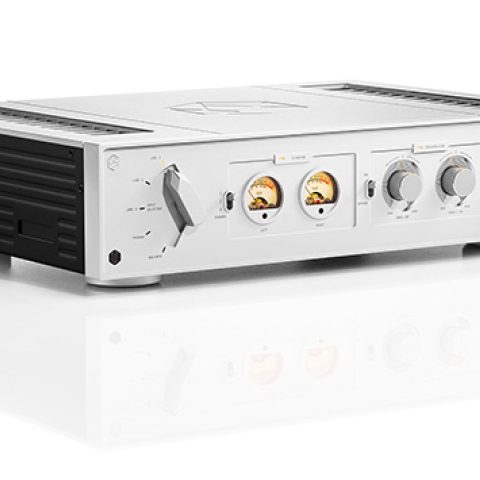
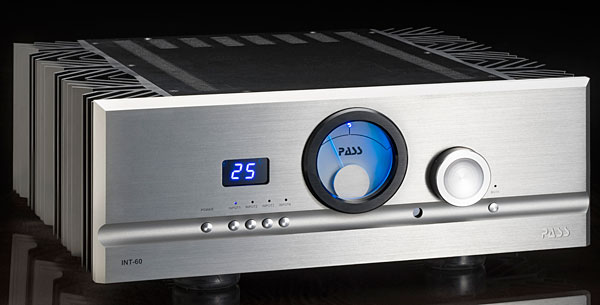
What if I said that the Pass INT-60 is a reference-quality stereo integrated amplifier that reproduces recordings in a manner refined and sensuous? That it has a nicely sculpted enclosure that looks expensive and feels timelessly tasteful? That it puts out 60Wpc into 8 ohms and powered every speaker I tried with steady, tantalizing assurance?
Review over. Are you ready for me to coddiwomple? Or would you prefer I discuss the virtues of high-bias class-A vs class-D amplification?
Or should I attempt to answer the No.1 question that the mere existence of the INT-60 poses to everyone who experiences it: Is it the best integrated amplifier ever?
Because I'm a New Yorker, I always answer a question with a question: How can I know if a painting I saw in a museum, a book I read, or that beer I just drank, would be considered "good" by anyone other than myself? Can I ever objectively assess the quality of my private experiences? Or yours? I think that assigning value to temporal experiences is, at best, a dodgy concept, but I do it all the time—inside my head. Sharing those in-my-head evaluations with a scrutinizing public is beyond difficult, and is best done with extreme caution. Even then, I can do it only in a comparative, anecdotal, or poetic fashion. Why? Because as quickly as my experiences occur, they are turned into memories—and you know how sketchy memories can be.
And what about measurements? Can John Atkinson's graphs of impressive sinewaves and squarewaves corroborate relative value? Maybe . . . but, as my friend Steve Guttenberg always says, "Measurements are useless at predicting user preferences."
Ultimately, the virtue of an audio component must be judged solely on the quality of experience it delivers to someone using it to listen to familiar recordings. Therefore, as a reviewer, the most effective tools I can employ are: memories of a lifetime of musical pleasures, a handful of interesting recordings, and some rigorously honed connoisseurship. If you stay with me, I will apply all three to the heaviest and most gratifyingly effective amplifier that has ever graced my Bed Stuy hermitage.
Description
Pass Laboratories, founded in 1991, has at least three Daoshi, or high priests of Taoist amplifier design: Nelson Pass and his colleague, Wayne Colburn, plus a new hire, Jam Somasundram, who designed the HPA-1 headphone amp, all of whom create fresh new inventions based on the ancient alchemy of single-ended, class-A amp design. According to a statement by Pass on his company's website, the INT-60 isn't literally identical to its standalone counterpart, the XA60.8 [60W monoblock power amplifier]: "[I]n particular the INT-60 is a stereo amplifier using the hardware of a single-channel XA60.8, and it necessarily has lower bias current in the output stage and does not operate [in] class-A to 60W, rather somewhat less than half that.
"There are a couple new wrinkles to the 'preamp' portions of these two products. The volume-control circuit outputs are buffered by 6dB gain stages whose input JFETs present many megohms of load, getting attenuator distortions down below the 0.001% line. The extra gain allows optimal figures for the power-amp stages, and offers improvement over the previous 'passive' circuits."
The INT-60 comes set to 29dB gain; removing an internal pair of jumpers adds 6dB more. At the lower gain, about 800mV will drive it to full power. "Each channel has 20 power transistors rated at 150W each," Colburn told me. "The power supply is a large toroid rated at 1kVA feeding 240,000µF of capacitors in multiple filtered sections." Illustrating this point with comparisons to two different series of Pass Labs power amplifiers, Colburn said that the power supply in the INT-60 is an XA60.8 supply, not an XA60.5 supply.
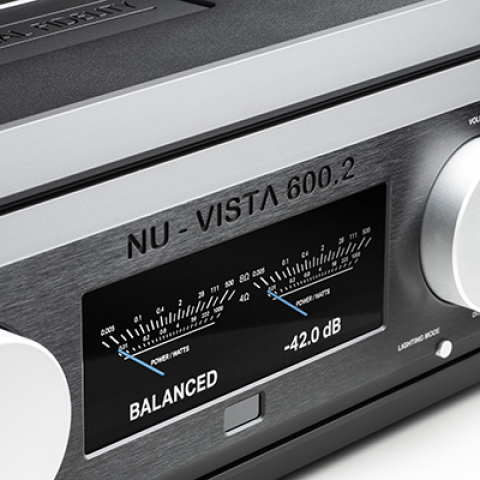
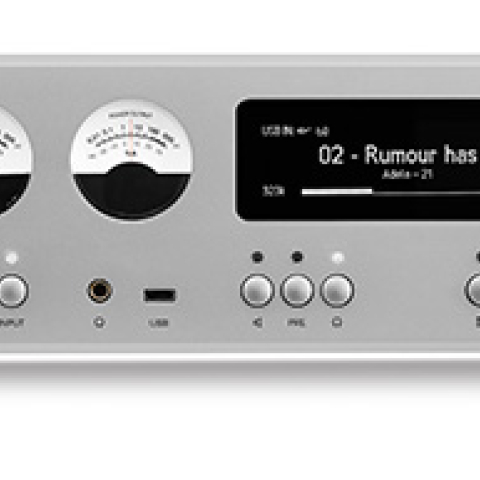
The elegant front panel, designed by Desmond Harrington, has Standby and Mute buttons, four input buttons, a Volume knob, and one of Pass Labs' signature needle-and-scale meters, this one indicating when the INT-60 slips out of class-A and into class-AB. According to Kent English, of Pass Labs tech support, a "[p]ianissimo note has the meter staff left of 12 o'clock," and a "[f]ortississimo note has the meter staff right of 12 o'clock . . . and well right of 12 o'clock, the meter hits the right-hand stop at about rated output."
 The INT-60's rear panel features four line-level preamp inputs: two that offer both XLR and RCA connectors, and two more offering RCAs only. Also included are two preamp outputs (XLR and RCA); two pairs of high-quality speaker binding posts, built with torque-limiting ratchets; and an AC power switch, IEC mains socket, fuse holder, and ground post.
Listening with the Zu Audio Soul Supremes
The INT-60's rear panel features four line-level preamp inputs: two that offer both XLR and RCA connectors, and two more offering RCAs only. Also included are two preamp outputs (XLR and RCA); two pairs of high-quality speaker binding posts, built with torque-limiting ratchets; and an AC power switch, IEC mains socket, fuse holder, and ground post.
Listening with the Zu Audio Soul Supremes
As some of you know, here in Bed Stuy, I'm my own one-man religious order: the Hermit of Hart Street. Wearing black and cloistered in my leafy grotto, I use as my daily prayers the sacred music of the world's diverse cultures. The biggest part of this spiritual practice involves listening to every LP of Gregorian chant or early music I can find. I especially enjoy the well-played, superbly recorded offerings from French Harmonia Mundi. Lost in meditation . . . I'd taken at least a dozen tours of both sides of Konrad Ruhland and Capella Antiqua de Munich's Chants Grégoriens pour le Temps de Noël (LP, Harmonia Mundi 5112) before I noticed the single example of polyphony, "Iube Domne Silentium." But it took me no time at all to hear the Pass Labs INT-60 demonstrating to me why the Zu Audio Soul Supreme loudspeakers ($4500/pair), which I reviewed in the July 2016 issue, aren't merely good but great. (Think perfect tonal character mixed with palpable sensations of realness.) It took me even less time to recognize the clear sophistication the Pass integrated brought to these mesmerizing performances recorded in 1972–73. Imagine a real acoustic space vibrating with 10th-century plainsong floating above an abyss of reverential audio silence. Imagine the most delicate and well-defined choral textures. Imagine no excess added reverb distracting from the torchlit atmosphere of the recording venue.
The Soul Supremes can sing and chant with only a few watts; typically, they sound present, fast, and superdetailed through the midrange, but with a slight bit of extra energy between 2kHz and 8kHz. The INT-60 seemed to mitigate that extra energy. That clanky piano sound that John Atkinson referred to in his write-up of his measurements of the Zu became relatively unnoticeable. The Soul Supreme's bass is always quick, clean, and a little lean; with the INT-60 it was less lean, more muscular, and BIG.
In my room, this amp-speaker combination made me bless Pass and venerate Zu for their contributions to some of the best reproductions of music I've experienced this century. If you wonder about my personal taste in audio—what kind of sound I really like—this is it.
Listening with the Magnepan .7s
I don't care what class of "Recommended Components" El Capo puts them in—I love the Magnepan .7 loudspeakers' ($1400/pair) fundamental musicality, détail liquide, and spectacular imaging. The Pass Labs INT-60 drove the .7s with more subtle magic, slam, and lush joy than I'd previously heard from these speakers. But occasionally, that joy got a bit too lush.
Pass Laboratories, founded in 1991, has at least three Daoshi, or high priests of Taoist amplifier design: Nelson Pass and his colleague, Wayne Colburn, plus a new hire, Jam Somasundram, who designed the HPA-1 headphone amp, all of whom create fresh new inventions based on the ancient alchemy of single-ended, class-A amp design. According to a statement by Pass on his company's website, the INT-60 isn't literally identical to its standalone counterpart, the XA60.8 [60W monoblock power amplifier]: "[I]n particular the INT-60 is a stereo amplifier using the hardware of a single-channel XA60.8, and it necessarily has lower bias current in the output stage and does not operate [in] class-A to 60W, rather somewhat less than half that.
The INT-60's rear panel features four line-level preamp inputs: two that offer both XLR and RCA connectors, and two more offering RCAs only. Also included are two preamp outputs (XLR and RCA); two pairs of high-quality speaker binding posts, built with torque-limiting ratchets; and an AC power switch, IEC mains socket, fuse holder, and ground post.
Listening with the Zu Audio Soul SupremesAs some of you know, here in Bed Stuy, I'm my own one-man religious order: the Hermit of Hart Street. Wearing black and cloistered in my leafy grotto, I use as my daily prayers the sacred music of the world's diverse cultures. The biggest part of this spiritual practice involves listening to every LP of Gregorian chant or early music I can find. I especially enjoy the well-played, superbly recorded offerings from French Harmonia Mundi. Lost in meditation . . . I'd taken at least a dozen tours of both sides of Konrad Ruhland and Capella Antiqua de Munich's Chants Grégoriens pour le Temps de Noël (LP, Harmonia Mundi 5112) before I noticed the single example of polyphony, "Iube Domne Silentium." But it took me no time at all to hear the Pass Labs INT-60 demonstrating to me why the Zu Audio Soul Supreme loudspeakers ($4500/pair), which I reviewed in the July 2016 issue, aren't merely good but great. (Think perfect tonal character mixed with palpable sensations of realness.) It took me even less time to recognize the clear sophistication the Pass integrated brought to these mesmerizing performances recorded in 1972–73. Imagine a real acoustic space vibrating with 10th-century plainsong floating above an abyss of reverential audio silence. Imagine the most delicate and well-defined choral textures. Imagine no excess added reverb distracting from the torchlit atmosphere of the recording venue.
I don't care what class of "Recommended Components" El Capo puts them in—I love the Magnepan .7 loudspeakers' ($1400/pair) fundamental musicality, détail liquide, and spectacular imaging. The Pass Labs INT-60 drove the .7s with more subtle magic, slam, and lush joy than I'd previously heard from these speakers. But occasionally, that joy got a bit too lush.