

Sidebar 3: Measurements
Before performing any measurements, I ran one Pass Labs XA60.8 (serial no. 28984) for an hour at one-third its specified maximum power of 60W into 8 ohms—thermally, the worst case for an amplifier with a class-B or -AB output stage. By the end of the hour, the top panel was warm, at 96.4°F (35.8°C), and the side-mounted heatsinks were a little hotter, at 109.1°F (42.8°C). (Temperatures were measured with a Mastercool infrared thermometer.) The XA60.8 ran a little cooler than the XA60.5 I reviewed in January 2014, probably due to its larger heatsinks.
I performed a full set of measurements using my Audio Precision SYS2722 system (see the January 2008 "As We See It"). The voltage gain at 1kHz into 8 ohms was 25.3dB for both the balanced and unbalanced inputs (for unbalanced drive, pins 2 and 3 of the XLR jack were connected with a jumper), meaning that the XA60.8 will output 1W into 8 ohms with a drive signal of 155mV. The amplifier was non-inverting (ie, it preserved absolute polarity) with both inputs. Its input impedance was usefully higher than that of the XA60.5, at 49k ohms unbalanced and 100k ohms balanced at 20Hz and 1kHz, dropping to 38k ohms at 20kHz for unbalanced signals. (The balanced input impedance at 20kHz was 92k ohms.)
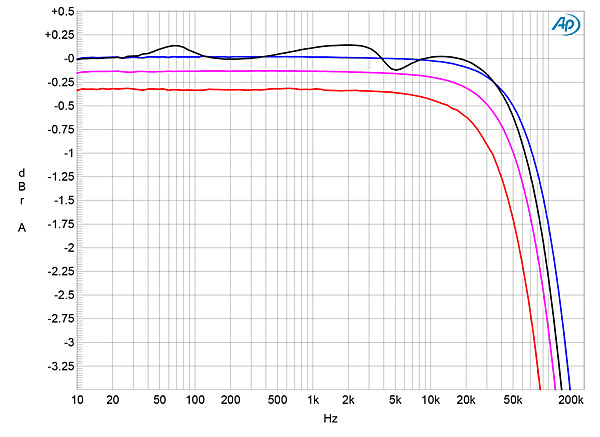
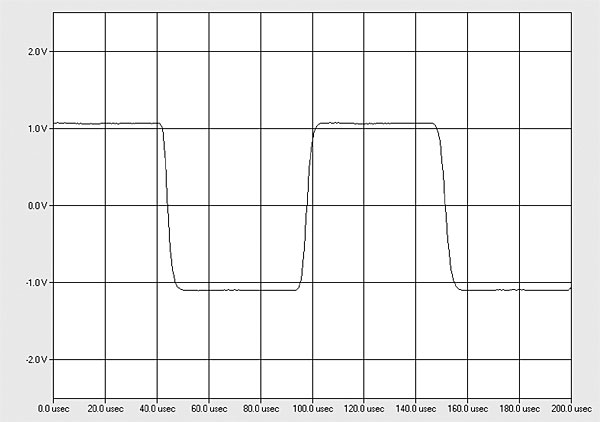
The XA60.8's output impedance, including 6' of speaker cable, was 0.07 ohm at 20Hz and 1kHz, rising to 0.1 ohm at 20kHz. The modulation of the amplifier's frequency response, due to the Ohm's law interaction between this source impedance and the impedance of our standard simulated loudspeaker, was just ±0.1dB (fig.1, gray trace). Into an 8 ohm resistive load (blue trace), the XA605's response was flat up to 20kHz, then rolled off to reach –3dB around 120kHz. The response rolled off a little earlier into lower impedances, but was still just 0.3dB down at 20kHz into 2 ohms (red trace). With this wide a small-signal bandwidth, the amplifier's reproduction of a 10kHz squarewave into 8 ohms featured short risetimes and a well-squared shape (fig.2).
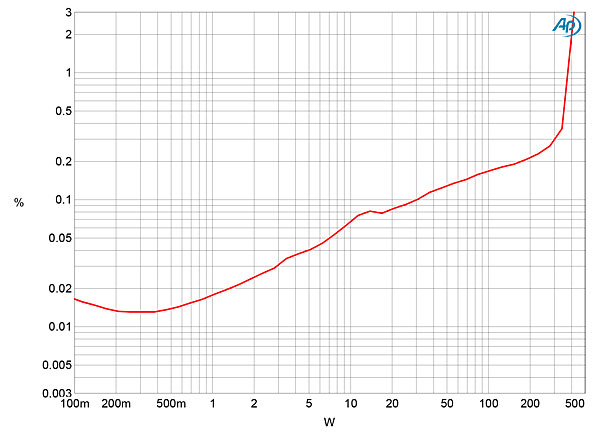
 Specified as putting out 60W into 8 ohms and 120W into 4 ohms (both 17.8dBW), the XA60.8 considerably exceeded that power, delivering, at 1% total harmonic distortion (THD), 150W into 8 ohms (21.8dBW, fig.4), 240W into 4 ohms (20.8dBW, fig.5), and 380W into 2 ohms (19.8dBW, fig.6). The THD begins to rise above the noise floor at high powers, but remains at or below 0.1% below the specified output power. The percentage of THD then slowly rises with increasing power, suggesting that the XA60.8 has only a small amount of corrective feedback.


 Fortunately, the XA60.8's distortion is predominantly the subjectively innocuous low-order variety. Fig.8 shows the waveform of the THD spuriae at two-thirds the specified power; it suggests that the third harmonic is predominant, though at low frequencies at this power (fig.9) the second harmonic is highest in level, at –72dB (0.02%). With a 1kHz signal, the second harmonic remains at this level, but the third has risen to –63dB (0.07%, fig.10). Some higher-order harmonics can also be seen in fig.10, but all are much lower in level than the second and third harmonics.

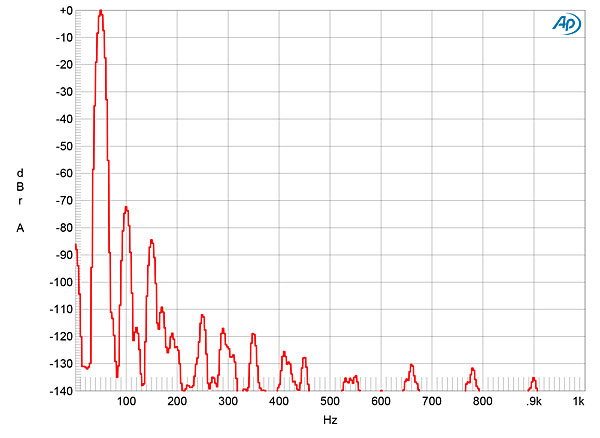
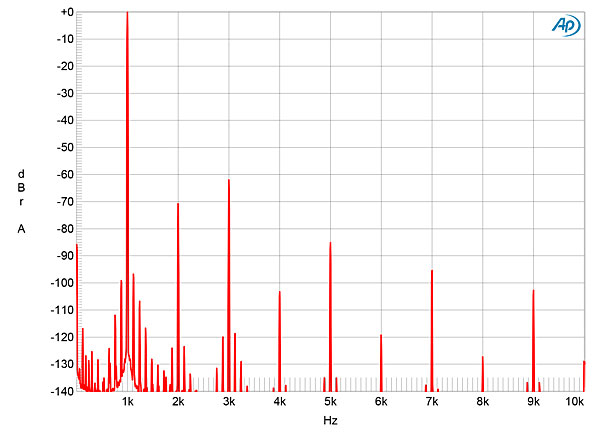

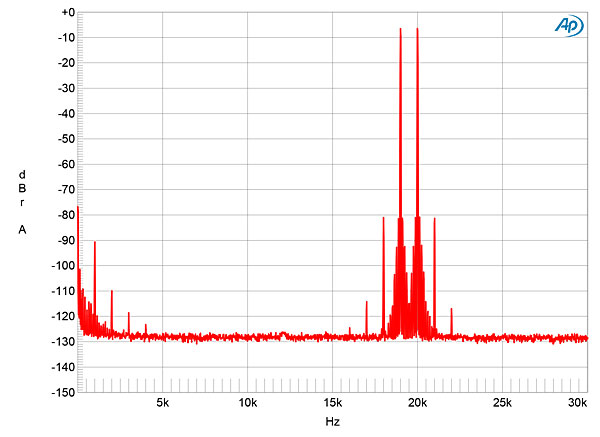
Fig.1 Pass Labs XA60.8, frequency response at 2.83V into: simulated loudspeaker load (gray), 8 ohms (blue), 4 ohms (magenta), 2 ohms (red) (0.5dB/vertical div.).
Fig.2 Pass Labs XA60.8, small-signal 10kHz squarewave into 8 ohms.
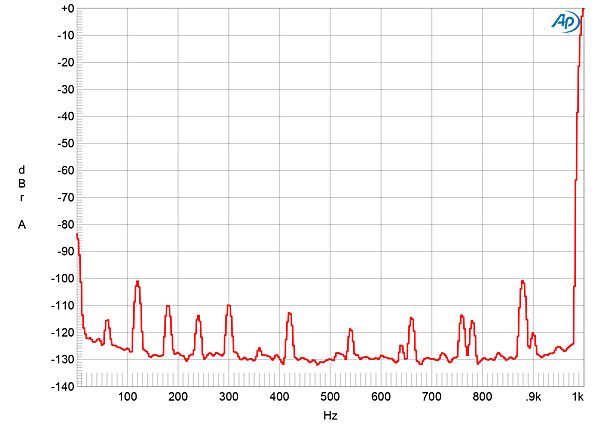
The unweighted, wideband signal/noise ratio, ref. 1W into 8 ohms and taken with the input shorted to ground, was an excellent 80.9dB. This improved to 81.8dB when the measurement bandwidth was restricted to the audioband—and further still, to 93.6dB, when the measurement was A-weighted. This is a quiet amplifier. Fig.3 indicates that both the odd and even harmonics of the 60Hz power-supply frequency were present, though these all lay at or below –100dB ref. 1W into 8 ohms.
Fig.3 Pass Labs XA60.8, spectrum of 1kHz sinewave, DC–1kHz, at 1W into 8 ohms (linear frequency scale).
Fig.4 Pass Labs XA60.8, distortion (%) vs 1kHz continuous output power into 8 ohms.
Fig.5 Pass Labs XA60.8, distortion (%) vs 1kHz continuous output power into 4 ohms.
Fig.6 Pass Labs XA60.8, distortion (%) vs 1kHz continuous output power into 2 ohms.
I examined how the percentage of THD+noise changed with frequency at 9V, a level where I could be sure, from the earlier measurements, that I was looking at actual distortion rather than noise. The THD+N was extremely low in the midrange into 8 and 4 ohms (fig.7, blue and magenta traces), and only just above 0.1% into 2 ohms (red). It rose linearly as the frequency increased, the three traces converging in the high treble—which suggests that the circuit has limited open-loop bandwidth.
Fig.7 Pass Labs XA60.8, THD+N (%) vs frequency at 9V into: 8 ohms (blue), 4 ohms (magenta), 2 ohms (red).
Fig.8 Pass Labs XA60.8, 1kHz waveform at 20W into 8 ohms, 0.072% THD+N (top); distortion and noise waveform with fundamental notched out (bottom, not to scale).
Fig.9 Pass Labs XA60.8, spectrum of 50Hz sinewave, DC–1kHz, at 40W into 8 ohms (linear frequency scale).
Fig.10 Pass Labs XA60.8, spectrum of 1kHz sinewave, DC–10kHz, at 40W into 8 ohms (linear frequency scale).
As with the XA60.5, the XA60.8's top-octave decrease in linearity seen in fig.7 was associated with some higher-order intermodulation products that were fairly high in level when the XA60.8 was asked to drive an equal mix of 19 and 20kHz tones at a level just below visible clipping on the oscilloscope screen (fig.11). However, the subjectively more objectionable second-order product at 1kHz is almost 20dB lower, at –78dB (0.012%). At lower powers, the intermodulation products were all much lower in level (fig.12).
Fig.11 Pass Labs XA60.8, HF intermodulation spectrum, DC–30kHz, 19+20kHz at 40W peak into 8 ohms (linear frequency scale).
Fig.12 Pass Labs XA60.8, HF intermodulation spectrum, DC–30kHz, 19+20kHz at 2W peak into 4 ohms (linear frequency scale).
The measured performance of the Pass Labs XA60.8 is very similar to that of the XA60.5. Both are well-engineered amplifiers that deliver more usable power than their modest specifications suggest.—John Atkinson















