

Sidebar 3: Measurements
The PrimaLuna EVO 400 arrived without the eight EL34 output tubes installed, just the six 12AU7 small-signal tubes. Neither the EL34s nor the sockets are numbered, so I assumed that PrimaLuna's Adaptive Auto Bias system would ensure that the tubes were optimally biased after I installed them. (As recommended for EL34s in the manual, I made sure that the bias switch on the right side of the chassis was set to Low.) None of the four red LEDs for each channel's tube condition illuminated during the testing, which meant that PrimaLuna's BTI circuit didn't detect a bad tube. I measured the EVO 400 with my Audio Precision SYS2722 system, performing a complete set of tests from each of the 8 ohm and 4 ohm taps in both Ultralinear and Triode output modes, repeating some tests from the headphone output. The review sample was not fitted with the optional PhonoLogue moving magnet phono stage.
The EVO 400's unbalanced input impedance was a usefully high 33k ohms at 20Hz and 1kHz, dropping inconsequentially to 29k ohms at 20kHz. The PrimaLuna amplifier preserved absolute polarity from both output transformer taps and from the headphone output. The amplifier's maximum voltage gain at 1kHz into 8 ohms depended on the output mode and tap. The highest gain was from the 8 ohm tap in Ultralinear mode, at 37.3dB. The gain from the 8 ohm tape in Triode mode was 1.3dB lower. The gains from the 4 ohm tap into 8 ohms were 36dB in Ultralinear mode and 33.8dB in Triode mode. The maximum gain from the headphone output was 20.15dB.
The amplifier's output impedance also depended on the output mode and tap. The highest impedance was from the 8 ohm tap in Ultralinear mode, at 2.5 ohms at 20Hz and 1kHz, rising to 3.3 ohms at 20kHz. This resulted in ±1.4dB variations in frequency response with our standard simulated loudspeaker (fig.1, gray trace). The output impedance from the 8 ohm tap in Triode mode was slightly lower, ranging from 2.25 ohms to 2.85 ohms, which reduced the variations in response to ±1.2dB (fig.2, gray trace). As expected, the 4 ohm tap featured the lowest output impedance: 1.45 ohms at 20Hz and 1kHz, 1.8 ohms at 20kHz, in Ultralinear mode; 1.3 ohms at 20Hz and 1kHz, 1.6 ohms at 20kHz, in Triode mode. The headphone output's source impedance was a low 3.2 ohms across the audio band.


 Fitted with EL34 output tubes, the PrimaLuna amplifier is specified as delivering 38Wpc into 8 ohms in Triode mode (15.8dBW) and 70Wpc into 8 ohms in Ultralinear mode (18.4dBW). Using our definition of clipping, which is when the output's THD+noise percentage reaches 1%, with both channels driven with a 1kHz signal the EVO 400's 8 ohm tap in Ultralinear mode clipped at 63Wpc into 8 ohms (18.0dBW, fig.5). Relaxing the definition of clipping to 3% THD+N gave the specified power of 70Wpc into 8 ohms. In Triode mode, the 8 ohm tap gave 33Wpc (15.2dBW) at 1% THD+N and 39Wpc (15.9dBW) at 3% THD+N (fig.6). Similar maximum powers at 3% THD+N were available from the 4 ohm tap when driving 4 ohms: 67Wpc (15.25dBW) in Ultralinear mode and 37Wpc (12.67dBW) in Triode mode.




 Other than the higher level of second-harmonic distortion in the right channel, the PrimaLuna EVO 400's performance on the test bench was what I would expect from an amplifier with a push-pull output stage that uses paralleled EL34 tubes. The test results suggest that the lowest distortion will be obtained with the 4 ohm tap in Ultralinear mode.—John Atkinson
Fig.1 PrimaLuna EVO400, Ultralinear mode, 8 ohm tap, frequency response at 2.83V into: simulated loudspeaker load (gray), 8 ohms (left channel blue, right red), 4 ohms (left cyan, right magenta), 2 ohms (green) (2dB/vertical div.).
Fig.2 PrimaLuna EVO400, Triode mode, 8 ohm tap, frequency response at 2.83V into: simulated loudspeaker load (gray), 8 ohms (left channel blue, right red), 4 ohms (left cyan, right magenta), 2 ohms (green) (2dB/vertical div.).
Into resistive loads, the small-signal response from both transformer taps was flat almost to 20kHz and rolled off above that frequency (blue, red, cyan, magenta, and green traces in figs.1 and 2). A residual resonance just below 70kHz can be seen in the ultrasonic rolloff. This resonance is well-damped, however, with just one cycle of ringing visible with the amplifier's reproduction of a 10kHz squarewave (fig.3).
Fig.3 PrimaLuna EVO400, Triode mode, 8 ohm tap, small-signal 10kHz squarewave into 8 ohms.
Figs.1 and 2 were taken with the volume control set to its maximum, where the channel matching was within 0.1dB. The excellent matching was maintained at lower settings of the control, but peculiarly, the right channel lagged the left channel by a second or so in reaching the new level when the volume was changed. L–R channel separation was good below 2kHz, at 70dB, but 50dB in the other direction. The separation reduced to 56dB and 38dB, respectively, at the top of the audioband.
Measured at the 8 ohm taps and taken with the inputs shorted to ground and the volume control at its maximum, the amplfier's unweighted, wideband signal/noise ratio in Ultralinear mode was 64dB in the left channel, 67.5dB in the right channel, ref. 1W into 8 ohms. These ratios respectively improved slightly to 65.3dB and 70.2dB when the measurement bandwidth was restricted to the audioband, and to 70.3dB and 74.8dB when A-weighted. The S/N ratios in Triode mode were 2–3dB higher, and were 3dB higher again from the 4 ohm tap. The main power supply–related spuriae in the EVO 400's noisefloor were at 60Hz and 120Hz and the random noise level was a little higher in the left channel (fig.4, blue trace) than the right (red trace), which correlates with the lower S/N ratios in that channel.
Fig.4 PrimaLuna EVO400, Triode mode, 4 ohm tap, spectrum of 1kHz sinewave, DC–1kHz, at 1W into 8 ohms with volume control at its maximum (left channel blue, right red; linear frequency scale).
Fig.5 PrimaLuna EVO400, Ultralinear mode, 8 ohm tap, distortion (%) vs 1kHz continuous output power into 8 ohms.
Fig.6 PrimaLuna EVO400, Triode mode, 8 ohm tap, distortion (%) vs 1kHz continuous output power into 8 ohms.
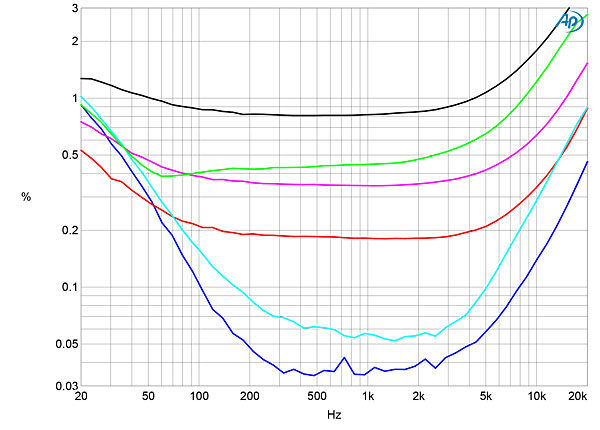
The traces in figs.5 and 6 were taken with the left channel and the distortion levels in both output modes dropped below 0.1% at low powers. Although I haven't shown the relevant graphs, the distortion at moderate powers was even lower when the output transformer tap was driving a load higher than its nominal value. I plotted how the THD+N percentage changed with frequency at 4.9V from the 4 ohm tap—a voltage that is equivalent to 3W into 8 ohms, 6W into 4 ohms, and 12W into 2 ohms—in both Ultralinear mode (fig.7) and Triode mode (fig.8). These graphs show that the distortion was significantly higher in the right channel (red, magenta, and gray traces) than the left (blue, cyan, and green). It is possible that the tubes were not as well-matched in the right channel as in the left. (The more closely the tubes are matched in a push-pull design, the lower the level of even-order distortion.) The distortion also rises at the frequency extremes and into loads that are equal to or below the nominal transformer tap impedance.
Fig.7 PrimaLuna EVO400, Ultralinear mode, 8 ohm tap, THD+N (%) vs frequency at 4.9V into: 8 ohms (left blue, right red), 4 ohms (left cyan, right magenta), 2 ohms (left green), right gray).
Fig.8 PrimaLuna EVO400, Triode mode, 4 ohm tap, THD+N (%) vs frequency at 4.9V into: 8 ohms (left blue, right red), 4 ohms (left cyan, right magenta), 2 ohms (left green), right gray).
Fortunately, the EVO 400's distortion was predominantly the sonically benign second harmonic (fig.9), though as expected it was higher in level in the right channel (fig.10). This graph also shows that at low frequencies the third harmonic makes an appearance, though it is lower in level at higher frequencies (fig.11). When the amplifier drove an equal mix of 19 and 20kHz tones at a peak level of 3W into 8 ohms from the 8 ohm tap (fig.12), the second-order difference product at 1kHz ay at –57dB (0.14%) in both channels and the higher-order intermodulation products were all below –66dB (0.05%). The graph was taken in Triode mode; intermodulation distortion in Ultralinear mode was similar in level.
Fig.9 PrimaLuna EVO400, Ultralinear mode, 4 ohm tap, 1kHz waveform at 5W into 8 ohms, 0.066% THD+N (top); distortion and noise waveform with fundamental notched out (bottom, not to scale).
Fig.10 PrimaLuna EVO400, Triode mode, 4 ohm tap, spectrum of 50Hz sinewave, DC–1kHz, at 3Wpc into 8 ohms (left channel blue, right red; linear frequency scale).
Fig.11 PrimaLuna EVO400, Ultralinear mode, 8 ohm tap, spectrum of 1kHz sinewave, DC–10kHz, at 3Wpc into 8 ohms (left channel blue, right red; linear frequency scale).
Fig.12 PrimaLuna EVO400, Triode mode, 8 ohm tap, HF intermodulation spectrum, DC–30kHz, 19+20kHz at 3Wpc peak into 8 ohms (left channel blue, right red; linear frequency scale).















