

Sidebar 3: Measurements
I measured Pro-Ject's Pre Box S2 Digital with my Audio Precision SYS2722 system (see the January 2008 "As We See It"). I used both the Audio Precision's S/PDIF outputs and USB data sourced from my MacBook Pro running on battery power and playing WAV and AIFF test-tone files. Apple's USB Prober utility identified the Pro-Ject as "Pre Box S2 Digital" from "Pro-Ject," and confirmed that its USB port operated in the optimal isochronous asynchronous mode. Apple's AudioMIDI utility revealed that, via USB, the Pre Box S2 Digital accepted 32-bit integer data sampled at all rates up to 768kHz; its TosLink and coaxial S/PDIF inputs accepted PCM data sampled at up to 192kHz.
Pressing the Menu button revealed that the review sample was set to Distortion Compensate Disabled and the Audio Quality to User. I left these settings alone for the measurements and mostly used the Hybrid reconstruction filter, except where indicated. With the volume control set to its maximum, the output levels were 2.02V from the unbalanced jacks, 2V from the headphone output. The voltage varied very slightly according to which filter had been selected. The maximum levels with the Optimal Transient and Linear Apodizing filters were 0.05dB higher than with the Hybrid filter. The output impedance was a very low 0.5 ohm from both outputs, both of which preserved absolute polarity (ie, were non-inverting).
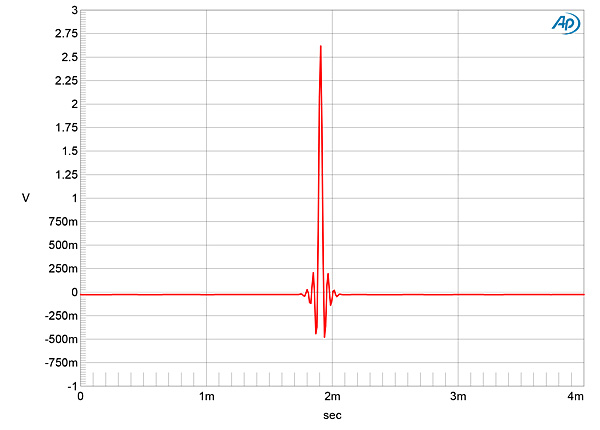
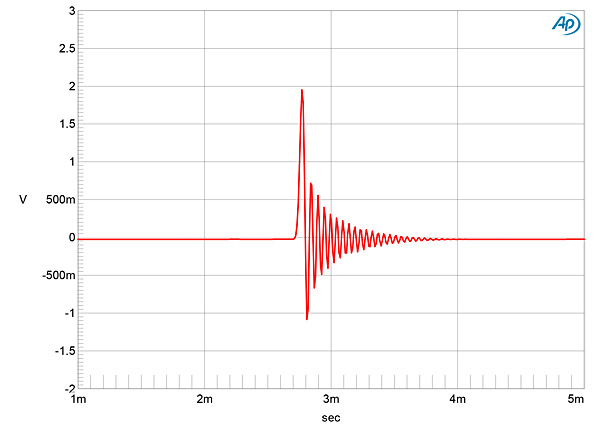
The Pro-Ject's impulse response depended on which of its reconstruction filters had been selected. With 44.1kHz data, the Brickwall, Fast Rolloff, and Linear Apodizing filters' impulse responses were all conventional linear-phase types, with time-symmetrical ringing (fig.1). Slow Rolloff is a much shorter linear-phase filter (fig.2), Minimum Phase Fast a minimum-phase filter with all of the ringing following the single high sample (fig.3), and Minimum Phase Slow a shorter minimum-phase filter (fig.4). The Optimal Transient filter had a perfect transient response (fig.5; the small amount of linear-phase ringing in this graph is due to the Audio Precision's A/D converter operating at a 200kHz sample rate). The Hybrid filter had some slight Nyquist-frequency ringing, with considerably more ringing after the single high sample than before (fig.6).



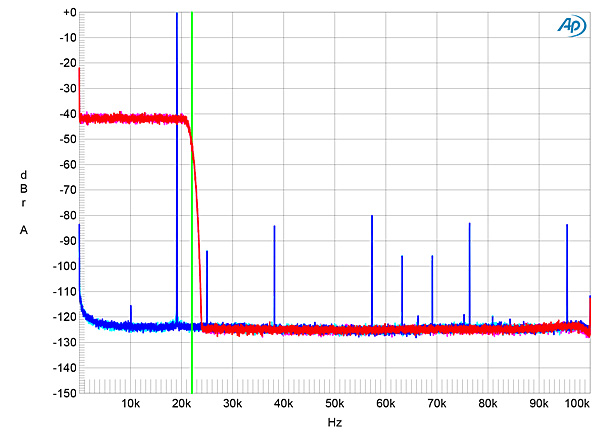
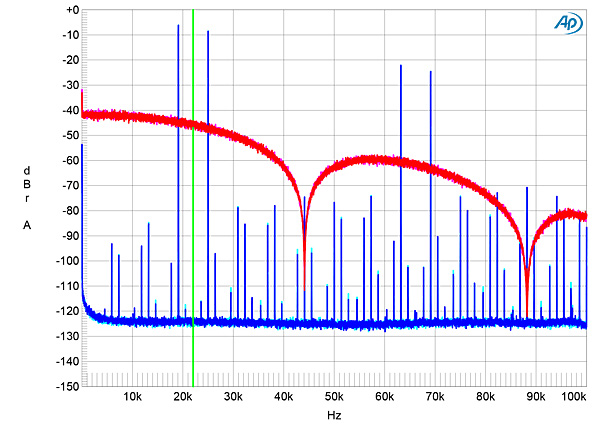
 With white noise sampled at 44.1kHz, the ultrasonic rolloff again depended on the reconstruction filter and mostly fell into three categories. The Fast Rolloff and Minimum Phase Fast filters rolled off the output above 20kHz, reaching full stopband attenuation by 24kHz (fig.7, magenta and red traces), and the aliased image of a 19.1kHz tone at 0dBFS (cyan, blue) was suppressed by 94dB. The Slow Rolloff and Minimum Phase Slow filters had, as expected, the same slower ultrasonic rolloff (fig.8), with just 27dB attenuation of the image at 25kHz. The Hybrid, Linear Apodizing, and Brickwall filters behaved identically, with a null at the Nyquist frequency of 22.05kHz (fig.9). As is usual with a filter that offers perfect time-domain behavior, the Optimal Transient filter offered a very slow rolloff with just 3dB attenuation of the aliased image at 25kHz, and nulls at 44.1 and 88.2kHz (fig.10).




 With a full-scale 50Hz tone, the second harmonic was the highest in level in the right channel (fig.16, red trace), at –94dB (0.002%), and the third harmonic the highest in level in the left channel (fig.16, blue), at –110dB (0.0003%). These low levels of harmonic distortion were maintained into the punishing 600 ohm load.

 When I tested the Pre Box S2 Digital for its rejection of word-clock jitter using undithered 16-bit J-Test data fed to the TosLink input, the odd-order harmonics of the low-frequency, LSB-level squarewave were all at the correct levels (fig.20, sloping green line), though a sideband pair of unknown origin can be seen in the left channel at ±2.2kHz. These sidebands were also present with 24-bit TosLink data (fig.21), but were absent when I repeated the analysis with 24-bit USB data (fig.22).


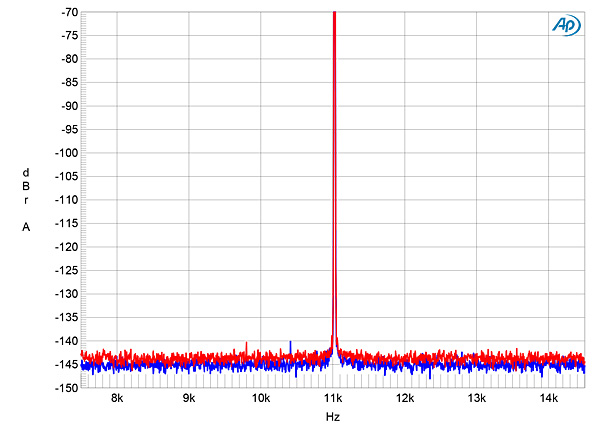
Fig.1 Pro-Ject Pre Box S2 Digital, Brickwall filter, impulse response (one sample at 0dBFS, 44.1kHz sampling, 4ms time window).
Fig.2 Pro-Ject Pre Box S2 Digital, Slow Rolloff filter, impulse response (one sample at 0dBFS, 44.1kHz sampling, 4ms time window).
Fig.3 Pro-Ject Pre Box S2 Digital, Minimum Phase Fast filter, impulse response (one sample at 0dBFS, 44.1kHz sampling, 4ms time window).
Fig.4 Pro-Ject Pre Box S2 Digital, Minimum Phase Fast filter, impulse response (one sample at 0dBFS, 44.1kHz sampling, 4ms time window).
Fig.5 Pro-Ject Pre Box S2 Digital, Optimal Transient filter, impulse response (one sample at 0dBFS, 44.1kHz sampling, 4ms time window).
Fig.6 Pro-Ject Pre Box S2 Digital, Hybrid filter, impulse response (one sample at 0dBFS, 44.1kHz sampling, 4ms time window).
Fig.7 Pro-Ject Pre Box S2 Digital, Fast Rolloff filter, wideband spectrum of white noise at –4dBFS (left channel red, right magenta) and 19.1kHz tone at 0dBFS (left blue, right cyan), with data sampled at 44.1kHz (20dB/vertical div.).
Fig.8 Pro-Ject Pre Box S2 Digital, Slow Rolloff filter, wideband spectrum of white noise at –4dBFS (left channel red, right magenta) and 19.1kHz tone at 0dBFS (left blue, right cyan), with data sampled at 44.1kHz (20dB/vertical div.).
Fig.9 Pro-Ject Pre Box S2 Digital, Linear Apodizing filter, wideband spectrum of white noise at –4dBFS (left channel red, right magenta) and 19.1kHz tone at 0dBFS (left blue, right cyan), with data sampled at 44.1kHz (20dB/vertical div.).
Fig.10 Pro-Ject Pre Box S2 Digital, Optimal Transient filter, wideband spectrum of white noise at –4dBFS (left channel red, right magenta) and 19.1kHz tone at 0dBFS (left blue, right cyan), with data sampled at 44.1kHz (20dB/vertical div.).
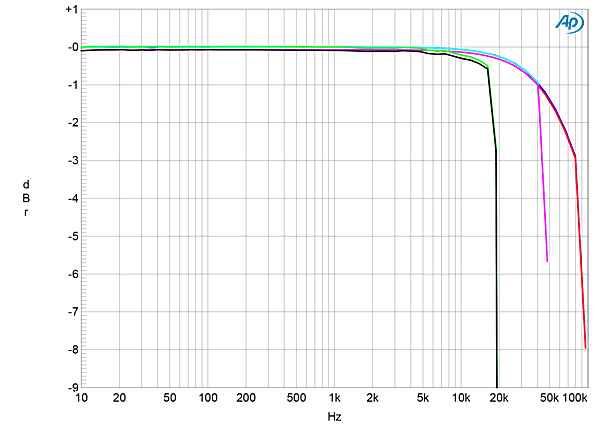
Fig.11 shows the Pro-Ject's frequency response with the Hybrid filter at sample rates of 44.1, 96, and 192kHz. The response rolls off relatively quickly above each Nyquist frequency (half the sample rate) from both the line and headphone outputs. The Pro-Ject's channel separation (not shown) was superb, at >120dB below 3kHz, and still 112dB in both directions at 20kHz. The low-frequency noise floor was very low, and commendably free from power-supply–related spuriae (fig.12). The low noise and the superb channel-separation measurement are extraordinarily good, considering that the Pre Box S2 Digital is powered by a tiny wall-wart supply. Someone at Pro-Ject knows how to optimize a printed-circuit-board layout!
Fig.11 Pro-Ject Pre Box S2 Digital, Hybrid filter, frequency response at –12dBFS into 100k ohms with data sampled at: 44.1kHz (left channel gray, right green), 96kHz (left cyan, right magenta), 192kHz (left blue, right red) (1dB/vertical div.).
Fig.12 Pro-Ject Pre Box S2 Digital, spectrum (0Hz–1kHz) of dithered 1kHz tone at 0dBFS (left channel blue, right red) (20dB/vertical div.).
Increasing the bit depth from 16 to 24 with a dithered 1kHz tone at –90dBFS lowered the noise floor by almost 20dB (fig.13), which implies a resolution of 19 bits. With undithered data representing a tone at exactly –90.31dBFS (fig.14), the three DC voltage levels described by the data were well resolved, with a symmetrical waveform. With undithered 24-bit data, the result was a clean sinewave (fig.15).
Fig.13 Pro-Ject Pre Box S2 Digital, spectrum with noise and spuriae of dithered 1kHz tone at –90dBFS with: 16-bit data (left channel cyan, right magenta), 24-bit data (left blue, right red) (20dB/vertical div.).
Fig.14 Pro-Ject Pre Box S2 Digital, waveform of undithered 1kHz sinewave at –90.31dBFS, 16-bit TosLink data (left channel blue, right red).
Fig.15 Pro-Ject Pre Box S2 Digital, waveform of undithered 1kHz sinewave at –90.31dBFS, 24-bit TosLink data (left channel blue, right red).
Fig.16 Pro-Ject Pre Box S2 Digital, spectrum of 50Hz sinewave, DC–1kHz, at 0dBFS into 100k ohms (left channel blue, right red; linear frequency scale).
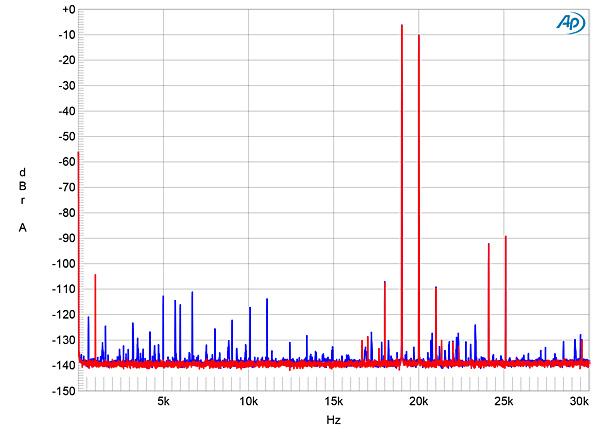
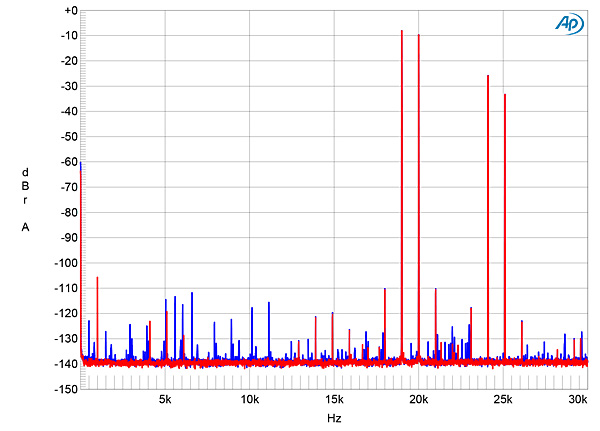
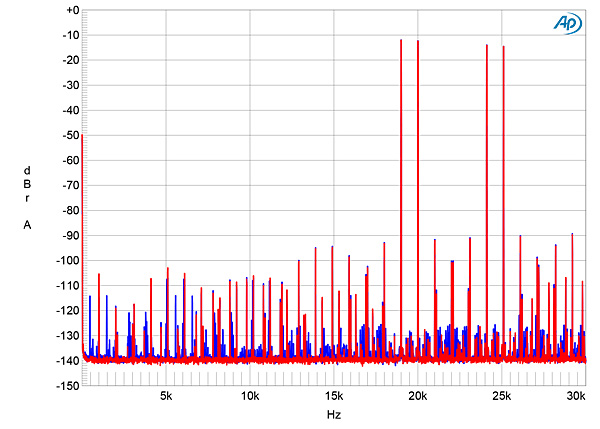
While intermodulation products were always extremely low in level, how the Pro-Ject handled a full-scale mix of tones at 19 and 20kHz depended on the filter selected. With the Brickwall, Fast Rolloff, Minimum Phase Fast, and Hybrid filters, the aliased images of the fundamental tones were all suppressed by 90dB or more (fig.17), though the left channel (blue trace) had more low-level audioband spuriae present than the right (red). As expected from their slower ultrasonic rolloffs, the Slow Rolloff and Minimum Phase Slow filters suppressed the aliased images by around 20dB (fig.18). With its poor ultrasonic rejection, the Optimal Transient filter produced aliased images of the fundamental tones at very high levels, with many higher-order aliased images appearing in the audioband, even when I used the volume control to reduce the signal level by 3dB (fig.19). (The improved performance at the lower level implies that the Pro-Ject's volume control operates in the digital domain.)
Fig.17 Pro-Ject Pre Box S2 Digital, Brickwall filter, HF intermodulation spectrum, DC–30kHz, 19+20kHz at 0dBFS into 100k ohms, 44.1kHz data (left channel blue, right red; linear frequency scale).
Fig.18 Pro-Ject Pre Box S2 Digital, Minimum Phase Slow filter, HF intermodulation spectrum, DC–30kHz, 19+20kHz at 0dBFS into 100k ohms, 44.1kHz data (left channel blue, right red; linear frequency scale).
Fig.19 Pro-Ject Pre Box S2 Digital, Optimal Transient filter, HF intermodulation spectrum, DC–30kHz, 19+20kHz at –3dBFS into 100k ohms, 44.1kHz data (left channel blue, right red; linear frequency scale).
Fig.20 Pro-Ject Pre Box S2 Digital, high-resolution jitter spectrum of analog output signal, 11.025kHz at –6dBFS, sampled at 44.1kHz with LSB toggled at 229Hz: 16-bit TosLink data (left channel blue, right red). Center frequency of trace, 11.025kHz; frequency range, ±3.5kHz.
Fig.21 Pro-Ject Pre Box S2 Digital, high-resolution jitter spectrum of analog output signal, 11.025kHz at –6dBFS, sampled at 44.1kHz with LSB toggled at 229Hz: 24-bit TosLink data (left channel blue, right red). Center frequency of trace, 11.025kHz; frequency range, ±3.5kHz.
Fig.22 Pro-Ject Pre Box S2 Digital, high-resolution jitter spectrum of analog output signal, 11.025kHz at –6dBFS, sampled at 44.1kHz with LSB toggled at 229Hz: 24-bit USB data (left channel blue, right red). Center frequency of trace, 11.025kHz; frequency range, ±3.5kHz.
I was pleasantly surprised by the Pro-Ject Pre Box S2 Digital. This tiny, inexpensive box offers almost state-of-the-art measured digital performance. I note that KM didn't say definitively which of the eight reconstruction filters he preferred, mainly using the Optimal Transient filter. However, I suspect from the measurements that the Hybrid filter offers the best balance between time-domain and frequency-domain performance.—John Atkinson















