

When I used the Pre Box S2 as a headphone amp with my Asus laptop PC, I listened through AKG Acoustics K612 Pro Reference Studio ($250) or Master & Dynamic MH40 ($299) headphones. "The S2 can support any headphones," Goddard told me, "but may not have quite enough drive for some super-high-impedance cans." A Mytek USB cable connected the Pro-Ject to my laptop when I listened to Tidal or played files from an external hard drive. When I used the Pre Box S2 in my larger system as a DAC, a single run of Triode Wire Labs Spirit II interconnect joined my Tascam CD-200iL CD player's digital output to the Pro-Ject's coaxial digital input. A pair of Triode Wire Labs Spirit II single-ended interconnects connected the Pro-Ject to the analog input jacks of the Parasound Halo Hint 6 integrated amplifier or Shindo Laboratory Haut-Brion power amp.
The Pre Box S2 Digital sat lightly on four DiversiTech rubber and cork anti-vibration pads placed atop the CD player.
Pre Box S2 Digital as headphone amp
I don't often listen through headphones, but the S2 had me pulling out my decent cans, Master & Dynamic MH40s.
First, I experimented with the Pre Box S2's eight filters, playing Miles Davis's epic Filles de Kilimanjaro (16-bit/44.1kHz stream, Columbia/Tidal). I heard very little difference among the filters. Perhaps Slow Rolloff made Herbie Hancock's Fender Rhodes electric piano sound slightly creamier. Brickwall may have made Tony Williams's already shocking snare-drum rolls and pumping hi-hat eighth-notes a few degrees crisper, but I couldn't be sure. Singer Nancy Wilson's 1960 chartbuster, Something Wonderful (16/44.1 stream, Capitol/Tidal), had me reveling in her sassy, urbane delivery, but neither the Pre Box S2's Minimum Phase Fast nor Linear Apodizing filters altered or improved Wilson's elated flow in any significant way.
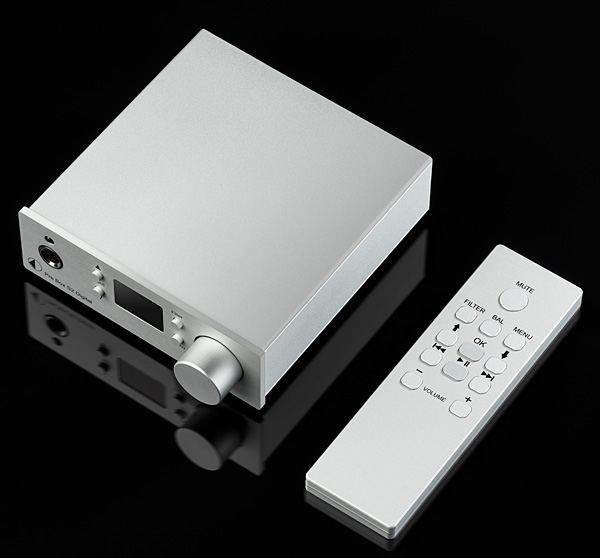 Throughout my listening to PCM files, the Pre Box S2 delivered extremely clean, crisp, well-sorted, enjoyable sound. On Something Wonderful, arranger Billy May's swinging big band was well proportioned, every note from the drums and double bass supremely punchy and extended, with excellent timing, realistic tone, and good spatial depth. Wilson's voice was joyously dead-center in the center-fill zone of my skull, her every syllable beautifully precise, every fleshy tone and subtle inflection seemingly flawless. It felt as if Wilson were singing directly to me, with my head replacing her vocal mike. I heard only a clean, non–gussied-up, fairly faithful representation of the files I played through it.
Phoenix's United (16/44.1, Parlophone/Tidal) sounded big, deep, and nicely spacious via the Master & Dynamic–Pro-Ject combo, the French quartet's energetic power-pop delivered with excellent bass depth and weight—drums were as dead-on thick as one of Dr. Dre's Snoop Dog productions—and with a pleasingly saturated midrange and treble. As emotional and melodic as their songs are topical, Phoenix may now be the finest power-pop band in the English-speaking world.
Then I clicked on Tom Petty's "Running Down a Dream" (24/96, Tidal MQA Master). The MQA icon lit up, as did the blue light. The music became louder, deeper, broader, more enveloping, even more dynamic. The soundstage seemed to grow and surround my head in a way that Tidal's non–MQA Master tracks hadn't.
MQA was a revelation through the Pre Box S2 Digital. Skipping around among Tom Petty, Frank Sinatra, David Bowie, Aretha Franklin, Billie Holiday, and some classical from 2L Sampler 2007: The Nordic Sound (24/96 2L/Tidal MQA), I heard major differences compared to PCM versions for most if not all recordings.
For instance, in non-MQA Tidal the 2000 Rudy Van Gelder Edition of Hank Mobley's No Room for Squares sounds as it does on CD (Blue Note ST-84149): clipped treble, small of stature, truncated transients, and shallow bass. The MQA version reveals a broader, richer frequency range, more air around instruments, greater depth, and generally better tone. These improvements held true for most of my comparisons of MQA and non-MQA files from Tidal. I particularly enjoyed hearing Wayne Shorter's music in MQA—then wondered why there are no MQA titles from the Miles Davis and Pink Floyd catalogs.
Pre Box S2 Digital vs AudioQuest DragonFly Red
Throughout my listening to PCM files, the Pre Box S2 delivered extremely clean, crisp, well-sorted, enjoyable sound. On Something Wonderful, arranger Billy May's swinging big band was well proportioned, every note from the drums and double bass supremely punchy and extended, with excellent timing, realistic tone, and good spatial depth. Wilson's voice was joyously dead-center in the center-fill zone of my skull, her every syllable beautifully precise, every fleshy tone and subtle inflection seemingly flawless. It felt as if Wilson were singing directly to me, with my head replacing her vocal mike. I heard only a clean, non–gussied-up, fairly faithful representation of the files I played through it.
Phoenix's United (16/44.1, Parlophone/Tidal) sounded big, deep, and nicely spacious via the Master & Dynamic–Pro-Ject combo, the French quartet's energetic power-pop delivered with excellent bass depth and weight—drums were as dead-on thick as one of Dr. Dre's Snoop Dog productions—and with a pleasingly saturated midrange and treble. As emotional and melodic as their songs are topical, Phoenix may now be the finest power-pop band in the English-speaking world.
Then I clicked on Tom Petty's "Running Down a Dream" (24/96, Tidal MQA Master). The MQA icon lit up, as did the blue light. The music became louder, deeper, broader, more enveloping, even more dynamic. The soundstage seemed to grow and surround my head in a way that Tidal's non–MQA Master tracks hadn't.
MQA was a revelation through the Pre Box S2 Digital. Skipping around among Tom Petty, Frank Sinatra, David Bowie, Aretha Franklin, Billie Holiday, and some classical from 2L Sampler 2007: The Nordic Sound (24/96 2L/Tidal MQA), I heard major differences compared to PCM versions for most if not all recordings.
For instance, in non-MQA Tidal the 2000 Rudy Van Gelder Edition of Hank Mobley's No Room for Squares sounds as it does on CD (Blue Note ST-84149): clipped treble, small of stature, truncated transients, and shallow bass. The MQA version reveals a broader, richer frequency range, more air around instruments, greater depth, and generally better tone. These improvements held true for most of my comparisons of MQA and non-MQA files from Tidal. I particularly enjoyed hearing Wayne Shorter's music in MQA—then wondered why there are no MQA titles from the Miles Davis and Pink Floyd catalogs.
Pre Box S2 Digital vs AudioQuest DragonFly Red
While the Pro-Ject Pre Box S2 Digital provided a very clean signal as a headphone amp, I was curious how its sound, particularly with MQA, would compare with that of AudioQuest's popular DragonFly Red USB DAC and headphone amplifier ($199.95). Sticking with No Room for Squares' opening track, "Three Way Split," a supercharged, swinging example of Mobley's magic, the Pro-Ject with its Optimal Transient filter laid out the tune in toe-tapping, head-bobbing fashion. Doing my best to match volume levels after the switch, the AQ offered a louder, easier-to-feel bass line; drums had slightly more air, dynamics, and tonal richness; and the soundstage enveloping my head seemed bigger and more spacious. These differences were small but noticeable. The recent Super Deluxe Edition of the Beatles' The Beatles (Apple), aka "The White Album," remastered and remixed by Giles Martin, is quite a revelation on its own, and the MQA version in Tidal floored me. Through the Pro-Ject and Master & Dynamics, "Sexy Sadie" sounded superb. Vocal harmonies were cleaner and clearer than ever before, the flanged "wow-wow-wows" spooky and dreamlike; the clanging, off-kilter piano was bigger and deeper, and Ringo's drums chugged harder. Hats off to MQA and Pro-Ject. The same track through the DragonFly Red was more luxurious in overall tonality, and images within the soundstage sounded meatier and fuller. The immediacy and palpability of voices and instruments also improved. A touch of upper-frequency air and clarity may have been lost, but the greater fullness was satisfying. Pre Box S2 Digital DAC with Tascam CD-200iL CD player
In 2014, after reading John Marks's review of Tascam's inexpensive CD-200 CD player (recently discontinued), I bought one pronto. The CD-200iL version I got greatly improved on Tascam's CD-401 CD player, ca 1995, a sample of which I'd picked up at auction—in fact, I was surprised at how good the CD-200iL sounded: vibrant and spacious.
I compared the Tascam's internal DAC to that of the Pro-Ject by playing tracks first through the Tascam, then the same tracks using the CD player as a transport to the Pro-Ject with its Optimal Transient filter. And though I could find no information online about its DAC, the CD-200iL bettered the Pre Box S2 Digital, if only slightly. But as we know, in audio, small differences can add up to big results.
Clarinetist Ben Goldberg's Subatomic Particle Homesick Blues (CD, Bag Production BA G003) was one of my favorite jazz CDs of 2013. Blowing hard and swinging harder, Goldberg draws you in and nails you to your seat, and the sound on this CD is meaty and natural. Some indie-label jazz CDs can suffer from poor sound, but Subatomic is a joy. Through the Pre Box S2, Devin Hoff's double-bass notes were stronger and a mite deeper, and the general sound was similar, if a bit tipped-up and a tad thinner overall. The criss-crossing horn lines weren't as well defined as through the Tascam, and the soundstage was more confused.
Switching to a collection of works by Tchaikovsky performed by the London Symphony Orchestra, conducted by Kenneth Alwyn, originally recorded for Decca in 1958 (CD, Decca/Polygram Special Markets CSCD 6038), the Pro-Ject revealed the soaring crescendo in Capriccio Italien as a series of leading-edge notes, and made the sweeping orchestral motion somehow tinnier. The strings had a shiny quality that didn't come across through the Tascam. The differences were subtle but repeatable.
Conclusion
At $399, Pro-Ject's Pre Box S2 Digital ticks off so many boxes of user friendliness that it's a steal. The Pre Box S2's PCM and MQA options sound fantastic. I can think of no other mini-machine that does so much so well, with so wide an array of musical sounds and styles. Its DAC was competitive with that of my Tascam CD player; as a headphone amp, it's a small way into big listening—it sounded good with a variety of headphones. If you're a traveling man or a La-Z-Boy disc jockey, Pro-Ject's Pre Box S2 Digital demands an investigation.
I don't often listen through headphones, but the S2 had me pulling out my decent cans, Master & Dynamic MH40s.
Throughout my listening to PCM files, the Pre Box S2 delivered extremely clean, crisp, well-sorted, enjoyable sound. On Something Wonderful, arranger Billy May's swinging big band was well proportioned, every note from the drums and double bass supremely punchy and extended, with excellent timing, realistic tone, and good spatial depth. Wilson's voice was joyously dead-center in the center-fill zone of my skull, her every syllable beautifully precise, every fleshy tone and subtle inflection seemingly flawless. It felt as if Wilson were singing directly to me, with my head replacing her vocal mike. I heard only a clean, non–gussied-up, fairly faithful representation of the files I played through it.
Phoenix's United (16/44.1, Parlophone/Tidal) sounded big, deep, and nicely spacious via the Master & Dynamic–Pro-Ject combo, the French quartet's energetic power-pop delivered with excellent bass depth and weight—drums were as dead-on thick as one of Dr. Dre's Snoop Dog productions—and with a pleasingly saturated midrange and treble. As emotional and melodic as their songs are topical, Phoenix may now be the finest power-pop band in the English-speaking world.
While the Pro-Ject Pre Box S2 Digital provided a very clean signal as a headphone amp, I was curious how its sound, particularly with MQA, would compare with that of AudioQuest's popular DragonFly Red USB DAC and headphone amplifier ($199.95). Sticking with No Room for Squares' opening track, "Three Way Split," a supercharged, swinging example of Mobley's magic, the Pro-Ject with its Optimal Transient filter laid out the tune in toe-tapping, head-bobbing fashion. Doing my best to match volume levels after the switch, the AQ offered a louder, easier-to-feel bass line; drums had slightly more air, dynamics, and tonal richness; and the soundstage enveloping my head seemed bigger and more spacious. These differences were small but noticeable. The recent Super Deluxe Edition of the Beatles' The Beatles (Apple), aka "The White Album," remastered and remixed by Giles Martin, is quite a revelation on its own, and the MQA version in Tidal floored me. Through the Pro-Ject and Master & Dynamics, "Sexy Sadie" sounded superb. Vocal harmonies were cleaner and clearer than ever before, the flanged "wow-wow-wows" spooky and dreamlike; the clanging, off-kilter piano was bigger and deeper, and Ringo's drums chugged harder. Hats off to MQA and Pro-Ject. The same track through the DragonFly Red was more luxurious in overall tonality, and images within the soundstage sounded meatier and fuller. The immediacy and palpability of voices and instruments also improved. A touch of upper-frequency air and clarity may have been lost, but the greater fullness was satisfying.
Pre Box S2 Digital DAC with Tascam CD-200iL CD playerIn 2014, after reading John Marks's review of Tascam's inexpensive CD-200 CD player (recently discontinued), I bought one pronto. The CD-200iL version I got greatly improved on Tascam's CD-401 CD player, ca 1995, a sample of which I'd picked up at auction—in fact, I was surprised at how good the CD-200iL sounded: vibrant and spacious.
At $399, Pro-Ject's Pre Box S2 Digital ticks off so many boxes of user friendliness that it's a steal. The Pre Box S2's PCM and MQA options sound fantastic. I can think of no other mini-machine that does so much so well, with so wide an array of musical sounds and styles. Its DAC was competitive with that of my Tascam CD player; as a headphone amp, it's a small way into big listening—it sounded good with a variety of headphones. If you're a traveling man or a La-Z-Boy disc jockey, Pro-Ject's Pre Box S2 Digital demands an investigation.















