

The dual-mono pink noise track on Editor's Choice sounded at its most even, if a little mellow, when my ears were level with or just above the top of the P5's cabinets. Higher than that and the noise started to sound a little hollow, with the treble sounding detached. The central image of the noise seemed a little wider than it had been with, for example, KEF LS50s but was stable with no "splashing" to the sides
at some frequencies. Midrange coloration was low. The little PSBs did well with both male and female spoken voices, whether it was Richard Lehnert's introductions to the channel identification and phase tracks on Editor's Choice or Terry Gross's Fresh Air interviews on NPR, streamed from WNYC with Roon's Internet Radio function. The lack of top-octave air with the low–bit-rate WNYC feed was very audible, however, and removing the grilles gave slightly more energy in the mid-treble and above.
The first music track I played with the mega-bucks system was "Goldfinger" from Small Town, guitarist Bill Frisell's live album of duets with double bass player Thomas Morgan (16/44.1 WAV file, from ECM 002654602). Morgan's double bass had sufficient upper bass weight, as did Charlie Haden's double bass on "Bemsha Swing," from Live From Montreal with guitarist Jim Hall (16/44.1 AIF file ripped from Impulse! B002176502—a tip of the hat to Herb Reichert for recommending this great album to me). There was no low bass, of course, though the speakers did more than hint at the dropped-bass underpinnings in the second half of Lorde's "Royals" (from Pure Heroine, 24/48 MQA FLAC, Tidal).
Despite my finding spoken voices uncolored, on "History Repeats Itself " (24/96 ALAC file, from Play On Words, Chesky JD105) Sara K.'s voice sounded a touch "hooty." However, the P5s presented the drums on this purist recording well back in the soundstage, and Bruce Dunlap's acoustic guitar had a natural tonality (footnote 1). Staying with guitar, or rather guitars, all the diverse instruments on "Guitar Blues Odyssey: From Roots to Fruits" on Quincy Jones's Smackwater Jack (16/44.1 ALAC file, ripped from CD, A&M 393 037-2) were reproduced with good articulation and clarity. One doesn't expect large-scale dynamic performance from a small pair of bookshelf speakers. Nevertheless, large-scale orchestral music didn't suffer too much as long as I kept the maximum volume at the listening position below 90dB (C weighting, slow ballistics, measured with the Studio Six Digital SPL meter app on my iPhone 6S). The first movement from Brahms' Symphony No.4 in E minor, with Kurt Sanderling conducting the Dresden Staatskapelle (16/44.1 ALAC file, from CD, Eurodisc 6922), sounded rich and uncolored, if perhaps a little mellow, with rather restricted soundstage depth.
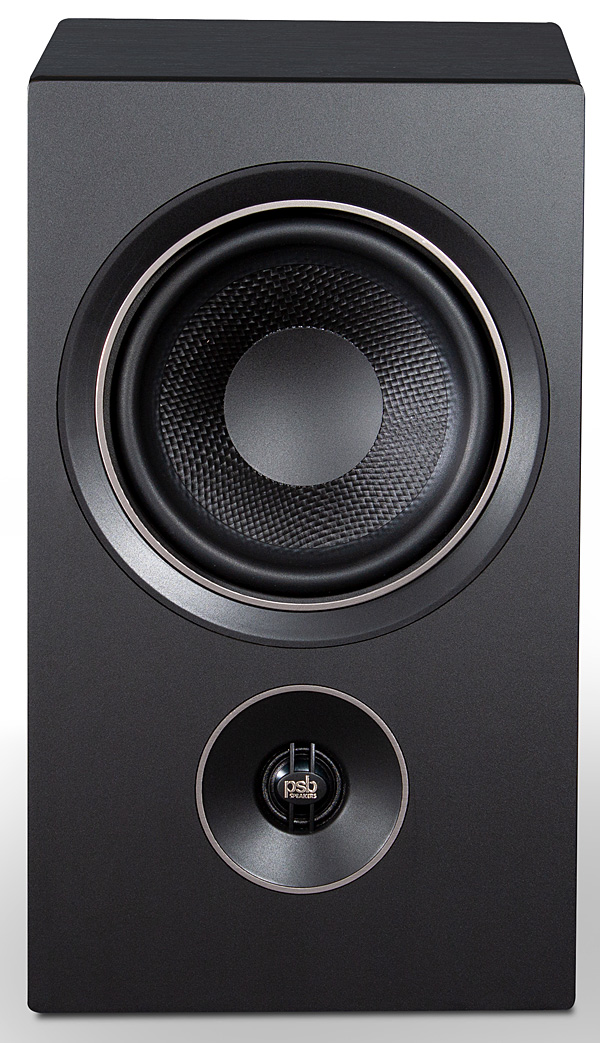 Well-recorded rock with enviable dynamics in these days of the Loudness Wars, like Peter Gabriel's nod to minimalist style, "San Jacinto" from Security (16/44.1 ALAC file, from UK CD, Charisma 800 091-2), er . . . rocked, though again clarity, particularly at low frequencies, was best as long as the playback level didn't exceed 90dBC/slow. And the admittedly early-digital–sounding drums on "Wallflower" from the same album had pretty good slam considering that the cone diameter of each of the two woofers was just 4".
Enough of my spoiling the little PSBs with the Lamm monoblocks: How did the speakers fare with the real-world NAD C 328 amplifier?
Listening Round 2
Well-recorded rock with enviable dynamics in these days of the Loudness Wars, like Peter Gabriel's nod to minimalist style, "San Jacinto" from Security (16/44.1 ALAC file, from UK CD, Charisma 800 091-2), er . . . rocked, though again clarity, particularly at low frequencies, was best as long as the playback level didn't exceed 90dBC/slow. And the admittedly early-digital–sounding drums on "Wallflower" from the same album had pretty good slam considering that the cone diameter of each of the two woofers was just 4".
Enough of my spoiling the little PSBs with the Lamm monoblocks: How did the speakers fare with the real-world NAD C 328 amplifier?
Listening Round 2
The PSB Alpha P5s acquitted themselves well in the inexpensive system, though the overall presentation was smaller-scaled, less authoritative even with the NAD's Bass EQ enabled. (This adds 6dB of boost at 80Hz with a sharp rolloff below that frequency.) The leading edge of the double bass on Sara K.'s "History Repeats Itself" lacked a little definition compared with when the speakers were driven by the expensive Lamm monoblocks, and I was more aware with the NAD amplifier that these are small speakers. Even so, the Kurt Sanderling Brahms recording still satisfied, though the double basses sounded gruffer than they had with the Lamms unless I turned off the amplifier's Bass boost. Satisfied that the Alpha P5s were a good match with the NAD C 328, it was time for some comparisons. Listening Round 3
I didn't have any similarly priced speakers to compare with the PSB Alpha P5s, but I did have on hand two pairs of loudspeakers around the same size: KEF LS50s and my 1978 pair of Rogers LS3/5a's, both of which I use as reference minimonitors.
Comparing the Alpha P5s with the KEFs, with the speakers in the same positions in the room and driven by the NAD C 328, the PSB's sensitivity was very similar to that of the KEFs, though its treble balance was slightly mellower. The KEFs, however, offered better-defined stereo imaging and a more natural-sounding midbass region, as one should expect given that the LS50 currently costs $1300/pair. With the LS3/5a's, the current versions of which are priced at almost $3000/pair, again stereo imaging precision was better than with the Alpha P5s. The double basses on the Brahms symphony recording didn't sound as gruff with the NAD's Bass EQ with the LS3/5a's as they had with the PSBs. However, the English speaker's top octaves sounded elevated compared with the Canadian's, which added some sizzle to the cymbals on the Quincy Jones track, and male spoken voice had a touch of nasality. The Alpha P5 was also around 3dB more sensitive than the LS3/5a.
Overall, the PSB did relatively well in comparison with the more-expensive speakers. It was outclassed but not by a wide margin.
Summing up
A reviewer gets a buzz when he is auditioning a cost-no-object product that digs deep into the heart of his music. But he gets an even bigger buzz when the component that is giving him so much musical satisfaction is priced within the reach of real people rather than hedge-fund billionaires. So it was with PSB's Alpha P5. No, it doesn't go superloud, nor does it go superlow. But like its predecessors, the compromises made by the designer to keep the P5 affordable have been carefully managed. For communicating the message of your favorite music, this little speaker scores super big-time.
Footnote 1: Revealing the interconnectedness of everything audiophile, Bruce Dunlap used to live in Stereophile's erstwhile hometown, Santa Fe, NM. When Bruce relocated eastward at the end of the 1980s, I bought his recording gear, which included the B&K/DPA 4006 omnidirectional microphone that I have used ever since to measure loudspeakers, including the subject of this review. (Paul Barton had the microphone calibrated for me at the NRC in Ottawa, Canada.)
Well-recorded rock with enviable dynamics in these days of the Loudness Wars, like Peter Gabriel's nod to minimalist style, "San Jacinto" from Security (16/44.1 ALAC file, from UK CD, Charisma 800 091-2), er . . . rocked, though again clarity, particularly at low frequencies, was best as long as the playback level didn't exceed 90dBC/slow. And the admittedly early-digital–sounding drums on "Wallflower" from the same album had pretty good slam considering that the cone diameter of each of the two woofers was just 4".
Enough of my spoiling the little PSBs with the Lamm monoblocks: How did the speakers fare with the real-world NAD C 328 amplifier?
The PSB Alpha P5s acquitted themselves well in the inexpensive system, though the overall presentation was smaller-scaled, less authoritative even with the NAD's Bass EQ enabled. (This adds 6dB of boost at 80Hz with a sharp rolloff below that frequency.) The leading edge of the double bass on Sara K.'s "History Repeats Itself" lacked a little definition compared with when the speakers were driven by the expensive Lamm monoblocks, and I was more aware with the NAD amplifier that these are small speakers. Even so, the Kurt Sanderling Brahms recording still satisfied, though the double basses sounded gruffer than they had with the Lamms unless I turned off the amplifier's Bass boost. Satisfied that the Alpha P5s were a good match with the NAD C 328, it was time for some comparisons. Listening Round 3
I didn't have any similarly priced speakers to compare with the PSB Alpha P5s, but I did have on hand two pairs of loudspeakers around the same size: KEF LS50s and my 1978 pair of Rogers LS3/5a's, both of which I use as reference minimonitors.
A reviewer gets a buzz when he is auditioning a cost-no-object product that digs deep into the heart of his music. But he gets an even bigger buzz when the component that is giving him so much musical satisfaction is priced within the reach of real people rather than hedge-fund billionaires. So it was with PSB's Alpha P5. No, it doesn't go superloud, nor does it go superlow. But like its predecessors, the compromises made by the designer to keep the P5 affordable have been carefully managed. For communicating the message of your favorite music, this little speaker scores super big-time.
Footnote 1: Revealing the interconnectedness of everything audiophile, Bruce Dunlap used to live in Stereophile's erstwhile hometown, Santa Fe, NM. When Bruce relocated eastward at the end of the 1980s, I bought his recording gear, which included the B&K/DPA 4006 omnidirectional microphone that I have used ever since to measure loudspeakers, including the subject of this review. (Paul Barton had the microphone calibrated for me at the NRC in Ottawa, Canada.)















