

Moving back in time from the Brahms, I cued up a performance of Beethoven's Fifth "Emperor" Concerto, with Kristian Bezuidenhout accompanied by the Freiburger Barockorchester conducted by Pablo Heras-Casado (24/96 FLAC, Qobuz/Harmonia Mundi). Again the soundstage lacked depth. However, the percussive, less sustained, rather "clattery" tone of the forte piano featured on this recording, compared with the modern instrument on the Brahms recording, was laid bare by the Synchrony T600s. Piano is revealing of midrange coloration; the PSBs reproduced the character of Vogt's and Bezuidenhout's instruments in an exemplary manner, with no notes popping forward.
 While treble detail wasn't obscured, I couldn't escape the feeling with both these piano concerto recordings that the PSB's highs sounded slightly mellow. There was less top-octave "air" surrounding that wonderful melody on the cello that starts the Brahms's third movement compared with the Canton Reference 7Ks that had preceded them in my room. Staying with a recording that features piano, I played "This Town" from Patricia Barber's Clique (24/352 MQA Tidal/Impex, unfolded to 24/88.2 by Roon; the MBL N31 does not decode MQA data). I mentioned this track in my Canton review as having highs that seemed in good balance with the lower frequencies, neither the hi-hat cymbals nor the sibilance on Barber's voice exaggerated. The hi-hat's highs were certainly present with the T600s but not to the same extent as with the Cantons. It is possible I heard the PSB's highs as mellow because I was latching on to their slightly forward-sounding midrange—Barber's voice was projected forward in the soundstage—as my reference for tonal balance.
Nevertheless, Barber's piano had excellent presence and a natural-sounding tonal balance. After repeatedly listening to this superbly recorded album, my favorite track has become the Barber trio's treatment of Thelonious Monk's "Straight, No Chaser." Bassist Patrick Mulcahy pushes the track along with a propulsive walking bass line. His instrument had a good combination of weight and definition, as did my Fender Precision bass guitar on the channel identification and phasing tracks on Editor's Choice.
While treble detail wasn't obscured, I couldn't escape the feeling with both these piano concerto recordings that the PSB's highs sounded slightly mellow. There was less top-octave "air" surrounding that wonderful melody on the cello that starts the Brahms's third movement compared with the Canton Reference 7Ks that had preceded them in my room. Staying with a recording that features piano, I played "This Town" from Patricia Barber's Clique (24/352 MQA Tidal/Impex, unfolded to 24/88.2 by Roon; the MBL N31 does not decode MQA data). I mentioned this track in my Canton review as having highs that seemed in good balance with the lower frequencies, neither the hi-hat cymbals nor the sibilance on Barber's voice exaggerated. The hi-hat's highs were certainly present with the T600s but not to the same extent as with the Cantons. It is possible I heard the PSB's highs as mellow because I was latching on to their slightly forward-sounding midrange—Barber's voice was projected forward in the soundstage—as my reference for tonal balance.
Nevertheless, Barber's piano had excellent presence and a natural-sounding tonal balance. After repeatedly listening to this superbly recorded album, my favorite track has become the Barber trio's treatment of Thelonious Monk's "Straight, No Chaser." Bassist Patrick Mulcahy pushes the track along with a propulsive walking bass line. His instrument had a good combination of weight and definition, as did my Fender Precision bass guitar on the channel identification and phasing tracks on Editor's Choice.
 Some years ago, Harman's Floyd Toole discussed what he referred to as the "circle of confusion." "We use recordings to judge our loudspeakers. We use loudspeakers to judge our recordings," was how recording engineer Bob Katz described this paradox in 2017. This is why I use some of my own recordings when I review loudspeakers. Accordingly, after I noted the shallow soundstage I experienced with the Beethoven and Brahms piano concerto albums, I cued up "In Paradisum" from our June 2020 Recording of the Month, Translations, with the Portland State Chamber Choir conducted by Ethan Sperry (24/96 WAV, Naxos 8.574124, footnote 2).
 This work by Latvian composer Eriks Eenvalds features a solo cello and an off-stage viola. The cello represents the composer's late grandmother, to whom the work is dedicated, and the viola her soul. The choir is presented as a halo around the cello and notes the dedicatee's passing by singing "In Paradisum" from the Catholic Requiem Mass. Producer Erik Lichte and I had worked hard at the sessions and in mixing to achieve the appropriate ethereal texture in the sound of the singers. The choir did indeed sound ethereal with the PSBs, with good weight to the basses. Memory is a fickle witness, of course, but the viola didn't sound as distant as it had been when I played this track on Jason Victor Serinus's Wilson Alexia 2s or when I reviewed the Magico M2s I was using when I mastered the 24/96 files for the CD release. To put this comment into perspective, those speakers are much more expensive than the Synchrony T600: The Wilson costs $57,900/pair, the Magico $63,600/pair. (Returns may be diminishing, but that doesn't mean they are not real.) Also, there was a little more soundstage depth with the USB/JitterBug-connected Ayre QB-9 Twenty than there had been with the network-connected MBL N31.
 I finished my critical auditioning of the PSB Synchrony T600s with an album celebrating its 50th anniversary as I write these words: Surf's Up from The Beach Boys (24/96 MQA FLAC, Tidal/Brother Records/Reprise). Other than Mike Love's and Al Jardine's hokey "Student Demonstration Time," the songs on Surf's Up have been in heavy rotation since I first heard the album on a friend's pseudo-quadraphonic system in 1972. With the PSBs, the bass line on "Disney Girls" spoke evenly, and the backing voices that surround Bruce Johnston's gentle lead vocal were stably spread across the stage. Peculiarly, Johnston's voice pulled to the right of center. I checked that this wasn't a circle-of-confusion moment by listening again to the dual-mono voice and bass guitar in the channel phasing track on Editor's Choice and found that this was characteristic of the recording, not the loudspeakers! (Peculiarly, whereas the out-of-phase bass guitar on Editor's Choice was positioned to the left of the left-hand speaker position with the Canton K7s, the PSBs positioned it to the right of the right-hand speaker (footnote 3). This may well have been due to the different lower-frequency drive-unit polarities of the two loudspeaker types.)
 It was the title track that excelled with the PSBs. Every detail was present—the distant French horn swoops; the ostinato piano positioned deep left of center in the soundstage; the tinkly glockenspiel that pans from left to right; the low synth notes that underpin the bridge; that glorious "children's song" coda punctuated by the cascading piano line—but without any unnatural-sounding spotlighting. The Synchrony T600s transported me back almost half a century to the first time I was bowled over by this track.
Conclusion
It was the title track that excelled with the PSBs. Every detail was present—the distant French horn swoops; the ostinato piano positioned deep left of center in the soundstage; the tinkly glockenspiel that pans from left to right; the low synth notes that underpin the bridge; that glorious "children's song" coda punctuated by the cascading piano line—but without any unnatural-sounding spotlighting. The Synchrony T600s transported me back almost half a century to the first time I was bowled over by this track.
Conclusion
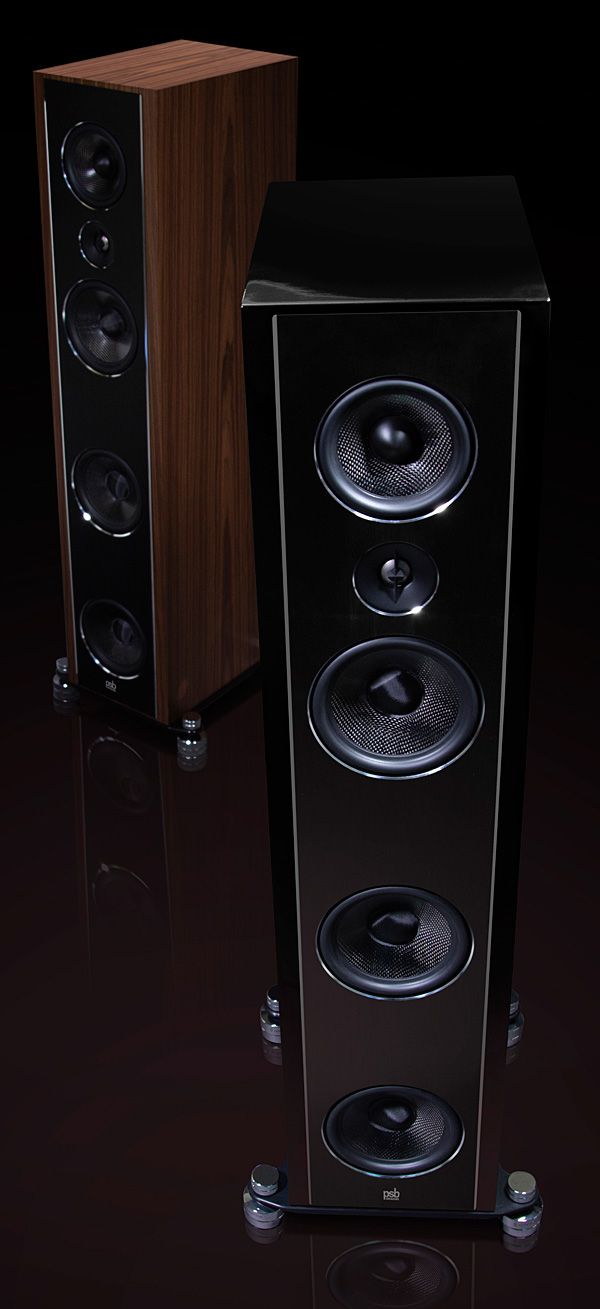
This was a difficult review to write because, unlike some loudspeakers, PSB's Synchrony T600 stepped out of the way of the music being played, imposing almost no character on the sound other than a slightly mellow high treble and a slightly forward midrange. (The upper-bass emphasis with pink noise turned out to be musically inconsequential.) The stereo imaging was stable and precise, and the bass was extended and clean-sounding: I commend PSB for providing the rubber plugs for optimizing the in-room low-frequency balance. The inclusion of the IsoAcoustic GAIA II isolating feet is a welcome bonus. The Synchrony T600 is a worthy successor to the Imagine T3, at a competitive price.
Footnote 2: You can listen to this track on YouTube. Footnote 3: Peculiar indeed. I've never experienced this behavior with out-of-phase signals, so I asked JA to comment. "It is odd," he responded by email, "but I have encountered this specific imaging with this track before."—Jim Austin
While treble detail wasn't obscured, I couldn't escape the feeling with both these piano concerto recordings that the PSB's highs sounded slightly mellow. There was less top-octave "air" surrounding that wonderful melody on the cello that starts the Brahms's third movement compared with the Canton Reference 7Ks that had preceded them in my room. Staying with a recording that features piano, I played "This Town" from Patricia Barber's Clique (24/352 MQA Tidal/Impex, unfolded to 24/88.2 by Roon; the MBL N31 does not decode MQA data). I mentioned this track in my Canton review as having highs that seemed in good balance with the lower frequencies, neither the hi-hat cymbals nor the sibilance on Barber's voice exaggerated. The hi-hat's highs were certainly present with the T600s but not to the same extent as with the Cantons. It is possible I heard the PSB's highs as mellow because I was latching on to their slightly forward-sounding midrange—Barber's voice was projected forward in the soundstage—as my reference for tonal balance.
Nevertheless, Barber's piano had excellent presence and a natural-sounding tonal balance. After repeatedly listening to this superbly recorded album, my favorite track has become the Barber trio's treatment of Thelonious Monk's "Straight, No Chaser." Bassist Patrick Mulcahy pushes the track along with a propulsive walking bass line. His instrument had a good combination of weight and definition, as did my Fender Precision bass guitar on the channel identification and phasing tracks on Editor's Choice.
Some years ago, Harman's Floyd Toole discussed what he referred to as the "circle of confusion." "We use recordings to judge our loudspeakers. We use loudspeakers to judge our recordings," was how recording engineer Bob Katz described this paradox in 2017. This is why I use some of my own recordings when I review loudspeakers. Accordingly, after I noted the shallow soundstage I experienced with the Beethoven and Brahms piano concerto albums, I cued up "In Paradisum" from our June 2020 Recording of the Month, Translations, with the Portland State Chamber Choir conducted by Ethan Sperry (24/96 WAV, Naxos 8.574124, footnote 2).
This work by Latvian composer Eriks Eenvalds features a solo cello and an off-stage viola. The cello represents the composer's late grandmother, to whom the work is dedicated, and the viola her soul. The choir is presented as a halo around the cello and notes the dedicatee's passing by singing "In Paradisum" from the Catholic Requiem Mass. Producer Erik Lichte and I had worked hard at the sessions and in mixing to achieve the appropriate ethereal texture in the sound of the singers. The choir did indeed sound ethereal with the PSBs, with good weight to the basses. Memory is a fickle witness, of course, but the viola didn't sound as distant as it had been when I played this track on Jason Victor Serinus's Wilson Alexia 2s or when I reviewed the Magico M2s I was using when I mastered the 24/96 files for the CD release. To put this comment into perspective, those speakers are much more expensive than the Synchrony T600: The Wilson costs $57,900/pair, the Magico $63,600/pair. (Returns may be diminishing, but that doesn't mean they are not real.) Also, there was a little more soundstage depth with the USB/JitterBug-connected Ayre QB-9 Twenty than there had been with the network-connected MBL N31.
I finished my critical auditioning of the PSB Synchrony T600s with an album celebrating its 50th anniversary as I write these words: Surf's Up from The Beach Boys (24/96 MQA FLAC, Tidal/Brother Records/Reprise). Other than Mike Love's and Al Jardine's hokey "Student Demonstration Time," the songs on Surf's Up have been in heavy rotation since I first heard the album on a friend's pseudo-quadraphonic system in 1972. With the PSBs, the bass line on "Disney Girls" spoke evenly, and the backing voices that surround Bruce Johnston's gentle lead vocal were stably spread across the stage. Peculiarly, Johnston's voice pulled to the right of center. I checked that this wasn't a circle-of-confusion moment by listening again to the dual-mono voice and bass guitar in the channel phasing track on Editor's Choice and found that this was characteristic of the recording, not the loudspeakers! (Peculiarly, whereas the out-of-phase bass guitar on Editor's Choice was positioned to the left of the left-hand speaker position with the Canton K7s, the PSBs positioned it to the right of the right-hand speaker (footnote 3). This may well have been due to the different lower-frequency drive-unit polarities of the two loudspeaker types.)
It was the title track that excelled with the PSBs. Every detail was present—the distant French horn swoops; the ostinato piano positioned deep left of center in the soundstage; the tinkly glockenspiel that pans from left to right; the low synth notes that underpin the bridge; that glorious "children's song" coda punctuated by the cascading piano line—but without any unnatural-sounding spotlighting. The Synchrony T600s transported me back almost half a century to the first time I was bowled over by this track.
ConclusionThis was a difficult review to write because, unlike some loudspeakers, PSB's Synchrony T600 stepped out of the way of the music being played, imposing almost no character on the sound other than a slightly mellow high treble and a slightly forward midrange. (The upper-bass emphasis with pink noise turned out to be musically inconsequential.) The stereo imaging was stable and precise, and the bass was extended and clean-sounding: I commend PSB for providing the rubber plugs for optimizing the in-room low-frequency balance. The inclusion of the IsoAcoustic GAIA II isolating feet is a welcome bonus. The Synchrony T600 is a worthy successor to the Imagine T3, at a competitive price.
Footnote 2: You can listen to this track on YouTube. Footnote 3: Peculiar indeed. I've never experienced this behavior with out-of-phase signals, so I asked JA to comment. "It is odd," he responded by email, "but I have encountered this specific imaging with this track before."—Jim Austin















