"Blackbird," from my mastering of Cassandra Wilson's Silver Pony (CD, Blue Note 6297522), recorded and produced by the great John Fischbach, has a warm, liquid quality and Reginald Veal's deep, luscious Fender bass. Herlin Riley's snare drum should knock you in the chest. Without the AVAAs, I could easily detect a disturbing overhang in the back of the room, and the bass, up through the midrange, lost focus, beauty, and definition.
"Do You Remember," Jill Scott's seminal hip-hop/neo-soul hit from Who Is Jill Scott? Words and Sounds, Vol.1 (CD, Hidden Beach 62137), was engineered conservatively in 2000, before the loudness wars got out of hand. With the AVAAs, its hip-hop bass and kick were loud, tight, and impacting. Without the AVAAs, a distinct bass overhang masked the clarity of the sound.
When I was about seven, my dad introduced me to Arthur Fiedler and the Boston Pops. I wore down a copy of Hi-Fi Fiedler (RCA Living Stereo), playing it on a V-M turntable and producing lasting memories. Fast forward to 2015—I discovered the album on HDtracks at 24-bit/88.2kHz and downloaded it fast as light. Despite the peak saturation, the sound is to die for; this Richard Mohr and Lewis Layton production, made between 1956 and 1960 in Boston's Symphony Hall, has a glorious bloom that was enhanced by the AVAAs, for a fuller, warmer, more authentic sound.
Other tracks exhibited similar improvements, including from David Chesky's The Body Acoustic (CD, Chesky JD274), and David Crosby's Croz (CD, Blue Castle 11421), both in 24/96 from HDtracks. And with the AVAAs, Buena Vista Social Club (World Circuit/Elektra Nonesuch), also in 24/96, sounded more distinct and focused all the way up to the midrange.
I'm hooked: The AVAA C20 is a revolutionary product that puts the final polish on the sound of a fine playback system. Attention, PSI Audio: I'm going to have to buy these—or else you'll have to tear them out of my hands!
Measurements and Placement
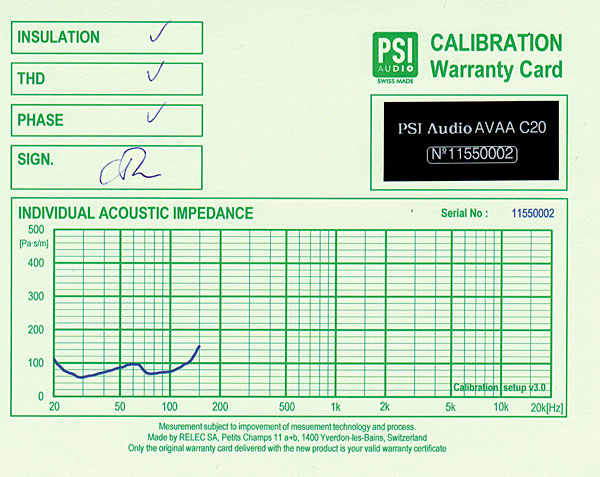
Each AVAA C20 comes with an individual certification (see fig.1) showing that it measures from ¼ to 1/8 the nominal 400 N-s/m3 impedance of free air in the frequency range of interest. Translation: It's better than air at absorbing sound. I have no way of verifying an AVAA's effective impedance, but I can measure its effects on frequency response, decay time, distortion, and waterfall response in the room.
 Thus it was easy to find candidate locations for the AVAAs. Keep in mind that a frequency-response measurement is a small but important part of the picture. It quickly reveals the room modes, and permits comparisons of a room with and without treatments installed.
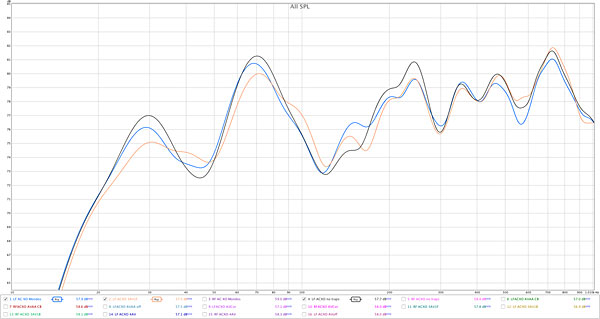
Because an active bass trap shouldn't be placed where it would interfere with a subwoofer, I put one AVAA C20 in each rear corner, then remeasured (graph not shown; see photo 2). Two AVAA C20s measurably improved the three lowest modes. Then I added a third, at center front. This yielded my prize trace, the orange one in fig.2: the effects of three AVAAs. Compare the orange (AVAA) and black (naked room) traces: They tell a dramatic story of a new technology at work, with an unprecedentedly surgical effect in the 20–50Hz range, which should have a salubrious effect on the sound. I foresee manufacturers toting these into boomy demo rooms at next year's Consumer Electronics Show!
Thus it was easy to find candidate locations for the AVAAs. Keep in mind that a frequency-response measurement is a small but important part of the picture. It quickly reveals the room modes, and permits comparisons of a room with and without treatments installed.
Because an active bass trap shouldn't be placed where it would interfere with a subwoofer, I put one AVAA C20 in each rear corner, then remeasured (graph not shown; see photo 2). Two AVAA C20s measurably improved the three lowest modes. Then I added a third, at center front. This yielded my prize trace, the orange one in fig.2: the effects of three AVAAs. Compare the orange (AVAA) and black (naked room) traces: They tell a dramatic story of a new technology at work, with an unprecedentedly surgical effect in the 20–50Hz range, which should have a salubrious effect on the sound. I foresee manufacturers toting these into boomy demo rooms at next year's Consumer Electronics Show!

The ultimate solution was a combination of three AVAAs and four Passive Traps instead of the previous six. Additionally, my room benefitted from: curtains; judiciously placed hard Sonex panels to remove some sidewall flutter echo and diffuse rear-wall reflections; and room correction (digital EQ, time correction, crossover) by AcourateConvolver. Passive traps 4" to 6" thick can help the mids and, to some degree, the bass, but too many can overdamp the upper mids and highs and make the system sound dead. PSI Audio's AVAA C20s helped me avoid that, um, trap.
Each AVAA C20 comes with an individual certification (see fig.1) showing that it measures from ¼ to 1/8 the nominal 400 N-s/m3 impedance of free air in the frequency range of interest. Translation: It's better than air at absorbing sound. I have no way of verifying an AVAA's effective impedance, but I can measure its effects on frequency response, decay time, distortion, and waterfall response in the room.
Fig.1 Certification of a PSI Audio AVAA C20's acoustic impedance. In comparison, free air has a nominal acoustic impedance of 400 N-s/m3.
One object of acoustic treatments is to lower a room's response peaks and raise the dips without affecting anything else: a tall order. First, I measured my room's response without equalization—just a crossover and time correction implemented in AcourateConvolver. For ease of presentation, I measured these with Room EQ Wizard analysis software, with a 150ms window and psychoacoustic smoothing, the mike at the listening position. The black trace in fig.2 represents my measurement of the "naked" room, without PSI AVAA C20s or my six RealTraps MondoTraps.
To locate the resonant points in the room, I played the sinewave oscillator in Room EQ Wizard, changing its frequency by clicking on any point in the graph (a very nice feature). This room's problem frequencies include 29, 46, 70, 125, and 145Hz. (A dip at 125Hz is the Allison effect—ie, cancellations from adjacent boundaries.) Walking around the room, I could easily hear the maximum and minimum points. I couldn't detect any lengthwise standing waves—ie, any buildup between the front and rear walls: in my room, the primary modes are standing waves along the diagonals. The 29Hz sinewave built up in the corners and at the listening position. The 46Hz sinewave was strong in the corners and weak at the listening position (even when I played only the left or right channel, I could hear the 46Hz resonance in all four corners). The 70Hz mode built up at the front bay window and in the corners. The 145Hz mode manifested primarily as a resonance at the center front, near the floor.
Photo 2: PSI Audio AVAA C20 trap in rear right corner.
By comparison, the blue trace in fig.2 is the left speaker with six RealTraps MondoTraps: four behind the curtains, two on the front wall. Compare the performance: three AVAAs (orange trace) vs six MondoTraps (blue) vs no treatment (black). Notice that the Mondos seem to shift the center point of some modes, while the AVAAs precisely attack them. The AVAAs smoothly and effectively attenuate the 29Hz peak at the listening position by an amazing 2dB, which is 1.25dB better than six big Mondos. Just three AVAAs have effectively flattened the 25–55Hz range within 1dB—a most impressive performance. The AVAAs filled in the 45Hz dip by a significant 1.5dB, while six Mondos helped it by only 0.8dB. The AVAAs attenuated the 70Hz peak by 1.25dB, while six Mondos attenuated it by only 0.5dB.
Fig.2 Left speaker measured with Room EQ Wizard, no EQ applied, SPL at 1dB/division, frequency range of 10Hz–1kHz: no traps (black trace), six RealTraps MondoTraps (blue), three PSI Audio AVAA C20 traps (orange).
Notice how the AVAAs broadly improve the 90–110Hz range by about 1dB, including the dip near 120Hz, which the Mondos barely touched—although the Mondos did fill in the hole between 150 and 180Hz up to 1dB better than did the AVAAs. And above that, the AVAAs had barely any effect, up to and including a 300Hz dip that the Mondos improved by a subtle 0.5dB; the AVAAs were completely ineffective, as this is an octave above their stated range of operation. That said, a dip at about 550Hz was worsened by the Mondos, by a significant 1.25dB, while the AVAAs filled it in by about 0.8dB—even though this is far above their stated range of operation. Then again, the Mondos improved a 725Hz peak that the AVAAs ignored. Trapping is not a win-win scenario, but the AVAAs definitely did more overall good within their claimed range of effectiveness.
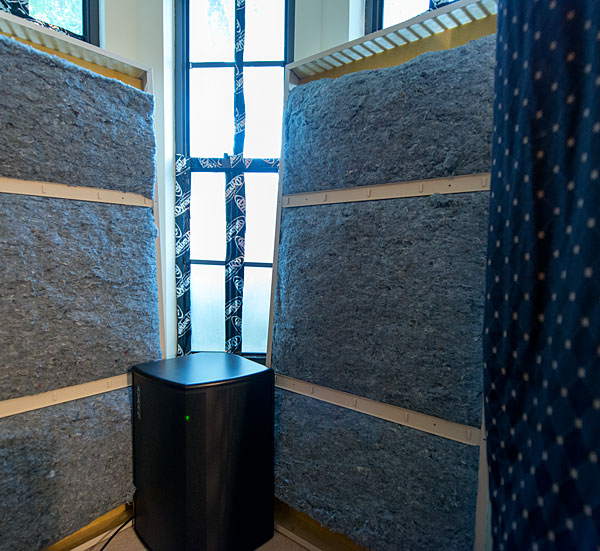
In the next step, using just three AVAAs, I measured and linearized using Acourate and AcourateConvolver. A first listen to some reference recordings revealed that removing the six MondoTraps had done wonders for the mids and highs, opening and livening up the sound in a mostly good way. But I felt that the bass and mids were now a bit too resonant, thickening the sound and making individual notes harder to distinguish. So I installed two customized passive traps, standing vertically in the bay window behind the curtains (photo 3).
Photo 3: Behind the curtains: AVAA C20 in center of bay window, flanked by two customized traps using 6" of Bonded Logic insulation. Note Dynamat damping sheets on windows.
What to do with the fourth AVAA C20? Placing it at the center rear subtly improved some modes, but worsened the modes at 30 and 70Hz. Moving it to the center front, stacked atop the one already there, helped some modes by a subtle 0.5dB without measurably or audibly hurting anything else. After listening to some more music, I decided that four AVAAs plus MondoTraps overdamped the room: it's great to have tight, even bass, but if it doesn't bloom correctly, it must be wrong. Three AVAA C20s were perfect for this room. (That said, after further listening, I realized that the upper mids weren't well defined—some slap echo in the corners was reducing the definition. So I reinstated the two MondoTraps on the front walls, visible in photo 1.)
ConclusionsThe ultimate solution was a combination of three AVAAs and four Passive Traps instead of the previous six. Additionally, my room benefitted from: curtains; judiciously placed hard Sonex panels to remove some sidewall flutter echo and diffuse rear-wall reflections; and room correction (digital EQ, time correction, crossover) by AcourateConvolver. Passive traps 4" to 6" thick can help the mids and, to some degree, the bass, but too many can overdamp the upper mids and highs and make the system sound dead. PSI Audio's AVAA C20s helped me avoid that, um, trap.