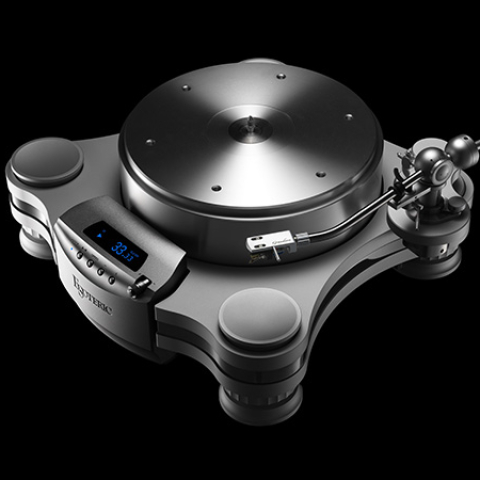
Digital Processors:
A+:
Bel Canto E1X-DAC: $6800
The Roon Ready e1X DAC/Control Preamplifier offers AES3, coaxial and optical S/PDIF, digital inputs, and USB and UPnP/DLNA-compatible Ethernet ports. (The USB and Ethernet ports support MQA-encoded data and DSD data in the DoP format.) There are also line-level and MC/MM phono analog inputs, these converted to digital so that they can be adjusted with the DSP-domain Tilt, Bass EQ, and volume controls. The e1X features line outputs, a headphone outputthe Tilt and BassEQ controls are not operative with this outputand a subwoofer output. Bel Canto’s free Seek app (iOS only) allows the e1x to stream audio from Qobuz, Tidal, Spotify, and vTuner internet radio and to play files from DropBox, OneDrive, and iCloud folders, or from a drive plugged into the DAC’s USB-A port. Like all of Bel Canto's digital products the e1X uses a Texas Instruments PCM1792A DAC chip, which may be a 20-year-old design, but, as JA’s measurements revealed, is still capable of very high resolution and low linearity error. In his critical listening sessions, JA found it difficult to ascribe an identifiable tonal character to the Bel Canto. He noted that low frequencies were well-defined with good weight, high frequencies were neither exaggerated nor rolled off, and the midrange sounded natural, but the thing that did strike him was how clear a view into recorded soundstages he was experiencing. “Transparency to the source combined with low-frequency articulation and weight was the e1X DAC's calling card,” he concluded about the e1X’s performance as a DAC. JA found that even though the line and phono analog inputs offered excellent measured performance, the presentation was slightly darker with analog sources, “as if the analog input had placed a finely woven scrim between me and the recorded soundstages.” The Tilt and Bass EQ controls proved useful in minimizing this character. (Vol.45 Nos.10 & 11 WWW) Benchmark DAC3 HGC: $2399 (includes remote) ★ $$$
Benchmark DAC3 B: $1899 $$$
Benchmark’s DAC3 HGCthe last three letters designate this as the audiophile version, with a headphone amp and two analog inputssupports files up to 24/192 and DSD64, the latter as DoP (via USB). Bearing in mind the manufacturer's suggestion that there should be no audible difference between their DAC1 and DAC3, JCA wrote, “In fact, I found the sounds of the two DACs quite different. The DAC1 was brighter; … the DAC3 was all about depths, in several respects … I heard deeper into the music.” The concise conclusion to JA's Measurements sidebar: “All I can say is ‘Wow!’” In a Follow-Up, JCA wrote of using the Benchmark processor with the same company’s AHB2 power ampa combination of high source output voltage and modest amplifier gain that he describes as “optimal for minimizing noise and distortion”and reported hearing “richer and more interesting” reproduction of very subtle details. The DAC3 B is a stripped- down, lower-priced version of the DAC3 HGC, which omits the headphone amplifier, balanced and unbalanced analog inputs, volume, mute, and polarity controls, and the remote control. It has a fixed output level of 12.3V, which is about 10dB too high to be optimal with a typical domestic audio system. The DAC3 B retains the HGC’s high-resolution ES9028PRO DAC chips, and when he auditioned it using the USB input JA found it offered a fatigue-free, musically involving wealth of recorded detail. “An audiophile bargain,” he concluded. (Vol.40 No.11, Vol.41 No.10; HGC version WWW; Vol.46 No.3, B version WWW) CH Precision C1.2 DAC/Controller: from $36,000; As reviewed $43,500
In standard form, priced at $36,000, this modular Swiss processor offers AES3 and coaxial and optical S/PDIF digital inputs. Optional inputs are asynchronous USB ($3000), Ethernet ($6000), an analog input board, with one balanced and one unbalanced input ($2500). An optional clock synchronization board costs $1500, while it can be used with an external power supply ($20,500) and clock ($24,500). The C1.2 incorporates a volume control and uses four 24-bit PCM1704 chips per channel. With the exception of the USB input, it upsamples the input data to 705.6kHz or 768kHz. It will also accept MQA data, and DSD data via DoP. JCA wrote that With classical recordings, what he heard with the C1.2 “is what acoustical instruments sound like, precisely rendered in space. The sense of that space, and of the sounds flowing through it, is expansive and relaxed; ... it simply sounded right.” On the test bench, its measurements indicated that the C1.2’s reconstruction filter is a linear-phase type optimized for time-domain performance. Noise, jitter, and distortion were extremely low and resolution was high, between 19 and 20 bits. However, it appeared that the LSB with 24-bit data was being truncated. Nevertheless, the C1.2, both with and without its external clock and power supply, produced the best sound JCA had heard from a digital source. (Vol.46 No.2 WWW)
dCS Bartók APEX Upsampling DAC/Network Streamer: $22,000
With headphone amp: $24,100
The result of extensive changes to dCS's Ring DAC hardware and an improved power supply, among other changes, the Apex version of HR's daily-driver D/A headphone amplifier produced musical sounds that were more fantastically appealing than the ones generated by the original Bartók or any other DAC he'd reviewed. Using the dCS Mosaic app, DXD upsampling, Filter 3, and Map 1, HE wrote that "the Bartók Apex has a wet feel to its clarity. The original leaned toward transistor-dry . . . [The Apex] mixed an R-2R naturalness . . . with a muscular, free-flowing dynamic that kept my attention focused on musical content." (Vol.46 No.8 WWW) dCS Lina Upsampling DAC: $14,400
dCS Lina Master Clock: $8150
The Lina, dCS’s lowest priced streaming DAC, offers two AES3 inputs, two electrical S/PDIF, one TosLink, one USB Type B, and one USB Type A, plus Ethernet (LAN). Using dCS’s Mosaic network control and streaming app, HR auditioned the Lina both by itself and clocked by the Lina Master Clock. With the DAC alone he noted how spatially expansive and physically present the Poor Things soundtrack sounded and how big-screen the soundspace “looked.” Compared with the dCS Bartók Apex, the Lina’s “light” felt “slightly more brilliant and maybe 3° cooler.” Connecting the Lina Master Clock to the Lina’s word clock input, HR heard an easily noticeable increase in vividosity, dimensionality, and transparency. “It was not a loud change, but neither was it subtle,” he wrote. “The clock-enhanced repro seemed distinctly calmer and sharper focused, with smaller, more clearly outlined molecules of sound.” HR concluded by noting that he judges the quality of digital playback “not by its resolution but by its density, rhythmic force, and the beauty of its space and light. The Lina excelled at all three.” (Vol.47 No.5 WWW) dCS Rossini APEX Upsampling DAC/Network Streamer: $34,500
The successor to the English company’s well-regarded Rossini, the APEX edition is based on a reconfigured Ring DAC circuit board with an all-new analog output stage. (Earlier Rossinis can be upgraded for $9000.) Using his preferred settingsFilter 5 for Red Book, F3 for 24/88.2 up to 24/192, F6 for higher PCM resolutions, F1DSD for DSD, and M1 for MQA, DXD upsampling, and Ring DAC Map 1JVS compared the APEX with the earlier 2.0 version with an album of Ravel piano concertos and immediately noted that with the APEX there was “a deeper silence between notes, a greater sense of grace, flow, and warmth from string instruments, and a beautiful finish to the sound that epitomized fin de siècle elegance.” With a Talk Talk track, he felt that the Rossini 2.0 “sounded thinner than the APEX, with less substance. Everything seemed diminished and less involving. There was less there.” JVS concluded that the Rossini APEX DAC was “more than another upgrade; it’s a major advance in digital sound reproduction, one that elevates an already excellent DAC to a much higher level.” While noting that the behavior of the six choices of reconstruction filter were identical to those of the earlier Rossini and dCS Vivaldi processors, JA commented that overall, “the dCS Rossini APEX’s measured performance was beyond reproach.” (Vol.40 No.1, Vol.41 No.5, Vol.42 No.5, original version; Vol.42 No.6, 2.0 version; Vol.45 No.10 WWW)
dCS Varèse: $267,500
The five-chassis Varèse D/A processor is the ultimate digital statement from British manufacturer dCS. One chassis houses what is called the Core, which manages audio input, conversion, oversampling, noise shaping, filtering, and streaming. It includes an integrated network streamer that, together with the new dCS Mosaic ACTUS app, enables PCM rates up to 24/384 and DSD up to DSD512 and automatically oversamples PCM. The processed data are sent to two mono Ring DAC chassis, one for each channel, via proprietary ACTUS cables. Chassis four is the User Interface. A full-color touch screen tracks data, album artwork, play queues, and other settings. Complete with a Bluetooth antenna, it works in tandem with the Varèse remote control and the Mosaic ACTUS app. Chassis five contains the Master Clock, which utilizes new ACTUS and patented Tomix protocols. The Varèse’s signal processing options are the same as those offered by the dCS Vivaldi; JVS stuck with his Vivaldi choices for his auditioning—6V output, Mapper 3, and DXD oversampling—and moved between PCM filters F3, F4, and F5. His data source was an Innuos Statement NG/PhoenixNet combo connected to the Core via USB, and he used the Innuos Sense app as well as the dCS Mosaic ACTUS app. The result? “I forgot about note taking as my critical faculties ceded to a sense of wonder. ... All the key elements of the audiophile experience—the ‘you are there’ presence and aliveness, the absence of a veil between you and the music, the depth and weight of images, the drop-dead ‘Is it live or is it Memorex?’ veracity, and the overarching sense of being swept up and transported by the music and its creators’ collective achievement—continue to overwhelm me.” JVS concluded his review by writing “From the time the Vareèse entered my system, my sole frustration was that I was unable to listen all the time, every day. I have never experienced so much pleasure and satisfaction, reveling in all kinds of music, in my music room.” Not surprisingly, the Varèse excelled on Paul Miller’s test bench, with superbly low levels of distortion, noise, and jitter and high resolution. (Vol.48 No.5 WWW) dCS Vivaldi APEX DAC: $48,800
dCS Vivaldi Master Clock: $24,100
dCS Vivaldi Upsampler Plus/Network Streamer: $32,000
The result of the same painstaking development process that produced the dCS Rossini Apex, the Vivaldi Apex features the same analog board and the same choice of coefficient mapping for its Ring DAC and reconstruction filters as the Rossini. However, its larger chassis allows for allows greater flexibility in transformer positioning, component isolation, and what can be done with I/O and the control board. According to dCS, “Vivaldi’s hardware represents a much more ambitious approach to D/A conversion than the Rossini’s digital processing platform.” As the Vivaldi Apex doesn’t have the upsampling options offered by the single-box Rossini, JVS auditioned the Vivaldi Apex with the Vivaldi Upsampler Plus , as well as with the Vivaldi Master Clock. Compared with the superb-sounding Rossini Apex and its matching Clock, JVS found the midrange richer and the highs a mite less bright. The Rossini Apex’s depiction “seemed lighter and less substantial, with smaller images,” he wrote. In the test lab, the Vivaldi Apex offered superb measured performance, with very high resolution and channel separation, and extremely low noise and jitter. JVS summed up his experience of the Vivaldi Apex by writing “It is rare, in a home listening room, to experience anew the full impact of great orchestral music heard in a concert hall. But the Vivaldi Apex DAC, Vivaldi Upsampler Plus, and Vivaldi Master Clock together have made that possible, repeatedly.” Upgrades for the earlier Vivaldi DAC and Vivaldi One cost $9000. (Vol.46 No.3 WWW) EMM Labs DA2i: $35,000
This made-in-Canada, Roon Ready processor is the successor to the EMM DV2 that JVS reviewed in 2019. The DA2i features a brand-new “folded cascade” analog output stage designed by Ed Meitner. Unlike the otherwise identical DV2i, it doesn’t have a volume control, but it offers the same optical and coaxial S/PDIF, AES3, USB-B, and network inputs; there is also a USB-A port for connecting an external drive. All the inputs support 24/192 PCM and DSD; the USB-B and network inputs also support up to 2×DSD, DXD (352/384kHz), and MQA data. The DAC uses EMM Labs’ proprietary, discrete, dual-differential, “MDAC2” D/A converters, which render everything as very high-rate (16×) DSD. JVS used Roon to audition the DA2i—the MConnect app can also be used—and noted that it accurately reproduced the timbres of violin, cello, and piano. Bass was as solid as it gets. “The EMM Labs DA2i Stereo D/A Converter is one of those all-too-rare components whose every sound speaks truth,” he concluded. On PM’s test bench, the DA2i excelled, offering high resolution, very low audioband noise, superb channel separation, and very high rejection of jitter. “All told, the DA2i is a wonderful example of a proven technology tastefully matured,” he decided. (Vol.48 No.3 WWW)
exaSound s88 Mark II: $7599
KR was impressed by this network-connected 8-channel D/A processor, writing that “the s88 sounded just right from the first notes, and that impression endured as I immersed myself in a wide range of music over several weeks. … [I]n fact, it exceeds the performance of any DAC that I have used. I would describe its sound as transparent rather than detailed, dynamically responsive rather than lively, and honest in how it presents voices.” On the test bench, the s88 offered a resolution of 21 bits, which is among the highest the magazine has found. The default reconstruction filter is a minimum-phase type and harmonic distortion, intermodulation distortion, and noise levels were all extremely low. KR concluded: “For some who are already committed to multichannel, the s88, with its superb DAC, convenient streaming and that oh-so-welcome volume control, may be the realization of their dreams. It is of mine.” KR has since obtained the Mark II upgrade, which has no discernible effect on sonics. (Vol.44 No.4 WWW) Ferrum Wandla: $2795
This slim, MQA-capable D/A processor from Poland can be used with its line-wart supply or with Ferrum’s HYPSOS external supply ($1195). Digital inputs include AES3; optical and electrical S/PDIF; USB-C (PCM up to 32/768, DSD up to DSD 256); and HDMI ARC. There is also a single-ended analog input as well as balanced and unbalanced analog outputs. The Wandla offers three of the reconstruction filters incorporated in its ESS Sabre ES-9038PRO DAC chip plus two “HQ” filters created for Ferrum by Signalyst, known for their work on the HQPlayer app. (HR preferred the default HQ Apodizing filter.) With the Wandla’s standard supply, HR felt that “melodies felt inhibited, and there was a subtle but distinct metallic hardness that infused the body of every note. Reverb tails were shortened.” Adding the HYPSOS supply set to 22V “made menu-surfing a pleasure,” commented HR, adding that hardness was relieved. “Martha Argerich’s Winter Music became supple and distinctly more three-dimensional, with clear, vibrating open spaces between notes.” He wished that this power supply upgrade was something every audiophile could experience. The improvement was not subtle, “and it leaves no doubt about how much a component’s source of energy affects the flow, luster, and body of reproduced music.” HR concluded that the Wandla-HYPSOS combo “is a thoroughly, wisely engineered converter that made me look forward to using it and made me smile every time I did. At its best with the HYPSOS, the Wandla danced in the same ballroom as DACs costing over $10,000.” On the test bench, the Wandla performed supremely well with both analog and digital inputs, even without the HYPSOS supply. “It boasts very high resolution, very low distortion and noise, and a bombproof output stage,” wrote JA. (Vol.47 No.2 WWW) HoloAudio May KTE (Level 3): $5898 as reviewed
This well-constructed, hot-running, R-2R ladder DAC–based, two-box processor costs $3798–$4998 depending on options. It offers seven digital inputs—two coaxial, one optical, an AES3, a USB, and two I2S over HDMI—and balanced (XLR) and single-ended (RCA) analog outputs. The input stage uses op-amps, the output stage discrete transistors biased into class-A. It can be operated as a NOS (Non-OverSampling) DAC or in three different oversampling (OS) modes. (The DSD mode reduces the output level by 6dB.) When HR auditioned the top-of-the-line Level 3 version of the May in NOS mode, the very first album he played “sounded more fundamentally right than any digital reproduction I have experienced in my little bunker,” he wrote. “Better than any DAC I know, the May recovers the natural pressure behind musical flow.” He found that PCM oversampling added a harsh glare and muddled image specificity, and while the sound was clear with CD data and DSD oversampling, with a nice flow and fine musical textures, the bass was softer and soundstages less precisely drawn. “The May’s true-to-life demeanor made recorded music seem infinite and beautiful,” he concluded. JA was equally impressed by the transparency and neutrality of the May, though he found that the excellent soundstage depth and sense of musical “drive” in NOS mode had to be set against this mode’s tendency to make pianos sound too “clangy.” Piano in OS DSD mode remained clean and closer to the true sound of the instrument, he decided. In addition, densely scored climaxes “clogged up” a little in NOS mode while remaining clean in DSD mode. On the test bench, the May offered superb measured performance, including 22-bit resolution, greater even than that offered by the overperforming Weiss DAC502! (Vol.43 Nos.8 & 9 WWW)
Ideon eos: $9999
Manufactured in Greece, the eos offers electrical S/PDIF digital inputs on RCA and BN jacks and a USB port, the last featuring three-stage noise filtering. (Ideon calls this port a “Proprietary Triple Distillation USB input.”) A large display on the front panel displays the incoming data’s sample rate, the output level can be set to High or Low, and there are both balanced and single-ended analog outputs. HR used the USB input for his critical listening; he found that neither of his reference processors, a dCS Lina and a HoloAudio Spring3, had greater raw clarity than the Ideon. “What the eos DAC was doing better than any DAC I’ve used is compel me to play songs over and over.” The eos played a favorite Alan Lomax track more clearly, with better tone and greater vibratory presence, than any HR could remember. With CDs played on a Sparkler transport feeding the Ideon’s S/PDIF input, he wrote that the eos’s presence, immediacy, and raw transparency “were now subordinated to an atmosphere of copious nuance and wide-spectrum tonal shading.” Overall, the Ideon eos’s sound character most closely resembled Wattson Audio’s Madison. “The eos has that same jet-engine, DAC-of-the-future presence and drive, to which it adds a lot of corporeal, tone-correct realism that I found extremely compelling,” HR concluded. On JA’s test bench, the measured resolution with the output set to High was 18 bits; the Low setting reduced the measured resolution by 1 bit. Both harmonic and intermodulation distortion were very low, and the Ideon eos was immune to jitter with both its coaxial and USB inputs. The only anomalous behavior JA found was that with data sampled at 44.1kHz, the response rolled off sharply above 17kHz and was down by 16dB at 20kHz. (Vol.48 No.9 WWW) Mola Mola Tambaqui: $14,600
This Bruno Putzeysdesigned, Roon Ready D/A processor uses a proprietary digital filter/DAC stage and can be controlled with a smartphone app or an Apple Remote. No MQA capability, but the Tambaqui decodes DSD natively. Digital inputs include USB, TosLink and coaxial S/PDIF, AES3, Ethernet, and I2S over HDMI. Analog outputs are balanced on XLR and headphone on ¼" and four-pin XLR jacks, both with a volume control and a choice of maximum output level. HR loved what he heard, writing that “the Mola Mola’s most conspicuous sonic trait was a bright, evenly illumined clarity”; he added that “Mola Mola's Tambaqui did not whisperit declared loudly: ‘See! The truth is more beautiful than you thought it would be!’” In his follow-up review, KM agreed with HR: “The Mola Mola Tambaqui DAC is easily the finest digital-to-analog converter I've heard in my reference system, provoking fresh epiphanies with well-known music. Its beautiful remote control and its ability to function as a preamp adds more value to this expensive machine.” JA found that the Tambaqui offered almost 22 bits of resolution, one of the highest he had encountered, and declared that his testing revealed state-of-the-digital-art measured performance. (Vol.44 No.12, Vol.45 Nos.1 & 6 WWW) Moon 891: $25,000
Although the Moon 891 network player/preamplifier has no internal storage, it can play files from streaming services, a directly attached NAS, or a USB stick, using Simaudio’s MiND (Moon Intelligent Network Device) Controller app. (Both JVS and TF noticed that tracks streaming from Qobuz through Roon sounded somewhat “blurred” compared to the same tracks streamed from Qobuz through the MiND app.) As well as two pairs of single-ended analog inputs and one balanced pair the 891 has ARC HDMI, AES3, S/PDIF, and TosLink digital inputs. Its DAC converts PCM and MQA files up to 32/384 (with 24-bit files upconverted to 32-bit) and DSD files up to 256. It also includes a fully configurable MC/MM phono stage. JVS used the 891 as a D/A processor for his original review, and discussed its performance as a line preamp in a follow-up review elsewhere in this issue; TF auditioned the phono stage for a follow-up. JVS was impressed by the 891’s digital-domain performance, writing that “it’s a fine-sounding, easy-to-operate one-stop front-end that requires minimal cabling and setup acumen for it to shine.” He concluded that it provides “truthful full-range sound that is so satisfyingly complete that the forever-seeking Serinus kept focusing on what was present rather than what was lacking. The 891's performance is musical to the core. Highly recommended.” When he auditioned the phono stage with Ortofon and Shure MM cartridges, TF wrote that “the Moon North 891’s phono preamp is exceptional: quiet and fully revealing. I’m sure it will play well and sound great with cartridges more complex and expensive than mine. On my simple, blue-collar rig, it made vinyl listening fulfilling and fun.” In the test lab, JA noted that the 891’s digital inputs offered a resolution of 22 bits, with superb rejection of jitter. He was also impressed by the phono stage’s performance in both MM and MC modes, though he noted that to get the lowest noise from the 891's phono input, the gain should not be set too high. (TF used the MM-appropriate setting of 40dB.) JA concluded that the Moon 891 offered measured performance that was state-of-the-art for both analog and digital inputs. (Vol.48 Nos.1, 3 & 4 WWW)
NAD Masters Series M66: $6999
The Roon Ready NAD M66 integrates sophisticated streaming options with a modern, multiple input/output preamplifier complete with subwoofer outputs, D/A and A/D conversion, DSP, bass management, DDH to handle intersample overs, and Dirac Live room correctiona USB microphone is includedas well as MM/MC phono inputs. Digital inputs include Bluetooth, Wi-Fi, HDMI/eARC, LAN, USB, two RCA and two optical S/PDIF, and a single AES3. While there’s a remote control, the most practical and comprehensive means of operating the M66 is with the BluOS app. The M66 has an Analog Direct mode, where the signal with the phono, single-ended and balanced line inputs remains analog from input to output. However, Analog Direct bypasses the tone controls, bass management, and Dirac Live with the analog inputs. It also eliminates the L/R balance control. By default Analog Direct is defeated and the analog input is digitized at 24/96. KR had the consistent impression that the Analog Direct pathway was a little more relaxed and open, but he could not consistently determine whether it was engaged or not. When he used the NAD as a D/A processor, KR noted that the sound was clean, with notable delineation of instruments and a nice sense of space appropriate to each recording. “This tells me that the DAC in the M66 is superb and the analog path through the M66 is transparent.” he commented. “As an analog preamp, as a digital ‘preamp,’ as a DAC, as a room-correction tool, as a Roon endpoint or BluOS-based streamer, its functional and sonic performance is outstanding,” he concluded. “The NAD M66 is a tour de force!” JA was equally impressed when he tested the M66: “The appropriate word to describe the measured performance of the NAD M66's line, phono, and digital inputs is ‘superb.’” (Vol.47 No.11 WWW) Okto dac8 Stereo: €1289 (€1408 with Streaming Option) $$$
Almost identical to the multichannel dac8 PRO in appearance, the dac8 Stereo features a ¼" headphone jack, two pairs of balanced-output XLR jacks, and a plethora of inputs: one AES3 (XLR); four S/PDIF (two coaxial RCA, two TosLink optical); USB Type B; two USB Type A; and Ethernet (RJ45). The ESS Sabre DAC chips offer a choice of seven reconstruction filters for PCM data and two ultrasonic low-pass filters for DSD data. Despite its affordable price, the dac8 Stereo was one of the highest-resolution D/A processors JA had experienced—21 bits, rivaled only by the HoloAudio May, the MBL N31, the Mola Mola Tambaqui, and the Weiss DAC502. The USB input offers lower jitter than the S/PDIF and AES3 inputs, he found, and so is preferred. The dac8 Stereo “opened a transparent window into recorded soundstages, unaccompanied by any feeling of fatigue or undue tonal emphasis,” JA wrote, adding that he continued to be impressed throughout his auditioning by the Okto processor’s combination of upper-bass weight and leading-edge definition. “Not only does the Okto dac8 Stereo offer superb sound quality and state-of-the-art measured performance; its price is a fraction of what you’d pay for competing products,” he concluded. Listed price includes a Raspberry Pi 4–based streaming module (€89 when bought separately) and an Apple remote control (€25 when bought separately). (Vol.44 No.2 WWW) StormAudio ISP Evo immersive sound preamp/processor: $18,999–$22,999 depending on channel count and digital format
While this multichannel preamp/processor offers a few “legacy” analog inputs, it is for the most part all-digital, input to output, including network connections on both ends. Since it is “AoIP (AES67/Ravenna) Dante Compatible,” it can communicate directly to network-enabled loudspeakers, DACs, amplifiers, etc. KR used Merging’s MAD ASIO driver package installed on his PC server and was then able to send the Evo’s output to the network input of his Ravenna-compliant Hapi II multichannel DAC. The central graphical display on the front panel indicates input choice, source format, overall volume, and an active level display of the individual channels. Menu access is accomplished with the Up, Down, and Home buttons to the left of the display and the large multifunction knob to the right. There is also a remote control and a Web app, both of which KR preferred. The Evo incorporates Dirac Live Active Room Treatment (ART), which utilizes the low-frequency output of all the speakers and subs (each within its own useful bandwidth) to control the room by sending out antisignals to cancel low-frequency resonances, taking into consideration the in-room acoustical interaction of all the speakers and subs up to 150Hz. While the ISP Evo limits its output sample rate to 48kHz while applying its digital signal processing, KR found that the sound with the ISP Evo was remarkably clear and undistorted, fully capable of distinguishing between lossy sources and higher-resolution, discrete, lossless sources, as well as between lossy streamed Atmos and Atmos TrueHD. KR concluded that he was confident that the ISP Evo, as a purely digital processer, did not impose significant, audible coloration on the sound. “What’s more, the sophisticated yet lucid configuration procedures and the smooth integration of functions and controls are up to the standard that one expects from a high-end product. In particular, the ISP Evo offers the most integrated and effective implementation of Dirac Live I’ve ever used.” (Vol.47 No.3 WWW)
Totaldac d1-unity: 11,500
Listening to a 16/44.1 stream of the soundtrack to Todd Haynes’s 2007 film I’m Not There, AH commented that the body of Salvador Duran’s Martin acoustic guitar “sounded rich, dense, and distinctly solid, as it does through a good record player and on stage. Hearing it hanging between my speakers produced what my brain had assumed was a distinctly analog thrill. The French DAC was allowing me to revel in one of the most fun illusions of reproduced musicthe realistic presence of voices and instrumentsusing a digital signal.” AH concluded that the Totaldac made music sound more unrestrained and physically believable than any digital front-end he’d heard. (Vol.46 No.12 WWW) Wattson Madison LE Streamer: $4995
This small, light, Swiss, Roon Ready streaming processor has three digital inputs—100Mb/s Ethernet, S/PDIF on RCA, and TosLink—a volume control, which incorporates lossless LEEDH processing, and balanced, single-ended, and headphone outputs. A stereo Wolfson WM8742 DAC chip is used for each channel, with upsampling and spline-filtering implemented with a Sharc DSP chip. In addition to Roon, the Madison is compatible with UPnP/DLNA, AirPlay, Qobuz, Tidal Connect, and Audirvana. Supported formats are PCM up to 384kHz and DSD to DSD256. Wattson Music, the company's iOS App, allows you to change inputs, control volume, adjust the brightness of the front-panel lights, and perform some DSP equalization for “acoustic correction of speaker placement.” Listening with loudspeakers, HR found that the Madison LE sounded vivid and compelling; he was struck by the clarity and vibrancy of the musical presentation. He was equally impressed when he listened with headphones, writing that the Madison’s headphone output made Beyerdynamic’s easy-to-drive DT 1770 Pro MKII closed backs sound more liquid clear and pro-level resolving than they had any right to at their $599 price. HR concluded that the Madison LE streamer-DAC delivered a level of vibrancy and vital clarity he had not previously encountered for under five figures. “My highest recommendation.” On the test bench, JA found that the Madison’s reconstruction filter was a very short linear-phase type optimized for time-domain performance. Noise, jitter, and distortion were extremely low, and resolution was very high, at 21 bits. “The measured performance of the Wattson Audio Madison LE is state of the digital art, at a relatively affordable price,” concluded JA. (Vol.48 No.4 WWW) Weiss DAC204: $3495
This unassuming-looking processor is based on the ESS Sabre 9018S DAC chip and features USB, AES3, and S/PDIF on RCA and TosLink digital inputs. Accepted formats are DSD64 and DSD128 and PCM 44.1kHz–384kHz, though 352.8 and 384kHz frequencies get downsampled to half their value to be compatible with the AES3 and S/PDIF output specifications. As well as balanced and single-ended analog outputs, there are AES3 and S/PDIF digital outputs. Two toggle switches on the back panel allow the DAC’s output to be lowered by 10dB, 20dB, or 30dB to optimize system matching. Images were solid, with outlines that were clear but not etched, found RS. Detail was plentiful and naturally presented. “Perhaps the most striking characteristic of the 204 was how it endowed instruments with physical presence, providing each with its own small, deep soundstage within the overarching one,” he wrote. The Weiss DAC204 allowed him to hear deep into recordings. “Its presentation has an analog-like flow, but it doesn’t sound analog,” RS concluded. “Rather, it sounds digital but ultraclean, vivid, and pure.” In JA’s test lab, the Weiss DAC204 offered a jitter-free analog signal with measured resolution of 21 bits and vanishingly low noise and distortion. “The measured performance of the Weiss DAC204 is state of the digital art,” he concluded. (Vol.48 No.8 WWW)
Weiss Engineering Helios: $23,995
The Roon Ready Helios superficially looks identical to the DAC502 that JA reviewed in August 2022, but it uses a new output stage that can drive headphones directly (headphone adapter cables cost $495). While the Helios uses the same ESS Sabre ES9038PRO HyperStream II DAC chip, four of the DAC channels are operated in parallel for each analog output compared with the DAC502’s two. The Helios offers the same DSP functions as the earlier processorRoom EQ, Creative (parametric) EQ, DeEsser, Dynamic Adaptation, Vinyl Emulation, and Crosstalk Cancellationand there are now a large number of equalization presets available for headphones. In the test lab, the Weiss Helios featured a resolution between 21 and 22 bits, which is the highest JA had encountered, greater even than that of the DAC502. The Helios also offered very low levels of harmonic and intermodulation distortion and excellent rejection of word-clock jitter. JA wrote of the DAC502 that it retrieved more information from the digits than any other DAC he had auditioned. With both loudspeakers and headphones, he found that the Helios echoed the DAC502’s extraordinary clarity, “but with an enhanced sense of involvement with the music.” JA concluded that three decades ago, choosing a product that favored “accuracy” or “musicality” may have been necessary, but today that isn’t the case. “The Weiss Helios shows you can have both.” (Vol.47 No.3 WWW) A: Accuphase DG-68 Digital Voicing Equalizer: $18,975
The fifth iteration of a unique Japanese product that made its debut in 1997, the DG-68 offers high-resolution, DSP-based multiband equalization and versatile room-acoustic correction abilities (a microphone is included), coupled with a 35-band spectrum analyzer and, according to JA’s measurements, state-of-the-art digital/analog conversion. The DG-68 has both analog and digital inputs and outputs. Using the analog inputs and outputs and experimenting with the DG-68’s settings to optimize the sound of his reference system in his room, JVS found that with VC/EQ active, “guitar strums sounded more realistic, bass was fuller. … Tonality was superb, and the slightest change in dynamics or emphasis was easy to hear and savor.” He concluded that Accuphase’s Digital Voicing Equalizer enriched his experience of reproduced music far more than he could have imagined. “It is transformational and performs flawlessly, to oft-astounding effect. For those who can afford it, its rich musical dividends may prove essential.” JVS subsequently repeated his auditioning using the DG-68’s digital inputs and outputs. He found that the sound was “more substantial in the best ways possible without, to these ears, any loss in transparency, color, [or] depth. … The DG-68’s digital in/ out operation enhanced my listening experience in every imaginable way short of transporting me to the actual recording venue.” (Vol.44 Nos.8 & 12 WWW) Audio-GD R7HE MK3: $4990 in silver and black
Designed and developed under the leadership of Mr. He Qinghua, the “First Prize Winner” of the National Semiconductor (USA) Audio Design Contest, the R7HE MK2 features the Chinese manufacturer’s current-domain topology. This two-channel processor features eight sets of fully discrete R2R DAC modules for decoding PCM data and four sets of discrete DSD hardware decoders. There are six digital inputsUSB, I2S (over RCA and BNC), TosLink, AES3, and HDMIand both balanced and single-ended analog outputs. It offers 2×, 4×, and 8× oversampling modes, as well as a NOS mode. While HR found that the R7HE’s 8× oversampling mode pristine, pure, tight, and clear in a manner he was sure many audiophiles will find compelling, overall he thought oversampling “felt awkward and emotionally detached. It did not express recordings with as much beauty or feeling as NOS.” HR concluded that what was unique and special about the Audio-GD R7HE MK2 in NOS mode was “how it renders recordings in a heightened state of naturally lit beauty and how clearly it conveys the force and drive behind recorded sounds. The R7HE delivered the dynamism and clarity of the Mola Mola Tambaqui coupled with the triode-like splendor of the HoloAudio May and Denafrips’s Terminator Plus.” (Vol.45 No.11 WWW)
Cambridge Audio EXN100: $1799
This streaming, Roon Ready D/A processor offers Ethernet, USB-A 2.0 (for attached storage), USB-B asynchronous (for computer connection), S/PDIF on RCA, optical S/PDIF TosLink, and HDMI-eARC digital inputs. As well as Roon, the EXN100 supports UPnP, USB Media, Apple AirPlay 2, Google Cast, Spotify Connect, Tidal, and Qobuz, with PCM up to 32/768k and DSD up to DSD512. The DAC chip is ESS ES9028Q2M. Outputs are balanced and single-ended analog and coaxial and optical digital. Although the EXN100 has a volume control, it can also be controlled with Cambridge’s user-friendly StreamMagic app. While the Cambridge didn’t sound quite as precisely detailed as the much more expensive dCS Bartók, TF found that the EXN-100 sounded “quick, precise, and complete,” like the “killer-priced” Cambridge MXN10 he reviewed in May 2024 “but even more so.” Listening to a needle drop he had made of Clifford Brown and Max Roach’s Study in Brown, TF noted that the EXN100 sounded cinematic, “with a bit more flesh-and-blood humanity to the voices and punch and drive to the instruments” than the MXN100. He summed up his review by writing, “If you want to hear streaming sound truly hi-fi, without breaking the bank, I suggest you check out the Cambridge EXN100. It may be just the ticket to freshen and expand your relationship with music.” In JA’s test lab, the EXN100 offered superb measured performance, with resolution close to 21 bits and vanishingly low levels of distortion and noise. (Vol.48 No.4 WWW) Cambridge Audio MXN10: $499 $$$
The affordable, Roon Ready MXN10 features Ethernet and Wi-Fi inputs, coaxial and optical digital outputs, and unbalanced RCA analog outputs. A USB-A port allows files stored on a memory stick to be played. It can be controlled by Roon or fed audio data with the Cambridge StreamMagic app, which works on Apple and Google smartphones and tablets and natively incorporates Spotify Connect, Qobuz, Tidal, and Deezer. TF was surprised how well the MXN10’s converter and analog output stage stood up in comparison to the much more expensive dCS Bartók. While a careful listener “probably will favor the Bartók’s improved detail and tighter low end,” he wrote, “let me stress how unfair a comparison this is and let me say again, the MXN10’s built-in DAC sounds damn good.” TF concluded that “the MXN10 is a thoughtfully considered, high-performance bridge to the future-present, at a price that’s friendly to most budgets.” On the test bench, the MXN10 offered superb channel separation and very low noise and distortion, coupled with excellent jitter rejection. “That the MXN10 performs as well as it does suggests that Cambridge Audio has some serious engineering talent in-house,” concluded JA. (Vol.47 No.5 WWW) Eversolo DMP-A8: $1980
Eversolo bills the DMP-A8 not just as a streamer and DAC but as a high-quality analog preamplifier;it has balanced and single-ended analog inputs as well as an HDMI ARC input, two TosLink digital inputs, two S/PDIF digital inputs on RCA, Ethernet and USB ports, and Bluetooth connectivity. There are balanced and unbalanced analog outputs, an I2S bus to feed an outboard DAC, TosLink and coax digital outputs, and a USB output port. A solid-state drive can be installed for local file playback. The clean front panel features a volume control and a 6" LCD touchscreen that shows the onboard parametric EQ settings or virtual VU meters. There is also a dedicated control app. The DMP-A8’s AKM DAC offers a choice of six reconstruction filters: Sharp Rolloff; Slow Rolloff; Short Delay with Sharp Rolloff; Short Delay with Slow Rolloff; Super Slow; and Low Dispersion with Short Delay. Short Delay with Sharp Rolloff is the default. With that filter, RvB found that instruments popped in 3D fashion and voices had great presence, solidity, and timbre. Harmonic textures were rich but not especially warm, and there was just a touch more bite than RvB heard from the HiFi Rose RS520 streaming integrated amplifier, which he reviewed in July 2023. Summing up, he wrote that the Eversolo DMP-A8 “is an easy-to-love, highly intuitive piece. … A little music-making powerhouse of exceptional versatility.” On the test bench, JA noted that the Eversolo DMP-A8’s measured performance was state-of-the-art in both analog and digital domains. It offers high resolution, superbly low distortion and noise, and superb rejection of jitter. (Vol.47 No.7 WWW)
HiFi Rose RS250A: $2695
The original version of the Roon Ready RS250 offered every feature a downsizing audiophile would need other than a power amplifier and loudspeakers: network, FM radio, digital, and line-level analog audio inputs; video, digital, and analog outputs, including a headphone jack; and a four-color touchscreen that, as well as controlling the RS250, displays streamed videos. The RS250 can also be controlled with the RoseConnect Premium app for iOS and Android. Optional accessories include an internal SSD for music-data storage and a CD drive. Of several filters on offer, JA preferred the apodizing “Corrected minimum phase Fast Roll-off” filter, which he felt offered maximum transparency to recorded detail. Upsampling, he found, slightly softened the highs. The only measured shortfall was higher-than-usual jitter from the internal DAC, which might have been associated with a slight lack of low-frequency clarity. The RS250A replaced the RS250’s ESS ES9038Q2M two-channel DAC chip with the higher-performance ESS ES9028PRO and supports PCM data formats up to 32/768 and DSD formats up to DSD512. JA concluded his review of the original RS250 by writing, “the sound quality of the HiFi Rose RS250 suggests that nothing had been compromised in packing so many features into its small chassis.” JA repeats that conclusion for the new RS250A, adding that “it is an elegant-looking, well-engineered, multipurpose component.” (RS250, Vol.44 No.12 WWW; RS250A, Vol.46 No.10 WWW) HoloAudio Spring 3 KTE: $3828
The original nonoversampling (NOS) Spring, which HR and AD reviewed in Vol.41 Nos.5 & 7, was HR’s reference DAC for two years. The Spring 3 is available in thee versions; the sample reviewed was the top-of-the-line KTE Level 3, which sports a flat-wire-wound O-core power transformer, high-purity 1.5mm OCC silver wiring, R-2R DAC modules hand-selected based on measured performance, and the “enhanced” USB module found only in the Level 2 and KTE versions of HoloAudio’s May. HR found that the Spring 3 sounded more like the May than the original Spring but noted that it brought “something uniquely its own to the HoloAudio experience, something lively and bright and rosy-cheeked alluring.” One might almost say “springlike.” He summed his time with the Spring 3 by writing that in terms of build quality, engineering intelligence, and the ebullient character of its solid, stirringly vital sound, the HoloAudio Spring 3 is equal to or better than any DAC he’d used. (Vol.45 No.5 WWW) Ideon Audio Ayazi mk2: $4200
Ideon Audio 3R Master Time Black Star Clock: $4500
Reviewed as a system, this pairing from Greece offers coaxial S/PDIF and asynchronous USB inputs and one pair of single-ended outputs. The Ayazi processor uses the well-regarded ESS DAC chips. Without the Master Time Black Star Clock, AH found that the Ayazi reproduced music with less resolution and timbral accuracy and created a spatially smaller, less lifelike sound. “Music sounded duller and less compelling,” he wrote. With the external clock, nothing was exaggerated or missing, including deep bass and the high highs, and nothing sounded strident or splashy. This sense of order was heightened by profoundly silent backgrounds and remarkable resolution. “With a combined price of $7800, it is by no means inexpensive,” AH concluded, “but it provides good value for the refined musical spectacle it creates.” JA noted that the Ayazi did well on the test bench, but he didn’t find any difference in its measured performance when fed USB data via the 3R Master Time Black Star Clock. Still, based on AH's subjective evaluation, the A+ rating is only when used with the 3R Master Time Black Star Clock; without the clock, this is a class B DAC. (Vol.45 No.8 WWW)
iFi Audio NEO Stream: $1299
As the name suggests, this is a streaming D/A processor. It offers a choice of four digital reconstruction filters, including iFi's "Bit Perfect" type and features full MQA decoding. There is an RJ45 Ethernet input, an optical M12 Ethernet input, two USB Type A jacks (both input and output), a USB-C connection for system updates, a Wi-Fi antenna, and 12S on HDMI, TosLink, coax S/PDIF, and AES3 digital outputs. There are balanced (on a 4.4mm "Pentacon" jack), and single-ended (RCA) analog outputs. A small "OptiBox" transceiver, which converts an electrical Ethernet signal to optical, is included, this powered by a supplied AC-to-USB-C adapter, and uses a short supplied SC optical interconnect. SM streamed MQA-encoded music from Tidal Connect using Roon, the "Stream-iFi" app, and the galvanically isolated Ethernet connection. "Something just felt 'right" about the sonic product MQA achieves," he wrote. Using both the iFi's own DACs and separate DACs driven by the NEO Stream's AES3 digital output, SM concluded that NEO Stream's sound quality was beyond reproach and its versatility was impressive. "It's particularly well-suited to those who are happy with their traditional hi-fi rigs and are looking to add state-of-the-art streaming to the mix." JA was impressed by the NEO Stream's measured performance, though he did note that the analog output's resolution is limited to 1718 bits. (Vol.46 No.8 WWW) Linear Tube Audio Aero: $3950 ★
The US-made Aero uses the vintage Analog Devices AD1865 18-bit, non-oversampling, R-2R DAC chip and a balanced output stage with two GE 12SN7 twin-triode tubes. (Conventional 6SN7 tubes can also be used; a rear-panel switch makes the necessary change in the tube heater voltage.) Coaxial S/PDIF and USB inputs are specified to accept 24-bit data sampled up to 192kHz, though the sample JA measured was limited to 96kHz through the optical port. HR streamed remastered, pre-1949 mono recordings sourced from Qobuz to the USB port and noted that LTA’s DAC featured the “Kodachrome tone” he’d come to associate with NOS R-2R converters. “Best of all,” he wrote, “the Aero added a faint halo of tube luminosity that accentuated room tones and piano harmonics while hinting at the tube gear these recordings were made with.” He expected that; what he didn’t expect “was for the Aero to present these recordings with such a stirring sense of rhythm and momentum, traits I don’t usually associate with NOS DACs.” He summed up the Aero as offering “extreme clarity, timbral beauty, and fit, athletic boogie factor.” On the test-bench, the NOS topology delivers time perfect performance, though the price paid for this is the presence of a large number of aliased products in the audioband with high-level, high-frequency audio data. The distortion signature was dominated by the subjectively benign second harmonic. THD was higher from the single-ended output than from the balanced. (Vol.47 No.8 WWW) Lumin P1: $12,000
The elegant-looking, Roon Ready P1 offers a complete set of digital inputs—AES3, S/PDIF (coaxial and TosLink), USB, Ethernet (electrical and optical), with full MQA decoding—as well as balanced and unbalanced analog inputs, one HDMI 2.0 input, and three ARC-enabled HDMI 2.0 outputs with 4K video passthrough. There are balanced and single-ended analog outputs and S/PDIF (BNC) and USB digital outputs, and the digital volume control is based on Leedh processing, which minimizes the number of additional bits introduced in mathematical operations in order to reduce or eliminate truncation-related loss of information. JA auditioned the P1 with Lumin’s L1 network-attached UPnP server ($1400 for the 5TB version; a 2TB version is also available), using both Roon and Lumin’s app. He was surprised to find that bass guitar had a better sense of drive when played from the L1 with the Lumin app than when he used Roon to play the file from the Roon Nucleus’s internal storage. JA concluded that the P1 was a superb-sounding D/A processor and “its transparent-sounding analog inputs and full video functionality are a welcome bonus.” On the test bench, the P1 offered high resolution and low noise and distortion. The analog inputs had a low input impedance, which might be a problem with source components having tubed output stages. (Vol.45 No.4 WWW)
PS Audio PerfectWave DirectStream MK2: $7999
The same size as its well-regarded predecessor, the MK2 processor replaces the rectangular, four-color touchscreen with a smaller display with a Mute/Menu button to its left and a blue-illuminated five-button controller to its right. It still upsamples PCM data to 30-bit words, now sampled at twice the original's 28.224MHz, still processed by a digital-domain volume control before being resampled to single-bit, quad-rate DSD and converted to analog with a low-pass filter. Though there is no Ethernet port (this function being relegated to the partnering Digital Lens, sold separately), the MK2 has seven digital inputs: two AES3, optical and coaxial S/PDIF (one each), asynchronous USB Type B, and two I2S over HDMI (the last two for use with PS Audio PerfectWave transports). Each digital input can be galvanically isolated to eliminate noise on shared grounds. Analog outputs are unbalanced and balanced. (The latter's XLR jacks don’t have the usual locking mechanism; JA found that the weight of the AudioQuest interconnects he initially used kept pulling the plugs out.) Overall, JA enjoyed how the DirectStream MK2 played music, commenting that while its low frequencies don’t have quite the drive he appreciates with the Benchmark and MBL processors, “it betters its predecessor in this respect and sounds more open in the highs.” At the measurement bench, he was bothered by the high levels of random noise in the MK2’s output, mostly ultrasonic but in-band, too, and some 20× higher than its predecessor’s. In theory, this noise compromises the processor’s low-level resolution. While his auditioning suggested that the DirectStream MK2’s retrieval of recorded detail was not in the same class as the resolution overachievers that the magazine has reviewed, his enjoyment of the music was not unduly impaired. In early 2024, PS Audio introduced the Mount Massive FPGA firmware. JA found that this reduced the amount of ultrasonic noise in the output and lowered the level of the audioband noisefloor, but not the point where the DAC’s resolution rivaled that of the highest-performance processors. (Vol.46 No.6, Vol.47 No.7 WWW) TEAC UD-701N: $4299.99
The Roon Ready UD-701N uses a discrete delta sigma DAC comprised of discrete circuitry that uses field-programmable gate arrays (FPGA). Up-conversion can be used with all digital inputs and comes in three powers: 2×, 4×, or 8×Fs. Users can also set the delta-sigma sampling frequency: 128×, 256×, or 512×Fs. There are multiple digital inputstwo TosLink, coaxial S/PDIF on RCA and BNC, USB, Ethernet, and Bluetooth. As well as Roon, the UD-701N can be used with TEAC’s HR Audio Player and HR Streamer apps. However, this isn't just a D/A processorit's also a fully balanced, two-input (RCA + XLR) line-level preamplifier and a two-output headphone amplifier (4-pin XLR and 1/4" jack). The analog input signals remain analog all the way through, including to the headphone outputs. HR commented that the 701N's analog stage “put a nice semigloss on the sound” and offered “unusually deep, perfectly tuned bass.” With digital data, he found that DSD sounded better than PCM. With PCM data, he switched to 1-bit when a piano recording needed firming up, and to multibit when he needed more color and atmosphere on a vocal recital or movie soundtrack. However, he felt that the upsamplng modes were “more of a placebo than a panacea.” Overall, “TEAC's UD-701N rendered my analog and digital content with a powerful, unprocessed, extrasolid this-is-it feel that made extended listening easy and something to look forward to.” On the test bench, there was no reconstruction filter with upsampling turned offthe impulse response was a time-perfect delta function. This was also the case with all the upsampling modes, but these offered improved rejection of aliased images. Digital resolution in all modes was close to 16 bits. JA reported that the UD-701N's behavior as an analog preamplifier offered a wide frequency response coupled with superbly low crosstalk, noise, and distortion, even into 600 ohms. (Vol.47 No.12 WWW) B: Fezz Audio Equinox: $2995
This Polish processor, designed by Lampizator’s Łukasz Fikus, uses a Burr Brown PCM 1794 converter chip with a single 12AU7 output tube. There is a USB Type B port, as well as coaxial and optical S/PDIF digital inputs. HR used the USB input; JA found that the optical inputs only worked with data sampled at 44.1kHz, and then only with one particular optical cable. Listening to a favorite Sun Ra album, HR wrote that bass and treble came through with extra-clean transients and extraordinary low-level detail. “Qobuz streaming sounded unusually alive and communicative. There was punch, and leading-edge transients felt electric. Images were conspicuously large,” he found, and concluded that the Equinox is “a price-conscious reimagining of what an audiophile D/A converter needs to be. ... It is simple to use, fashionable looking, and it delivers 80% (or more) of the sound quality you’d get with a DAC with a five-figure price tag.” In the test lab, the Equinox offered a lower-than-usual maximum output level, a very high output impedance, a measured resolution of between 17 and 18 bits, power supply–related spuriae in its output, and substantial levels of second harmonic and second-order intermodulation distortion. “Disappointing,” concluded JA. (Vol.48 No.6 WWW)
Lejonklou Källa: $8495
Audiophiles turn up their noses at the lossy compression used by the Spotify streaming service. But to his amazement, AH found that with this bare-bones Swedish DACit is limited to 16/44.1 resolution and the manufacturer says it’s designed to work best with AirPlay“Spotify drew me into my music in a way I hadn’t experienced previously with digital. It did away with the invisible glass wall digital often places between the music and the listener more thoroughly than any device I’ve heard.” Compared with lossless audio streamed to the Källa from Qobuz, AH found that while he heard slightly more solidity, more incisive detail, and maybe a bit more tone color with Qobuz, with Spotify “the music simply soared and jumped, while with Qobuz it kind of sat there, glowering.” (Vol.46 No.3 WWW) Mojo Audio Mystique X'25 AM: $8499
The made-in-New Mexico Mystique X SE offers AES3, coaxial S/PDIF, and USB digital inputs, single-ended analog outputs, and features a pair of vintage 20-bit Analog Devices AD1862 ladder-DAC chips. The SE version that HR reviewed adds ultrafast, ultralow-noise, zero-recovery SiC Schottky rectification diodes, ups the capacitance of the four-pole Mundorf capacitors to 22,000µF, and employs a "massive" power supply with Lundahl amorphous-core chokes. HR liked what he heard: "The Mojo's extremely natural, easy-flowing sound trumped every inclination I had to do comparisons with some other digital source," he wrote, and complimented the Mystique's presentation of low-level detail: "The Mojo DAC made piano tones glow and whisper, how all the little quiet notesones I don't usually heargot through, letting me enjoy their unique expressiveness and admire them individually." Overall, the Mystique X SE "produced a unique, sophisticated listening experience that presented digital recordings as beautiful, probing, and engaging." JA was less impressed with how the Mojo DAC measured. The Mystique's real-world resolution "was about 16 bits below 1kHz and 17 bits above about 4kHz," he wrote, and found that while low-level information was boosted in level, the background noise levels were both high and different in the two channels. He felt that the limited resolution and high positive linearity error at low levels were matters for concern, though he did note that these problems will be least audible with 16/44.1 data. In his own auditioning, JA also noted the enhancement of low-level detail but despite the disappointing measured behavior he didn't immediately notice anything questionable about the Mystique's sound quality with 16/44.1 USB data; the tonal balance was warm, and there was nothing fatiguing about the treble. Hi-rez audio didn't sound offer the expended improvement, however. He did find that the Mojo DAC formed a synergistic partnership with the Jay's Audio upsampling CD transport. (Vol.46 Nos.4 & 5 WWW) C: WiiM Mini: $89 $$$
This tiny, unbelievably affordable, Wi-Fi–capable network bridge also has an analog input and output with A/D and D/A converters and a volume control. The analog input is limited to 16/48 but via Wi-Fi, the Mini will accept hi-rez data up to 24/192 and output those data from its TosLink S/PDIF port. It will also decode hi-rez data to analog, though the sample rate is limited to 96kHz. WiiM’s Home app allows hi-rez audio to be streamed from Qobuz, and the Mini can also receive normal-resolution data sent via Wi-Fi using AirPlay 2 and Roon. Multiple Minis can be operated simultaneously for multiroom usea built-in microphone allows each Mini’s latency to be calibrated to ensure that they are synchronized. JA commented that the Mini’s analog input and output are serviceable, but it was its ability to output hi-rez audio data from its TosLink output that got this bargain-priced product a recommendation. While preparing the review in April 2022, JA occasionally had problems with word-length truncation when streaming 24-bit data from Qobuz or from files on his iPhone when he changed the maximum TosLink sample rate with the Home app. These problems could be resolved with a reboot, and a firmware update dated July 1, 2022, solved it completely. Rating is for DAC performance; Class A as a network bridge. (Vol.45 No.8 WWW)
Deletions
iFi Zen DAC Signature V2, discontinued. Meitner MA3 Integrated, replaced by newer model not yet reviewed. Jadis JS1, not auditioned in a long time.
The Roon Ready e1X DAC/Control Preamplifier offers AES3, coaxial and optical S/PDIF, digital inputs, and USB and UPnP/DLNA-compatible Ethernet ports. (The USB and Ethernet ports support MQA-encoded data and DSD data in the DoP format.) There are also line-level and MC/MM phono analog inputs, these converted to digital so that they can be adjusted with the DSP-domain Tilt, Bass EQ, and volume controls. The e1X features line outputs, a headphone outputthe Tilt and BassEQ controls are not operative with this outputand a subwoofer output. Bel Canto’s free Seek app (iOS only) allows the e1x to stream audio from Qobuz, Tidal, Spotify, and vTuner internet radio and to play files from DropBox, OneDrive, and iCloud folders, or from a drive plugged into the DAC’s USB-A port. Like all of Bel Canto's digital products the e1X uses a Texas Instruments PCM1792A DAC chip, which may be a 20-year-old design, but, as JA’s measurements revealed, is still capable of very high resolution and low linearity error. In his critical listening sessions, JA found it difficult to ascribe an identifiable tonal character to the Bel Canto. He noted that low frequencies were well-defined with good weight, high frequencies were neither exaggerated nor rolled off, and the midrange sounded natural, but the thing that did strike him was how clear a view into recorded soundstages he was experiencing. “Transparency to the source combined with low-frequency articulation and weight was the e1X DAC's calling card,” he concluded about the e1X’s performance as a DAC. JA found that even though the line and phono analog inputs offered excellent measured performance, the presentation was slightly darker with analog sources, “as if the analog input had placed a finely woven scrim between me and the recorded soundstages.” The Tilt and Bass EQ controls proved useful in minimizing this character. (Vol.45 Nos.10 & 11 WWW) Benchmark DAC3 HGC: $2399 (includes remote) ★ $$$
Benchmark DAC3 B: $1899 $$$
Benchmark’s DAC3 HGCthe last three letters designate this as the audiophile version, with a headphone amp and two analog inputssupports files up to 24/192 and DSD64, the latter as DoP (via USB). Bearing in mind the manufacturer's suggestion that there should be no audible difference between their DAC1 and DAC3, JCA wrote, “In fact, I found the sounds of the two DACs quite different. The DAC1 was brighter; … the DAC3 was all about depths, in several respects … I heard deeper into the music.” The concise conclusion to JA's Measurements sidebar: “All I can say is ‘Wow!’” In a Follow-Up, JCA wrote of using the Benchmark processor with the same company’s AHB2 power ampa combination of high source output voltage and modest amplifier gain that he describes as “optimal for minimizing noise and distortion”and reported hearing “richer and more interesting” reproduction of very subtle details. The DAC3 B is a stripped- down, lower-priced version of the DAC3 HGC, which omits the headphone amplifier, balanced and unbalanced analog inputs, volume, mute, and polarity controls, and the remote control. It has a fixed output level of 12.3V, which is about 10dB too high to be optimal with a typical domestic audio system. The DAC3 B retains the HGC’s high-resolution ES9028PRO DAC chips, and when he auditioned it using the USB input JA found it offered a fatigue-free, musically involving wealth of recorded detail. “An audiophile bargain,” he concluded. (Vol.40 No.11, Vol.41 No.10; HGC version WWW; Vol.46 No.3, B version WWW) CH Precision C1.2 DAC/Controller: from $36,000; As reviewed $43,500
In standard form, priced at $36,000, this modular Swiss processor offers AES3 and coaxial and optical S/PDIF digital inputs. Optional inputs are asynchronous USB ($3000), Ethernet ($6000), an analog input board, with one balanced and one unbalanced input ($2500). An optional clock synchronization board costs $1500, while it can be used with an external power supply ($20,500) and clock ($24,500). The C1.2 incorporates a volume control and uses four 24-bit PCM1704 chips per channel. With the exception of the USB input, it upsamples the input data to 705.6kHz or 768kHz. It will also accept MQA data, and DSD data via DoP. JCA wrote that With classical recordings, what he heard with the C1.2 “is what acoustical instruments sound like, precisely rendered in space. The sense of that space, and of the sounds flowing through it, is expansive and relaxed; ... it simply sounded right.” On the test bench, its measurements indicated that the C1.2’s reconstruction filter is a linear-phase type optimized for time-domain performance. Noise, jitter, and distortion were extremely low and resolution was high, between 19 and 20 bits. However, it appeared that the LSB with 24-bit data was being truncated. Nevertheless, the C1.2, both with and without its external clock and power supply, produced the best sound JCA had heard from a digital source. (Vol.46 No.2 WWW)
With headphone amp: $24,100
The result of extensive changes to dCS's Ring DAC hardware and an improved power supply, among other changes, the Apex version of HR's daily-driver D/A headphone amplifier produced musical sounds that were more fantastically appealing than the ones generated by the original Bartók or any other DAC he'd reviewed. Using the dCS Mosaic app, DXD upsampling, Filter 3, and Map 1, HE wrote that "the Bartók Apex has a wet feel to its clarity. The original leaned toward transistor-dry . . . [The Apex] mixed an R-2R naturalness . . . with a muscular, free-flowing dynamic that kept my attention focused on musical content." (Vol.46 No.8 WWW) dCS Lina Upsampling DAC: $14,400
dCS Lina Master Clock: $8150
The Lina, dCS’s lowest priced streaming DAC, offers two AES3 inputs, two electrical S/PDIF, one TosLink, one USB Type B, and one USB Type A, plus Ethernet (LAN). Using dCS’s Mosaic network control and streaming app, HR auditioned the Lina both by itself and clocked by the Lina Master Clock. With the DAC alone he noted how spatially expansive and physically present the Poor Things soundtrack sounded and how big-screen the soundspace “looked.” Compared with the dCS Bartók Apex, the Lina’s “light” felt “slightly more brilliant and maybe 3° cooler.” Connecting the Lina Master Clock to the Lina’s word clock input, HR heard an easily noticeable increase in vividosity, dimensionality, and transparency. “It was not a loud change, but neither was it subtle,” he wrote. “The clock-enhanced repro seemed distinctly calmer and sharper focused, with smaller, more clearly outlined molecules of sound.” HR concluded by noting that he judges the quality of digital playback “not by its resolution but by its density, rhythmic force, and the beauty of its space and light. The Lina excelled at all three.” (Vol.47 No.5 WWW) dCS Rossini APEX Upsampling DAC/Network Streamer: $34,500
The successor to the English company’s well-regarded Rossini, the APEX edition is based on a reconfigured Ring DAC circuit board with an all-new analog output stage. (Earlier Rossinis can be upgraded for $9000.) Using his preferred settingsFilter 5 for Red Book, F3 for 24/88.2 up to 24/192, F6 for higher PCM resolutions, F1DSD for DSD, and M1 for MQA, DXD upsampling, and Ring DAC Map 1JVS compared the APEX with the earlier 2.0 version with an album of Ravel piano concertos and immediately noted that with the APEX there was “a deeper silence between notes, a greater sense of grace, flow, and warmth from string instruments, and a beautiful finish to the sound that epitomized fin de siècle elegance.” With a Talk Talk track, he felt that the Rossini 2.0 “sounded thinner than the APEX, with less substance. Everything seemed diminished and less involving. There was less there.” JVS concluded that the Rossini APEX DAC was “more than another upgrade; it’s a major advance in digital sound reproduction, one that elevates an already excellent DAC to a much higher level.” While noting that the behavior of the six choices of reconstruction filter were identical to those of the earlier Rossini and dCS Vivaldi processors, JA commented that overall, “the dCS Rossini APEX’s measured performance was beyond reproach.” (Vol.40 No.1, Vol.41 No.5, Vol.42 No.5, original version; Vol.42 No.6, 2.0 version; Vol.45 No.10 WWW)
The five-chassis Varèse D/A processor is the ultimate digital statement from British manufacturer dCS. One chassis houses what is called the Core, which manages audio input, conversion, oversampling, noise shaping, filtering, and streaming. It includes an integrated network streamer that, together with the new dCS Mosaic ACTUS app, enables PCM rates up to 24/384 and DSD up to DSD512 and automatically oversamples PCM. The processed data are sent to two mono Ring DAC chassis, one for each channel, via proprietary ACTUS cables. Chassis four is the User Interface. A full-color touch screen tracks data, album artwork, play queues, and other settings. Complete with a Bluetooth antenna, it works in tandem with the Varèse remote control and the Mosaic ACTUS app. Chassis five contains the Master Clock, which utilizes new ACTUS and patented Tomix protocols. The Varèse’s signal processing options are the same as those offered by the dCS Vivaldi; JVS stuck with his Vivaldi choices for his auditioning—6V output, Mapper 3, and DXD oversampling—and moved between PCM filters F3, F4, and F5. His data source was an Innuos Statement NG/PhoenixNet combo connected to the Core via USB, and he used the Innuos Sense app as well as the dCS Mosaic ACTUS app. The result? “I forgot about note taking as my critical faculties ceded to a sense of wonder. ... All the key elements of the audiophile experience—the ‘you are there’ presence and aliveness, the absence of a veil between you and the music, the depth and weight of images, the drop-dead ‘Is it live or is it Memorex?’ veracity, and the overarching sense of being swept up and transported by the music and its creators’ collective achievement—continue to overwhelm me.” JVS concluded his review by writing “From the time the Vareèse entered my system, my sole frustration was that I was unable to listen all the time, every day. I have never experienced so much pleasure and satisfaction, reveling in all kinds of music, in my music room.” Not surprisingly, the Varèse excelled on Paul Miller’s test bench, with superbly low levels of distortion, noise, and jitter and high resolution. (Vol.48 No.5 WWW) dCS Vivaldi APEX DAC: $48,800
dCS Vivaldi Master Clock: $24,100
dCS Vivaldi Upsampler Plus/Network Streamer: $32,000
The result of the same painstaking development process that produced the dCS Rossini Apex, the Vivaldi Apex features the same analog board and the same choice of coefficient mapping for its Ring DAC and reconstruction filters as the Rossini. However, its larger chassis allows for allows greater flexibility in transformer positioning, component isolation, and what can be done with I/O and the control board. According to dCS, “Vivaldi’s hardware represents a much more ambitious approach to D/A conversion than the Rossini’s digital processing platform.” As the Vivaldi Apex doesn’t have the upsampling options offered by the single-box Rossini, JVS auditioned the Vivaldi Apex with the Vivaldi Upsampler Plus , as well as with the Vivaldi Master Clock. Compared with the superb-sounding Rossini Apex and its matching Clock, JVS found the midrange richer and the highs a mite less bright. The Rossini Apex’s depiction “seemed lighter and less substantial, with smaller images,” he wrote. In the test lab, the Vivaldi Apex offered superb measured performance, with very high resolution and channel separation, and extremely low noise and jitter. JVS summed up his experience of the Vivaldi Apex by writing “It is rare, in a home listening room, to experience anew the full impact of great orchestral music heard in a concert hall. But the Vivaldi Apex DAC, Vivaldi Upsampler Plus, and Vivaldi Master Clock together have made that possible, repeatedly.” Upgrades for the earlier Vivaldi DAC and Vivaldi One cost $9000. (Vol.46 No.3 WWW) EMM Labs DA2i: $35,000
This made-in-Canada, Roon Ready processor is the successor to the EMM DV2 that JVS reviewed in 2019. The DA2i features a brand-new “folded cascade” analog output stage designed by Ed Meitner. Unlike the otherwise identical DV2i, it doesn’t have a volume control, but it offers the same optical and coaxial S/PDIF, AES3, USB-B, and network inputs; there is also a USB-A port for connecting an external drive. All the inputs support 24/192 PCM and DSD; the USB-B and network inputs also support up to 2×DSD, DXD (352/384kHz), and MQA data. The DAC uses EMM Labs’ proprietary, discrete, dual-differential, “MDAC2” D/A converters, which render everything as very high-rate (16×) DSD. JVS used Roon to audition the DA2i—the MConnect app can also be used—and noted that it accurately reproduced the timbres of violin, cello, and piano. Bass was as solid as it gets. “The EMM Labs DA2i Stereo D/A Converter is one of those all-too-rare components whose every sound speaks truth,” he concluded. On PM’s test bench, the DA2i excelled, offering high resolution, very low audioband noise, superb channel separation, and very high rejection of jitter. “All told, the DA2i is a wonderful example of a proven technology tastefully matured,” he decided. (Vol.48 No.3 WWW)
KR was impressed by this network-connected 8-channel D/A processor, writing that “the s88 sounded just right from the first notes, and that impression endured as I immersed myself in a wide range of music over several weeks. … [I]n fact, it exceeds the performance of any DAC that I have used. I would describe its sound as transparent rather than detailed, dynamically responsive rather than lively, and honest in how it presents voices.” On the test bench, the s88 offered a resolution of 21 bits, which is among the highest the magazine has found. The default reconstruction filter is a minimum-phase type and harmonic distortion, intermodulation distortion, and noise levels were all extremely low. KR concluded: “For some who are already committed to multichannel, the s88, with its superb DAC, convenient streaming and that oh-so-welcome volume control, may be the realization of their dreams. It is of mine.” KR has since obtained the Mark II upgrade, which has no discernible effect on sonics. (Vol.44 No.4 WWW) Ferrum Wandla: $2795
This slim, MQA-capable D/A processor from Poland can be used with its line-wart supply or with Ferrum’s HYPSOS external supply ($1195). Digital inputs include AES3; optical and electrical S/PDIF; USB-C (PCM up to 32/768, DSD up to DSD 256); and HDMI ARC. There is also a single-ended analog input as well as balanced and unbalanced analog outputs. The Wandla offers three of the reconstruction filters incorporated in its ESS Sabre ES-9038PRO DAC chip plus two “HQ” filters created for Ferrum by Signalyst, known for their work on the HQPlayer app. (HR preferred the default HQ Apodizing filter.) With the Wandla’s standard supply, HR felt that “melodies felt inhibited, and there was a subtle but distinct metallic hardness that infused the body of every note. Reverb tails were shortened.” Adding the HYPSOS supply set to 22V “made menu-surfing a pleasure,” commented HR, adding that hardness was relieved. “Martha Argerich’s Winter Music became supple and distinctly more three-dimensional, with clear, vibrating open spaces between notes.” He wished that this power supply upgrade was something every audiophile could experience. The improvement was not subtle, “and it leaves no doubt about how much a component’s source of energy affects the flow, luster, and body of reproduced music.” HR concluded that the Wandla-HYPSOS combo “is a thoroughly, wisely engineered converter that made me look forward to using it and made me smile every time I did. At its best with the HYPSOS, the Wandla danced in the same ballroom as DACs costing over $10,000.” On the test bench, the Wandla performed supremely well with both analog and digital inputs, even without the HYPSOS supply. “It boasts very high resolution, very low distortion and noise, and a bombproof output stage,” wrote JA. (Vol.47 No.2 WWW) HoloAudio May KTE (Level 3): $5898 as reviewed
This well-constructed, hot-running, R-2R ladder DAC–based, two-box processor costs $3798–$4998 depending on options. It offers seven digital inputs—two coaxial, one optical, an AES3, a USB, and two I2S over HDMI—and balanced (XLR) and single-ended (RCA) analog outputs. The input stage uses op-amps, the output stage discrete transistors biased into class-A. It can be operated as a NOS (Non-OverSampling) DAC or in three different oversampling (OS) modes. (The DSD mode reduces the output level by 6dB.) When HR auditioned the top-of-the-line Level 3 version of the May in NOS mode, the very first album he played “sounded more fundamentally right than any digital reproduction I have experienced in my little bunker,” he wrote. “Better than any DAC I know, the May recovers the natural pressure behind musical flow.” He found that PCM oversampling added a harsh glare and muddled image specificity, and while the sound was clear with CD data and DSD oversampling, with a nice flow and fine musical textures, the bass was softer and soundstages less precisely drawn. “The May’s true-to-life demeanor made recorded music seem infinite and beautiful,” he concluded. JA was equally impressed by the transparency and neutrality of the May, though he found that the excellent soundstage depth and sense of musical “drive” in NOS mode had to be set against this mode’s tendency to make pianos sound too “clangy.” Piano in OS DSD mode remained clean and closer to the true sound of the instrument, he decided. In addition, densely scored climaxes “clogged up” a little in NOS mode while remaining clean in DSD mode. On the test bench, the May offered superb measured performance, including 22-bit resolution, greater even than that offered by the overperforming Weiss DAC502! (Vol.43 Nos.8 & 9 WWW)
Manufactured in Greece, the eos offers electrical S/PDIF digital inputs on RCA and BN jacks and a USB port, the last featuring three-stage noise filtering. (Ideon calls this port a “Proprietary Triple Distillation USB input.”) A large display on the front panel displays the incoming data’s sample rate, the output level can be set to High or Low, and there are both balanced and single-ended analog outputs. HR used the USB input for his critical listening; he found that neither of his reference processors, a dCS Lina and a HoloAudio Spring3, had greater raw clarity than the Ideon. “What the eos DAC was doing better than any DAC I’ve used is compel me to play songs over and over.” The eos played a favorite Alan Lomax track more clearly, with better tone and greater vibratory presence, than any HR could remember. With CDs played on a Sparkler transport feeding the Ideon’s S/PDIF input, he wrote that the eos’s presence, immediacy, and raw transparency “were now subordinated to an atmosphere of copious nuance and wide-spectrum tonal shading.” Overall, the Ideon eos’s sound character most closely resembled Wattson Audio’s Madison. “The eos has that same jet-engine, DAC-of-the-future presence and drive, to which it adds a lot of corporeal, tone-correct realism that I found extremely compelling,” HR concluded. On JA’s test bench, the measured resolution with the output set to High was 18 bits; the Low setting reduced the measured resolution by 1 bit. Both harmonic and intermodulation distortion were very low, and the Ideon eos was immune to jitter with both its coaxial and USB inputs. The only anomalous behavior JA found was that with data sampled at 44.1kHz, the response rolled off sharply above 17kHz and was down by 16dB at 20kHz. (Vol.48 No.9 WWW) Mola Mola Tambaqui: $14,600
This Bruno Putzeysdesigned, Roon Ready D/A processor uses a proprietary digital filter/DAC stage and can be controlled with a smartphone app or an Apple Remote. No MQA capability, but the Tambaqui decodes DSD natively. Digital inputs include USB, TosLink and coaxial S/PDIF, AES3, Ethernet, and I2S over HDMI. Analog outputs are balanced on XLR and headphone on ¼" and four-pin XLR jacks, both with a volume control and a choice of maximum output level. HR loved what he heard, writing that “the Mola Mola’s most conspicuous sonic trait was a bright, evenly illumined clarity”; he added that “Mola Mola's Tambaqui did not whisperit declared loudly: ‘See! The truth is more beautiful than you thought it would be!’” In his follow-up review, KM agreed with HR: “The Mola Mola Tambaqui DAC is easily the finest digital-to-analog converter I've heard in my reference system, provoking fresh epiphanies with well-known music. Its beautiful remote control and its ability to function as a preamp adds more value to this expensive machine.” JA found that the Tambaqui offered almost 22 bits of resolution, one of the highest he had encountered, and declared that his testing revealed state-of-the-digital-art measured performance. (Vol.44 No.12, Vol.45 Nos.1 & 6 WWW) Moon 891: $25,000
Although the Moon 891 network player/preamplifier has no internal storage, it can play files from streaming services, a directly attached NAS, or a USB stick, using Simaudio’s MiND (Moon Intelligent Network Device) Controller app. (Both JVS and TF noticed that tracks streaming from Qobuz through Roon sounded somewhat “blurred” compared to the same tracks streamed from Qobuz through the MiND app.) As well as two pairs of single-ended analog inputs and one balanced pair the 891 has ARC HDMI, AES3, S/PDIF, and TosLink digital inputs. Its DAC converts PCM and MQA files up to 32/384 (with 24-bit files upconverted to 32-bit) and DSD files up to 256. It also includes a fully configurable MC/MM phono stage. JVS used the 891 as a D/A processor for his original review, and discussed its performance as a line preamp in a follow-up review elsewhere in this issue; TF auditioned the phono stage for a follow-up. JVS was impressed by the 891’s digital-domain performance, writing that “it’s a fine-sounding, easy-to-operate one-stop front-end that requires minimal cabling and setup acumen for it to shine.” He concluded that it provides “truthful full-range sound that is so satisfyingly complete that the forever-seeking Serinus kept focusing on what was present rather than what was lacking. The 891's performance is musical to the core. Highly recommended.” When he auditioned the phono stage with Ortofon and Shure MM cartridges, TF wrote that “the Moon North 891’s phono preamp is exceptional: quiet and fully revealing. I’m sure it will play well and sound great with cartridges more complex and expensive than mine. On my simple, blue-collar rig, it made vinyl listening fulfilling and fun.” In the test lab, JA noted that the 891’s digital inputs offered a resolution of 22 bits, with superb rejection of jitter. He was also impressed by the phono stage’s performance in both MM and MC modes, though he noted that to get the lowest noise from the 891's phono input, the gain should not be set too high. (TF used the MM-appropriate setting of 40dB.) JA concluded that the Moon 891 offered measured performance that was state-of-the-art for both analog and digital inputs. (Vol.48 Nos.1, 3 & 4 WWW)
The Roon Ready NAD M66 integrates sophisticated streaming options with a modern, multiple input/output preamplifier complete with subwoofer outputs, D/A and A/D conversion, DSP, bass management, DDH to handle intersample overs, and Dirac Live room correctiona USB microphone is includedas well as MM/MC phono inputs. Digital inputs include Bluetooth, Wi-Fi, HDMI/eARC, LAN, USB, two RCA and two optical S/PDIF, and a single AES3. While there’s a remote control, the most practical and comprehensive means of operating the M66 is with the BluOS app. The M66 has an Analog Direct mode, where the signal with the phono, single-ended and balanced line inputs remains analog from input to output. However, Analog Direct bypasses the tone controls, bass management, and Dirac Live with the analog inputs. It also eliminates the L/R balance control. By default Analog Direct is defeated and the analog input is digitized at 24/96. KR had the consistent impression that the Analog Direct pathway was a little more relaxed and open, but he could not consistently determine whether it was engaged or not. When he used the NAD as a D/A processor, KR noted that the sound was clean, with notable delineation of instruments and a nice sense of space appropriate to each recording. “This tells me that the DAC in the M66 is superb and the analog path through the M66 is transparent.” he commented. “As an analog preamp, as a digital ‘preamp,’ as a DAC, as a room-correction tool, as a Roon endpoint or BluOS-based streamer, its functional and sonic performance is outstanding,” he concluded. “The NAD M66 is a tour de force!” JA was equally impressed when he tested the M66: “The appropriate word to describe the measured performance of the NAD M66's line, phono, and digital inputs is ‘superb.’” (Vol.47 No.11 WWW) Okto dac8 Stereo: €1289 (€1408 with Streaming Option) $$$
Almost identical to the multichannel dac8 PRO in appearance, the dac8 Stereo features a ¼" headphone jack, two pairs of balanced-output XLR jacks, and a plethora of inputs: one AES3 (XLR); four S/PDIF (two coaxial RCA, two TosLink optical); USB Type B; two USB Type A; and Ethernet (RJ45). The ESS Sabre DAC chips offer a choice of seven reconstruction filters for PCM data and two ultrasonic low-pass filters for DSD data. Despite its affordable price, the dac8 Stereo was one of the highest-resolution D/A processors JA had experienced—21 bits, rivaled only by the HoloAudio May, the MBL N31, the Mola Mola Tambaqui, and the Weiss DAC502. The USB input offers lower jitter than the S/PDIF and AES3 inputs, he found, and so is preferred. The dac8 Stereo “opened a transparent window into recorded soundstages, unaccompanied by any feeling of fatigue or undue tonal emphasis,” JA wrote, adding that he continued to be impressed throughout his auditioning by the Okto processor’s combination of upper-bass weight and leading-edge definition. “Not only does the Okto dac8 Stereo offer superb sound quality and state-of-the-art measured performance; its price is a fraction of what you’d pay for competing products,” he concluded. Listed price includes a Raspberry Pi 4–based streaming module (€89 when bought separately) and an Apple remote control (€25 when bought separately). (Vol.44 No.2 WWW) StormAudio ISP Evo immersive sound preamp/processor: $18,999–$22,999 depending on channel count and digital format
While this multichannel preamp/processor offers a few “legacy” analog inputs, it is for the most part all-digital, input to output, including network connections on both ends. Since it is “AoIP (AES67/Ravenna) Dante Compatible,” it can communicate directly to network-enabled loudspeakers, DACs, amplifiers, etc. KR used Merging’s MAD ASIO driver package installed on his PC server and was then able to send the Evo’s output to the network input of his Ravenna-compliant Hapi II multichannel DAC. The central graphical display on the front panel indicates input choice, source format, overall volume, and an active level display of the individual channels. Menu access is accomplished with the Up, Down, and Home buttons to the left of the display and the large multifunction knob to the right. There is also a remote control and a Web app, both of which KR preferred. The Evo incorporates Dirac Live Active Room Treatment (ART), which utilizes the low-frequency output of all the speakers and subs (each within its own useful bandwidth) to control the room by sending out antisignals to cancel low-frequency resonances, taking into consideration the in-room acoustical interaction of all the speakers and subs up to 150Hz. While the ISP Evo limits its output sample rate to 48kHz while applying its digital signal processing, KR found that the sound with the ISP Evo was remarkably clear and undistorted, fully capable of distinguishing between lossy sources and higher-resolution, discrete, lossless sources, as well as between lossy streamed Atmos and Atmos TrueHD. KR concluded that he was confident that the ISP Evo, as a purely digital processer, did not impose significant, audible coloration on the sound. “What’s more, the sophisticated yet lucid configuration procedures and the smooth integration of functions and controls are up to the standard that one expects from a high-end product. In particular, the ISP Evo offers the most integrated and effective implementation of Dirac Live I’ve ever used.” (Vol.47 No.3 WWW)
Listening to a 16/44.1 stream of the soundtrack to Todd Haynes’s 2007 film I’m Not There, AH commented that the body of Salvador Duran’s Martin acoustic guitar “sounded rich, dense, and distinctly solid, as it does through a good record player and on stage. Hearing it hanging between my speakers produced what my brain had assumed was a distinctly analog thrill. The French DAC was allowing me to revel in one of the most fun illusions of reproduced musicthe realistic presence of voices and instrumentsusing a digital signal.” AH concluded that the Totaldac made music sound more unrestrained and physically believable than any digital front-end he’d heard. (Vol.46 No.12 WWW) Wattson Madison LE Streamer: $4995
This small, light, Swiss, Roon Ready streaming processor has three digital inputs—100Mb/s Ethernet, S/PDIF on RCA, and TosLink—a volume control, which incorporates lossless LEEDH processing, and balanced, single-ended, and headphone outputs. A stereo Wolfson WM8742 DAC chip is used for each channel, with upsampling and spline-filtering implemented with a Sharc DSP chip. In addition to Roon, the Madison is compatible with UPnP/DLNA, AirPlay, Qobuz, Tidal Connect, and Audirvana. Supported formats are PCM up to 384kHz and DSD to DSD256. Wattson Music, the company's iOS App, allows you to change inputs, control volume, adjust the brightness of the front-panel lights, and perform some DSP equalization for “acoustic correction of speaker placement.” Listening with loudspeakers, HR found that the Madison LE sounded vivid and compelling; he was struck by the clarity and vibrancy of the musical presentation. He was equally impressed when he listened with headphones, writing that the Madison’s headphone output made Beyerdynamic’s easy-to-drive DT 1770 Pro MKII closed backs sound more liquid clear and pro-level resolving than they had any right to at their $599 price. HR concluded that the Madison LE streamer-DAC delivered a level of vibrancy and vital clarity he had not previously encountered for under five figures. “My highest recommendation.” On the test bench, JA found that the Madison’s reconstruction filter was a very short linear-phase type optimized for time-domain performance. Noise, jitter, and distortion were extremely low, and resolution was very high, at 21 bits. “The measured performance of the Wattson Audio Madison LE is state of the digital art, at a relatively affordable price,” concluded JA. (Vol.48 No.4 WWW) Weiss DAC204: $3495
This unassuming-looking processor is based on the ESS Sabre 9018S DAC chip and features USB, AES3, and S/PDIF on RCA and TosLink digital inputs. Accepted formats are DSD64 and DSD128 and PCM 44.1kHz–384kHz, though 352.8 and 384kHz frequencies get downsampled to half their value to be compatible with the AES3 and S/PDIF output specifications. As well as balanced and single-ended analog outputs, there are AES3 and S/PDIF digital outputs. Two toggle switches on the back panel allow the DAC’s output to be lowered by 10dB, 20dB, or 30dB to optimize system matching. Images were solid, with outlines that were clear but not etched, found RS. Detail was plentiful and naturally presented. “Perhaps the most striking characteristic of the 204 was how it endowed instruments with physical presence, providing each with its own small, deep soundstage within the overarching one,” he wrote. The Weiss DAC204 allowed him to hear deep into recordings. “Its presentation has an analog-like flow, but it doesn’t sound analog,” RS concluded. “Rather, it sounds digital but ultraclean, vivid, and pure.” In JA’s test lab, the Weiss DAC204 offered a jitter-free analog signal with measured resolution of 21 bits and vanishingly low noise and distortion. “The measured performance of the Weiss DAC204 is state of the digital art,” he concluded. (Vol.48 No.8 WWW)
The Roon Ready Helios superficially looks identical to the DAC502 that JA reviewed in August 2022, but it uses a new output stage that can drive headphones directly (headphone adapter cables cost $495). While the Helios uses the same ESS Sabre ES9038PRO HyperStream II DAC chip, four of the DAC channels are operated in parallel for each analog output compared with the DAC502’s two. The Helios offers the same DSP functions as the earlier processorRoom EQ, Creative (parametric) EQ, DeEsser, Dynamic Adaptation, Vinyl Emulation, and Crosstalk Cancellationand there are now a large number of equalization presets available for headphones. In the test lab, the Weiss Helios featured a resolution between 21 and 22 bits, which is the highest JA had encountered, greater even than that of the DAC502. The Helios also offered very low levels of harmonic and intermodulation distortion and excellent rejection of word-clock jitter. JA wrote of the DAC502 that it retrieved more information from the digits than any other DAC he had auditioned. With both loudspeakers and headphones, he found that the Helios echoed the DAC502’s extraordinary clarity, “but with an enhanced sense of involvement with the music.” JA concluded that three decades ago, choosing a product that favored “accuracy” or “musicality” may have been necessary, but today that isn’t the case. “The Weiss Helios shows you can have both.” (Vol.47 No.3 WWW) A: Accuphase DG-68 Digital Voicing Equalizer: $18,975
The fifth iteration of a unique Japanese product that made its debut in 1997, the DG-68 offers high-resolution, DSP-based multiband equalization and versatile room-acoustic correction abilities (a microphone is included), coupled with a 35-band spectrum analyzer and, according to JA’s measurements, state-of-the-art digital/analog conversion. The DG-68 has both analog and digital inputs and outputs. Using the analog inputs and outputs and experimenting with the DG-68’s settings to optimize the sound of his reference system in his room, JVS found that with VC/EQ active, “guitar strums sounded more realistic, bass was fuller. … Tonality was superb, and the slightest change in dynamics or emphasis was easy to hear and savor.” He concluded that Accuphase’s Digital Voicing Equalizer enriched his experience of reproduced music far more than he could have imagined. “It is transformational and performs flawlessly, to oft-astounding effect. For those who can afford it, its rich musical dividends may prove essential.” JVS subsequently repeated his auditioning using the DG-68’s digital inputs and outputs. He found that the sound was “more substantial in the best ways possible without, to these ears, any loss in transparency, color, [or] depth. … The DG-68’s digital in/ out operation enhanced my listening experience in every imaginable way short of transporting me to the actual recording venue.” (Vol.44 Nos.8 & 12 WWW) Audio-GD R7HE MK3: $4990 in silver and black
Designed and developed under the leadership of Mr. He Qinghua, the “First Prize Winner” of the National Semiconductor (USA) Audio Design Contest, the R7HE MK2 features the Chinese manufacturer’s current-domain topology. This two-channel processor features eight sets of fully discrete R2R DAC modules for decoding PCM data and four sets of discrete DSD hardware decoders. There are six digital inputsUSB, I2S (over RCA and BNC), TosLink, AES3, and HDMIand both balanced and single-ended analog outputs. It offers 2×, 4×, and 8× oversampling modes, as well as a NOS mode. While HR found that the R7HE’s 8× oversampling mode pristine, pure, tight, and clear in a manner he was sure many audiophiles will find compelling, overall he thought oversampling “felt awkward and emotionally detached. It did not express recordings with as much beauty or feeling as NOS.” HR concluded that what was unique and special about the Audio-GD R7HE MK2 in NOS mode was “how it renders recordings in a heightened state of naturally lit beauty and how clearly it conveys the force and drive behind recorded sounds. The R7HE delivered the dynamism and clarity of the Mola Mola Tambaqui coupled with the triode-like splendor of the HoloAudio May and Denafrips’s Terminator Plus.” (Vol.45 No.11 WWW)
This streaming, Roon Ready D/A processor offers Ethernet, USB-A 2.0 (for attached storage), USB-B asynchronous (for computer connection), S/PDIF on RCA, optical S/PDIF TosLink, and HDMI-eARC digital inputs. As well as Roon, the EXN100 supports UPnP, USB Media, Apple AirPlay 2, Google Cast, Spotify Connect, Tidal, and Qobuz, with PCM up to 32/768k and DSD up to DSD512. The DAC chip is ESS ES9028Q2M. Outputs are balanced and single-ended analog and coaxial and optical digital. Although the EXN100 has a volume control, it can also be controlled with Cambridge’s user-friendly StreamMagic app. While the Cambridge didn’t sound quite as precisely detailed as the much more expensive dCS Bartók, TF found that the EXN-100 sounded “quick, precise, and complete,” like the “killer-priced” Cambridge MXN10 he reviewed in May 2024 “but even more so.” Listening to a needle drop he had made of Clifford Brown and Max Roach’s Study in Brown, TF noted that the EXN100 sounded cinematic, “with a bit more flesh-and-blood humanity to the voices and punch and drive to the instruments” than the MXN100. He summed up his review by writing, “If you want to hear streaming sound truly hi-fi, without breaking the bank, I suggest you check out the Cambridge EXN100. It may be just the ticket to freshen and expand your relationship with music.” In JA’s test lab, the EXN100 offered superb measured performance, with resolution close to 21 bits and vanishingly low levels of distortion and noise. (Vol.48 No.4 WWW) Cambridge Audio MXN10: $499 $$$
The affordable, Roon Ready MXN10 features Ethernet and Wi-Fi inputs, coaxial and optical digital outputs, and unbalanced RCA analog outputs. A USB-A port allows files stored on a memory stick to be played. It can be controlled by Roon or fed audio data with the Cambridge StreamMagic app, which works on Apple and Google smartphones and tablets and natively incorporates Spotify Connect, Qobuz, Tidal, and Deezer. TF was surprised how well the MXN10’s converter and analog output stage stood up in comparison to the much more expensive dCS Bartók. While a careful listener “probably will favor the Bartók’s improved detail and tighter low end,” he wrote, “let me stress how unfair a comparison this is and let me say again, the MXN10’s built-in DAC sounds damn good.” TF concluded that “the MXN10 is a thoughtfully considered, high-performance bridge to the future-present, at a price that’s friendly to most budgets.” On the test bench, the MXN10 offered superb channel separation and very low noise and distortion, coupled with excellent jitter rejection. “That the MXN10 performs as well as it does suggests that Cambridge Audio has some serious engineering talent in-house,” concluded JA. (Vol.47 No.5 WWW) Eversolo DMP-A8: $1980
Eversolo bills the DMP-A8 not just as a streamer and DAC but as a high-quality analog preamplifier;it has balanced and single-ended analog inputs as well as an HDMI ARC input, two TosLink digital inputs, two S/PDIF digital inputs on RCA, Ethernet and USB ports, and Bluetooth connectivity. There are balanced and unbalanced analog outputs, an I2S bus to feed an outboard DAC, TosLink and coax digital outputs, and a USB output port. A solid-state drive can be installed for local file playback. The clean front panel features a volume control and a 6" LCD touchscreen that shows the onboard parametric EQ settings or virtual VU meters. There is also a dedicated control app. The DMP-A8’s AKM DAC offers a choice of six reconstruction filters: Sharp Rolloff; Slow Rolloff; Short Delay with Sharp Rolloff; Short Delay with Slow Rolloff; Super Slow; and Low Dispersion with Short Delay. Short Delay with Sharp Rolloff is the default. With that filter, RvB found that instruments popped in 3D fashion and voices had great presence, solidity, and timbre. Harmonic textures were rich but not especially warm, and there was just a touch more bite than RvB heard from the HiFi Rose RS520 streaming integrated amplifier, which he reviewed in July 2023. Summing up, he wrote that the Eversolo DMP-A8 “is an easy-to-love, highly intuitive piece. … A little music-making powerhouse of exceptional versatility.” On the test bench, JA noted that the Eversolo DMP-A8’s measured performance was state-of-the-art in both analog and digital domains. It offers high resolution, superbly low distortion and noise, and superb rejection of jitter. (Vol.47 No.7 WWW)
The original version of the Roon Ready RS250 offered every feature a downsizing audiophile would need other than a power amplifier and loudspeakers: network, FM radio, digital, and line-level analog audio inputs; video, digital, and analog outputs, including a headphone jack; and a four-color touchscreen that, as well as controlling the RS250, displays streamed videos. The RS250 can also be controlled with the RoseConnect Premium app for iOS and Android. Optional accessories include an internal SSD for music-data storage and a CD drive. Of several filters on offer, JA preferred the apodizing “Corrected minimum phase Fast Roll-off” filter, which he felt offered maximum transparency to recorded detail. Upsampling, he found, slightly softened the highs. The only measured shortfall was higher-than-usual jitter from the internal DAC, which might have been associated with a slight lack of low-frequency clarity. The RS250A replaced the RS250’s ESS ES9038Q2M two-channel DAC chip with the higher-performance ESS ES9028PRO and supports PCM data formats up to 32/768 and DSD formats up to DSD512. JA concluded his review of the original RS250 by writing, “the sound quality of the HiFi Rose RS250 suggests that nothing had been compromised in packing so many features into its small chassis.” JA repeats that conclusion for the new RS250A, adding that “it is an elegant-looking, well-engineered, multipurpose component.” (RS250, Vol.44 No.12 WWW; RS250A, Vol.46 No.10 WWW) HoloAudio Spring 3 KTE: $3828
The original nonoversampling (NOS) Spring, which HR and AD reviewed in Vol.41 Nos.5 & 7, was HR’s reference DAC for two years. The Spring 3 is available in thee versions; the sample reviewed was the top-of-the-line KTE Level 3, which sports a flat-wire-wound O-core power transformer, high-purity 1.5mm OCC silver wiring, R-2R DAC modules hand-selected based on measured performance, and the “enhanced” USB module found only in the Level 2 and KTE versions of HoloAudio’s May. HR found that the Spring 3 sounded more like the May than the original Spring but noted that it brought “something uniquely its own to the HoloAudio experience, something lively and bright and rosy-cheeked alluring.” One might almost say “springlike.” He summed his time with the Spring 3 by writing that in terms of build quality, engineering intelligence, and the ebullient character of its solid, stirringly vital sound, the HoloAudio Spring 3 is equal to or better than any DAC he’d used. (Vol.45 No.5 WWW) Ideon Audio Ayazi mk2: $4200
Ideon Audio 3R Master Time Black Star Clock: $4500
Reviewed as a system, this pairing from Greece offers coaxial S/PDIF and asynchronous USB inputs and one pair of single-ended outputs. The Ayazi processor uses the well-regarded ESS DAC chips. Without the Master Time Black Star Clock, AH found that the Ayazi reproduced music with less resolution and timbral accuracy and created a spatially smaller, less lifelike sound. “Music sounded duller and less compelling,” he wrote. With the external clock, nothing was exaggerated or missing, including deep bass and the high highs, and nothing sounded strident or splashy. This sense of order was heightened by profoundly silent backgrounds and remarkable resolution. “With a combined price of $7800, it is by no means inexpensive,” AH concluded, “but it provides good value for the refined musical spectacle it creates.” JA noted that the Ayazi did well on the test bench, but he didn’t find any difference in its measured performance when fed USB data via the 3R Master Time Black Star Clock. Still, based on AH's subjective evaluation, the A+ rating is only when used with the 3R Master Time Black Star Clock; without the clock, this is a class B DAC. (Vol.45 No.8 WWW)
As the name suggests, this is a streaming D/A processor. It offers a choice of four digital reconstruction filters, including iFi's "Bit Perfect" type and features full MQA decoding. There is an RJ45 Ethernet input, an optical M12 Ethernet input, two USB Type A jacks (both input and output), a USB-C connection for system updates, a Wi-Fi antenna, and 12S on HDMI, TosLink, coax S/PDIF, and AES3 digital outputs. There are balanced (on a 4.4mm "Pentacon" jack), and single-ended (RCA) analog outputs. A small "OptiBox" transceiver, which converts an electrical Ethernet signal to optical, is included, this powered by a supplied AC-to-USB-C adapter, and uses a short supplied SC optical interconnect. SM streamed MQA-encoded music from Tidal Connect using Roon, the "Stream-iFi" app, and the galvanically isolated Ethernet connection. "Something just felt 'right" about the sonic product MQA achieves," he wrote. Using both the iFi's own DACs and separate DACs driven by the NEO Stream's AES3 digital output, SM concluded that NEO Stream's sound quality was beyond reproach and its versatility was impressive. "It's particularly well-suited to those who are happy with their traditional hi-fi rigs and are looking to add state-of-the-art streaming to the mix." JA was impressed by the NEO Stream's measured performance, though he did note that the analog output's resolution is limited to 1718 bits. (Vol.46 No.8 WWW) Linear Tube Audio Aero: $3950 ★
The US-made Aero uses the vintage Analog Devices AD1865 18-bit, non-oversampling, R-2R DAC chip and a balanced output stage with two GE 12SN7 twin-triode tubes. (Conventional 6SN7 tubes can also be used; a rear-panel switch makes the necessary change in the tube heater voltage.) Coaxial S/PDIF and USB inputs are specified to accept 24-bit data sampled up to 192kHz, though the sample JA measured was limited to 96kHz through the optical port. HR streamed remastered, pre-1949 mono recordings sourced from Qobuz to the USB port and noted that LTA’s DAC featured the “Kodachrome tone” he’d come to associate with NOS R-2R converters. “Best of all,” he wrote, “the Aero added a faint halo of tube luminosity that accentuated room tones and piano harmonics while hinting at the tube gear these recordings were made with.” He expected that; what he didn’t expect “was for the Aero to present these recordings with such a stirring sense of rhythm and momentum, traits I don’t usually associate with NOS DACs.” He summed up the Aero as offering “extreme clarity, timbral beauty, and fit, athletic boogie factor.” On the test-bench, the NOS topology delivers time perfect performance, though the price paid for this is the presence of a large number of aliased products in the audioband with high-level, high-frequency audio data. The distortion signature was dominated by the subjectively benign second harmonic. THD was higher from the single-ended output than from the balanced. (Vol.47 No.8 WWW) Lumin P1: $12,000
The elegant-looking, Roon Ready P1 offers a complete set of digital inputs—AES3, S/PDIF (coaxial and TosLink), USB, Ethernet (electrical and optical), with full MQA decoding—as well as balanced and unbalanced analog inputs, one HDMI 2.0 input, and three ARC-enabled HDMI 2.0 outputs with 4K video passthrough. There are balanced and single-ended analog outputs and S/PDIF (BNC) and USB digital outputs, and the digital volume control is based on Leedh processing, which minimizes the number of additional bits introduced in mathematical operations in order to reduce or eliminate truncation-related loss of information. JA auditioned the P1 with Lumin’s L1 network-attached UPnP server ($1400 for the 5TB version; a 2TB version is also available), using both Roon and Lumin’s app. He was surprised to find that bass guitar had a better sense of drive when played from the L1 with the Lumin app than when he used Roon to play the file from the Roon Nucleus’s internal storage. JA concluded that the P1 was a superb-sounding D/A processor and “its transparent-sounding analog inputs and full video functionality are a welcome bonus.” On the test bench, the P1 offered high resolution and low noise and distortion. The analog inputs had a low input impedance, which might be a problem with source components having tubed output stages. (Vol.45 No.4 WWW)
The same size as its well-regarded predecessor, the MK2 processor replaces the rectangular, four-color touchscreen with a smaller display with a Mute/Menu button to its left and a blue-illuminated five-button controller to its right. It still upsamples PCM data to 30-bit words, now sampled at twice the original's 28.224MHz, still processed by a digital-domain volume control before being resampled to single-bit, quad-rate DSD and converted to analog with a low-pass filter. Though there is no Ethernet port (this function being relegated to the partnering Digital Lens, sold separately), the MK2 has seven digital inputs: two AES3, optical and coaxial S/PDIF (one each), asynchronous USB Type B, and two I2S over HDMI (the last two for use with PS Audio PerfectWave transports). Each digital input can be galvanically isolated to eliminate noise on shared grounds. Analog outputs are unbalanced and balanced. (The latter's XLR jacks don’t have the usual locking mechanism; JA found that the weight of the AudioQuest interconnects he initially used kept pulling the plugs out.) Overall, JA enjoyed how the DirectStream MK2 played music, commenting that while its low frequencies don’t have quite the drive he appreciates with the Benchmark and MBL processors, “it betters its predecessor in this respect and sounds more open in the highs.” At the measurement bench, he was bothered by the high levels of random noise in the MK2’s output, mostly ultrasonic but in-band, too, and some 20× higher than its predecessor’s. In theory, this noise compromises the processor’s low-level resolution. While his auditioning suggested that the DirectStream MK2’s retrieval of recorded detail was not in the same class as the resolution overachievers that the magazine has reviewed, his enjoyment of the music was not unduly impaired. In early 2024, PS Audio introduced the Mount Massive FPGA firmware. JA found that this reduced the amount of ultrasonic noise in the output and lowered the level of the audioband noisefloor, but not the point where the DAC’s resolution rivaled that of the highest-performance processors. (Vol.46 No.6, Vol.47 No.7 WWW) TEAC UD-701N: $4299.99
The Roon Ready UD-701N uses a discrete delta sigma DAC comprised of discrete circuitry that uses field-programmable gate arrays (FPGA). Up-conversion can be used with all digital inputs and comes in three powers: 2×, 4×, or 8×Fs. Users can also set the delta-sigma sampling frequency: 128×, 256×, or 512×Fs. There are multiple digital inputstwo TosLink, coaxial S/PDIF on RCA and BNC, USB, Ethernet, and Bluetooth. As well as Roon, the UD-701N can be used with TEAC’s HR Audio Player and HR Streamer apps. However, this isn't just a D/A processorit's also a fully balanced, two-input (RCA + XLR) line-level preamplifier and a two-output headphone amplifier (4-pin XLR and 1/4" jack). The analog input signals remain analog all the way through, including to the headphone outputs. HR commented that the 701N's analog stage “put a nice semigloss on the sound” and offered “unusually deep, perfectly tuned bass.” With digital data, he found that DSD sounded better than PCM. With PCM data, he switched to 1-bit when a piano recording needed firming up, and to multibit when he needed more color and atmosphere on a vocal recital or movie soundtrack. However, he felt that the upsamplng modes were “more of a placebo than a panacea.” Overall, “TEAC's UD-701N rendered my analog and digital content with a powerful, unprocessed, extrasolid this-is-it feel that made extended listening easy and something to look forward to.” On the test bench, there was no reconstruction filter with upsampling turned offthe impulse response was a time-perfect delta function. This was also the case with all the upsampling modes, but these offered improved rejection of aliased images. Digital resolution in all modes was close to 16 bits. JA reported that the UD-701N's behavior as an analog preamplifier offered a wide frequency response coupled with superbly low crosstalk, noise, and distortion, even into 600 ohms. (Vol.47 No.12 WWW) B: Fezz Audio Equinox: $2995
This Polish processor, designed by Lampizator’s Łukasz Fikus, uses a Burr Brown PCM 1794 converter chip with a single 12AU7 output tube. There is a USB Type B port, as well as coaxial and optical S/PDIF digital inputs. HR used the USB input; JA found that the optical inputs only worked with data sampled at 44.1kHz, and then only with one particular optical cable. Listening to a favorite Sun Ra album, HR wrote that bass and treble came through with extra-clean transients and extraordinary low-level detail. “Qobuz streaming sounded unusually alive and communicative. There was punch, and leading-edge transients felt electric. Images were conspicuously large,” he found, and concluded that the Equinox is “a price-conscious reimagining of what an audiophile D/A converter needs to be. ... It is simple to use, fashionable looking, and it delivers 80% (or more) of the sound quality you’d get with a DAC with a five-figure price tag.” In the test lab, the Equinox offered a lower-than-usual maximum output level, a very high output impedance, a measured resolution of between 17 and 18 bits, power supply–related spuriae in its output, and substantial levels of second harmonic and second-order intermodulation distortion. “Disappointing,” concluded JA. (Vol.48 No.6 WWW)
Audiophiles turn up their noses at the lossy compression used by the Spotify streaming service. But to his amazement, AH found that with this bare-bones Swedish DACit is limited to 16/44.1 resolution and the manufacturer says it’s designed to work best with AirPlay“Spotify drew me into my music in a way I hadn’t experienced previously with digital. It did away with the invisible glass wall digital often places between the music and the listener more thoroughly than any device I’ve heard.” Compared with lossless audio streamed to the Källa from Qobuz, AH found that while he heard slightly more solidity, more incisive detail, and maybe a bit more tone color with Qobuz, with Spotify “the music simply soared and jumped, while with Qobuz it kind of sat there, glowering.” (Vol.46 No.3 WWW) Mojo Audio Mystique X'25 AM: $8499
The made-in-New Mexico Mystique X SE offers AES3, coaxial S/PDIF, and USB digital inputs, single-ended analog outputs, and features a pair of vintage 20-bit Analog Devices AD1862 ladder-DAC chips. The SE version that HR reviewed adds ultrafast, ultralow-noise, zero-recovery SiC Schottky rectification diodes, ups the capacitance of the four-pole Mundorf capacitors to 22,000µF, and employs a "massive" power supply with Lundahl amorphous-core chokes. HR liked what he heard: "The Mojo's extremely natural, easy-flowing sound trumped every inclination I had to do comparisons with some other digital source," he wrote, and complimented the Mystique's presentation of low-level detail: "The Mojo DAC made piano tones glow and whisper, how all the little quiet notesones I don't usually heargot through, letting me enjoy their unique expressiveness and admire them individually." Overall, the Mystique X SE "produced a unique, sophisticated listening experience that presented digital recordings as beautiful, probing, and engaging." JA was less impressed with how the Mojo DAC measured. The Mystique's real-world resolution "was about 16 bits below 1kHz and 17 bits above about 4kHz," he wrote, and found that while low-level information was boosted in level, the background noise levels were both high and different in the two channels. He felt that the limited resolution and high positive linearity error at low levels were matters for concern, though he did note that these problems will be least audible with 16/44.1 data. In his own auditioning, JA also noted the enhancement of low-level detail but despite the disappointing measured behavior he didn't immediately notice anything questionable about the Mystique's sound quality with 16/44.1 USB data; the tonal balance was warm, and there was nothing fatiguing about the treble. Hi-rez audio didn't sound offer the expended improvement, however. He did find that the Mojo DAC formed a synergistic partnership with the Jay's Audio upsampling CD transport. (Vol.46 Nos.4 & 5 WWW) C: WiiM Mini: $89 $$$
This tiny, unbelievably affordable, Wi-Fi–capable network bridge also has an analog input and output with A/D and D/A converters and a volume control. The analog input is limited to 16/48 but via Wi-Fi, the Mini will accept hi-rez data up to 24/192 and output those data from its TosLink S/PDIF port. It will also decode hi-rez data to analog, though the sample rate is limited to 96kHz. WiiM’s Home app allows hi-rez audio to be streamed from Qobuz, and the Mini can also receive normal-resolution data sent via Wi-Fi using AirPlay 2 and Roon. Multiple Minis can be operated simultaneously for multiroom usea built-in microphone allows each Mini’s latency to be calibrated to ensure that they are synchronized. JA commented that the Mini’s analog input and output are serviceable, but it was its ability to output hi-rez audio data from its TosLink output that got this bargain-priced product a recommendation. While preparing the review in April 2022, JA occasionally had problems with word-length truncation when streaming 24-bit data from Qobuz or from files on his iPhone when he changed the maximum TosLink sample rate with the Home app. These problems could be resolved with a reboot, and a firmware update dated July 1, 2022, solved it completely. Rating is for DAC performance; Class A as a network bridge. (Vol.45 No.8 WWW)
iFi Zen DAC Signature V2, discontinued. Meitner MA3 Integrated, replaced by newer model not yet reviewed. Jadis JS1, not auditioned in a long time.