Sidebar 3: Measurements
I used DRA Labs' MLSSA system and a calibrated DPA 4006 microphone to measure the Revel Performa3 F208's frequency response in the farfield, and an Earthworks QTC-40 for the nearfield responses. The F208 is a large, bulky speaker, so it wasn't possible for me to raise it far enough above the floor to get good frequency resolution in the midrange. Bear this mind as you read on.
My estimate of the F208's voltage sensitivity, measured on the tweeter axis, was 88.9dB(B)/2.83V/m, which is within experimental error of the specified 88.5dB. The speaker's plots of impedance magnitude and electrical phase angle against frequency are shown in fig.1. The impedance ranges between 4 and 7 ohms for most of the audioband, though there are dips to 3.6 ohms at 100Hz and 3.2 or 3.7 ohms at 2.9kHz, depending on whether the HF control switch is set to its maximum or minimum, respectively. The phase angle is generally low, or high only when the impedance is also high, ameliorating its effect. However, the combination of 5 ohms and –50° at 25Hz means that the F208 will need to be driven by a good 4 ohm-rated amplifier. As Erick Lichte noted, the speaker worked better from his tube amplifier's 4 ohm than from its 8 ohm output.
 The impedance traces are free from the small wrinkles in the midrange that would suggest the presence of cabinet resonances of various kinds. However, when I investigated the enclosure panels' vibrational behavior, I did find a fairly strong mode at 465Hz on the sidewalls level with the midrange drive-unit (fig.2). As EL didn't comment on any midrange congestion, I assume that this mode measures worse than it sounds, both because the frequency is high and because the affected area of the panel is small.


 The Revel's horizontal dispersion, normalized to the tweeter-axis response, is shown in fig.5. The use of a waveguide around the tweeter results in well-controlled off-axis behavior in the treble, which in a listening room of typical size will compensate for the slight top-octave boost seen in figs. 3 and 4. The smooth off-axis traces and even spacing of the contour lines in this graph correlate with the well-defined stereo imaging noted by EL. In the vertical plane (fig.6), the use of high-order crossover filters results in very little change in the speaker's balance over a wide range of listener heights—a good thing, given the tweeter's height from the ground of 43".

 In the time domain, the F208's step response on the tweeter axis (fig.7) reveals that all four drive-units are connected in positive acoustic polarity, and that the decay of each driver's step is smoothly integrated with the start of the step of the driver next lower in frequency. This correlates with the excellent frequency-domain integration of their outputs seen in fig.4. The cumulative spectral-decay plot on the tweeter axis has limited midrange resolution due to the need to window out the reflections of the woofers' outputs from the too-close floor, but fig.8 still reveals a superbly clean decay in the treble.


Fig.1 Revel Performa3 F208, electrical impedance (solid) and phase (dashed) with HF control set to its maximum (bottom traces) and minimum (top) (2 ohms/vertical div.).
Fig.2 Revel Performa3 F208, cumulative spectral-decay plot calculated from output of accelerometer fastened to center of side panel level with midrange drive-unit (MLS driving voltage to speaker, 7.55V; measurement bandwidth, 2kHz).
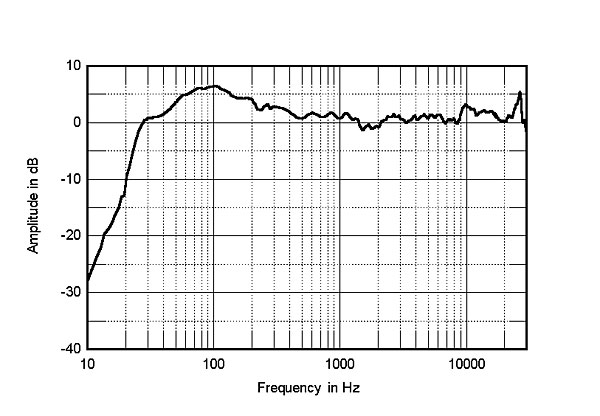
Fig.3 shows the individual responses of the port (red trace), the woofers (blue), and the midrange/tweeter section (green), scaled in the ratios of the square roots of their radiating areas. The woofer response is actually the sum of the outputs of the two woofers, whose minimum-motion notches are at slightly different frequencies: the top woofer at 30Hz, the bottom at 25.4Hz, the discrepancy perhaps due to manufacturing tolerances. Their combined output has a sharply defined notch at 27.3Hz, the frequency of the saddle in the impedance-magnitude trace, which indicates the tuning frequency of the port. The port's output peaks at this frequency, as expected, and cleanly rolls off above 40Hz, with no resonant modes evident in the midrange. The woofers cross over to the midrange drive-unit at around 260Hz, close to the specified 270Hz, with a steep filter slope. The apparent boost in the woofer's response is due to the nearfield measurement technique, and can also be seen in the overall response (fig.4), calculated from measurements taken with the LF control set to Flat rather than Boundary. But it is also apparent that the F208 is a full-range design, with useful output down to below 30Hz.
Fig.3 Revel Performa3 F208, acoustic crossover on tweeter axis at 50", corrected for microphone response, with nearfield responses of midrange unit (green trace), woofer (blue), and port (red), respectively plotted below 355Hz, 1kHz, and 320Hz.
Fig.4 Revel Performa3 F208, anechoic response on tweeter axis at 50", averaged across 30° horizontal window and corrected for microphone response, with complex sum of nearfield responses plotted below 300Hz.
The F208's upper-frequency response is remarkably smooth and flat in both fig.3, taken on the tweeter axis, and fig.4, which was averaged across a 30° horizontal window centered on the same axis. There is a very slight lack of energy between 1 and 2kHz and a slight excess above 9kHz, but both of these errors will have very little effect on sound quality, if at all. The trace in fig.4 was taken with the HF control centered; set to its maximum and minimum positions, it raised or lowered the speaker's output above 3kHz by the specified 1dB.
Fig.5 Revel Performa3 F208, lateral-response family at 50", normalized to response on tweeter axis, from back to front: differences in response 90–5° off axis, reference response, differences in response 5–90° off axis.
Fig.6 Revel Performa3 F208, vertical-response family at 50" without grille, normalized to response on tweeter axis, from back to front: differences in response 10–5° above axis, reference response, differences in response 5–15° below axis.
Fig.7 Revel Performa3 F208, step response on tweeter axis at 50" (5ms time window, 30kHz bandwidth).
Fig.8 Revel Performa3 F208, cumulative spectral-decay plot on tweeter axis at 50" (0.15ms risetime).
Summing up the Revel's measured performance is easy: In every way, this is textbook loudspeaker design. It's no wonder that Erick Lichte liked this speaker as much as he did.—John Atkinson