

Sidebar 3: Measurements
I performed a full set of measurements on the Schiit Aegir, using my Audio Precision SYS-2722 system (see the January 2008 "As We See It"). Before doing any testing, I preconditioned the Aegir by running it at one-third power into 8 ohms for an hour. At the end of that time, the side-mounted heatsinks were hot, at 114.3°F (45.8°C) toward the rear, a little cooler nearer the front.
The Schiit's voltage gain into 8 ohms was slightly lower than the specified 22dB, at 19.5dB for both unbalanced and balanced inputs, the latter measured with the speaker output taken from the two hot terminals as described in the manual. The amplifier preserved absolute polarity (ie, was noninverting) for both modes of operation, the latter with the positive speaker connection made to the right channel's hot binding post, the negative to the left channel's post. (According to the amplifier's rear panel, the XLR is wired with pin 2 hot.) The single-ended input impedance is specified as 22k ohms. However, I measured 11.5k ohms at low and middle frequencies, dropping to 10k ohms at 20kHz. The balanced input impedance was twice the unbalanced, as expected.
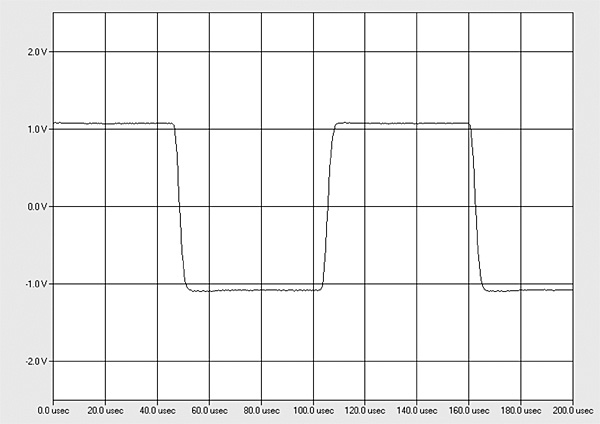
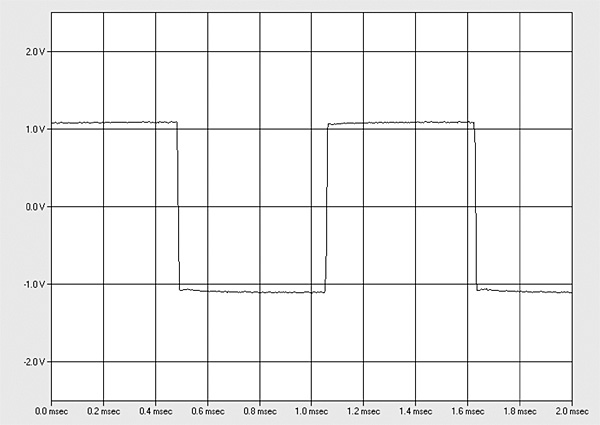
The Aegir's output impedance was fairly low, at 0.125 ohm at 20Hz and 1kHz, rising very slightly to 0.15 ohm at 20kHz. As a result, the response with our standard simulated loudspeaker varied by just ±0.1dB (fig.1, gray trace). his graph shows that the audioband response into 8 ohms (blue and red traces) is flat up to 20kHz, with an ultrasonic rolloff reaching –3dB at 180kHz. The two channels are closely matched, and the Aegir reproduced a 10kHz squarewave with very short risetimes and no overshoot or ringing (fig.2). A 1kHz squarewave was perfectly square (fig.3).

 Schiit specifies the Aegir's maximum power as 20Wpc into 8 ohms and 40Wpc into 4 ohms, both equivalent to 13dBW with our convention of referencing all powers to 1W into 8 ohms. With "clipping" defined as when the THD+noise reaches 1%, fig.6 indicates that with both channels driven, the Aegir exceeded its specified power into 8 ohms, clipping at 28Wpc (14.5dBW). Into 4 ohms (fig.7), the Aegir again exceeded its specification, delivering 43Wpc (13.3dBW) at 1% THD+N. Figs. 4 and 5 indicate that the distortion is very low at all powers below clipping. In mono output mode, Schiit says that the Aegir will deliver 80W into 8 ohms (19dBW). With a balanced, bridged output, the maximum voltage swing is twice that of each individual stage, meaning that the potential maximum power is increased by a factor of four. However, when I measured the maximum power delivery in mono mode, the Aegir's protection circuitry cut off the output at 49Wpc into 8 ohms (17dBW, fig.8).



 I was pleasantly surprised by the Schiit Aegir's measured performance. It is a well-engineered amplifier at an affordable price.—John Atkinson
Fig.1 Schiit Aegir, frequency response at 2.83V into: simulated loudspeaker load (gray), 8 ohms (left channel blue, right red), 4 ohms (left cyan, right magenta), 2 ohms (green) (1dB/vertical div.).
Fig.2 Schiit Aegir, small-signal, 10kHz squarewave into 8 ohms.
Fig.3 Schiit Aegir, small-signal, 1kHz squarewave into 8 ohms.
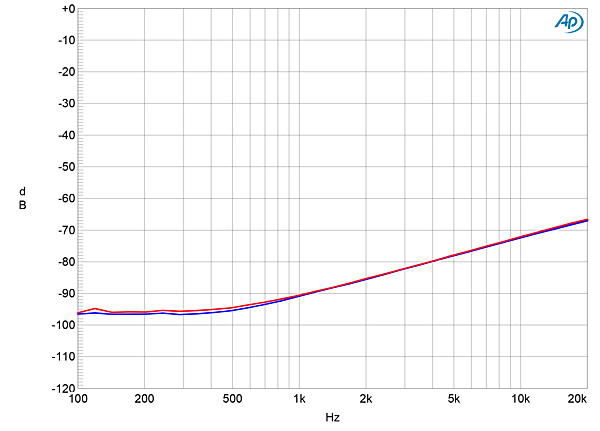
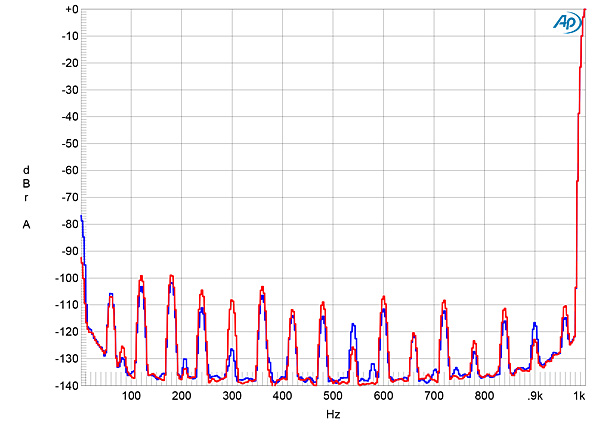
Channel separation was very good, measuring >90dB in both directions below 1kHz, and still 67dB at 20kHz (fig.4). Perhaps because of the low gain, the wideband, unweighted signal/noise ratio, ref. 2.83V and measured with the input shorted to ground, was a high 88dB in the left channel and 81.4dB in the right. These ratios improved to 93dB when the measurement bandwidth was restricted to the audioband, and to 101dB when A-weighted. Spectral analysis of the Aegir's noise floor (fig.5) revealed spuriae both at 120Hz and its harmonics, and at 60Hz and its odd-order harmonics. All of these spuriae are very low in level, however, and will not be audible.
Fig.4 Schiit Aegir, channel separation (dB/vertical div.).
Fig.5 Schiit Aegir, spectrum of 1kHz sinewave, DC–1kHz, at 1W into 8 ohms (linear frequency scale).
Fig.6 Schiit Aegir, both channels driven, distortion (%) vs 1kHz continuous output power into 8 ohms.
Fig.7 Schiit Aegir, both channels driven, distortion (%) vs 1kHz continuous output power into 4 ohms.
Fig.8 Schiit Aegir, bridged-mono mode, distortion (%) vs 1kHz continuous output power into 8 ohms.
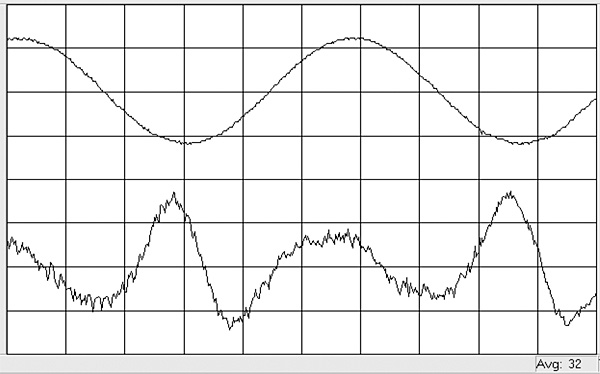
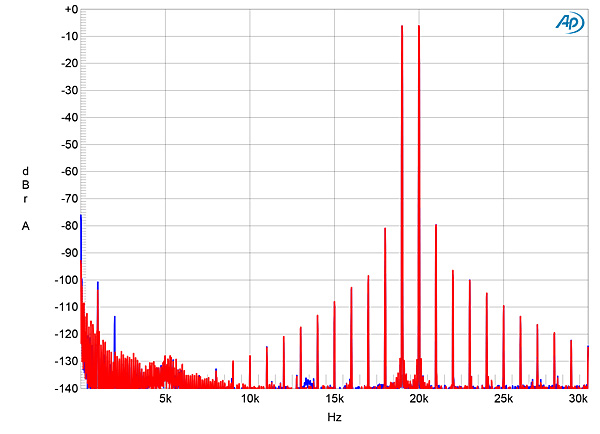
The Schiit Aegir offered very low levels of distortion into 8 ohms (fig.9, blue and red traces) for most of the audioband, but with the usual increase in the top two octaves, due to the corresponding reduction in open-loop gain margin. The distortion increased into 4 ohms but to a greater extent in the left channel (cyan trace) than the right (magenta). The waveform of the residual distortion and noise (fig.10) suggests that the subjectively benign second harmonic is dominant, though spectral analysis (fig.11) indicates that the third harmonic is only a few dB lower in level. Tested with an equal mix of 19 and 20kHz tones at one-third power into 8 ohms, the second-order difference product lay below –100dB (0.001%) in both channels (fig.12). However, the levels of higher-order intermodulation products were higher, though still low, at –80dB (0.01%). When I kept the output voltage the same and halved the load impedance, the higher-order products remained at the same levels, though the difference product rose to a still-negligible –86dB (0.005%).
Fig.9 Schiit Aegir, THD+N (%) vs frequency at 6V into: 8 ohms (left channel blue, right red), 4 ohms (left cyan, right magenta).
Fig.10 Schiit Aegir, 1kHz waveform at 6Wpc into 8 ohms, 0.0022% THD+N (top); distortion and noise waveform with fundamental notched out (bottom, not to scale).
Fig.11 Schiit Aegir, spectrum of 50Hz sinewave, DC–1kHz, at 8Wpc into 8 ohms (linear frequency scale).
Fig.12 Schiit Aegir, HF intermodulation spectrum, DC–30kHz, 19+20kHz at 8Wpc peak into 8 ohms (linear frequency scale).















