

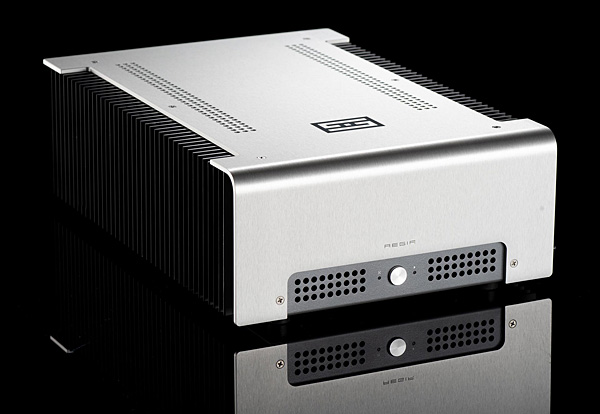
The Harbeth P3ESR's least good trait is how compressed it can sound on bass-charged, highly dynamic programs. To my surprise, Schiit's Aegir alleviated that shortcoming (at least somewhat) by demonstrating a vigorous class-D-like force, delivering strong momentum, clean bass detail, and articulate, open highs.
Like a child with a short-wave radio, what I seek from my audio system is a sense of something human—like a real person's voice from a faraway place, emerging miraculously from my speakers. Harbeth's P3ESR loudspeakers, driven by the Nelson Pass-designed class-A, zero-feedback First Watt SIT-3 amplifier ($4000), have a special talent for making voices feel like they come from genuine humans (with moist vocal cords). This combo is my current reference for authentic fidelity. But folks, at exactly one-fifth the SIT-3's price, the Schiit Aegir gave me a majority-portion, perhaps as much as 80%, of the SIT-3's detail-rich humanity. What is the argument against that?
Compared to PrimaLuna tubes
I apologize now for my lack of under-$1k basic amplifiers to which I can compare Schiit's Aegir. As usual, though, I will make comparisons to a couple of reasonably priced, well-reviewed amplifiers whose value and sonic character have been established by critical consensus.
I will start with the PrimaLuna's lowest-cost EL-34 tube amplifier, the ProLogue Premium, playing Stravinsky's L'Histoire du soldat (Columbia LP MS7093) through my reference Harbeth Monitor 30.2 loudspeakers. Compared to the Aegir, the ProLogue Premium transcribed a thinner but more transparent air through the top octaves. The PrimaLuna put more space and atmosphere into this Columbia Studio A recording. The Aegir located instruments on the soundstage with greater precision.
 Both the Schiit and the PrimaLuna reproduced flutes and massed violins with tube-like elegance. Both amps activated the spaces around high-frequency sounds, but the Aegir's top octaves were more sharply focused. More detailed. Overall, the Aegir's sonic presentation was more precisely articulated than the PrimaLuna's.
Compared to the Rogue Sphinx
Both the Schiit and the PrimaLuna reproduced flutes and massed violins with tube-like elegance. Both amps activated the spaces around high-frequency sounds, but the Aegir's top octaves were more sharply focused. More detailed. Overall, the Aegir's sonic presentation was more precisely articulated than the PrimaLuna's.
Compared to the Rogue Sphinx
Let me start by saying, lest some of you forgot, that the Rogue Sphinx (footnote 2) is a modestly priced ($1295) integrated amplifier that drives most speakers and conveys a balance of beauty, delicacy, and authority that is outstanding in its price range. However:
As I listened at length to Cabaret Modern: Night at the Magic Mirror Tent, it became obvious: the Aegir's midrange was more fleshed-out, detail-wise; the Aegir's bass was denser and more completely described. With the Aegir, the overall sound was more complex and sophisticated— more naturally transparent and relaxed—than with the Rogue integrated.
Driving the Harbeth M30.2s, the Aegir cleared the last bits of haze from the Magic Mirror Tent. It made every track sound fresh and clean—almost raw.
Driving KEF LS50s
Ever since I reviewed it, Schiit's Ragnarok integrated amplifier ($1499) has been my No.1 favorite amp to power KEF's LS50s. The 60Wpc (8 ohms) Ragnarok plays the LS50s with major kick-ass jump and boogie. With the Raggy, the venerable KEFs lose their Brit-fi reserve and bust loose.
To impress me, the Schiit Aegir needed to be more invigorating than the Ragnarok. Otherwise, why not just take the basic Raggy-rock amp and throw it into a Schiit Vidar chassis? I also hoped the Aegir would excavate more nuance and microdynamics.
 I wish you could have heard the Stanley Brothers airing it out on "Dickson County Breakdown" from The Complete Mercury Recordings (44.1/16 FLAC Mercury/Tidal). The Aegir went full-throttle on plucked acoustic bass and Ralph Stanley's psychedelic banjo. The sound literally jumped from the KEFs. I was almost impressed.
You tell me, is it fair to judge a component by how it plays two simple songs? I think it is. If an amp and speakers can't deliver enough authentic high fidelity for me to enjoy two of my favorite songs by two of my favorite singers, what good is it?
The Aegir needed to make the KEF LS50s deliver all the twisty yodeling harmonics and rich rustic tones of country legend Hank Williams' voice on "Long Gone Lonesome Blues," from 40 Greatest Hits (44.1/16 FLAC Mercury/ Tidal). No question, I would have wished I could cancel this review if it didn't—but it did. It reproduced Hank's iconic voice with the exact saxophone-like character I require for my enjoyment. Best of all, the Aegir-LS50 combo gave me the full dose of chilling spring reverb on the most haunting song ever: Lefty Frizzell's "Long Black Veil," from Look What Thoughts Will Do (44.1/16 FLAC Columbia/Tidal). I played this recording twice and cried three times. The LS50/Aegir combo is 100% recommendable.
Driving Klipsch RP-600Ms
I wish you could have heard the Stanley Brothers airing it out on "Dickson County Breakdown" from The Complete Mercury Recordings (44.1/16 FLAC Mercury/Tidal). The Aegir went full-throttle on plucked acoustic bass and Ralph Stanley's psychedelic banjo. The sound literally jumped from the KEFs. I was almost impressed.
You tell me, is it fair to judge a component by how it plays two simple songs? I think it is. If an amp and speakers can't deliver enough authentic high fidelity for me to enjoy two of my favorite songs by two of my favorite singers, what good is it?
The Aegir needed to make the KEF LS50s deliver all the twisty yodeling harmonics and rich rustic tones of country legend Hank Williams' voice on "Long Gone Lonesome Blues," from 40 Greatest Hits (44.1/16 FLAC Mercury/ Tidal). No question, I would have wished I could cancel this review if it didn't—but it did. It reproduced Hank's iconic voice with the exact saxophone-like character I require for my enjoyment. Best of all, the Aegir-LS50 combo gave me the full dose of chilling spring reverb on the most haunting song ever: Lefty Frizzell's "Long Black Veil," from Look What Thoughts Will Do (44.1/16 FLAC Columbia/Tidal). I played this recording twice and cried three times. The LS50/Aegir combo is 100% recommendable.
Driving Klipsch RP-600Ms
I grew up in Chicago, watching Junior Wells at Theresa's Lounge and stealing Little Walter 45s from the Chess Records outlet where I worked. Those harmonica masters showed me that blowing the blues was the most directly expressive of all blues-music forms. Obviously, the "mouth harp" was invented to simulate the wailing of trains and the solitude of pain. The harmonica generates full-spectrum harmonics with extreme dynamics. I'd thought I knew all the best blues harp players (after the original Sonny Boy Williamson) until I found "Fast Train" by John Lee Thomas on Deep River of Song: Georgia, "I'm Gonna Make You Happy" (44.1/16 FLAC Rounder/Tidal). This simple recording peeled skin off my body, and the Aegir amp and $549/pair Klipsch RP-600M loudspeakers forced me to play it more than seven times in a row. It sounded physically lush and orgasmic. The Schiit-Klipsch duo did lively-fast and dead-slow. Dangerous. Hypnotizing. Best of all, it created a nuanced low-grain sound that I could live with forever. Total price for amp and speakers: under $1400. Driving Magnepan .7s
40Wpc into 4 ohms should be enough to play the $1400/ pair Magnepan .7s in my small room—right? Well then, imagine "Po' Laz'us," also from Deep River of Song (singer unknown), at 80dB average with crazy 94dB peaks (C-weighted). Or better yet, how about Kortnie Heying making tears pour down my face at 86dB average while singing the title song from I'll Fly Away: Country Hymns and Songs of Faith (44.1/16 FLAC EMI CMG/Tidal)? Kortnie sounded pure and heavenly—but only at low SPLs. At higher volumes, the Aegir's clipping was frequent and easily noticeable, but not totally damning.
 Thought and sound merge perfectly
If your system sounds like shit (not Schiit), you can be sure it is not a THD+noise issue (it never is). You must blame your speakers, their pathetic crossovers, and your room: All three are flinging poo at you, all the time! The problem is obvious, and the solution is easy: Get some proper (crossoverless) headphones (with a flat impedance) and connect them directly to the Schiit Aegir outputs. Good headphones enjoy abundant class-A power (footnote 3). The first head-mounted transducers I connected to the Aegir were HiFiMan's $2999 HE1000 V2s: ruler-flat 32 ohm impedance, ruler-flat phase angle, and only 297mV RMS required to reach 90dB SPL (footnote 3). The V2s sounded so naturally fresh, clean, open, and uncompressed, I wondered why I've wasted so much time listening to emphysemic wood boxes. Not surprisingly, poo-flinging distortions were reduced even further when I switched to the $4999 JPS Labs Abyss AB-1266 Phi headphones: the Aegir-Abyss sound was as close to authentic fidelity as I have ever experienced.
In the end
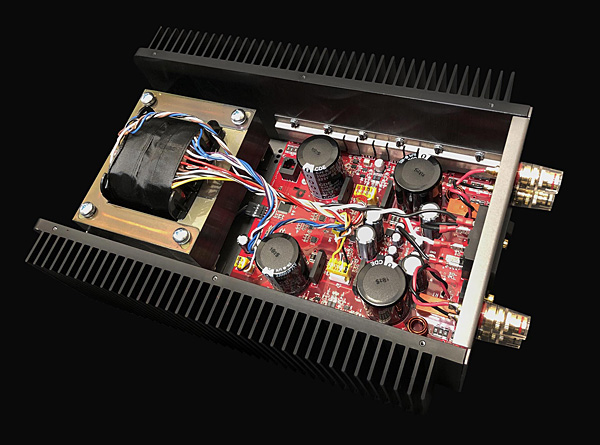
What makes the Schiit Audio Aegir so special is how it generates class-D-like force and clarity plus the information-dense refinements of class-A. And how, at $799, it could dare to sound as trippy and lifelike as it does. The Aegir struck me as a design that will withstand and even rejoice in the scrutiny of time—much like the affordable Wharfedale, KEF, Harbeth, and Magnepan loudspeakers I tested it with. Unless you need more power or have an uncontrollable urge to spend more money, I can think of no arguments against Schiit's innovative Aegir.
Footnote 2: Recently replaced by the Sphinx v2, which we have not yet reviewed. Footnote 3: Just remember to turn the volume down first.—Jim Austin Footnote 3: See Innerfidelity.com/images/HiFiMANHE1000.pdf.
I apologize now for my lack of under-$1k basic amplifiers to which I can compare Schiit's Aegir. As usual, though, I will make comparisons to a couple of reasonably priced, well-reviewed amplifiers whose value and sonic character have been established by critical consensus.
Both the Schiit and the PrimaLuna reproduced flutes and massed violins with tube-like elegance. Both amps activated the spaces around high-frequency sounds, but the Aegir's top octaves were more sharply focused. More detailed. Overall, the Aegir's sonic presentation was more precisely articulated than the PrimaLuna's.
Compared to the Rogue SphinxLet me start by saying, lest some of you forgot, that the Rogue Sphinx (footnote 2) is a modestly priced ($1295) integrated amplifier that drives most speakers and conveys a balance of beauty, delicacy, and authority that is outstanding in its price range. However:
Ever since I reviewed it, Schiit's Ragnarok integrated amplifier ($1499) has been my No.1 favorite amp to power KEF's LS50s. The 60Wpc (8 ohms) Ragnarok plays the LS50s with major kick-ass jump and boogie. With the Raggy, the venerable KEFs lose their Brit-fi reserve and bust loose.
I wish you could have heard the Stanley Brothers airing it out on "Dickson County Breakdown" from The Complete Mercury Recordings (44.1/16 FLAC Mercury/Tidal). The Aegir went full-throttle on plucked acoustic bass and Ralph Stanley's psychedelic banjo. The sound literally jumped from the KEFs. I was almost impressed.
You tell me, is it fair to judge a component by how it plays two simple songs? I think it is. If an amp and speakers can't deliver enough authentic high fidelity for me to enjoy two of my favorite songs by two of my favorite singers, what good is it?
I grew up in Chicago, watching Junior Wells at Theresa's Lounge and stealing Little Walter 45s from the Chess Records outlet where I worked. Those harmonica masters showed me that blowing the blues was the most directly expressive of all blues-music forms. Obviously, the "mouth harp" was invented to simulate the wailing of trains and the solitude of pain. The harmonica generates full-spectrum harmonics with extreme dynamics. I'd thought I knew all the best blues harp players (after the original Sonny Boy Williamson) until I found "Fast Train" by John Lee Thomas on Deep River of Song: Georgia, "I'm Gonna Make You Happy" (44.1/16 FLAC Rounder/Tidal). This simple recording peeled skin off my body, and the Aegir amp and $549/pair Klipsch RP-600M loudspeakers forced me to play it more than seven times in a row. It sounded physically lush and orgasmic. The Schiit-Klipsch duo did lively-fast and dead-slow. Dangerous. Hypnotizing. Best of all, it created a nuanced low-grain sound that I could live with forever. Total price for amp and speakers: under $1400. Driving Magnepan .7s
40Wpc into 4 ohms should be enough to play the $1400/ pair Magnepan .7s in my small room—right? Well then, imagine "Po' Laz'us," also from Deep River of Song (singer unknown), at 80dB average with crazy 94dB peaks (C-weighted). Or better yet, how about Kortnie Heying making tears pour down my face at 86dB average while singing the title song from I'll Fly Away: Country Hymns and Songs of Faith (44.1/16 FLAC EMI CMG/Tidal)? Kortnie sounded pure and heavenly—but only at low SPLs. At higher volumes, the Aegir's clipping was frequent and easily noticeable, but not totally damning.
Thought and sound merge perfectlyIf your system sounds like shit (not Schiit), you can be sure it is not a THD+noise issue (it never is). You must blame your speakers, their pathetic crossovers, and your room: All three are flinging poo at you, all the time! The problem is obvious, and the solution is easy: Get some proper (crossoverless) headphones (with a flat impedance) and connect them directly to the Schiit Aegir outputs. Good headphones enjoy abundant class-A power (footnote 3). The first head-mounted transducers I connected to the Aegir were HiFiMan's $2999 HE1000 V2s: ruler-flat 32 ohm impedance, ruler-flat phase angle, and only 297mV RMS required to reach 90dB SPL (footnote 3). The V2s sounded so naturally fresh, clean, open, and uncompressed, I wondered why I've wasted so much time listening to emphysemic wood boxes. Not surprisingly, poo-flinging distortions were reduced even further when I switched to the $4999 JPS Labs Abyss AB-1266 Phi headphones: the Aegir-Abyss sound was as close to authentic fidelity as I have ever experienced.
What makes the Schiit Audio Aegir so special is how it generates class-D-like force and clarity plus the information-dense refinements of class-A. And how, at $799, it could dare to sound as trippy and lifelike as it does. The Aegir struck me as a design that will withstand and even rejoice in the scrutiny of time—much like the affordable Wharfedale, KEF, Harbeth, and Magnepan loudspeakers I tested it with. Unless you need more power or have an uncontrollable urge to spend more money, I can think of no arguments against Schiit's innovative Aegir.
Footnote 2: Recently replaced by the Sphinx v2, which we have not yet reviewed. Footnote 3: Just remember to turn the volume down first.—Jim Austin Footnote 3: See Innerfidelity.com/images/HiFiMANHE1000.pdf.















